Mark The Days - March

March is the month that can’t make up its mind—snow boots in the morning, flip-flops by dinner. It’s like the year’s awkward teenager: moody, unpredictable, and occasionally dressed like a leprechaun. One minute you're bracing for a blizzard, the next you're sunburned from walking to the mailbox. Somewhere in the chaos, we celebrate pi, potatoes, poetry, and the mystical power of green beer. March is when things start to wake up, thaw out, and go just a little sideways. And frankly, we wouldn’t have it any other way.
- Details
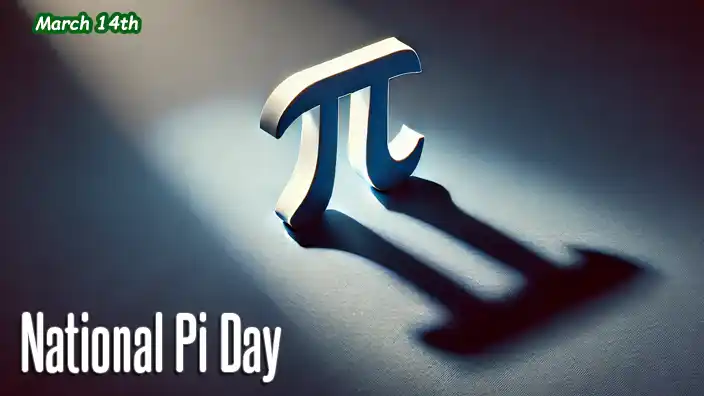
Pi is the only number that could get away with never giving a straight answer. No matter how many digits you ask for, it just keeps talking—kind of like that one uncle at family gatherings who starts with a simple story and somehow ends up explaining the history of lawn care. Mathematicians have spent centuries trying to pin it down, but pi just laughs in their faces and keeps stretching into infinity. Meanwhile, the rest of us are over here using it for far more important calculations—like determining exactly how much pizza we need to order for Pi Day. Because if there’s one thing we know for sure, it’s that the only thing better than a never-ending number is a never-ending supply of pie.
Celebrated: Annually, on March 14th
Discover the joy of National Pi Day, where math enthusiasts and pie lovers unite! Learn about pi's history and enjoy tasty celebrations.


- Details
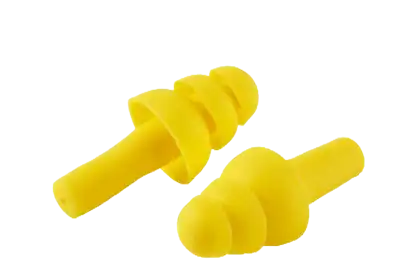
If you can hear this introduction, congratulations — your ears are already doing excellent work. World Hearing Day is a gentle reminder that while we spend plenty of time protecting our phones with cases and our coffee with lids, we often forget to protect the remarkable sound system built right into our heads. From whispered secrets to backyard squirrels plotting snack theft, hearing connects us to the world in ways we rarely notice until someone says, “I already told you that.” Today is the perfect excuse to turn the volume down, listen a little closer, and give your ears the appreciation they’ve quietly earned.
Celebrated: Annually, on March 3rd
Learn about World Hearing Day, hearing health, prevention tips, and how to protect your ears while enjoying the sounds of everyday life.

- Details
If there were ever a condiment that refused to stay in its lane, it’s ranch. What started as a simple salad dressing somehow worked its way onto wings, pizza, fries, and anything else that sits still long enough. National Ranch Day celebrates that creamy, herby overachiever that turned “just a dip” into a full-blown lifestyle. At this point, ranch isn’t just invited to the table—it’s running the show, and nobody’s complaining.
Celebrated: Annually, on March 10th
Check out the history of Ranch with fun facts and humor, learn about America’s favorite creamy dressing and dip


- Details
Panic, that sudden sensation that hits you like a surprise exam in a class you didn't know you were enrolled in. It's the body's own built-in fire alarm system, except it often goes off without any actual fire, leading to moments where you're sprinting through life like a cartoon character running off a cliff, legs still churning in mid-air. It's the reason you've rehearsed a Nobel Prize acceptance speech but not what to say in a 2-minute elevator pitch. In the grand theater of life, panic is the overzealous understudy that jumps on stage at the slightest cue, ready to turn a soliloquy into a slapstick comedy.
Celebrated: Annually, on March 9th
Embrace the chaos on Panic Day, a day dedicated to freaking out and letting go of stress. Discover the origins, traditions, and benefits of this unique celebration.


- Details
National Fruit Compote Day is here to remind us that sometimes the fanciest-sounding dishes are just fruit that decided to dress up a little. No baking degree required, no complicated techniques—just fruit, a bit of sweetness, and the patience to not eat it straight from the pot (a challenge many of us fail with dignity).
Celebrated: Annually, on March 1st
Join us for National Fruit Compote Day with easy ideas, history, and tasty ways to enjoy this simple, versatile fruit dish at home.


- Details
Debunking is the fine art of politely (or not-so-politely) telling someone, “Actually…” before dropping a truth bomb that shatters their carefully curated fantasy. It’s like popping a balloon, but instead of helium, it’s filled with nonsense. Whether it’s correcting a friend who insists the moon landing was staged or explaining to your aunt that forwarding chain emails won’t grant her eternal youth, debunking is both a public service and an extreme test of patience. It’s the intellectual equivalent of wiping smudges off someone’s glasses—they didn’t ask for it, they might not appreciate it, but deep down, the world looks a lot clearer when you're done.
Celebrated: Annually, on March 11th
Join the fight against misinformation on Debunking Day! Learn how to separate fact from fiction and enjoy fun facts that are actually true.


- Details
Swirling in a glass like a tiny, boozy masterpiece, it’s the kind of drink that makes you feel like a sophisticated socialite—even if you’re just wearing sweatpants and avoiding eye contact with the bartender. With every sip, the flavors dance between refreshing and dangerously deceptive because, let’s be honest, that fruity garnish is just a distraction from the fact that you’re essentially drinking a cleverly disguised potion of chaos. One moment, you’re savoring the artistry, and the next, you’re enthusiastically explaining your life’s ambitions to a stranger who just wanted to order a beer.
Celebrated: Annually, on March 24th
Explore the spirited celebration of National Cocktail Day, a day dedicated to the art, science, and slight mischief of mixology, from the Roaring Twenties to modern bars. Cheers to a love affair with cocktails!

- Details
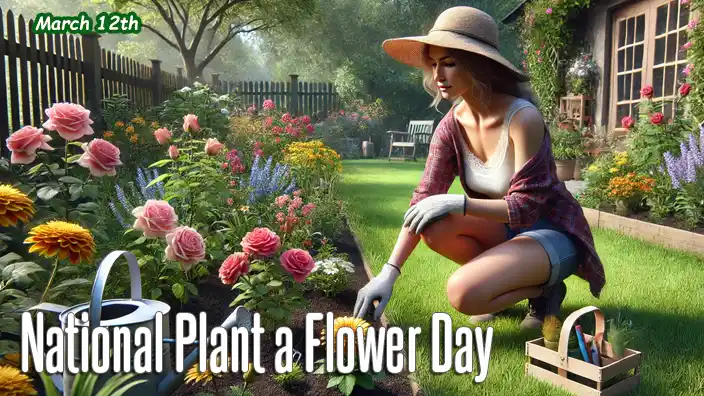
Planting flowers is a lot like dating—you pick something that looks nice, give it attention, and hope it doesn’t die on you. At first, you're all in: carefully planting each seed, whispering encouraging words like, “You got this, little buddy!” But give it a few weeks, and suddenly you're standing over a wilted mess wondering where it all went wrong. Meanwhile, that one rogue dandelion you didn’t even plant is thriving like it pays rent. Gardening experts say plants need water, sunlight, and love—yet somehow, weeds survive just fine with absolutely none of that.
Celebrated: Annually, on March 12th
Explore the rich history of flower planting and discover its benefits for mental health, air quality, and pollinator support on National Plant a Flower Day.


- Details
Cats are nature's Zen masters, teaching us the art of living in the moment, preferably right in the center of the keyboard when you're on a deadline. They're the only creatures who've mastered the delicate balance between utter disdain and irresistible charm, often in the same glance. Their daily routine includes, but is not limited to, plotting world domination, perfecting the art of napping in sunbeams, and launching surprise attacks on unsuspecting human ankles. To own a cat is to understand that you don't really own them; you're merely their staff, tasked with the sacred duty of can opener and laser pointer operator. In short, cats are the fluffy overlords we didn't know we needed, turning even the most mundane moments into adventures in patience and lint rollers.
Celebrated: Annually, on March 2nd
International Rescue Cat Day is a global paw-ty celebrating feline rescues and their human companions. Learn the origins and significance of this special day.


- Details
Few inventions have improved mornings quite like cereal — the breakfast that asks only one thing of you: stay awake long enough to pour milk without missing the bowl. National Cereal Day celebrates the crunchy companion that has rescued rushed mornings, fueled generations of school days, and quietly doubled as an acceptable dinner when nobody felt like cooking. Whether you favor sensible flakes or sugar-coated nostalgia, cereal proves that sometimes the simplest meals bring the greatest comfort — and the loudest crunch.
Celebrated: Annually, on March 7th
Celebrate National Cereal Day with the history, fun facts, and science behind breakfast’s most convenient and beloved crunchy classic.

- Details
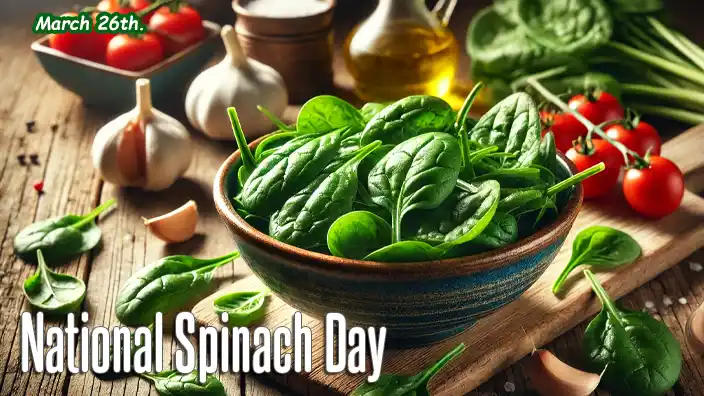
Spinach is that overachiever in the vegetable drawer—you know, the one flexing its nutrients while the lettuce just lies there doing its best impression of crunchy water. It’s the only leafy green that can sneak into your smoothie, sauté like a pro, and still have the nerve to puff up your ego because you “ate something healthy today.” And let’s be honest—spinach doesn’t really wilt under pressure, it just lounges elegantly in the pan like, “I’m still nutritious, darling.”
Celebrated: Annually, on March 26th
Celebrate National Spinach Day on March 26th with fun facts, health tips, tasty ideas, and the leafy history behind this nutrient-packed kitchen hero.


- Details
As the British fleet sailed out of Boston Harbor on March 17, 1776, the American revolutionaries stood atop Dorchester Heights, arms crossed, probably muttering something like, “Don’t let the harbor hit you on the way out!” After nearly a year of occupying the city, General Howe and his redcoats were finally making their dramatic exit—though it was less of a charge into battle and more of a frantic pack-your-things-and-run situation. One can only imagine the British officers on deck, peering back at the shoreline, seeing Washington’s men waving smugly and the Grand Union Flag flapping proudly over Boston, thinking, “Well, this is awkward.” Meanwhile, Henry Knox, the mastermind behind the whole cannon-moving stunt, was probably in the background grinning ear to ear, already contemplating his next impossible mission—like, say, convincing Congress that his soldiers deserved a raise.
Celebrated: Annually, on March 17th
Explore the fascinating history of Evacuation Day, Boston's lesser-known holiday, commemorating the bloodless victory of George Washington's forces in 1776.


- Details
Puppies are nature's comedians, equipped with a boundless energy that propels them into a series of slapstick moments worthy of a prime-time sitcom. Whether they're chasing their own tails in an endless, dizzying dance, mistaking their reflection for a mysterious doppelganger poised for play, or executing a perfectly timed, though entirely accidental, belly flop onto a cushion that just so happens to slide across the floor, puppies embody the spirit of laughter. Their comedic timing is impeccable, often choosing the exact moment you take a sip of coffee to unleash their antics, ensuring a good laugh (and a bit of a mess). In the world according to puppies, every shoe is a chew toy, every puddle a spa, and every human, an audience to their delightful shenanigans.
Celebrated: Annually, on March 23th
Explore the heartwarming reasons why we adore puppies. Learn how they bring happiness, reduce stress, and teach us to embrace life's simple joys.

- Details
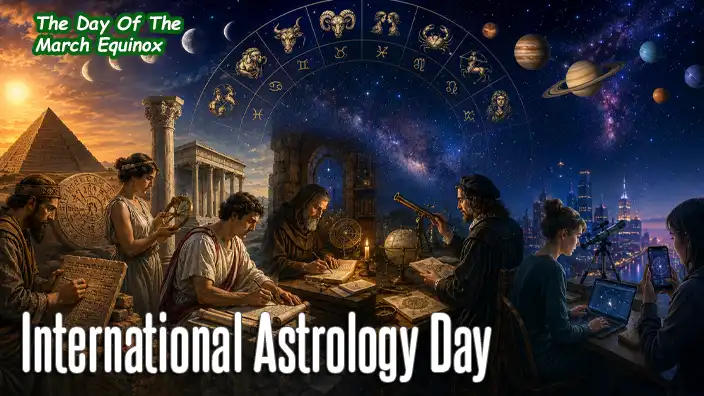
International Astrology Day celebrates the moment the Sun enters Aries and a brand-new astrological year begins. For some people, it's a day of reflection, self-discovery, and cosmic insight. For others, it's the annual reminder that Mercury is probably responsible for the missing car keys, the accidental text message, and that online purchase they don't remember making. Whether you're a devoted horoscope reader or simply enjoy gazing at the stars and wondering what they're up to, this celestial celebration offers the perfect excuse to see what the universe has planned.
Celebrated: Annually, on the March Equinox
Learn about International Astrology Day, the March Equinox, and the start of the astrological year. Explore zodiac signs, history, and traditions.

- Details
For a planet that rolls around the Sun like a lopsided barrel and smells like rotten eggs, Uranus sure gets a lot of attention—though, let’s be honest, most of it comes from its name. Discovered in 1781, this ice giant has spent the last two centuries being the cosmic equivalent of an unfortunate pun. But beyond the jokes, Uranus is genuinely bizarre—it’s tilted so far over that it basically orbits the Sun on its side, like it just gave up on standing upright. Add in the fact that it has 13 barely visible rings, some of the worst weather in the solar system, and a magnetic field that flips like a broken compass, and you’ve got one seriously confused planet. Scientists love studying Uranus, though—after all, it’s not every day you get to explore a celestial oddball that’s cold, windy, and eternally misunderstood.
Celebrated: Annually, on March 13th
Discover Uranus, the coldest planet in our solar system, known for its unusual rotation and stunning blue-green color. Uncover its secrets and oddities!


- Details
The ultimate fusion of convenience and carnival, proving that anything can be improved by sticking it on a stick and dunking it in batter. They're the culinary equivalent of a high-five, blending the sophistication of a hot dog with the whimsy of a county fair. Imagine the scene: sophisticated gourmets, corn dog in hand, debating the merits of mustard versus ketchup, while secretly longing for a dip in nacho cheese. In a world of complex cuisines, the corn dog stands tall (on a stick), a testament to the joy of simple pleasures and the universal language of deliciousness.
Celebrated: Annually, on the First Saturday of March Madness
From fairs to gourmet food trucks, corn dogs have evolved into a beloved snack. Learn how to celebrate National Corn Dog Day with fun ideas and recipes.


- Details
Nut clusters are proof that sometimes the best things in life happen by accident—like dropping peanuts into a pool of melted chocolate and deciding it’s a masterpiece. The chocolate doesn’t just coat the nuts; it hugs them like an overenthusiastic grandma at Thanksgiving, ensuring that each bite delivers a perfect mix of crunch and sweetness. It’s a snack that balances chaos and perfection, much like life itself—sometimes a little messy, sometimes a little lumpy, but always better when covered in chocolate.
Celebrated: Annually, on March 8th
Uncover the origins and popularity of peanut clusters. Learn how to celebrate National Peanut Cluster Day with homemade recipes and unique variations!


- Details
The skirt is the ultimate fashion paradox—it’s both breezy and dignified, rebellious and refined. It’s the only piece of clothing that lets you twirl like a majestic ballerina one moment and battle an unexpected gust of wind like an action hero the next. Wear it too short, and suddenly, every chair feels like a strategic challenge. Wear it too long, and you might accidentally mop the floor with style. But no matter the length, fabric, or era, the skirt remains a timeless wardrobe MVP—because let’s face it, pants just don’t have the same flair for drama!
Celebrated: Annually, on March 10th
Celebrate National Skirt Day by exploring the rich history and diverse styles of skirts, a timeless fashion piece for all. Embrace your unique style today!

From Our Marks Catelog
-

Peace for one hour? That’s like baking a cake and only eating the crumbs! If we can manage to...
-

There was a time when wearing pink to school might earn you a raised eyebrow, a snicker, or a...
-

Picture this: you're rummaging through a drawer, looking for a pen, but instead, you find a flip...
-

There’s nothing light about Good Friday—after all, it commemorates the darkest day in Christian...
-

Mental health is not just a personal matter—it's a global issue that affects millions of lives...
-

Having a hole in your bucket is nature’s way of saying, “You tried.” It’s the DIY version of a practical...

