Mark The Day
  • Home
    • Home - Vertical
    • Home - Horizontal
  • News
  • Search
  • Forum
Login / Register
Light
Dark
Copyright © 2026 Mark The Day. All Rights Reserved.
Have a Nice Day 😁
Mark The Day Mark The Day
  • Home
    • Home - Vertical
    • Home - Horizontal
  • News

    Marks Catelog

       Mark The Days

       Mark The Weeks

       Mark The Months

    Mark The News

    Mark The Day Relaunches With a Fresh New Look
    Details
    News
    1755
    11 m

    Mark The Day Relaunches With a Fresh New Look

    House, Senate pass 'National Day of Remembrance for Charlie Kirk'
    Details
    News
    2155
    1 y

    House, Senate pass 'National Day of Remembrance for Charlie Kirk'

    Connecticut Recognizes Diwali
    Details
    News
    3033
    1 y

    Connecticut Recognizes Diwali

  • Search
  • Forum
Light
Dark
  • Login
  • Register

Latest Articles

Published: 10 July 2025
Updated:   05 February 2026

We're always tinkering, typing, and time-stamping new celebrations onto the calendar—because the world just can’t stop marking things. From the profound to the peculiar, if it’s a day worth noting, we’re on it. Below, you’ll find the latest additions to our ever-growing catalog of Marks—freshly minted and ready to be celebrated (or at least chuckled at).

Khronos, Hephaestus, and Calliope working on computers in the Mark The Day Office, busily adding new "Marks" to the Mark The Day site.

  • Christmas Book Day
    Details
  • National Cinnamon Day
    Details
  • World Vegan Month
    Details
  • National Peppermint Bark Day
    Details
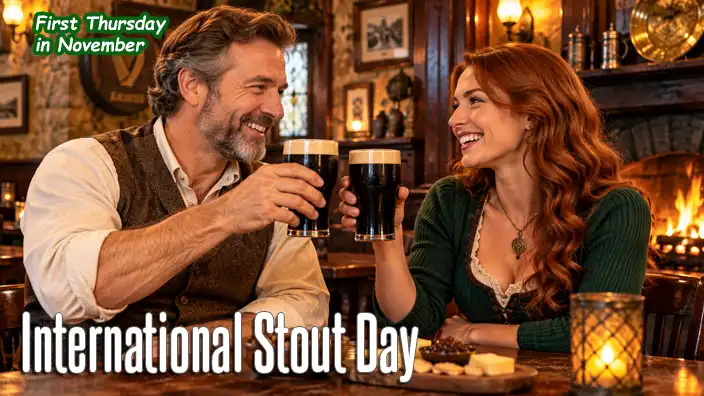
  • International Stout Day
    Details
  • World Pediatric Bone and Joint Day
    Details
  • Alaska Day
    Details
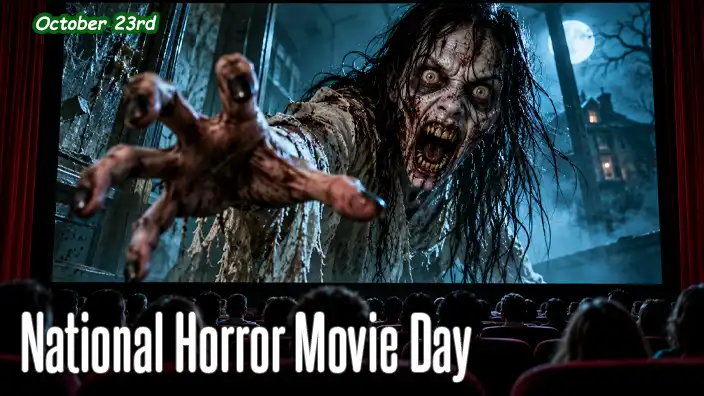
  • National Horror Movie Day
    Details
  • End of the Middle Ages Day
    Details
  • Team Margot Donor Registration Day
    Details
  • Adopt a Shelter Dog Month
    Details
  • World Gin Day
    Details

Please Share Our Content:

From Our Marks Catelog

  • Words Matter Week
    Details
    Mark The Weeks - March
    1147
    2 y

    In the hands of a master chef, a simple potato becomes a gourmet dish; in the mouth of a skilled...

  • National Eight-Track Tape Day
    Details
    Mark The Days - April
    1300
    1 y

    Sure, CDs may be shiny, sleek, and capable of skipping to any track with a single click, but let’s be...

  • Trading Cards for Grown-Ups Day
    Details
    Mark The Days - April
    1216
    8 m

    Trading Cards for Grown-ups Day is proof that maturity doesn’t mean giving up your favorite...

  • World Rock Paper Scissors Day
    Details
    Mark The Days - August
    1393
    2 y

    Rock, Paper, Scissors is the ultimate showdown of wits, reflexes, and sheer luck—a game where your...

  • Monty Python Status Day
    Details
    Mark The Days - May
    703
    5 m

    Monty Python Status Day is the rare and glorious occasion when society collectively agrees that...

  • National Maritime Day
    Details
    Mark The Days - May
    1161
    2 y

    Ah, the maritime industry—where people willingly sign up to live in floating steel cities, eat...

Mark The Day Mark The Day

Explore

  • Mark The Days
  • Mark The Weeks
  • Mark The Months
  • About Us
  • Latest Articles

Statistics

  • Search
  • Most Viewed Marks

Legal

  • Terms and Conditions
  • Cookie/Privacy Policy
  • Privacy Information Request

Interactive

  • Make A Suggestion
  • Contact Us
  • Teacher's Corner
  • Advertise With Us
  • Calendar
Copyright © 2026 Mark The Day. All Rights Reserved.
Have a Nice Day 😁
Helena, Montana Founded

On October 30, 1864, Helena, Montana, officially came into existence, thanks to four determined gold prospectors and a mining claim appropriately named Last Chance Gulch. Montana's gold fever had begun in earnest in 1862, when prospectors discovered rich placer deposits along Grasshopper Creek. Further discoveries attracted thousands of fortune seekers, all hoping to strike it rich before someone else beat them to it. Among them were four miners who noticed promising signs of gold in the Helena area but initially continued north toward the supposedly richer Kootenai goldfields. When that expedition proved disappointing, they returned to investigate their earlier discovery. Calling it their "last chance" turned out to be remarkably appropriate—and considerably more profitable than they had expected.

Their discovery sparked another gold rush, transforming Last Chance Gulch into one of Montana's richest placer mining districts. Within four years, the area produced an estimated $19 million in gold, an extraordinary fortune for the nineteenth century. Thousands of miners descended upon the settlement, creating an immediate demand for food, accommodation, equipment, and other necessities. Helena rapidly developed into a bustling frontier community, where fortunes could be made not only by digging for gold but also by selling supplies to those doing the digging. After all, even the most determined prospector needed somewhere to sleep and someone willing to sell him a shovel.

Unlike many Western boomtowns that vanished when their mines were exhausted, Helena successfully established a lasting economic foundation. Its position along important transportation routes, access to agricultural resources in the surrounding valley, and proximity to other mining communities helped it develop into a regional commercial center. In 1875, Helena became the capital of Montana Territory, and in 1894, five years after Montana achieved statehood, voters selected it as the permanent state capital. What began as four miners' final gamble had become one of Montana's most important cities—proof that sometimes taking one last chance really does pay off.

War of the World

On October 30, 1938, a radio broadcast convinced some Americans that visitors from Mars had arrived—and they weren't particularly interested in making friends. The production was Orson Welles' adaptation of H. G. Wells' science-fiction novel The War of the Worlds, performed by the Mercury Theatre on the Air over the CBS radio network. Welles, just 23 years old, had already established himself as a talented actor and radio performer, including his work as the mysterious crime fighter The Shadow. His adaptation was intended as Halloween entertainment, not an elaborate hoax, but its innovative presentation would make it one of the most famous broadcasts in radio history.

The program began at 8 p.m. with a conventional introduction before shifting into what sounded like an ordinary evening of dance music. Suddenly, fictional news bulletins interrupted the entertainment with reports of unusual activity on Mars, followed by the apparent crash of a mysterious object near Grovers Mill, New Jersey. Listeners heard increasingly alarming descriptions of tentacled creatures emerging from a metallic cylinder, unleashing deadly heat rays, and advancing across the countryside in enormous fighting machines. Realistic sound effects, convincing performances, and the familiar style of breaking news reports gave the fictional invasion an unsettling sense of authenticity. Some listeners who tuned in after the opening announcement mistook portions of the drama for genuine news, although later research has shown that contemporary newspaper accounts greatly exaggerated the extent of the resulting panic. Nevertheless, anyone expecting a relaxing evening of music might reasonably have wondered why the Martians had suddenly taken over the airwaves.

The broadcast attracted enormous publicity and prompted scrutiny from the Federal Communications Commission, although no laws were found to have been broken. Its reputation helped establish Welles as an exceptionally inventive director and storyteller, opening doors to Hollywood and a contract with RKO Pictures. In 1941, he directed, co-wrote, produced, and starred in Citizen Kane, a landmark film widely regarded as one of cinema's greatest achievements. Meanwhile, The War of the Worlds became a lasting example of radio's extraordinary ability to capture the imagination—and a reminder that, before fleeing from an alien invasion, it might be wise to check whether the announcer is reading the news or performing a science-fiction drama.

The Rumble in the Jungle

On October 30, 1974, Muhammad Ali delivered one of boxing's greatest upsets when he defeated undefeated heavyweight champion George Foreman in the eighth round of the legendary "Rumble in the Jungle" in Kinshasa, Zaire (now the Democratic Republic of the Congo). Ali, 32, faced a formidable 25-year-old opponent whose devastating punching power had made him the overwhelming favorite. Seven years earlier, Ali had been stripped of his heavyweight title after refusing induction into the U.S. military during the Vietnam War, a decision that also cost him his boxing license and several prime years of his career. Now, fighting before approximately 60,000 spectators, he was determined to reclaim his championship. The event, promoted by Don King and supported by Zaire's president, Mobutu Sese Seko, attracted worldwide attention, with each fighter guaranteed a reported $5 million. The crowd enthusiastically chanted "Ali, bomaye!"—roughly translated as "Ali, kill him!"—although the famously outspoken challenger hardly needed encouragement to make his presence known.

With the bout scheduled for the early morning hours to accommodate American television audiences, Foreman entered the ring expecting to overpower his older opponent. Instead, Ali unveiled a remarkable strategy that became known as the "rope-a-dope." Rather than constantly dancing around the ring, he leaned against the ropes, protected his head and body, absorbed or deflected Foreman's heavy punches, and repeatedly taunted the champion into exhausting himself. Foreman continued attacking, but his tremendous power gradually diminished as the rounds progressed. Ali, meanwhile, conserved energy, landed sharp counterpunches, and waited for the right moment. By the eighth round, Foreman was visibly fatigued. Ali suddenly launched a rapid combination, finishing with a crushing right hand that sent the champion sprawling onto the canvas. Foreman failed to beat the referee's count, and Ali reclaimed the heavyweight championship in one of the most extraordinary comebacks in sporting history. The man who had famously promised to "float like a butterfly and sting like a bee" had spent much of the evening impersonating a punching bag—and somehow made it look like a brilliant career move.

The victory made Ali only the second former heavyweight champion, after Floyd Patterson, to regain the world title, cementing his reputation as one of boxing's most remarkable competitors. He would eventually become the first man to win the heavyweight championship three times before retiring permanently in 1981. Ali died in 2016, leaving a legacy extending far beyond boxing through his influence on civil rights, religious freedom, and opposition to the Vietnam War. Foreman, meanwhile, staged an extraordinary comeback of his own after returning to professional boxing in 1987. In 1994, he defeated Michael Moorer to become the oldest heavyweight champion in history at 45, a record that made his earlier defeat seem like merely an inconvenient chapter in a very long story. Foreman also became a Christian minister, successful businessman, and the famously enthusiastic spokesman for the George Foreman Grill. He died in March 2025. Half a century after their unforgettable encounter in Africa, the Rumble in the Jungle remains a defining moment in sports history—proof that sometimes brains, patience, and a perfectly timed punch can overcome even the most terrifying pair of fists.

Jam Master Jay Murdered

On October 30, 2002, the hip-hop world suffered a devastating loss when Jam Master Jay, the pioneering DJ of Run-DMC, was shot and killed inside his recording studio in Queens, New York. Born Jason William Mizell in Brooklyn in 1965, Jay developed an early passion for music, learning to play several instruments before discovering the creative possibilities of turntables and scratching. After his family relocated to Hollis, Queens, he befriended Joseph Simmons and Darryl McDaniels, better known as Run and DMC. Together, they formed Run-DMC, a group that would transform hip-hop from an emerging musical movement into a worldwide cultural phenomenon. With Jay providing the electrifying turntable techniques and driving rhythms, the trio developed a powerful, stripped-down sound that helped define an entire generation. Their self-titled debut album arrived in 1984, followed by King of Rock in 1985, establishing the group as one of rap's most influential acts. Their signature Adidas sneakers, tracksuits, gold chains, and distinctive hats became almost as recognizable as their music—and considerably easier to imitate than Jay's turntable skills.

Run-DMC achieved international superstardom with their 1986 album Raising Hell, which featured their groundbreaking collaboration with Aerosmith on a remake of "Walk This Way." The song brought rap and rock audiences together, helped introduce hip-hop to mainstream MTV viewers, and demonstrated that musical boundaries were considerably less permanent than record executives had imagined. Run-DMC became the first rap group to appear on the cover of Rolling Stone and helped open doors for countless artists who followed. Beyond his performances, Jay became a respected mentor and entrepreneur, establishing Jam Master Jay Records and supporting emerging talent, including the influential rap group Onyx. Despite his international fame, he remained closely connected to his Queens neighborhood, where his studio served as a gathering place for aspiring musicians. That made his murder particularly heartbreaking. On the evening of October 30, 2002, armed attackers entered his studio and fatally shot him. The killing stunned friends, fans, and fellow performers, who struggled to understand why such a widely respected figure had become the victim of a calculated act of violence.

For nearly two decades, Jay's murder remained unresolved, generating numerous theories and frustrating investigators. In 2020, federal prosecutors charged Ronald Washington and Karl Jordan Jr. with his killing, alleging that the motive involved a dispute over a cocaine distribution arrangement from which the two men had been excluded. The allegations revealed a troubling dimension of Jay's private financial affairs that contrasted sharply with his public reputation as a supportive mentor and beloved musician. The lengthy investigation eventually produced major developments in federal court, although the legal proceedings continued to evolve years after the original indictments. Jay's musical legacy, however, has never been in doubt. Run-DMC entered the Rock & Roll Hall of Fame in 2009 and received a Grammy Lifetime Achievement Award in 2016, recognizing the trio's extraordinary contribution to modern music. Jam Master Jay helped establish the DJ as an essential creative force in hip-hop, proving that two turntables, a mixer, and a remarkable imagination could change popular music forever. His life ended tragically, but the beats he helped create continue to echo through generations of artists and audiences.

Note:  Karl Jordan Jr.'s 2024 murder conviction was overturned in December 2025, while Ronald Washington's conviction remained in place. Jay Bryant pleaded guilty in April 2026 to helping the killers enter the studio.