Celebrity Birthdays - May

May is basically the VIP lounge of months: warm, sunny, and not yet mosquito season. People born in May are annoyingly charming about it, too.
So let’s celebrate the folks who make us believe in backyard barbecues and fresh starts. They were born to bask in the glow of spring — and they want you to know it.

- Details
- Category: Celebrity Birthdays - May
Bill Paxton was one of those rare actors who felt like a friend every time he showed up on screen. Whether he was battling aliens in Aliens, chasing twisters in Twister, or panicking in Titanic, Paxton brought humor, heart, and a touch of everyman charm to every role. He could make even the wildest situations feel believable — and fun — which is why fans loved him so much. His passing in 2017 was a huge loss to Hollywood, but his legacy lives on through an incredible filmography that still entertains and inspires. His birthday should be celebrated with popcorn, a double feature, and maybe a loud “Game over, man!” in his honor.
 May 17, 1955, in Fort Worth, Texas
 February 25, 2017, in Los Angeles, California

Trivia
- Bill Paxton appeared in the music video for "Fish Heads" by Barnes & Barnes, which he also directed.
- He was one of the few actors to be killed by an alien, a predator, and a terminator in the films "Aliens," "Predator 2," and "The Terminator," respectively.
- Paxton was a close friend of fellow actor and director James Cameron, with whom he collaborated on several projects, including "Aliens," "Titanic," and "True Lies."
- He received an Emmy nomination for his role in the mini-series "Hatfields & McCoys," which also starred Kevin Costner.

- Details
- Category: Celebrity Birthdays - May
Some performers pick a lane and stay in it. Amber Tamblyn looked at all the lanes—acting, writing, directing, poetry—and decided to take all of them at once, preferably at full speed. She’s the kind of talent who can break your heart in a dramatic scene, make you laugh in the next, and then casually publish a book of poetry just to keep things interesting.
 May 14, 1983, in Santa Monica, California
Trivia
- She starred in General Hospital early in her career.
- She gained wider fame with The Sisterhood of the Traveling Pants.
- She received Emmy and Golden Globe nominations for Joan of Arcadia.
- She appeared in films like The Ring and 127 Hours.
- She is a published poet and author with multiple books.
- She made her directorial debut with Paint It Black (2016).

- Details
- Category: Celebrity Birthdays - May
Dust off the powdered wig and ring the Liberty Bell — it’s Patrick Henry’s birthday! The fiery Founding Father who gave us “Give me liberty, or give me death!” helped ignite the American Revolution with speeches so rousing they probably came with a standing ovation — and maybe a musket or two.
May 29, 1736, in Hanover County, Virginia
June 6, 1799, at his family's Virginia plantation, Red Hill
Trivia
- Patrick Henry was largely self-taught as a lawyer, passing the bar after only six weeks of formal study.
- He was a fervent supporter of religious freedom and played a significant role in the passage of the Virginia Statute for Religious Freedom, which laid the groundwork for the First Amendment.
- Henry declined several federal appointments, including Secretary of State and Chief Justice of the Supreme Court, preferring to remain in Virginia.

- Details
- Category: Celebrity Birthdays - May
Russell Hornsby has built a career playing characters with quiet strength and commanding presence, the kind of roles that stick with you long after the credits roll. From his breakout as Hank Griffin in Grimm to his powerful performances in Fences and The Hate U Give, Hornsby brings depth and gravitas to everything he does. More recently, he’s turned heads as boxing promoter Don King in Mike and as the lead in BMF, proving he can carry both historical figures and high-stakes dramas with equal weight. His birthday deserves a standing ovation, a thoughtful toast, and maybe a story or two about the many worlds he’s brought to life on screen.
May 15, 1974, in Oakland, California
Trivia
- Hornsby is an accomplished stage actor and has performed in numerous theater productions, including August Wilson's "Fences" and "Jitney."
- He is a devoted family man and often shares insights about balancing his professional career with his personal life.
- Hornsby has a background in sports and was an avid football player during his youth, which has influenced some of his roles, particularly those involving physicality and athleticism.
- He is known for his distinctive voice and has lent his vocal talents to several audiobooks and animated projects.

- Details
- Category: Celebrity Birthdays - May
Some actors try very hard to be charming. John Corbett just shows up and accidentally wins the room. He’s the kind of guy who could walk into a complicated situation, lean against a wall, say something simple, and somehow fix everything without raising his voice. On screen, he’s often the sensible choice—the one viewers are quietly rooting for while wondering why the main character is making things harder than they need to be. If life had a “pick the right guy” button, it would probably look a lot like John Corbett… and yet, somehow, people still hesitate.
Born May 9, 1961, in Wheeling, West Virginia
Trivia
- Originally worked as a steelworker before becoming an actor
- Broke out as Chris Stevens on Northern Exposure
- Played Aidan Shaw on Sex and the City
- Starred in My Big Fat Greek Wedding
- Has released country music albums
- Married Bo Derek in 2020
- Known for his relaxed, approachable acting style

- Details
- Category: Celebrity Birthdays - May
George Strait is country music royalty, plain and simple. Known as the “King of Country,” he’s racked up more number-one hits than just about anyone in history, with classics like Amarillo by Morning and Check Yes or No becoming the soundtrack of countless road trips and rodeos. Strait’s style is timeless — clean, traditional country with just the right mix of heartbreak and honky-tonk swagger. Even now, he’s still filling stadiums and proving that cowboy hats never go out of style. His birthday should be celebrated with a dance floor under the stars, a fiddle in the band, and a Texas-sized toast to the man who kept country true.
May 18, 1952, in Poteet, Texas
Trivia
- He holds the record for the most number-one songs in any genre, with more than 60 chart-toppers across his career.
- Before his music career took off, he served in the U.S. Army and performed with an Army-sponsored band called Rambling Country.
- His Cowboy Rides Away Tour finale in 2014 set the record for the largest indoor concert in North America, drawing over 104,000 fans to AT&T Stadium in Texas.
- Despite decades of superstardom, he’s famous for keeping a low profile, often heading straight back to his Texas ranch instead of the usual celebrity party circuit.

- Details
- Category: Celebrity Birthdays - May
You didn’t attend a Don Rickles show so much as you survived it—with dignity optional and laughter guaranteed. He had a gift for spotting you in a crowd, sizing you up in half a second, and delivering a line so sharp you’d swear he’d been preparing it your entire life. And yet, by the end of it, you weren’t offended—you were honored. Because if Rickles roasted you, it meant you mattered… or at the very least, you were sitting in the wrong seat at the wrong time.
May 8, 1926, in Queens, New York
April 6, 2017, in Beverly Hills, California
Trivia
- Served in the U.S. Navy during World War II.
- Known as “Mr. Warmth” for his insult comedy style.
- Became a Las Vegas headliner alongside top entertainers.
- Close friend of Frank Sinatra.
- Appeared frequently on The Tonight Show.
- Voiced Mr. Potato Head in Toy Story.
- Starred in films like Kelly’s Heroes and Casino.
- Won Emmy Awards for his television work.

- Details
- Category: Celebrity Birthdays - May
All aboard the Midnight Train — it’s Gladys Knight’s birthday! The “Empress of Soul” has been serenading us for decades with a voice so smooth it could turn any lyric into gold. From her days with the Pips to her solo success and hall-of-fame career, Knight has shown the world how to mix gospel roots, soulful power, and pure heart into timeless music. Today we celebrate a legend whose songs still make us sing along — even if we’re hopelessly off-key.
May 28, 1944, in Atlanta, Georgia
Trivia
- Gladys Knight started her music career at the age of seven, winning a talent contest on the television show "Ted Mack's Original Amateur Hour."
- She is a dedicated philanthropist, actively supporting various causes, including education, children's welfare, and diabetes research.
- Knight is a member of the Church of Jesus Christ of Latter-day Saints and often speaks about the importance of her faith in her life and career.

- Details
- Category: Celebrity Birthdays - May
Cher is living proof that you can reinvent yourself as many times as you want — and look fabulous every single time. From her early days with Sonny to conquering the charts solo, winning an Oscar for Moonstruck, and becoming the ultimate Twitter queen, Cher has spent decades refusing to fade quietly into the background. Her hits like Believe turned Auto-Tune into an art form, and her concerts are legendary, complete with dazzling costumes and enough attitude to power Vegas for a year. Her birthday should be celebrated with sequins, spotlight beams, and maybe a key change that shakes the chandelier — because if anyone can turn a party into a full-on spectacle, it’s Cher.
May 20, 1946, in El Centro, California
Trivia
- Cher holds the distinction of having won a Grammy, an Emmy, an Academy Award, and three Golden Globe Awards.
- She became the first artist to have a number-one single on a Billboard chart in six consecutive decades.
- Cher's role in "Moonstruck" not only earned her an Oscar but also solidified her reputation as a serious actress capable of taking on diverse and complex roles.
- She made her Broadway debut in the 1982 play "Come Back to the 5 & Dime, Jimmy Dean, Jimmy Dean," which was later adapted into a film.

- Details
- Category: Celebrity Birthdays - May
Some singers aim for perfection—clean notes, polished delivery, everything tucked in nice and neat. Eric Burdon clearly looked at that idea and said, “No thanks, I’ll take the raw version.” His voice doesn’t glide so much as charge, like it’s got somewhere important to be and you’d better keep up. It’s the kind of sound that feels like it’s been aged in a barrel somewhere between a blues club and a late-night confession. You don’t just hear an Eric Burdon performance—you experience it, whether you were ready or not.
May 11, 1941, in Newcastle upon Tyne, England
Trivia
- Known for the hit “House of the Rising Sun”
- Influenced by American blues artists like Ray Charles
- Fronted Eric Burdon and the Animals in the late 1960s
- Collaborated with the funk band War
- Hit song with War: “Spill the Wine”
- Inducted into the Rock and Roll Hall of Fame in 1994
- Known for his powerful, bluesy vocal style
- Continued performing and recording music for decades

- Details
- Category: Celebrity Birthdays - May
Salute and stand tall — it’s Louis Gossett Jr.’s birthday! The Oscar-winning actor who drilled his way into film history as the tough-as-nails Sgt. Foley, in An Officer and a Gentleman, has spent decades commanding the screen with presence and power. From Roots to Iron Eagle and beyond, Gossett has shown that whether he’s playing a mentor, a hero, or a man with a mission, he does it with heart — and today, we celebrate a true Hollywood heavyweight.
May 27, 1936, in Coney Island, New York
March 29, 2024, in Santa Monica, California
Trivia
- Sports Enthusiast: Before pursuing acting, Gossett was a talented athlete. He received a basketball scholarship to New York University, where he excelled in sports before deciding to focus on his acting career.
- Directorial Ventures: In addition to acting, Gossett has ventured into directing. He made his directorial debut with the television film "The Inspectors" (1998), showcasing his talent behind the camera.
- Author: Gossett is also an accomplished author. His memoir, "An Actor and a Gentleman," provides an insightful look into his life, career, and the challenges he has faced along the way.

- Details
- Category: Celebrity Birthdays - May
Kumail Nanjiani is what happens when sharp intelligence, dry humor, and an unexpected superhero transformation all decide to share the same body. One minute he’s delivering perfectly awkward punchlines, the next he’s starring in a Marvel movie looking like he’s been secretly bench-pressing entire cities. It’s the kind of career path that makes you think, “Well, there’s no traditional roadmap for that,” and frankly, that’s what makes it so fun to watch.
May 2, 1978, in Karachi, Pakistan
Trivia
- He moved to the United States to attend Grinnell College.
- He studied computer science and philosophy.
- He gained fame as Dinesh on Silicon Valley.
- He co-wrote and starred in The Big Sick, based on his real life.
- The film earned an Academy Award nomination for Best Original Screenplay.
- He played Kingo in Marvel’s Eternals.
- He is married to writer and producer Emily V. Gordon.

- Details
- Category: Celebrity Birthdays - May
Tony Goldwyn has spent his career playing characters who are as charming as they are complicated — which is probably why he made such a convincing president on Scandal. Whether he’s breaking hearts as the man who ruined pottery wheels forever in Ghost or leading high-stakes dramas on TV, Goldwyn brings a mix of intensity and warmth that keeps audiences glued to the screen. He’s also a director and producer, proving he can run things just as well behind the camera as in front of it. His birthday deserves a toast worthy of a White House gala — just keep an eye on the guest list, because things tend to get dramatic when Tony’s around.
May 20, 1960, in Los Angeles, California
Trivia
- Tony Goldwyn comes from a prominent Hollywood family; his grandfather was film producer Samuel Goldwyn, and his father was actor and producer Samuel Goldwyn Jr.
- He graduated from Brandeis University with a Bachelor of Arts degree in drama and later studied at the London Academy of Music and Dramatic Art.
- Goldwyn voiced the titular character in Disney's animated film "Tarzan" (1999).
- He is a co-founder of the production company Goldwyn Films, which focuses on socially relevant, thought-provoking content.
- Goldwyn has been married to production designer Jane Musky since 1987, and they have two daughters.

- Details
- Category: Celebrity Birthdays - May
Some actors deliver lines. Candice Bergen delivers verdicts. She’s the kind of on-screen presence who can end an argument with a look and make it feel like a perfectly reasonable conclusion. Whether she’s playing a journalist, a judge of character, or simply the smartest person in the room (which she often is), she brings a level of confidence that doesn’t ask for attention—it simply assumes it already has it. If there were ever a masterclass in “say less, mean more,” Candice Bergen would be teaching it… and everyone else would be taking notes.
May 9, 1946, in Beverly Hills, California
Trivia
- Daughter of Edgar Bergen
- Starred as Murphy Brown on Murphy Brown
- Won multiple Emmy Awards for Murphy Brown
- Nominated for an Academy Award for Starting Over
- Appeared in Miss Congeniality
- Studied at University of Pennsylvania
- Married director Louis Malle

- Details
- Category: Celebrity Birthdays - May
Megan Fox has been turning heads since she burst onto the scene, bringing equal parts glam and grit to the big screen. She became a blockbuster icon with Transformers, proving she could hold her own next to giant robots, explosions, and Shia LaBeouf’s fast-talking antics. Over the years, Megan has mixed action roles with edgy comedies and cult favorites like Jennifer’s Body, which went from misunderstood to full-on fan favorite. With her sharp wit, unapologetic confidence, and style that turns every red carpet into a runway, Megan is as fascinating off-screen as she is on it. Her birthday should be celebrated with fireworks, fast cars, and maybe a wink toward those
May 16, 1986, in Oak Ridge, Tennessee
Trivia
- Megan Fox has several tattoos, each with personal significance. One of her most famous tattoos is a quote from Shakespeare's "King Lear": "We will all laugh at gilded butterflies."
- She made her film debut in the 2001 movie "Holiday in the Sun," starring opposite the Olsen twins.
- Megan is a dedicated mother to her three sons with actor Brian Austin Green, and she often emphasizes the importance of family in her life.
- She is also an advocate for mental health awareness, openly discussing her struggles with self-esteem and the pressures of Hollywood.
- Details
- Category: Celebrity Birthdays - May
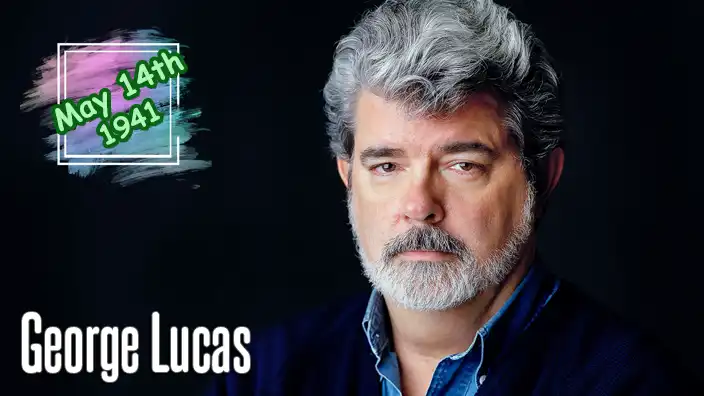
George Lucas is the man who gave us lightsabers and a reason to argue about whether Han shot first. The creator of Star Wars and Indiana Jones, Lucas turned space cowboys and whip-cracking archaeologists into global obsessions — and made “May the Fourth” an unofficial holiday. He also gave us Jar Jar Binks, but we’ll forgive him because he also gave us Yoda’s wisdom and Darth Vader’s entrance music. Basically, George Lucas didn’t just make movies — he built an entire galaxy far, far away and somehow got us all to live in it.
May 14, 1944, in Modesto, California
Trivia
- George Lucas originally wanted to direct Apocalypse Now, but the project went to Francis Ford Coppola.
- He based Yoda’s speech patterns on the way his own philosophy teachers spoke.
- Lucas made more money from Star Wars merchandise than from the films themselves.
- The name “Indiana” in Indiana Jones came from Lucas’s pet dog.
- He sold Lucasfilm to Disney in 2012 for about $4 billion, then donated much of his wealth to education.

- Details
- Category: Celebrity Birthdays - May
Ron Isley doesn’t rush a song—he lets it come to him like a man who knows dinner’s already paid for. There’s a confidence there that says he’s seen every trend, heard every new style, and still isn’t the least bit worried about keeping up. Why would he be? When your voice sounds like it’s been aging in a velvet-lined barrel for decades, you don’t chase the moment—the moment politely waits for you.
May 21, 1941, in Cincinnati, Ohio
Trivia
- Lead singer of The Isley Brothers.
- Known for the hit song “Shout.”
- Introduced the “Mr. Biggs” persona in the 2000s.
- Career spans more than six decades.
- Influenced artists across R&B, funk, and hip-hop.

- Details
- Category: Celebrity Birthdays - May
Some people leave behind statues, others leave behind books. Russell Stover left behind chocolate—and honestly, that might be the smartest legacy of the bunch. Because while history books gather dust, a good box of chocolates disappears faster than you can say, “I’ll just have one more.”
May 6, 1888, in Alton, Kansas
May 11, 1954, in Miami, Florida
Trivia
- He co-founded his candy business with his wife, Clara Stover.
- His company became known for boxed chocolates.
- The brand grew during the Great Depression as an affordable treat.
- Russell Stover Candies became a major U.S. chocolate producer.
- His name remains on the brand decades after his passing.
- His chocolates are especially popular during holidays.
- He helped popularize boxed chocolates as gifts.

- Details
- Category: Celebrity Birthdays - May
Stock the shelves and cue the awkward workplace banter — it’s Ben Feldman’s birthday! Best known for his charming, slightly neurotic turn as Jonah on Superstore (and for stealing scenes on Mad Men before that), Feldman has a knack for making everyday situations hilariously relatable. Whether he’s navigating retail chaos, corporate drama, or just trying to do the right thing, Feldman keeps us laughing — and today, the price tag says “celebrate.”
May 27, 1980, in Potomac, Maryland
Trivia
- Entrepreneurial Spirit: In addition to acting, Feldman has a stake in a winery, Angelica Cellars, showcasing his interest in the wine industry and entrepreneurial endeavors.
- Theater Roots: Before making it big on screen, Feldman had a successful run on Broadway, starring in "The Graduate" alongside Kathleen Turner and Alicia Silverstone.
- Voice Acting: Feldman has lent his voice to several animated projects, including the role of Chris in "Big Hero 6: The Series," further highlighting his diverse talents.

- Details
- Category: Celebrity Birthdays - May
There are people who spend years knocking on Hollywood’s door… and then there’s Rachel Zegler, who more or less walked up, sang a song, and had the door flung wide open. Not kicked in—no need for that—just opened with a polite “Oh, you’re the one we’ve been looking for.” It’s the kind of debut story that sounds suspiciously like a movie plot, which is fitting, because that’s exactly where it led her.
May 3, 2001, in Hackensack, New Jersey
Trivia
- Was selected from over 30,000 applicants for the role of Maria
- Began performing in school and local theater productions
- Known for her powerful soprano voice
- Played Lucy Gray Baird in a Hunger Games prequel
- Cast as Snow White in Disney’s live-action remake
- Frequently shares musical performances on social media
- Has Colombian and Polish heritage
- Started her film career as a teenager
- One of the youngest actresses to win a Golden Globe in her category

- Details
- Category: Celebrity Birthdays - May
In a world where most people hit snooze three times just to face a regular workday, Linda Evangelista once made it clear she wasn’t even opening one eye for less than five figures. And honestly, fair enough. When your job involves redefining beauty standards before breakfast, you’ve probably earned the right to negotiate with the alarm clock. The rest of us are just trying to find matching socks—she was out there setting the price of the entire industry.
May 10, 1965, in St. Catharines, Canada
Trivia
- Known for her famous quote about not working for less than $10,000 a day.
- Frequently changed her hairstyle and look, earning a reputation as a “chameleon.”
- Worked alongside Naomi Campbell, Christy Turlington, and Cindy Crawford.
- Appeared on numerous international fashion magazine covers.
- Collaborated with top photographers and designers.
- Took breaks from modeling to focus on her personal life.
- Later spoke publicly about health challenges affecting her appearance.
- Remains one of the most influential models in fashion history.
From Our Marks Catelog
-

Single parenthood is a crash course in multitasking—where making dinner, helping with homework, and dodging Lego...
-

Balloons are the life of any party, with their bright colors and whimsical shapes, but they also...
-

Letting things go is a skill we all think we have—until we’re in the shower five years later, replaying an...
-

Some holidays ask for deep reflection. Others demand fireworks, feasts, or elaborate decorations....
-
With a gaze that could melt ice and a mustache so perfectly groomed it might have had its own...
-

Imagine having the uncanny ability to make even the driest statistics sound like the punchline to a...

