Celebrity Birthdays - May

May is basically the VIP lounge of months: warm, sunny, and not yet mosquito season. People born in May are annoyingly charming about it, too.
So let’s celebrate the folks who make us believe in backyard barbecues and fresh starts. They were born to bask in the glow of spring — and they want you to know it.
- Details
- Category: Celebrity Birthdays - May
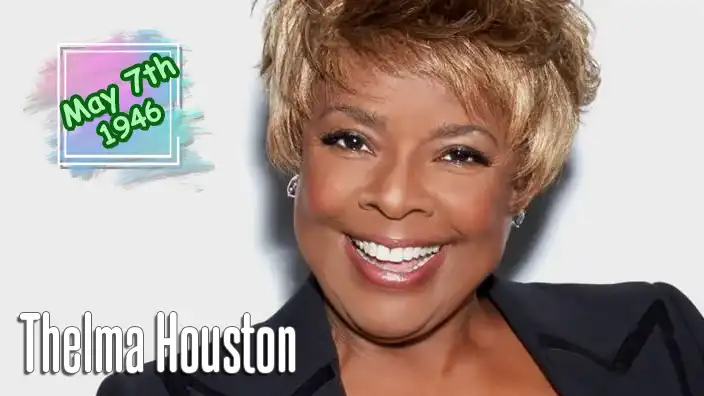
Some songs fade with time. Others hang around like that one guest who said they’d leave an hour ago but is still dancing in the living room. Thelma Houston’s biggest hit didn’t just stick—it moved in, rearranged the furniture, and turned into a full-blown anthem. And honestly, nobody’s asking it to leave.
 May 7, 1946, in Leland, Mississippi

Trivia
- Won a Grammy for “Don’t Leave Me This Way” (1976)
- Her version of the song became a disco-era anthem
- Began her career in gospel music
- Released her debut album Sunshower in 1969
- Worked with songwriter Jimmy Webb early in her career
- Known for her powerful and expressive vocal style
- Performed in musical theater and live stage productions

- Details
- Category: Celebrity Birthdays - May
Jewel went from living in her car to living on the charts, proving that a big voice and bigger determination can turn struggle into stardom. With heartfelt hits like Who Will Save Your Soul and You Were Meant for Me, she became the soundtrack of the ‘90s for anyone who ever stared out a rainy window feeling deep and poetic. Over the years, Jewel has explored pop, country, and folk, always staying true to her storytelling roots — and occasionally reminding us that she can yodel like nobody’s business. Her birthday deserves an acoustic guitar, a campfire, and a chorus of friends singing along under the stars.
May 23, 1974, in Payson, Utah
Trivia
- Jewel's initial passion was for opera, and she received formal training at the prestigious Interlochen Arts Academy in Michigan.
- She is a skilled yodeler, a talent she inherited from her father, Atz Kilcher, who is also a musician.
- Jewel made a guest appearance on the popular TV show "The Lyon's Den," showcasing her acting chops alongside Rob Lowe.
- An advocate for mental health, Jewel founded the Never Broken Foundation, which provides resources and tools for emotional well-being.
- In addition to her artistic talents, Jewel is also an entrepreneur, launching a line of jewelry that reflects her rustic, bohemian style.

- Details
- Category: Celebrity Birthdays - May
There’s always that one person who walks into a chaotic situation, takes a quiet look around, and somehow restores order without raising their voice—Carol Potter perfected that energy. She’s got the kind of presence that says, “I’ve already thought this through, and yes, we’re doing it my way,” but in the nicest possible way. You don’t argue—you just nod, reconsider your life choices, and suddenly feel like things might actually turn out alright.
May 21, 1948, in New York City
Trivia
- Best known as Cindy Walsh on Beverly Hills, 90210.
- Studied drama at Radcliffe College.
- Performed on Broadway early in her career.
- Worked as a television producer and coach later in life.
- Known for playing grounded, supportive characters.

- Details
- Category: Celebrity Birthdays - May
In a world where most people hit snooze three times just to face a regular workday, Linda Evangelista once made it clear she wasn’t even opening one eye for less than five figures. And honestly, fair enough. When your job involves redefining beauty standards before breakfast, you’ve probably earned the right to negotiate with the alarm clock. The rest of us are just trying to find matching socks—she was out there setting the price of the entire industry.
May 10, 1965, in St. Catharines, Canada
Trivia
- Known for her famous quote about not working for less than $10,000 a day.
- Frequently changed her hairstyle and look, earning a reputation as a “chameleon.”
- Worked alongside Naomi Campbell, Christy Turlington, and Cindy Crawford.
- Appeared on numerous international fashion magazine covers.
- Collaborated with top photographers and designers.
- Took breaks from modeling to focus on her personal life.
- Later spoke publicly about health challenges affecting her appearance.
- Remains one of the most influential models in fashion history.

- Details
- Category: Celebrity Birthdays - May
Some actors deliver lines. Candice Bergen delivers verdicts. She’s the kind of on-screen presence who can end an argument with a look and make it feel like a perfectly reasonable conclusion. Whether she’s playing a journalist, a judge of character, or simply the smartest person in the room (which she often is), she brings a level of confidence that doesn’t ask for attention—it simply assumes it already has it. If there were ever a masterclass in “say less, mean more,” Candice Bergen would be teaching it… and everyone else would be taking notes.
May 9, 1946, in Beverly Hills, California
Trivia
- Daughter of Edgar Bergen
- Starred as Murphy Brown on Murphy Brown
- Won multiple Emmy Awards for Murphy Brown
- Nominated for an Academy Award for Starting Over
- Appeared in Miss Congeniality
- Studied at University of Pennsylvania
- Married director Louis Malle

- Details
- Category: Celebrity Birthdays - May
Judy Collins has the kind of voice that makes you stop mid-sentence, mid-thought, and possibly mid-snack. While the rest of the world was getting louder in the 1960s, she calmly stepped up with a crystal-clear tone and said, “Let’s just sing this properly, shall we?” Decades later, she’s still doing exactly that—and doing it better than most.
May 1, 1939, in Seattle, Washington
Trivia
- She trained as a classical pianist before turning to folk music.
- She helped popularize “Both Sides, Now” by Joni Mitchell.
- She recorded songs by Leonard Cohen early in his career.
- Her version of “Send in the Clowns” won a Grammy Award.
- She has released over 50 albums.
- She is also a published author and activist.
- She continues to perform well into her later years.

- Details
- Category: Celebrity Birthdays - May
Joan Collins practically redefined glamour in the 1980s — shoulder pads, power suits, and martini-sharp one-liners included. As Alexis Carrington on Dynasty, she became television’s most stylish villain, proving that drama is always better when it’s delivered in sequins. Off-screen, Joan has been just as dazzling, with a career spanning decades in film, TV, and writing, not to mention a knack for staying as fabulous as ever. She’s a living reminder that age is just a number — and that number should always be written in lipstick. Her birthday should be celebrated with champagne, diamonds, and a dramatic entrance worthy of a primetime soap opera.
Born May 23, 1933, in London, England
Trivia
- Joan Collins was made a Dame Commander of the Order of the British Empire (DBE) in 2015 for her services to charity.
- She once turned down the role of Cleopatra in the 1963 film, which eventually went to Elizabeth Taylor.
- Collins has a keen interest in interior design and has published books on the subject, sharing her expertise and style tips.
- She made a memorable guest appearance on the popular TV show "Star Trek" in the episode "The City on the Edge of Forever."
- Despite her glamorous image, Collins is known for her practical approach to beauty and skincare, often emphasizing the importance of hydration and sun protection.

- Details
- Category: Celebrity Birthdays - May
Tune up the guitar and dust off the blue suede shoes — it’s Riley Keough’s birthday! The actress, model, and granddaughter of Elvis Presley has built a career that proves talent runs in the family, starring in everything from indie dramas to the high-octane chaos of Mad Max: Fury Road. Whether she’s playing a rock star in Daisy Jones & The Six or stealing scenes on the big screen, Keough keeps finding ways to surprise audiences — and today she’s got one more reason to shine brighter than a Vegas marquee.
May 29, 1989, in Los Angeles, California.
Trivia
- Riley Keough is an accomplished model and has worked with high-profile brands such as Dior and Dolce & Gabbana.
- She is married to stuntman Ben Smith-Petersen, whom she met while filming “Mad Max: Fury Road.”
- Keough has a tattoo in memory of her brother Benjamin Keough, who tragically passed away in 2020.

- Details
- Category: Celebrity Birthdays - May
Russell Hornsby has built a career playing characters with quiet strength and commanding presence, the kind of roles that stick with you long after the credits roll. From his breakout as Hank Griffin in Grimm to his powerful performances in Fences and The Hate U Give, Hornsby brings depth and gravitas to everything he does. More recently, he’s turned heads as boxing promoter Don King in Mike and as the lead in BMF, proving he can carry both historical figures and high-stakes dramas with equal weight. His birthday deserves a standing ovation, a thoughtful toast, and maybe a story or two about the many worlds he’s brought to life on screen.
 May 15, 1974, in Oakland, California
Trivia
- Hornsby is an accomplished stage actor and has performed in numerous theater productions, including August Wilson's "Fences" and "Jitney."
- He is a devoted family man and often shares insights about balancing his professional career with his personal life.
- Hornsby has a background in sports and was an avid football player during his youth, which has influenced some of his roles, particularly those involving physicality and athleticism.
- He is known for his distinctive voice and has lent his vocal talents to several audiobooks and animated projects.

- Details
- Category: Celebrity Birthdays - May
Some actors stick to one genre and make it their home. Rosario Dawson seems to treat genres like frequent flyer miles—collect them all, use them often, and never stay in one place too long. One minute she’s in a gritty indie film, the next she’s patching up superheroes, and then suddenly she’s wielding a lightsaber like it’s just another day at the office. At this point, if she showed up in a western, a sci-fi comedy, and a historical drama all in the same week, no one would blink—they’d just assume she’s keeping busy.
May 9, 1979, in New York City
Trivia
- Discovered as a teenager, leading to her debut in Kids (1995)
- Starred in Sin City
- Played Claire Temple across Marvel’s Netflix series
- Portrayed Ahsoka Tano in The Mandalorian and Ahsoka
- Known for roles in both film and television across multiple genres
- Active in political and social causes
- Has done extensive voice acting work in animated films and series

- Details
- Category: Celebrity Birthdays - May
Let’s be honest—if most people put on sunglasses indoors, someone’s going to ask if they’re okay. Bono does it, and suddenly it feels like a statement about art, identity, and possibly world peace. He’s one of the few people who can walk into a room dressed like he’s about to headline a stadium and also negotiate global policy before lunch. Somewhere between writing a hit song and meeting world leaders, he’s managed to convince everyone that both are just part of a normal Tuesday.
May 10, 1960, in Dublin, Ireland
Trivia
- Attended Mount Temple Comprehensive School in Dublin.
- Known for hits like “With or Without You” and “One.”
- Has been active in global humanitarian efforts.
- Often performs wearing signature sunglasses.
- U2’s The Joshua Tree became a landmark album.
- Has received numerous awards for music and activism.
- Known for blending music with social and political themes.

- Details
- Category: Celebrity Birthdays - May
Summon the crossroads demon and light a few black candles — it’s Mark Sheppard’s birthday! Known to Supernatural fans as the snarky, smooth-talking Crowley, Sheppard made evil look charming and sarcasm sound like poetry.
Whether he’s ruling Hell, scheming through Battlestar Galactica, or popping up in every sci-fi series you’ve ever loved, Sheppard has mastered the art of stealing scenes with one raised eyebrow. Today we celebrate a man who made villainy classy — and probably negotiated this party at a very reasonable price.
May 30, 1964, in London, England
Trivia
- Mark Sheppard is the son of actor W. Morgan Sheppard, with whom he has shared the screen on multiple occasions. They played the same character at different ages in "Doctor Who" and appeared together in "NCIS."
- Before pursuing acting, Sheppard was a successful musician, playing drums for bands such as Light a Big Fire. His musical talents occasionally surface in his acting roles, adding an extra layer to his performances.
- Sheppard's distinctive voice has made him a sought-after voice actor for video games and animated projects. He has lent his voice to popular games like "Destiny" and "The Conduit."
- He is an advocate for various charitable causes, often using his platform to raise awareness and support for organizations focused on mental health, veterans' issues, and animal welfare.

- Details
- Category: Celebrity Birthdays - May
Some people practice guitar in their spare time—Joe Bonamassa apparently created spare time just to practice more guitar. By the age most kids are still negotiating bedtime, he was already trading licks with legends and making grown musicians rethink their life choices. Give him six strings and a stage, and he’ll take you on a ride that starts in a smoky blues club and somehow ends with you wondering why your own guitar has been sitting in the corner collecting dust like it gave up before you did.
May 8, 1977, in New Hartford, New York
Trivia
- Began playing guitar at age four.
- Opened for B.B. King at age eleven.
- Started his solo career in 2000 with A New Day Yesterday.
- Known for blending blues with rock influences.
- Member of Black Country Communion.
- Frequently collaborates with Beth Hart.
- Has multiple No. 1 albums on the Billboard Blues chart.
- Founded the Keeping the Blues Alive Foundation.

- Details
- Category: Celebrity Birthdays - May
Malcolm X was one of the most electrifying and influential voices of the civil rights era, a man who challenged America to confront its deepest injustices. Known for his fierce intelligence, unflinching honesty, and ability to inspire action, he became a symbol of Black pride and self-determination. Over the course of his life, Malcolm’s views evolved, showing a remarkable willingness to grow and seek truth wherever it led him. His words still resonate decades later, reminding us that the fight for equality requires courage, clarity, and sometimes confrontation. His birthday should be honored with reflection, conversation, and a renewed commitment to justice.
May 19, 1925, in Omaha, Nebraska
 February 21, 1965, in New York City
Trivia
- Malcolm X was known for his strict dietary habits, often avoiding pork and other foods prohibited by Islamic dietary laws.
- He had a close relationship with Muhammad Ali, the legendary boxer, whom he influenced during Ali's conversion to Islam.
- His pilgrimage to Mecca profoundly impacted his worldview, leading him to adopt the name El-Hajj Malik El-Shabazz and a more inclusive approach to fighting racial injustice.
- Malcolm X's legacy continues to inspire numerous books, films, and academic studies, solidifying his place as a pivotal figure in the struggle for civil rights and social justice.

- Details
- Category: Celebrity Birthdays - May
Salute and stand tall — it’s Louis Gossett Jr.’s birthday! The Oscar-winning actor who drilled his way into film history as the tough-as-nails Sgt. Foley, in An Officer and a Gentleman, has spent decades commanding the screen with presence and power. From Roots to Iron Eagle and beyond, Gossett has shown that whether he’s playing a mentor, a hero, or a man with a mission, he does it with heart — and today, we celebrate a true Hollywood heavyweight.
May 27, 1936, in Coney Island, New York
March 29, 2024, in Santa Monica, California
Trivia
- Sports Enthusiast: Before pursuing acting, Gossett was a talented athlete. He received a basketball scholarship to New York University, where he excelled in sports before deciding to focus on his acting career.
- Directorial Ventures: In addition to acting, Gossett has ventured into directing. He made his directorial debut with the television film "The Inspectors" (1998), showcasing his talent behind the camera.
- Author: Gossett is also an accomplished author. His memoir, "An Actor and a Gentleman," provides an insightful look into his life, career, and the challenges he has faced along the way.

- Details
- Category: Celebrity Birthdays - May
While most teenagers are busy figuring out how to tune one guitar and maybe impress someone at a school dance, Mike Oldfield was off in a corner quietly assembling a full-blown musical universe like a man building a cathedral out of sound. No lyrics, no flashy gimmicks—just layer after layer of instruments, all played by the same fellow who probably didn’t even look up when history knocked on the door. Somewhere out there, a drummer is still waiting for his cue… and Mike already recorded the whole album without him.
May 15, 1953, in Reading, England
Trivia
- He recorded Tubular Bells at just 19 years old.
- He played over 20 different instruments on that album.
- The album was the first release on Virgin Records.
- Its theme became famous through The Exorcist.
- Tubular Bells has sold roughly 15 million copies worldwide.
- He began composing the album as a teenager (around age 17).
- The original album is one continuous piece split into two parts.
- He has worked across genres including rock, folk, ambient, and new age.

- Details
- Category: Celebrity Birthdays - May
While some stars chase fame like it’s an Olympic event, Carey Mulligan has built an extraordinary career by calmly collecting critical acclaim, delivering stunning performances, and generally making excellence look far too easy. With her graceful presence and remarkable ability to portray everything from heartbreak to razor-sharp determination, Mulligan has become the sort of actress who can quietly outshine an entire cast without ever seeming to break a sweat. Her birthday is the perfect excuse to celebrate a performer who proves subtlety can still steal the whole show.
May 28, 1985, in Westminster, London, England
Trivia
- Film debut in Pride & Prejudice (2005)
- Breakthrough role in An Education (2009)
- Starred in Drive and The Great Gatsby
- Earned Oscar nomination for Promising Young Woman
- Married to Marcus Mumford
- Acclaimed stage actress on Broadway and West End
- Known for emotionally nuanced performances

- Details
- Category: Celebrity Birthdays - May
Brec Bassinger is living proof that superheroes don’t always wear capes — sometimes they rock cosmic staffs and teenage sass. Best known for leading the charge in DC’s Stargirl, Brec brought Courtney Whitmore to life with just the right mix of optimism, humor, and “don’t-mess-with-me” attitude. She’s also popped up in plenty of other shows, but it’s her turn as the star-spangled hero that made her a favorite for fans of teen heroes and nostalgic comic book lovers alike. Off-screen, Brec is as bubbly and approachable as her character, sharing glimpses of her life with fans and proving that you can be both a superhero and someone you’d want to hang out with at a diner. If birthdays are about shining bright, Brec’s is practically a firework display.
May 25, 1999, in Saginaw, Texas
Trivia
- Brec Bassinger's middle name is Marie.
- She initially moved to Los Angeles with her mother to pursue her acting career, while her father and brothers stayed in Texas.
- Bassinger is a big fan of Harry Potter and often references the series in her social media posts.
- She has two older brothers, Beric and Brice, and is very close to her family.

- Details
- Category: Celebrity Birthdays - May
Stock the shelves and cue the awkward workplace banter — it’s Ben Feldman’s birthday! Best known for his charming, slightly neurotic turn as Jonah on Superstore (and for stealing scenes on Mad Men before that), Feldman has a knack for making everyday situations hilariously relatable. Whether he’s navigating retail chaos, corporate drama, or just trying to do the right thing, Feldman keeps us laughing — and today, the price tag says “celebrate.”
May 27, 1980, in Potomac, Maryland
Trivia
- Entrepreneurial Spirit: In addition to acting, Feldman has a stake in a winery, Angelica Cellars, showcasing his interest in the wine industry and entrepreneurial endeavors.
- Theater Roots: Before making it big on screen, Feldman had a successful run on Broadway, starring in "The Graduate" alongside Kathleen Turner and Alicia Silverstone.
- Voice Acting: Feldman has lent his voice to several animated projects, including the role of Chris in "Big Hero 6: The Series," further highlighting his diverse talents.

- Details
- Category: Celebrity Birthdays - May
Bill Smitrovich has spent decades as one of TV’s most dependable and relatable dads, best known for his role as Andrew Sheffield on Life Goes On, where he helped bring one of television’s most groundbreaking family dramas to life. With a career that spans everything from courtroom dramas like The Practice to action-packed thrillers and crime shows, Smitrovich has proven he can do it all — and make every character feel authentic. He’s the kind of actor who may not always grab the headlines, but when he’s on screen, you know you’re in good hands. His birthday should be celebrated with a warm family dinner, a heartfelt toast, and maybe a little primetime drama just for old time’s sake.
May 16, 1947, in Bridgeport, Connecticut
Trivia
- Bill Smitrovich has a deep interest in history and often incorporates historical research into his character preparation.
- He is an advocate for disability rights, inspired by his role in "Life Goes On," and has participated in various charitable activities supporting this cause.
- Smitrovich has appeared in numerous guest roles on popular television series, including "NYPD Blue," "The West Wing," and "24."
- Despite his extensive career, Smitrovich remains grounded and is known for his humility and professionalism on set.

- Details
- Category: Celebrity Birthdays - May
Janet Jackson is pop royalty — a groundbreaking performer who turned every stage into a spectacle and every album into an era. With hits like Rhythm Nation, Escapade, and Together Again, she’s given the world music that makes you dance, think, and feel all at once. Her iconic choreography, daring fashion, and powerhouse performances have influenced generations of artists, proving that being a Jackson comes with serious star power. Whether she’s headlining a world tour or quietly reinventing herself, Janet always brings something fresh and fearless. Her birthday should be celebrated with a dance floor, a killer beat, and at least one perfectly synchronized dance break.
May 16, 1966, in Gary, Indiana
Trivia
- Janet Jackson is the first and only artist to produce seven top-five hits from one album, "Rhythm Nation 1814."
- She has sold over 100 million records worldwide, making her one of the best-selling music artists of all time.
- Janet was inducted into the Rock and Roll Hall of Fame in 2019, a recognition of her enduring impact on the music industry.
From Our Marks Catelog
-

On the morning of September 11, 2001, the world stood still as unimaginable terror unfolded in the...
-

If common sense were sold in stores, it would probably be right next to the batteries—something everyone...
-

Sugar—the tiny, sweet granules that can turn the most disciplined of us into dessert-hunting...
-

In celebration of National Camp Day, a group of enthusiastic campers decides to hold a "Wilderness...
-

Firefighters are the rare breed of heroes who willingly charge into blazing chaos while the rest of us...
-

There are few moments in life as full of promise as standing at the edge of a buffet line with an...

