Celebrity Birthdays - April

April birthdays get all the flowers — and sometimes all the showers, too. They’ll tell you it builds character. We think it just builds frizz.
Let’s look at the famous faces who bring a little color to this in-between month. They’re the sunshine peeking through the rainclouds, reminding us that summer is just around the corner… probably.

- Details
- Category: Celebrity Birthdays - April
Rick Moranis is living proof that you don’t need to shout to steal a scene—you just need a pair of oversized glasses, impeccable timing, and the ability to say something completely ridiculous like it’s the most reasonable thing in the world. He shrank kids, battled ghosts, got outsmarted by his own inventions, and somehow made “lovable nerd” look like a superpower long before the rest of Hollywood caught on.
 April 18, 1953, in Toronto, Canada

Trivia
- He got his start in radio before moving into television.
- He was a key cast member on the comedy show SCTV.
- He played Louis Tully in Ghostbusters (1984).
- He portrayed Dark Helmet in Spaceballs (1987).
- He starred as Wayne Szalinski in Honey, I Shrunk the Kids (1989).
- He appeared in Little Shop of Horrors (1986), showcasing his singing ability.
- He stepped away from acting in the 1990s to focus on family.
- He has released comedy albums in addition to acting.
- He remains a beloved figure in classic comedy films.

- Details
- Category: Celebrity Birthdays - April
If there were ever a masterclass in turning charisma into a full-blown career, Carmen Electra would be teaching it—with a smile, a wink, and probably a perfectly timed entrance in slow motion. Whether she’s running down the beach, hosting a dating show, or popping up in a comedy that doesn’t take itself too seriously (and neither does she), Electra has built a career on being in on the joke—and making sure everyone else is having fun too.
 April 20, 1972, in Sharonville, Ohio
Trivia
- Discovered and mentored early in her career by Prince.
- Released a self-titled debut album in 1993.
- Rose to fame as Lani McKenzie on Baywatch.
- Hosted MTV’s Singled Out during its peak popularity.
- Starred in parody hits like Scary Movie.
- Appeared multiple times in Playboy magazine.
- Performed with The Pussycat Dolls before their mainstream success.
- Briefly married NBA star Dennis Rodman in 1998.
- Became a pop culture icon of the late 1990s and early 2000s.

- Details
- Category: Celebrity Birthdays - April
Charlie Chaplin managed to build one of the most successful entertainment careers in history without saying much at all—something many modern comedians might consider a useful skill. Armed with nothing more than a cane, a funny walk, and the ability to look both hopeful and hopeless at the same time, Chaplin could make audiences laugh, cry, and occasionally wonder how someone could trip over the same pair of oversized shoes quite so gracefully.
April 16, 1889, in London, England
 December 25, 1977, Corsier-sur-Vevey, Switzerland
Trivia
- Created the iconic character known as “The Tramp.”
- Began his film career at Keystone Studios in 1914.
- Co-founded United Artists in 1919.
- Starred in classic films like The Kid, City Lights, and Modern Times.
- Directed and starred in the political satire The Great Dictator.
- Was also a composer who wrote music for many of his films.
- Received an honorary Academy Award in 1972.
- One of the most influential figures in film history.
- Known worldwide for silent film comedy.
- Details
- Category: Celebrity Birthdays - April
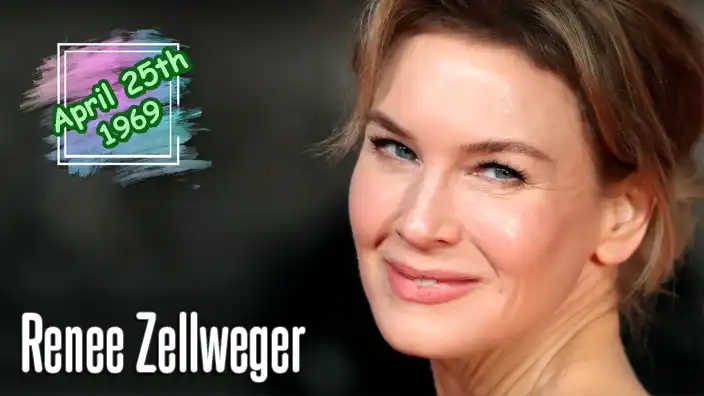
If awkward charm had a queen, Renée Zellweger would be sitting comfortably on the throne, probably holding a diary and wondering if she should have another glass of wine. She made being a lovable mess look so convincing that half the world started rooting for imperfection—and the other half started practicing a British accent in the mirror.
April 25, 1969, in Katy, Texas
Trivia
- Renée Zellweger learned a British accent for Bridget Jones’s Diary, fooling many viewers.
- She gained and later lost weight for the Bridget Jones role multiple times.
- She won an Oscar for Cold Mountain before winning Best Actress for Judy.
- She took a break from acting in the early 2010s before returning successfully.
- She worked undercover in a London publishing house to prepare for Bridget Jones.
- Her breakout role was in Jerry Maguire alongside Tom Cruise.
- She has Norwegian and Swiss heritage.
- She originally studied English literature before pursuing acting.

- Details
- Category: Celebrity Birthdays - April
Hollywood spent decades perfecting dramatic entrances, dazzling wardrobes, and carefully engineered star personas — then Ali MacGraw arrived looking effortlessly natural and made everyone wonder why they’d been trying so hard. She didn’t just star in one of the most famous romance films ever made; she convinced an entire generation that true love required sincerity, good timing, and possibly a very stylish winter coat.
April 1, 1939, in Pound Ridge, New York
Trivia
- Rose to international fame starring in Love Story (1970).
- Received an Academy Award nomination for Love Story.
- Won a Golden Globe for Most Promising Newcomer.
- Previously worked as a fashion model and photo stylist.
- Worked at Harper’s Bazaar before becoming an actress.
- Starred opposite Steve McQueen in The Getaway (1972).
- Married Steve McQueen during the height of both careers.
- Became a 1970s fashion icon known for natural beauty and simple style.

- Details
- Category: Celebrity Birthdays - April
Some actors command attention by shouting, grand gestures, and chewing the scenery like it owes them money. Sally Hawkins, on the other hand, walks into a scene, barely raises her voice, and somehow leaves everyone else looking like they’re trying too hard. She’s the kind of performer who can say everything without saying much at all—and if you blink, she’s already stolen the whole movie and politely left it back where she found it.
April 27, 1976, in Dulwich, London
Trivia
- She won a Golden Globe for Happy-Go-Lucky (2008).
- She has received two Academy Award nominations (Blue Jasmine and The Shape of Water).
- She trained at the Royal Academy of Dramatic Art (RADA).
- Her parents were both children’s book authors and illustrators.
- She played Mrs. Brown in the beloved Paddington films.
- She’s known for portraying emotionally complex characters with minimal dialogue.

- Details
- Category: Celebrity Birthdays - April
If there were an award for “Most Likely to Steal Every Scene While Also Making Perfect Hair Look Effortless,” Joe Keery would already have a shelf full of trophies—and probably a fan club dedicated solely to his conditioner routine. With a mix of charm, comedic timing, and just enough mystery to keep things interesting, Keery has gone from breakout TV star to bona fide fan favorite in what feels like the blink of an eye.
April 24, 1992, in Newburyport, Massachusetts
Trivia
- Studied acting at DePaul University’s Theatre School.
- Breakout role as Steve Harrington in Stranger Things.
- Character Steve was originally meant to be less likable.
- Appeared in Free Guy alongside Ryan Reynolds.
- Starred in thriller film Spree (2020).
- Performs music under the name Djo.
- Former member of band Post Animal.
- Known for his iconic hairstyle.
- Blends acting and music careers successfully.
- Details
- Category: Celebrity Birthdays - April
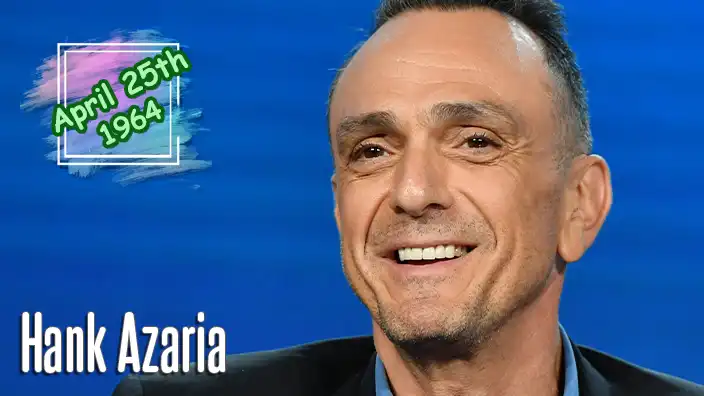
If you’ve ever laughed at a cartoon bartender, a clueless police chief, or a guy yelling “Hey, hey!” in a very specific voice, chances are you’ve already spent quality time with Hank Azaria—whether you realized it or not. The man has more voices than a crowded diner at breakfast, and somehow, he remembers which one to use.
April 25, 1964, in Queens, New York
Trivia
- Hank Azaria voices multiple major characters on The Simpsons.
- He won several Emmy Awards for both voice and live-action performances.
- He attended Tufts University before studying acting professionally.
- He appeared in The Birdcage alongside Robin Williams and Nathan Lane.
- He played David, Phoebe’s boyfriend, on Friends.
- Azaria stepped away from voicing Apu in response to cultural discussions.
- He has worked in film, television, and theater.
- His career spans over three decades in entertainment.

- Details
- Category: Celebrity Birthdays - April
Some musicians spend years trying to write their first meaningful song. Janis Ian managed to do it as a teenager and accidentally launched one of the most remarkable careers in modern songwriting. With a guitar in hand and lyrics far wiser than her years, Ian proved that powerful music doesn’t need flashy gimmicks—it just needs honesty. Over the decades she has written songs that make people laugh, think, cry, and occasionally stare at the ceiling wondering how someone could describe life quite that accurately.
April 7, 1951, in Farmingdale, New Jersey
Trivia
- She recorded “Society’s Child” at age 14.
- The song addressed interracial relationships, a controversial topic at the time.
- Her biggest hit, “At Seventeen,” was released in 1975.
- “At Seventeen” won the 1976 Grammy for Best Female Pop Vocal Performance.
- Ian has received multiple Grammy nominations and awards.
- She is also an author and essayist.
- Her songs have been recorded by many other artists.
- Ian has maintained a performing and recording career for more than five decades.

- Details
- Category: Celebrity Birthdays - April
If gravity had a sworn enemy, it would probably be Jackie Chan. For decades, audiences have watched him leap off buildings, crash through windows, tumble down staircases, and then politely bow during the end credits as if all that chaos was just another day at the office. While most actors rely on stunt doubles and clever camera tricks, Chan built a career doing the dangerous stuff himself—often while making us laugh. The result is a film legacy packed with jaw-dropping action, physical comedy, and the occasional chair, ladder, or refrigerator used as an improvised martial arts weapon.
April 7, 1954, in Victoria Peak, Hong Kong
Trivia
- He trained for about ten years at a demanding Peking Opera school as a child.
- Chan performed many of his own stunts, leading to numerous injuries throughout his career.
- He worked as a stuntman in Bruce Lee films early in his career.
- His action-comedy breakthrough came with “Drunken Master” (1978).
- Chan has appeared in nearly 150 films across his long career.
- In 2016 he received an Honorary Academy Award for lifetime achievement.
- He has stars on both the Hollywood Walk of Fame and Hong Kong Avenue of Stars.
- His nickname “Jackie” came from coworkers while he worked construction in Australia.

- Details
- Category: Celebrity Birthdays - April
Nicole Sullivan has the rare ability to commit so completely to a character that you’re not sure whether to laugh, applaud, or check if everything is okay. From over-the-top sketch comedy to animated chaos, she’s built a career on going all-in—and then pushing it just a little further for good measure. If there’s a line between “normal” and “hilarious,” Sullivan probably crossed it years ago and never looked back.
April 21, 1970, in Manhattan, New York City
Trivia
- Trained with The Groundlings improv group
- Rose to fame on MADtv
- Played Holly on The King of Queens
- Appeared in Scrubs
- Had a role in Monk
- Voice actor on Family Guy
- Featured on Black-ish
- Known for high-energy, character-driven comedy

- Details
- Category: Celebrity Birthdays - April
If talent were measured in sheer volume—both vocal and career-wise—Barbra Streisand would be operating on a level that requires its own category. She’s not just a singer, or an actress, or a director; she’s the kind of all-around force that makes you wonder if everyone else just decided to specialize because she took all the remaining options.
April 24, 1942, in Brooklyn, New York
Trivia
- Starred in Funny Girl on Broadway and film.
- Won an Academy Award for Funny Girl (1968).
- One of the best-selling music artists of all time.
- Directed and starred in Yentl (1983).
- First woman to win Golden Globe for Best Director.
- Achieved EGOT status.
- Known for hit song The Way We Were.
- Awarded the Presidential Medal of Freedom.
- Renowned for perfectionism and attention to detail.

- Details
- Category: Celebrity Birthdays - April
Some actors ease into a role. James Woods attacks it like it owes him money. With a voice that can cut glass and an intensity that could power a small city, Woods built a career playing characters you wouldn’t trust with your car keys—yet somehow can’t stop watching. Whether he’s charming, terrifying, or both at the same time, one thing’s certain: when James Woods shows up, subtlety usually packs its bags and leaves town.
April 18, 1947, in Vernal, Utah
Trivia
- James Woods attended MIT before leaving to pursue acting.
- He received an Academy Award nomination for Salvador (1986).
- He won two Emmy Awards for television performances.
- He starred in The Onion Field (1979), a major early role.
- He appeared in Casino (1995) alongside Robert De Niro and Joe Pesci.
- He voiced Hades in Disney’s Hercules (1997).
- He has worked extensively in both film and television.
- He is known for playing intense and morally complex characters.
- He began his career in theater before moving to film.
- He is known for his outspoken personality off-screen.

- Details
- Category: Celebrity Birthdays - April
Some guitarists politely play their solos. Mike McCready attacks them like they owe him money. Whether he’s bending notes, sliding across the fretboard, or unleashing a riff that rattles arena speakers, his playing has the kind of energy that makes rock fans grin and air-guitar along. If enthusiasm could be measured in decibels, McCready would probably need his own volume control.
April 5, 1966, in Pensacola, Florida
Trivia
- Raised in Seattle, Washington.
- Lead guitarist of Pearl Jam.
- Influenced by Jimi Hendrix and Stevie Ray Vaughan.
- Debut Pearl Jam album: Ten (1991).
- Known for powerful blues-style guitar solos.
- Member of the supergroup Mad Season.
- Played in the Seattle grunge movement.
- Public advocate for Crohn’s disease awareness.

- Details
- Category: Celebrity Birthdays - April
Hayden Christensen didn’t just play a character—he played the character who went from “promising young Jedi” to “office nightmare with a cape.” One minute he’s brooding about sand, the next he’s helping reshape the galaxy in a very unhealthy way. It’s not every actor who gets to portray one of cinema’s most famous villains mid-career crisis—and somehow make it iconic.
April 19, 1981, in Vancouver, Canada
Trivia
- Breakout role in Life as a House (2001).
- Played Anakin Skywalker in Star Wars Episodes II and III.
- Portrayed journalist Stephen Glass in Shattered Glass (2003).
- Starred in sci-fi film Jumper (2008).
- Took a break from acting to live and work on a farm.
- Returned as Darth Vader in Obi-Wan Kenobi (2022).
- Reprised the role again in Ahsoka (2023).
- Known for his quiet, introspective acting style.

- Details
- Category: Celebrity Birthdays - April
If you’ve watched movies or television for any length of time, chances are you’ve seen William Sadler somewhere—possibly as a villain, a military officer, a sheriff, or even the Grim Reaper himself. With a commanding voice and a face that directors seem to trust with authority (or occasionally mischief), Sadler has built one of those impressive Hollywood careers where audiences may not always know the name immediately—but the moment they see him, they say, “Oh, that guy! He’s great.” From action films to science fiction to historic dramas, Sadler has spent decades proving that character actors often steal the show.
April 13, 1950, in Buffalo, New York
Trivia
- Sadler played the villain Colonel Stuart in Die Hard 2 (1990).
- He portrayed Death in Bill & Ted’s Bogus Journey (1991).
- Sadler appeared as Heywood in The Shawshank Redemption (1994).
- He played President Matthew Ellis in Iron Man 3 (2013).
- Sadler has appeared in Star Trek: Deep Space Nine.
- He reprised the role of Death in Bill & Ted Face the Music (2020).
- In addition to acting, he has recorded and performed folk music.

- Details
- Category: Celebrity Birthdays - April
If modern billionaires dominate headlines today, J. P. Morgan might politely remind them that he was doing the “influential financial titan” routine long before social media, cable news, or tech startups existed. In the late 19th and early 20th centuries, when the American economy occasionally looked like it was about to fall apart, Morgan had a habit of stepping into the room, organizing the bankers, and calmly saying something along the lines of, “Right then, let’s sort this out.” Whether you admired him as a financial stabilizer or criticized him as a symbol of enormous corporate power, there’s no denying that J. P. Morgan helped shape modern American finance.
April 17, 1837, in Hartford, Connecticut
March 31, 1913, in Rome, Italy
Trivia
- His father, Junius Spencer Morgan, was also a prominent banker.
- Morgan helped finance the creation of U.S. Steel in 1901.
- U.S. Steel became the first billion-dollar corporation in the United States.
- Morgan played a key role in stabilizing markets during the Panic of 1907.
- His financial influence helped inspire the creation of the Federal Reserve System.
- He was an avid collector of art and rare books.
- His collection became the foundation of the Morgan Library and Museum in New York.
- The modern banking company JPMorgan Chase traces its roots to institutions he helped build.

- Details
- Category: Celebrity Birthdays - April
If Hollywood had a “cool girl with impeccable timing” category, Kate Hudson would have claimed it somewhere around 2000 and politely refused to give it back. She floated into Almost Famous like a 1970s daydream, made everyone wish they knew a Penny Lane, and then casually built a career that mixes charm, comedy, and just enough chaos to keep things lively. Some actors chase fame—Kate Hudson practically tripped over it, smiled, and said, “Well, this seems nice.”
April 19, 1979, in Los Angeles, California
Trivia
- Breakthrough role: Penny Lane in Almost Famous (2000).
- Won a Golden Globe for that role and earned an Oscar nomination.
- Starred in multiple romantic comedy hits in the 2000s.
- Co-founder of the fitness brand Fabletics.
- Released her debut music album Glorious in 2024.
- Has three children with different partners.
- Known for balancing comedy, drama, and musical roles.
- Appeared in Glass Onion: A Knives Out Mystery (2022).
- Grew up around Kurt Russell, whom she considers a father figure.
- Details
- Category: Celebrity Birthdays - April
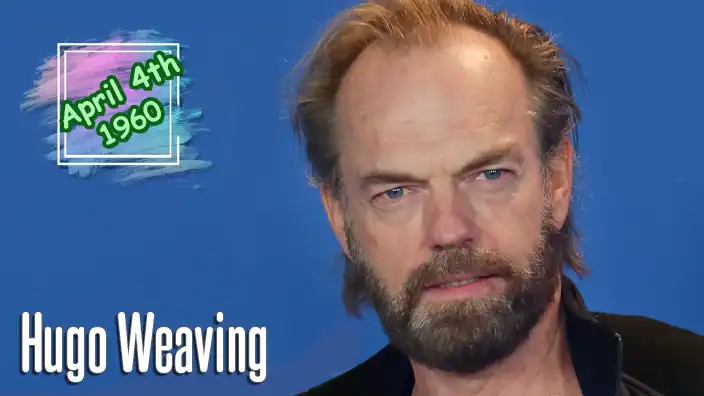
If Hollywood ever needed someone to play a brilliant villain, a wise elf lord, or a mysterious masked revolutionary, Hugo Weaving was already warming up backstage. With a voice that could probably intimidate a thunderstorm and acting skills to match, he has quietly become one of the most recognizable faces in modern cinema.
April 4, 1960, in Ibadan, Nigeria
Trivia
- Studied at NIDA in Sydney.
- Played Agent Smith in The Matrix.
- Appeared in all three Matrix films.
- Played Elrond in The Lord of the Rings.
- Starred as V in V for Vendetta.
- Played Red Skull in Captain America: The First Avenger.
- Known for his distinctive deep voice.
- Respected stage actor in Australia.
- Career spans film, television, and theater.

- Details
- Category: Celebrity Birthdays - April
Every now and then Hollywood produces someone who can do just about everything—write, direct, produce, and occasionally make audiences laugh, cry, and think all within the same two hours. Barry Levinson is one of those rare individuals. Over the course of several decades, he has directed everything from heartfelt dramas to political satires, often bringing a sharp eye for human behavior along with a bit of wit. If a movie leaves you entertained but also makes you quietly reflect on life while the credits roll, there’s a decent chance Barry Levinson had something to do with it.
April 6, 1942, in Baltimore, Maryland
Trivia
- Originally studied journalism in college
- Started career writing television comedy
- Writing partner with Valerie Curtin
- Oscar-nominated for ...And Justice for All
- Directed his first film Diner in 1982
- Known for several films set in Baltimore
- Won Oscar for directing Rain Man
- Rain Man won four Academy Awards
- Directed baseball film The Natural
- Directed political satire Wag the Dog

- Details
- Category: Celebrity Birthdays - April
If there were an award for turning selective mutism into one of television’s funniest running gags, Kunal Nayyar would have it framed, polished, and probably nervously explaining it to someone across the room. He made awkward silence an art form—and then, just when you got used to it, he started talking and somehow got even funnier. Not bad for a guy who once moved halfway across the world and decided, “Sure, let’s try acting.”
April 30, 1981, in Hammersmith, London
Trivia
- Moved to the United States for college and initially studied business.
- Earned an MFA in acting from Temple University.
- Got his start in theater before transitioning to television.
- Played Raj Koothrappali on The Big Bang Theory for 12 seasons.
- Known for Raj’s early inability to speak to women without alcohol.
- Became one of the highest-paid actors on television during the show’s run.
- Voiced a character in the animated film Trolls.
- Starred in Netflix’s Criminal: UK.
- Authored the memoir Yes, My Accent Is Real.
From Our Marks Catelog
-
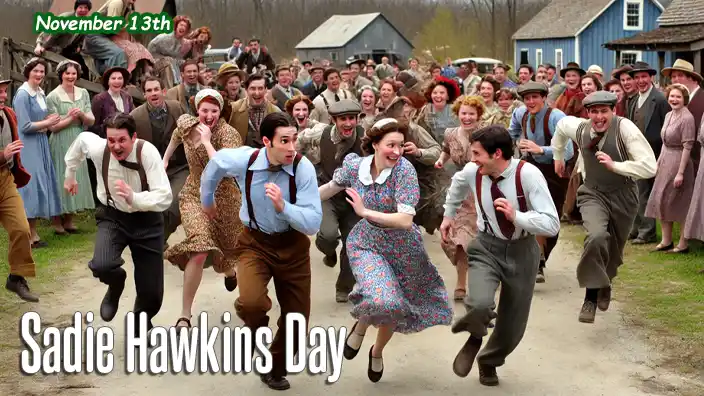
Sadie Hawkins Day is that rare annual event when the tables turn, and the thrill of the chase gets...
-

Pet Rocks are the ultimate low-maintenance pet—no feeding, no walking, no vet bills, and they...
-

The Merchant Navy is like the unsung hero of the high seas, quietly keeping the world...
-

Caribbean Americans bring a special kind of energy that’s hard to miss — the kind that says, “Yes, I work...
-

Logistics is like a high-stakes game of Tetris, but with trucks, ships, and planes instead of...
-
This is not just a 'weigh-in' for your New Year's resolutions, but a time when we collectively tip the...


