Celebrity Birthdays - April

April birthdays get all the flowers — and sometimes all the showers, too. They’ll tell you it builds character. We think it just builds frizz.
Let’s look at the famous faces who bring a little color to this in-between month. They’re the sunshine peeking through the rainclouds, reminding us that summer is just around the corner… probably.

- Details
- Category: Celebrity Birthdays - April
Some actors quietly build long careers with a handful of respectable roles. Alec Baldwin, on the other hand, seems to collect careers the way some people collect coffee mugs. Drama, comedy, television, voice acting, hosting, political impressions—he’s done all of it, often with the confidence of a man who knows the camera is going to find him eventually anyway. Whether he’s delivering sharp dialogue in a courtroom drama or delivering sharper sarcasm in a sitcom, Baldwin has spent decades proving that a powerful voice, strong screen presence, and impeccable timing can carry almost any scene.
 April 3, 1958, in Amityville, New York

Trivia
- Starred in The Hunt for Red October (1990).
- Famous for the sales speech in Glengarry Glen Ross.
- Won two Emmy Awards for 30 Rock.
- Played Jack Donaghy on 30 Rock.
- Frequent host of Saturday Night Live.
- Voiced the lead character in The Boss Baby.
- Studied acting at NYU’s Tisch School of the Arts.
- Known for his deep and recognizable voice.

- Details
- Category: Celebrity Birthdays - April
Catalina Sandino Moreno didn’t ease into Hollywood—she walked in, delivered a performance so powerful it made critics sit up straight, and picked up an Oscar nomination like it was part of the welcome package. No long warm-up, no slow climb—just one role, one film, and suddenly everyone knew her name. Not a bad way to get started.
 April 19, 1981, in Bogotá, Colombia
Trivia
- Studied advertising before pursuing acting.
- Breakout role in Maria Full of Grace (2004).
- First Colombian actress nominated for an Academy Award.
- Won the Silver Bear for Best Actress at the Berlin Film Festival.
- Starred in Fast Food Nation (2006).
- Appeared in Love in the Time of Cholera (2007).
- Played a journalist in The Bridge (2013–2014).
- Known for understated and emotionally grounded performances.

- Details
- Category: Celebrity Birthdays - April
Some actors ease into Hollywood. Channing Tatum? He danced his way in, flipped over the furniture, and somehow made it look like a perfectly reasonable career move. With a mix of athleticism, charm, and a willingness to laugh at himself, he’s carved out a spot where action hero, romantic lead, and comedy guy all live under the same roof. Not bad for someone who started out showing off dance moves instead of delivering monologues.
April 26, 1980, in Cullman, Alabama
Trivia
- His breakout role came in Step Up.
- He showed his comedic side in 21 Jump Street.
- Magic Mike was inspired by his real-life experiences as a dancer.
- He has starred in action films like G.I. Joe: The Rise of Cobra.
- He has done voice work, including roles in animated films.
- He has worked as a producer on several projects.
- He is known for blending physical performance with humor.

- Details
- Category: Celebrity Birthdays - April
If there were an award for turning selective mutism into one of television’s funniest running gags, Kunal Nayyar would have it framed, polished, and probably nervously explaining it to someone across the room. He made awkward silence an art form—and then, just when you got used to it, he started talking and somehow got even funnier. Not bad for a guy who once moved halfway across the world and decided, “Sure, let’s try acting.”
April 30, 1981, in Hammersmith, London
Trivia
- Moved to the United States for college and initially studied business.
- Earned an MFA in acting from Temple University.
- Got his start in theater before transitioning to television.
- Played Raj Koothrappali on The Big Bang Theory for 12 seasons.
- Known for Raj’s early inability to speak to women without alcohol.
- Became one of the highest-paid actors on television during the show’s run.
- Voiced a character in the animated film Trolls.
- Starred in Netflix’s Criminal: UK.
- Authored the memoir Yes, My Accent Is Real.

- Details
- Category: Celebrity Birthdays - April
Hollywood has plenty of actors who can shout dramatically while running away from explosions, but David Oyelowo built his reputation doing something far more difficult: standing still, speaking thoughtfully, and somehow making entire audiences lean forward and listen. When he shows up on screen, you don’t just watch — you pay attention, whether you planned to or not.
April 1, 1976, in Oxford, England
Trivia
- Trained at LAMDA in London.
- First Black actor to play an English king for the Royal Shakespeare Company.
- Starred as Martin Luther King Jr. in Selma (2014).
- Appeared in Lincoln (2012).
- Known for powerful speaking voice.
- Works as both actor and producer.
- Has performed extensively in Shakespeare plays.

- Details
- Category: Celebrity Birthdays - April
If you grew up in a time when television heroes didn’t just solve problems—they ran in slow motion while doing it—then Lee Majors was probably already etched into your memory. As the man who made bionic limbs look like a perfectly reasonable upgrade, Majors didn’t just play a hero… he was the hero. With a calm demeanor, a steady voice, and the ability to make jogging look like a high-tech operation, he became the face of a generation’s idea of strength. And let’s be honest—if someone offered most of us bionic legs today, we’d at least ask about the warranty.
April 23, 1939, in Wyandotte, Michigan
Trivia
- Lost both parents at a young age and was raised by relatives.
- Played Heath Barkley in The Big Valley (1965–1969).
- Starred as Steve Austin in The Six Million Dollar Man (1973–1978).
- The show inspired the spin-off The Bionic Woman.
- Starred in The Fall Guy (1981–1986).
- Originally pursued a career in football before injury.
- Known for iconic slow-motion running scenes.
- Continues to make appearances in film and television.

- Details
- Category: Celebrity Birthdays - April
If Hollywood ever needed someone who could convincingly play a demon, a medieval monk, a biker gang boss, and a lovable monster without breaking a sweat, Ron Perlman would probably raise his hand and say, “Sure, why not?” With a voice that sounds like it was carved out of granite and a face perfectly suited for characters that look like they’ve survived several centuries of hard living, Perlman has spent decades becoming one of the most recognizable “that guy” actors in film and television. Whether he’s covered in red makeup as Hellboy or glowering behind a pair of biker sunglasses, Perlman brings a mix of intensity, humor, and surprising warmth that keeps audiences coming back for more.
April 13, 1950, in New York City, New York
Trivia
- Perlman played Hellboy in both the 2004 film and its 2008 sequel.
- He portrayed Clay Morrow in the hit television series Sons of Anarchy.
- He frequently collaborates with director Guillermo del Toro.
- Perlman has voiced characters in many video games, including Fallout and Halo.
- His career began in the 1970s, and he remains active today.
- He once considered quitting acting before landing one of his early major film roles.
- Details
- Category: Celebrity Birthdays - April
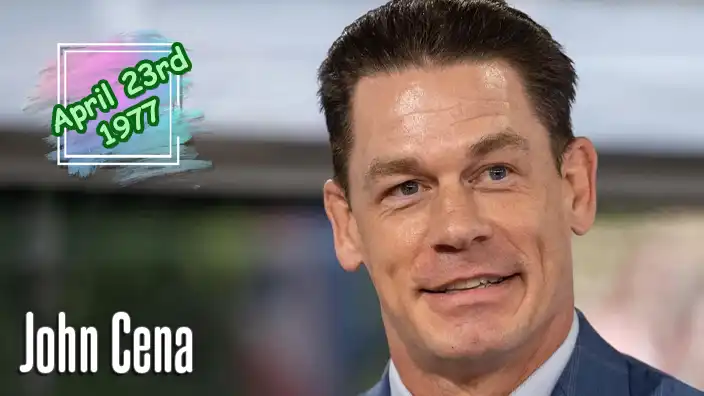
If there’s one man who can walk into a room, tip his cap, wave his hand in front of his face, and somehow convince millions of people he’s invisible, it’s John Cena. Equal parts superhero, motivational speaker, and walking bicep, Cena built a career out of hustle, loyalty, respect—and a refusal to ever lose cleanly on a Sunday night. Whether he’s body-slamming opponents, granting wishes to kids, or popping up in movies where he’s somehow both intimidating and hilarious, Cena has mastered the art of being everywhere while claiming he’s nowhere. If hard work had a spokesperson, it would look suspiciously like a guy in jorts.
April 23, 1977, in West Newbury, Massachusetts
Trivia
- Record 17-time WWE World Champion.
- Made WWE debut in 2002.
- Known for catchphrase: “You can’t see me!”
- Released a rap album in 2005.
- Starred in The Suicide Squad and Fast & Furious films.
- Holds record for most Make-A-Wish requests granted.
- College football player before wrestling career.
- Became a Grand Slam Champion in WWE.
- Retired from in-ring wrestling in 2025.

- Details
- Category: Celebrity Birthdays - April
Some actors make an impression. Samira Wiley makes a statement. Whether she’s delivering a witty remark, standing up for what’s right, or completely stealing the scene with a single glance, Wiley has built a reputation for performances that are both powerful and unforgettable. From prison dramas to dystopian television worlds, she has proven that a strong character, a sharp mind, and impeccable timing can turn any role into something audiences remember long after the credits roll.
April 15, 1987, in Washington, D.C.
Trivia
- Attended the prestigious Juilliard School in New York City
- Breakthrough role as Poussey Washington in Orange Is the New Black
- Played Moira in the Hulu series The Handmaid’s Tale
- Won a Primetime Emmy Award for Outstanding Guest Actress in a Drama Series
- Married television writer Lauren Morelli in 2017
- Active advocate for LGBTQ representation and equality
- Appeared in both television and theater productions
- Known for portraying emotionally powerful and socially relevant characters

- Details
- Category: Celebrity Birthdays - April
Most comedians have to carry an entire show on their own. Jeff Dunham? He shows up with a suitcase full of personalities—none of whom behave, all of whom talk back, and at least one who probably shouldn’t be allowed in polite company. Somehow, he manages to be the calm, reasonable one on stage… which is saying something when your coworkers include a grumpy old man, a hyperactive jalapeño, and a skeletal figure with no filter.
April 18, 1962, in Dallas, Texas
Trivia
- Jeff Dunham began practicing ventriloquism at age eight.
- He attended Baylor University while performing stand-up.
- His breakthrough came with Comedy Central specials in the mid-2000s.
- His popular characters include Walter, Achmed, Peanut, and José Jalapeño.
- He is one of the highest-grossing stand-up comedians in the world.
- He combines traditional ventriloquism with modern stand-up comedy.
- His specials have been widely viewed on television and streaming platforms.
- He has performed in sold-out arenas across the globe.
- He has authored a memoir about his life and career.

- Details
- Category: Celebrity Birthdays - April
Some actors fade away after their first hit movie. Dennis Quaid, on the other hand, seems to treat Hollywood like a long road trip—he just keeps driving, occasionally switching vehicles along the way. Over the decades he’s played astronauts, baseball players, presidents, cowboys, villains, and the kind of charming leading man who always looks like he knows where the nearest diner is. Whether he’s saving the world from alien invaders or cracking jokes in a family comedy, Quaid has been one of those dependable Hollywood faces who can make almost any movie feel a little more fun.
April 9, 1954, in Houston, Texas
Trivia
- Younger brother of actor Randy Quaid.
- Attended the University of Houston before pursuing acting.
- Breakthrough film: Breaking Away (1979).
- Played astronaut Gordon Cooper in The Right Stuff.
- Starred in the blockbuster Independence Day (1996).
- Played the father in the 1998 remake of The Parent Trap.
- Lead singer of the band Dennis Quaid and the Sharks.
- Portrayed U.S. President Ronald Reagan in the 2024 film Reagan.

- Details
- Category: Celebrity Birthdays - April
Some actors spend their careers trying to look mysterious, intense, or authoritative. Peter Capaldi manages to do all three just by raising one eyebrow and speaking in that unmistakably sharp Scottish voice. Whether he’s delivering a blistering political rant, stepping out of the TARDIS as a centuries-old alien, or quietly stealing a scene with perfect comedic timing, Capaldi has a talent for making every character feel like the smartest — and possibly the grumpiest — person in the room. And frankly, audiences wouldn’t have it any other way.
April 14, 1958, in Glasgow, Scotland
Trivia
- He studied graphic design at the Glasgow School of Art.
- Capaldi won an Academy Award for directing the short film Franz Kafka’s It’s a Wonderful Life.
- He played Malcolm Tucker in The Thick of It.
- Capaldi became the Twelfth Doctor in Doctor Who in 2013.
- As a child, he was an avid Doctor Who fan.
- He appeared in the political satire film In the Loop.
- Capaldi had a role in the blockbuster film World War Z.
- His portrayal of the Doctor emphasized a more serious and ancient tone.

- Details
- Category: Celebrity Birthdays - April
If modern billionaires dominate headlines today, J. P. Morgan might politely remind them that he was doing the “influential financial titan” routine long before social media, cable news, or tech startups existed. In the late 19th and early 20th centuries, when the American economy occasionally looked like it was about to fall apart, Morgan had a habit of stepping into the room, organizing the bankers, and calmly saying something along the lines of, “Right then, let’s sort this out.” Whether you admired him as a financial stabilizer or criticized him as a symbol of enormous corporate power, there’s no denying that J. P. Morgan helped shape modern American finance.
April 17, 1837, in Hartford, Connecticut
 March 31, 1913, in Rome, Italy
Trivia
- His father, Junius Spencer Morgan, was also a prominent banker.
- Morgan helped finance the creation of U.S. Steel in 1901.
- U.S. Steel became the first billion-dollar corporation in the United States.
- Morgan played a key role in stabilizing markets during the Panic of 1907.
- His financial influence helped inspire the creation of the Federal Reserve System.
- He was an avid collector of art and rare books.
- His collection became the foundation of the Morgan Library and Museum in New York.
- The modern banking company JPMorgan Chase traces its roots to institutions he helped build.

- Details
- Category: Celebrity Birthdays - April
Nicole Sullivan has the rare ability to commit so completely to a character that you’re not sure whether to laugh, applaud, or check if everything is okay. From over-the-top sketch comedy to animated chaos, she’s built a career on going all-in—and then pushing it just a little further for good measure. If there’s a line between “normal” and “hilarious,” Sullivan probably crossed it years ago and never looked back.
April 21, 1970, in Manhattan, New York City
Trivia
- Trained with The Groundlings improv group
- Rose to fame on MADtv
- Played Holly on The King of Queens
- Appeared in Scrubs
- Had a role in Monk
- Voice actor on Family Guy
- Featured on Black-ish
- Known for high-energy, character-driven comedy

- Details
- Category: Celebrity Birthdays - April
Some actors chase fame, some stumble into it, and then there’s America Ferrera—who showed up, delivered powerhouse performances, and quietly made it clear she wasn’t just here to be noticed, she was here to be remembered. From awkward teen struggles to high-fashion chaos to blockbuster pink perfection, she’s built a career that says, “Yes, I can do that too,” and then proves it—usually while making it look easier than it has any right to be.
April 18, 1984, in Los Angeles, California
Trivia
- She made her film debut in Real Women Have Curves (2002).
- She won an Emmy, Golden Globe, and SAG Award for Ugly Betty.
- She voiced Astrid in the How to Train Your Dragon films.
- She starred in The Sisterhood of the Traveling Pants.
- She played Amy Sosa in the sitcom Superstore.
- She has directed multiple episodes of television.
- She served as an executive producer on Superstore.
- Her performance in Barbie (2023) received widespread attention.
- She is an advocate for social and political causes, including voter engagement.

- Details
- Category: Celebrity Birthdays - April
If Hollywood had a “cool without trying too hard” category, Perry King would’ve quietly won it sometime in the late ’70s and never bothered to mention it again. He’s the kind of actor who didn’t chase the spotlight—it just kept finding him anyway. Give him a leather jacket, a helicopter, or a serious drama, and he’d handle all three like it was just another Tuesday.
April 30, 1948, in Alliance, Ohio
Trivia
- Studied theater at Yale University.
- Early film role in Slaughterhouse-Five (1972).
- Starred as Cody Allen in Riptide during the 1980s.
- Appeared in the influential TV film The Day After.
- Worked extensively in both television and film.
- Known for a calm, understated acting style.
- Has experience as a director and producer.
- Maintained a long, steady career without major breaks.

- Details
- Category: Celebrity Birthdays - April
Some musicians spend years trying to write their first meaningful song. Janis Ian managed to do it as a teenager and accidentally launched one of the most remarkable careers in modern songwriting. With a guitar in hand and lyrics far wiser than her years, Ian proved that powerful music doesn’t need flashy gimmicks—it just needs honesty. Over the decades she has written songs that make people laugh, think, cry, and occasionally stare at the ceiling wondering how someone could describe life quite that accurately.
April 7, 1951, in Farmingdale, New Jersey
Trivia
- She recorded “Society’s Child” at age 14.
- The song addressed interracial relationships, a controversial topic at the time.
- Her biggest hit, “At Seventeen,” was released in 1975.
- “At Seventeen” won the 1976 Grammy for Best Female Pop Vocal Performance.
- Ian has received multiple Grammy nominations and awards.
- She is also an author and essayist.
- Her songs have been recorded by many other artists.
- Ian has maintained a performing and recording career for more than five decades.

- Details
- Category: Celebrity Birthdays - April
Sean Bean has achieved something very few actors can claim: he has become famous not just for his acting talent, but for the remarkable number of times his characters don’t exactly make it to the end of the story. Knights, spies, soldiers, villains, kings—you name it, Sean Bean has played it, and sometimes audiences watch nervously wondering whether his character will survive the credits. Yet through it all, the Yorkshire-born actor has built a career full of memorable roles, powerful performances, and one of the most recognizable voices in British cinema.
April 17, 1959, in Sheffield, England
Trivia
- He trained at the Royal Academy of Dramatic Art (RADA).
- He won the RADA silver medal for outstanding performance.
- Bean played villain Alec Trevelyan in the James Bond film GoldenEye.
- He portrayed Boromir in The Lord of the Rings: The Fellowship of the Ring.
- He starred as Richard Sharpe in the television series Sharpe.
- Bean played Ned Stark in the first season of Game of Thrones.
- He often keeps his natural Yorkshire accent in film and television roles.
- He has appeared in both major Hollywood blockbusters and British television dramas.

- Details
- Category: Celebrity Birthdays - April
If you’ve ever watched a crime show and thought, “Now that guy looks like he knows exactly what’s going on,” there’s a good chance you were looking at Paul Guilfoyle. He’s not the loudest presence in the room, and he doesn’t need to be. With a steady voice, a sharp look, and the kind of calm authority that makes everyone else straighten up a little, Guilfoyle built a career out of being the person you trust when things get complicated—and on television, things are always complicated.
April 28, 1949, in Boston, Massachusetts
Trivia
- Began his career in theater before moving to film and television
- Appeared in Three Men and a Baby (1987)
- Featured in L.A. Confidential (1997)
- Best known as Captain Jim Brass on CSI: Crime Scene Investigation
- Appeared in over 300 episodes of CSI
- Known for portraying authoritative and grounded characters
- Has a background in both stage and screen acting
- Comes from a politically active family in Boston

- Details
- Category: Celebrity Birthdays - April
Kareem Abdul-Jabbar’s skyhook was so reliable that opposing defenders probably considered filing a formal complaint with the laws of physics. Imagine trying to block a shot released by a seven-foot-two basketball legend whose arm seems to extend halfway to the rafters. Opponents jumped, stretched, and occasionally prayed, but the result was usually the same: two points for Kareem and another defender wondering if he’d accidentally signed up for the wrong sport.
April 16, 1947, in New York City
Trivia
- Originally named Ferdinand Lewis Alcindor Jr.
- Played college basketball at UCLA under John Wooden.
- Won three NCAA championships with UCLA.
- Selected first overall in the 1969 NBA Draft by the Milwaukee Bucks.
- Helped lead the Bucks to an NBA championship in 1971.
- Won six NBA championships during his career.
- Famous for the nearly unstoppable “skyhook” shot.
- Played a memorable cameo role in the comedy Airplane!
- Known today as an author, historian, and cultural commentator.

- Details
- Category: Celebrity Birthdays - April
Jeffrey Dean Morgan looks like the kind of man who could either save your life, steal your motorcycle, or calmly lean against a doorway and make the whole scene better just by existing. He has one of those faces Hollywood loves: rugged, expressive, and just weathered enough to suggest he has seen things. Whether he is playing a grieving heart patient, a monster-fighting dad, a baseball-bat-wielding villain, or a man who seems suspiciously capable of surviving the apocalypse with a smirk, Morgan has built a career out of turning “supporting role” energy into “why is this guy stealing the whole show?” energy.
April 22, 1966, in Seattle, Washington
Trivia
- Played John Winchester in Supernatural.
- Played Denny Duquette in Grey’s Anatomy.
- Played Negan in The Walking Dead.
- Starred as the Comedian in Watchmen.
- Appeared in P.S. I Love You.
- Voiced Conquest in Invincible.
- Hosted NBC’s Destination X.
- Married actress Hilarie Burton in 2019.
From Our Marks Catelog
-
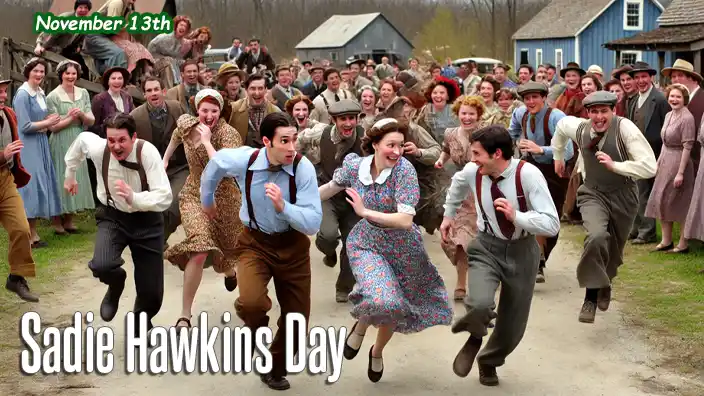
Sadie Hawkins Day is that rare annual event when the tables turn, and the thrill of the chase gets...
-

Pet Rocks are the ultimate low-maintenance pet—no feeding, no walking, no vet bills, and they...
-

The Merchant Navy is like the unsung hero of the high seas, quietly keeping the world...
-

Caribbean Americans bring a special kind of energy that’s hard to miss — the kind that says, “Yes, I work...
-

Logistics is like a high-stakes game of Tetris, but with trucks, ships, and planes instead of...
-
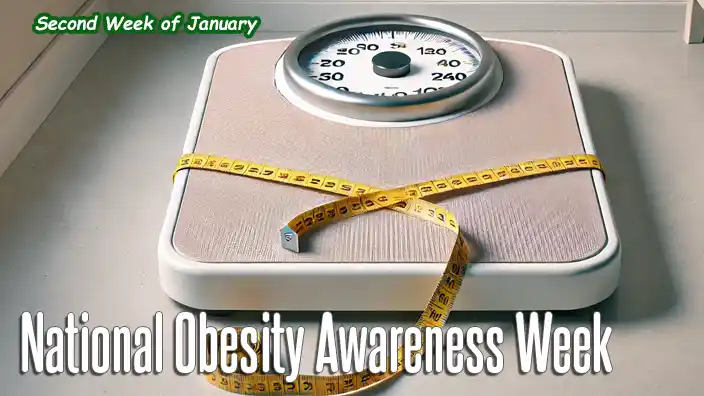
This is not just a 'weigh-in' for your New Year's resolutions, but a time when we collectively tip the...

