Celebrity Birthdays - June

Ah, June — school’s out, pools are open, and June birthday people are here to remind you that the fun starts now.
These stars are summer’s opening act, kicking off long days, warm nights, and questionable tan lines. Grab a lemonade and join us in celebrating the folks who make June the month of all things bright and loud.

- Details
- Category: Celebrity Birthdays - June
Mark Curry has the rare ability to make you laugh about things you swore you weren’t going to talk about. He’ll tell a story about family, sports, or life’s curveballs—and by the end, you’re laughing so hard you forget you were supposed to be serious. If timing is everything, Curry’s still running the clock like he’s up by two with ten seconds left—and yes, he’s taking the shot.
 June 1, 1961, in Oakland, California

Trivia
- He starred in Hangin’ with Mr. Cooper from 1992 to 1997.
- He hosted Showtime at the Apollo, winning over tough live audiences.
- He appeared in the blockbuster film Armageddon (1998).
- He suffered severe burns in a 2006 home accident and returned to comedy afterward.
- He frequently participates in celebrity basketball events.
- He has been an advocate for mental health awareness.

- Details
- Category: Celebrity Birthdays - June
Claire Holt has one of the strangest career résumés imaginable: she started as a mermaid and then became a thousand-year-old vampire. At this rate, her next role will probably be an alien queen or a time-traveling pirate. She’s spent so much time playing supernatural creatures that if someone handed her a script where she just played a regular person with a normal office job, she’d probably flip through it and ask, “So… when do I grow fangs or a tail?”
 June 11, 1988, in Brisbane, Australia
Trivia
- She starred as Emma in H2O: Just Add Water.
- She played Rebekah Mikaelson in The Vampire Diaries and The Originals.
- She was a competitive swimmer and water polo player growing up.
- She appeared in the thriller 47 Meters Down.
- She starred in the crime series Aquarius.
- She is a fitness enthusiast who enjoys yoga and running.
- She is open about her experiences with anxiety.
- She is a devoted dog lover.

- Details
- Category: Celebrity Birthdays - June
Dr. Ruth proved that you don’t need to be tall to be a giant in your field. At 4 feet 7 inches, she could barely see over some podiums, but she could certainly see right through people’s excuses for poor communication. With her cheerful accent and unstoppable energy, she turned late-night radio into a classroom for grown-ups—and probably made a few listeners blush while she was at it. If confidence were measured in decibels, she’d have been ten feet tall.
June 4, 1928, in Frankfurt, Germany
 July 12, 2024, in Manhatten, New York
Trivia
- Dr. Ruth was only 4 feet 7 inches tall but served as a sniper in the Haganah.
- Her radio show Sexually Speaking began as a small midnight program.
- She wrote more than 40 books on sex, relationships, and psychology.
- She earned a doctorate in education from Columbia University.
- She continued teaching and speaking publicly well into her 90s.

- Details
- Category: Celebrity Birthdays - June
Anne Winters may be a rising Hollywood star, but give her a board game and she’ll happily spend the evening arguing over hotel properties and triple-word scores. Somewhere between intense dramatic scenes and red-carpet events, she’s probably plotting a ruthless Monopoly strategy. And if her on-screen characters are any indication, you might want to think twice before agreeing to be the banker.
June 3, 1994, in Dallas, Texas
Trivia
- Anne Winters was born and raised in Dallas, Texas.
- She played Chloe Rice on the Netflix series 13 Reasons Why.
- Her role in Tyrant marked her first major TV breakthrough.
- She appeared opposite Nicolas Cage in Mom and Dad.
- Winters is a fan of board games like Monopoly and Scrabble.

- Details
- Category: Celebrity Birthdays - June
Willa Holland has the kind of cool, effortless vibe that makes it look like she just rolled out of bed, grabbed a guitar, fed the dogs, snapped a gorgeous travel photo, and accidentally became a television star before lunch. While other actors are busy perfecting their red-carpet poses, Willa seems more interested in finding the nearest sushi spot or planning her next adventure. She gives off the energy of someone who could save a city in a superhero show at night, then spend the next morning arguing with a barista about whether coffee counts as breakfast. Honestly, if laid-back confidence were a superpower, she’d never even need the costume.
June 18, 1991, in Los Angeles, California
Trivia
- She has a fascination with marine biology and enjoys visiting aquariums whenever she travels to a new city.
- Willa Holland once voiced the character of Aqua in the popular video game "Kingdom Hearts."
- Willa is an advocate for mental health awareness and has openly discussed her own struggles with anxiety to help others.
- Willa is an accomplished pianist and often uses music as a way to relax and express herself creatively.
- Willa was discovered by Steven Spielberg at the age of seven during a family holiday, which led to her signing with Ford Modeling Agency.

- Details
- Category: Celebrity Birthdays - June
Luke Youngblood has managed to build a career where he’s best known for either announcing magical sports or yelling “Pop! Pop!” at random intervals, which is honestly a pretty great résumé. Not everyone can say they’ve worked at Hogwarts and a fictional community college without even needing a time-turner. Somewhere out there, there’s probably a crossover universe where Lee Jordan is commentating a Quidditch match while Magnitude runs through the stands shouting his catchphrase. And frankly, that sounds like a show people would absolutely watch.
June 12, 1986, in London, England
Trivia
- Luke Youngblood played Lee Jordan in the first three Harry Potter films.
- He portrayed Magnitude on the TV series Community.
- His famous catchphrase on Community was “Pop! Pop!”
- He has performed in West End musical productions.
- He played Benny in In the Heights in London.
- Luke began acting as a child in British television shows.
- He is also a trained singer and dancer.

- Details
- Category: Celebrity Birthdays - June
If you survived watching Meet the Parents without cringing at least once, you may be superhuman. Through all that chaos, Teri Polo stood calmly in the middle of it like someone who had already rehearsed every possible awkward family dinner scenario. Meanwhile, most of us panic if our in-laws ask about our five-year plan. She handled De Niro’s interrogation scenes with grace — which frankly deserves its own award category.
June 1st, 1969, in Dover, Delaware
Trivia
- She originally trained as a ballet dancer before pursuing acting.
- She played Pam Byrnes in the Meet the Parents trilogy.
- She starred as Stef Adams Foster in The Fosters from 2013 to 2018.
- She filed for bankruptcy in 2014 but continued working steadily afterward.

- Details
- Category: Celebrity Birthdays - June
Paul Schulze has played so many serious, intense characters that you half-expect him to walk into a room and immediately start delivering a speech about life, morality, or a looming federal crisis. He’s been a priest who loved pasta a little too much, a government agent who took his job very seriously, and a pharmacist with a heart bigger than his common sense. If there’s ever a TV show about a deeply conflicted man standing in a dimly lit room, looking worried while holding a cup of coffee, Paul Schulze is probably already cast. And honestly, he’ll probably be the best part of the scene.
June 12, 1962, in New York City
Trivia
- He studied acting at SUNY Purchase.
- He played Father Phil Intintola on The Sopranos.
- He portrayed Ryan Chappelle on 24.
- He appeared in the thriller Panic Room with Jodie Foster.
- He starred as Eddie Walzer on Nurse Jackie.
- Schulze has appeared in multiple Law & Order episodes.
- He has a strong background in theater.
- He often plays intense or morally complex characters.

- Details
- Category: Celebrity Birthdays - June
If you ever met Liza Weil in person, part of your brain might still expect her to start lecturing you about your GPA, your five-year plan, and why you’re already behind schedule. That’s the power of Paris Geller. She played the role so convincingly that an entire generation of viewers still feels slightly nervous around ambitious overachievers. The funny part is, by all accounts, Liza herself is warm, thoughtful, and nothing like her famously intense character—though it might still be wise to have your résumé ready, just in case.
June 5, 1977, in Passaic, New Jersey
Trivia
- She grew up in a touring comedy troupe run by her actor parents.
- She made her stage debut as a child in her family’s productions.
- She originally auditioned for Rory on Gilmore Girls.
- The character of Paris Geller was created specifically for her.
- She reprised her role as Paris in Gilmore Girls: A Year in the Life (2016).
- She played Bonnie Winterbottom on How to Get Away with Murder for six seasons.
- She has appeared in shows like Scandal and Grey’s Anatomy.

- Details
- Category: Celebrity Birthdays - June
There are two guarantees in life: taxes and someone eventually saying, “This would sound better if Morgan Freeman narrated it.” He could read your grocery list and make it feel like an epic saga. Somewhere right now, he’s probably flying a plane, tending bees, or calmly explaining the mysteries of existence—all before lunch. And honestly, that feels exactly right.
June 1, 1937, in Memphis, Tennessee
Trivia
- Morgan Freeman served in the U.S. Air Force before pursuing acting full-time.
- He won an Academy Award for Million Dollar Baby in 2005.
- He earned his private pilot’s license at age 65.
- He turned his Mississippi ranch into a honeybee sanctuary.
- He co-owns the Ground Zero Blues Club in Clarksdale, Mississippi.
- He portrayed God in the comedy film Bruce Almighty.

- Details
- Category: Celebrity Birthdays - June
Landing a starring role on a hit television series is impressive enough. Doing it almost immediately after graduating from drama school is the sort of thing that makes aspiring actors stare at their résumés and sigh dramatically. Fortunately for Camila Mendes, talent, timing, and plenty of determination all arrived at the audition together.
June 29, 1994, in Charlottesville, Virginia
Trivia
- She is of Brazilian heritage and speaks Portuguese.
- Graduated from New York University's Tisch School of the Arts in 2016.
- Riverdale was her first professional acting audition.
- Played Veronica Lodge for all seven seasons of Riverdale.
- Won the Teen Choice Award for Choice Scene Stealer in 2017.
- Starred in The Perfect Date with Noah Centineo.
- Appeared in the hit film Palm Springs.
- Starred in Dangerous Lies, Do Revenge, Upgraded, and Música.

- Details
- Category: Celebrity Birthdays - June
Karl Urban has one of those faces that looks equally at home in medieval armor, a futuristic space uniform, or a long leather coat while threatening corrupt superheroes. He’s spent so much time fighting orcs, criminals, aliens, and super-powered maniacs that you get the feeling he probably checks under the bed at night just in case there’s a rogue villain hiding there. And yet, off-screen, he’s the kind of laid-back New Zealander who’d probably rather be surfing than saving the galaxy. It’s comforting to know that if the world ever does end, there’s a decent chance Karl Urban will show up wearing the right costume for the situation.
June 7, 1972, in Wellington, New Zealand
Trivia
- He made his screen debut at the age of eight in a New Zealand television commercial.
- He played multiple different characters on Xena: Warrior Princess.
- He is a passionate surfer and often returns to New Zealand to hit the waves.
- He kept Judge Dredd’s helmet on for the entire Dredd film to stay true to the comics.
- He is a big fan of rugby and supports New Zealand’s national team, the All Blacks.
- He originally auditioned for the role of Aragorn in The Lord of the Rings.
- His mother worked in the film industry, which helped spark his interest in acting.
- He has appeared in both Star Trek and The Lord of the Rings, two of the biggest franchises in film history.

- Details
- Category: Celebrity Birthdays - June
James Callis has the rare talent of making genius-level intelligence look both impressive and slightly dangerous. As Gaius Baltar, he could deliver a speech about theology, quantum physics, and his own innocence—all in the same breath—and somehow make it sound convincing. If there were an award for “Most Likely to Accidentally Doom Humanity While Explaining Why It Wasn’t His Fault,” he’d win it every time. Fortunately for the rest of us, off-screen he seems far more interested in piano, painting, and raising his kids than triggering any robotic uprisings.
June 4, 1971, in Hampstead, England
Trivia
- James Callis trained at the London Academy of Music and Dramatic Art (LAMDA).
- He played Bridget’s friend Tom in the Bridget Jones films.
- He won a Saturn Award for his role as Gaius Baltar.
- Callis speaks multiple languages, including French and Spanish.
- He is also a writer, musician, and visual artist.
- Details
- Category: Celebrity Birthdays - June
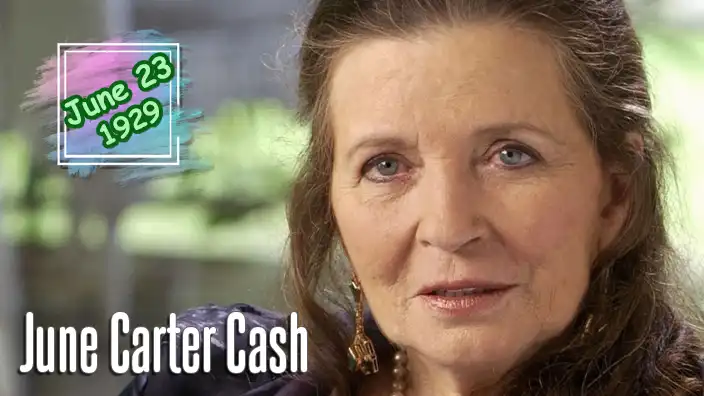
Some people are born into a family business. June Carter Cash was born into a family that practically invented country music. While most children grow up hearing bedtime stories, June grew up surrounded by songs, stages, instruments, and enough musical talent to fill several generations. She spent a lifetime making audiences laugh, sing along, and occasionally reach for a handkerchief. Along the way, she became a country music star, songwriter, actress, comedian, and one-half of one of the most famous partnerships in music history. Not bad for someone who could steal the spotlight simply by walking on stage with an autoharp and a grin.
June 23, 1929, in Maces Spring, Virginia
May 15, 2003, in Nashville, Tennessee
Trivia
- Began performing professionally as a child.
- Member of the Carter Family musical dynasty.
- Played guitar, banjo, autoharp, harmonica, and piano.
- Co-wrote the classic song "Ring of Fire."
- Married Johnny Cash in 1968.
- Won five Grammy Awards.
- Known for her comedy as much as her singing.
- Starred on television and in films.
- Mother of musician and producer John Carter Cash.
- Inducted into the Christian Music Hall of Fame in 2009.
- Named to the Country Music Hall of Fame in 2025.

- Details
- Category: Celebrity Birthdays - June
Justin Long has built an entire career on looking slightly confused while chaos unfolds around him. Whether he’s dodging dodgeballs, battling hackers, or facing off against something truly horrifying, his expression usually says, “I did not sign up for this.” If there were an award for Most Likely to Survive a Disaster by Accident, Justin would probably win it—mostly because he’d be too busy apologizing to the monster to realize he escaped.
June 2, 1978, in Fairfield, Connecticut
Trivia
- Justin Long studied acting at Vassar College.
- He voiced Alvin in the Alvin and the Chipmunks film series.
- He starred as the “Mac” in Apple’s famous “Get a Mac” commercials.
- His first major TV role was on the series Ed.
- He appeared in the horror hit Barbarian (2022).
- Details
- Category: Celebrity Birthdays - June
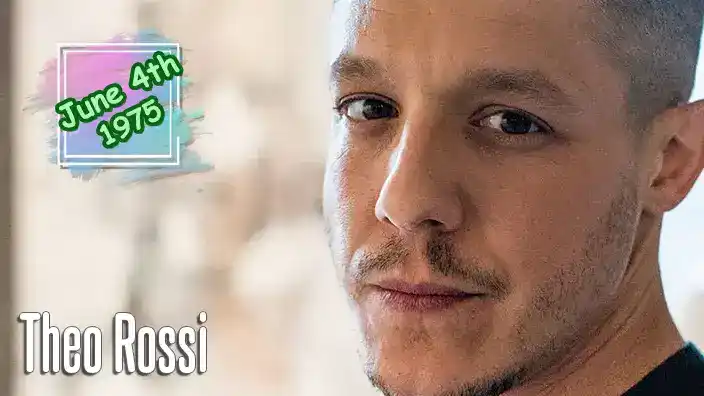
If you only knew Theo Rossi from his toughest roles, you’d assume he spends his free time glowering in dark corners and delivering intense monologues to passing strangers. In reality, he’s more likely to be out running a charity race, helping a nonprofit, or wrangling kids at home. It’s the classic actor’s paradox: the man who plays some of television’s most troubled characters is probably the one at the neighborhood barbecue reminding everyone to drink water and stretch before the softball game.
June 4, 1975, in Staten Island, New York
Trivia
- Theo Rossi's full name is John Theodore Rossi. He is of Italian and Spanish descent.
- He is a graduate of the Lee Strasberg Theatre and Film Institute in New York City, where he honed his acting skills.
- Rossi is an advocate for animal rights and often promotes adoption and rescue efforts through his social media platforms.
- He has appeared in various independent films, showcasing his willingness to take on diverse and challenging roles.
- Rossi has a distinctive collection of tattoos, many of which hold personal significance and reflect his life experiences.

- Details
- Category: Celebrity Birthdays - June
Ryan McCartan has the kind of career that makes you wonder if he secretly spins a giant “talent wheel” every morning. Acting? Sure. Singing? Of course. Broadway? Why not. One day he’s on a Disney set, the next he’s belting out show tunes in front of a packed theater, and somewhere in between he’s probably doing push-ups and scouting the nearest taco truck. If multitasking were an Olympic sport, Ryan would already have a gold medal—and he’d be celebrating it with extra salsa.
June 14, 1993, in Excelsior, Minnesota
Trivia
- Born in Excelsior, Minnesota.
- Starred as Diggie on Liv and Maddie.
- Played Fiyero on Broadway in Wicked.
- Appeared in The Rocky Horror Picture Show TV remake.
- Formerly part of the duo The Girl and the Dreamcatcher.
- Enjoys fitness and outdoor activities.
- Big fan of tacos.

- Details
- Category: Celebrity Birthdays - June
Paul McCartney has reached that rare level of fame where he can walk into a room, hum a random tune, and there’s a good chance it will turn into a classic. Most people spend years trying to write one decent song, while Paul casually stacked up hits like he was collecting coupons. Somewhere in the world, there’s probably a notebook he forgot about in 1965 that contains three melodies good enough to top the charts today. And while the rest of us complain about standing too long at the grocery store, he’s still out there performing three-hour concerts, waving to the crowd like, “Alright, just one more before tea.”
June 18, 1942, in Liverpool, England
Trivia
- He wrote the melody for “Yesterday” in a dream and reportedly woke up thinking he’d accidentally copied it from someone else.
- “Yesterday” has become one of the most covered songs in music history.
- He is one of the best-selling songwriters of all time, with more than 100 million singles sold as part of the Beatles.
- McCartney is the only artist to be inducted into the Rock and Roll Hall of Fame twice—once with the Beatles and once as a solo artist.
- He has performed for audiences that include British royalty, American presidents, and millions of fans at major global events.
- He was knighted in 1997, officially becoming Sir Paul McCartney.
- His song “Mull of Kintyre” became one of the best-selling singles in UK history.

- Details
- Category: Celebrity Birthdays - June
Dave Navarro looks like the kind of guy who could either headline a rock festival or quietly run a very stylish haunted bookstore. With his tattoos, dark clothing, and ever-present guitar, he gives off the vibe of someone who definitely knows a few secret chords that shouldn’t be played after midnight. Yet, despite the mysterious rock-star aura, he often comes across as surprisingly calm and thoughtful—like the cool older cousin who shows up at family gatherings, brings the best music, and somehow makes even the potato salad seem a little more rebellious.
June 7, 1967, in Santa Monica, California
Trivia
- He hosted the tattoo competition show Ink Master for many seasons.
- He is an avid collector of vintage guitars.
- His memoir Don’t Try This at Home details his life, struggles, and recovery.
- He has appeared in numerous reality shows and documentaries.
- He is known for his extensive tattoo collection, each with personal meaning.
- He briefly performed with Guns N’ Roses in the late 1990s.
- He has a strong interest in photography and visual art.
- Jane’s Addiction helped inspire the creation of the Lollapalooza music festival.

- Details
- Category: Celebrity Birthdays - June
Isabella Rossellini has the rare ability to glide into a room looking like she just stepped off a Renaissance painting, then casually start explaining the mating habits of snails with the enthusiasm of a science teacher on double espresso. One minute she’s the elegant daughter of Hollywood royalty, the next she’s in a short film dressed as an insect, proving that true sophistication includes a healthy sense of humor—and possibly antennae. It’s hard to say what’s more impressive: her film career, her fashion history, or the fact that she can make the love life of a beetle sound like a romantic epic.
June 18, 1952, in Rome, Italy
Trivia
- She is the daughter of legendary actress Ingrid Bergman and Italian director Roberto Rossellini.
- Isabella grew up speaking multiple languages, including Italian, French, and English.
- She worked as a fashion model before becoming an actress and became the face of Lancôme cosmetics for many years.
- She starred in David Lynch’s cult classic Blue Velvet (1986), one of her most famous film roles.
- She created and starred in the quirky short-film series Green Porno, which humorously explores animal mating habits.
- Isabella is also a trained ethologist and has studied animal behavior.
From Our Marks Catelog
-

Pizza is the ultimate customizable dish. It caters to all, from the staunch meat-lover who wants...
-

Your toes don't ask for much. They spend their days squeezed into shoes, dodging coffee tables,...
-

You’re trying to relax after a long day, but your dog has decided that now is the perfect time to...
-
Tiny, shiny, and unapologetically bold, these little fish have a knack for stealing the show at...
-

Horses are the comedians of the animal world, even if they don’t realize it. From sneaky maneuvers...
-
Some cars are built to get you from point A to point B. The Pink Cadillac was built to make sure...


