We've been busy making Mark The Day easier to navigate, mainly because we realized that finding a particular celebration among thousands of articles was beginning to resemble an archaeological expedition. You knew what you were looking for was in there somewhere, but finding it occasionally required patience, determination, and possibly a packed lunch.
Well, put away the shovel! We've introduced our brand-new Interactive Celebration Calendar, designed to help you discover what's happening on any day of the year without having to dig through mountains of information. Simply select a month, click a date, and there they are — holidays, celebrations, unusual observances, and all manner of excuses to do something you probably weren't planning to do when you got out of bed.
So go ahead, pick a date and see what you discover. With Mark The Day's new Interactive Calendar, finding something worth celebrating is easier than ever. And unlike your car keys, reading glasses, or that screwdriver you put down thirty seconds ago, everything is exactly where you expect it to be!
Explore celebrations currently listed for each date. Some observances change dates from year to year.
These observances are associated with July; weekly dates may vary.
Imagine you’re calmly sitting on your porch, sipping iced tea, when you notice a towering wall of...
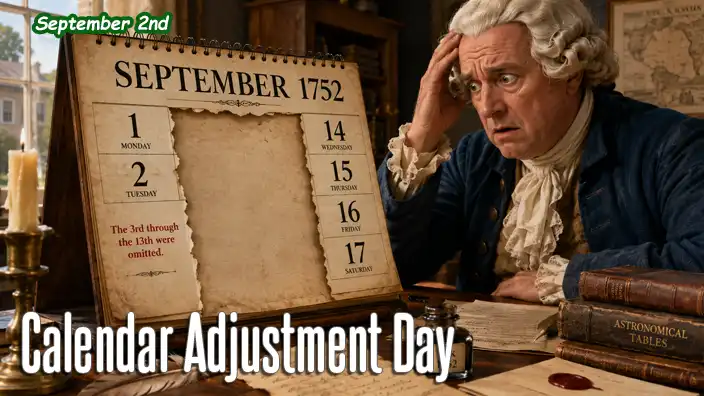
Ever wish you could skip a few days and catch up on life? In 1752, Great Britain and its American...
Cheese is proof that milk didn’t quit when it curdled—it evolved. From the crumbly rebellion of blue...
Capturing the perfect moment often feels like trying to herd cats—no matter how much you prepare,...
Imagine a world where lattes are the currency. Suddenly, coffee shops become banks, baristas are the new...
Without them, our lives would be a never-ending scavenger hunt for wall outlets and extension cords...
On October 17, 1835, as tensions between Texas settlers and the Mexican government escalated into open rebellion, Texan leaders approved a resolution establishing a mounted frontier defense force that would become the legendary Texas Rangers. The original assignment was to patrol and protect settlements between the Brazos and Trinity rivers, where isolated communities faced considerable dangers and had little access to organized protection. Although groups of frontier rangers had operated in Texas since 1823, this decision marked an important step toward formally recognizing the force. Following Texas's independence from Mexico in 1836, the Rangers continued serving the new republic, protecting settlements, confronting Mexican incursions, and participating in conflicts with Native American nations.
The early Texas Rangers were a far cry from the uniformed officers familiar today. These frontier volunteers generally supplied their own horses, firearms, and equipment, operating across enormous stretches of territory with limited supervision. Their duties shifted between military operations, frontier patrols, and criminal investigations, depending on the circumstances. Over time, they developed a formidable reputation for tracking fugitives, pursuing cattle rustlers, and confronting notorious outlaws, including John Wesley Hardin and King Fisher. Their history, however, was not entirely heroic. Ranger campaigns against Native Americans and Mexican communities included episodes of brutality and serious abuses of authority, leaving a complicated legacy alongside their celebrated law enforcement achievements.
By the early twentieth century, the Rangers were still policing remote communities, border regions, and rapidly expanding oil towns, but accusations of excessive force and misconduct prompted growing demands for reform. Investigations and political pressure gradually brought changes to the organization, culminating in a major restructuring in 1935, when the Rangers became part of the newly established Texas Department of Public Safety. This transformation helped turn a loosely organized frontier force into a professional statewide law enforcement agency. The Texas Rangers remain an enduring symbol of Texas history, although their story contains considerably more complexity than the familiar image of a lone lawman riding into town to straighten everything out.
On October 17, 1931, notorious Chicago gangster Al Capone was found guilty of federal income tax evasion, bringing an extraordinary criminal career to an unexpectedly ordinary conclusion. Born in Brooklyn, New York, in 1899 to Italian immigrant parents, Alphonse Gabriel Capone became involved in street gangs during his youth and acquired the nickname “Scarface” after a knife attack left permanent scars on his face. He eventually moved to Chicago, where he joined the criminal organization operated by Johnny Torrio. When Torrio retired in 1925, Capone assumed control of an expanding empire built on illegal liquor distribution, gambling, prostitution, and organized violence. Prohibition had created a thriving underground alcohol market, and Capone was more than willing to supply the merchandise, provided nobody objected to his rather unconventional business practices.
Throughout the 1920s, Capone accumulated enormous wealth and influence while Chicago endured bloody confrontations between rival criminal organizations. His operation relied on intimidation, political corruption, and violence to protect its lucrative activities. The infamous St. Valentine's Day Massacre of February 14, 1929, in which seven men associated with a rival gang were murdered, intensified public outrage and brought greater federal attention to organized crime. Although Capone was widely suspected of involvement, he was never convicted in connection with the killings. Federal prohibition agent Eliot Ness and his celebrated team, the Untouchables, targeted Capone's illegal alcohol operations, but investigators working on his finances ultimately secured the conviction that his more violent activities had failed to produce. On October 24, 1931, Capone received an 11-year federal prison sentence, a $50,000 fine, and additional financial penalties. For a man who had spent years outmaneuvering rival gangsters and law enforcement officers, being defeated by the Internal Revenue Service was a particularly expensive lesson in bookkeeping.
Capone initially served his sentence at the federal penitentiary in Atlanta before being transferred to Alcatraz Island in 1934, where his influence and privileges were considerably reduced. His health deteriorated during imprisonment, particularly because of complications from syphilis, and he was released in November 1939 after serving approximately seven and a half years. He spent his remaining years largely withdrawn from public life at his Florida residence on Palm Island, where he died on January 25, 1947. Capone's conviction became a landmark in the federal government's campaign against organized crime, demonstrating that financial investigations could succeed where traditional criminal prosecutions had struggled. The gangster who had survived Chicago's violent underworld was ultimately brought down by something far less glamorous than a rival mob boss: unpaid taxes.
On October 17, 1989, at 5:04 p.m. Pacific time, a powerful magnitude 6.9 earthquake struck Northern California, shaking the San Francisco Bay Area and leaving widespread destruction in its wake. Known as the Loma Prieta earthquake, the disaster originated along the San Andreas Fault system in the Santa Cruz Mountains, approximately 60 miles south of San Francisco. The timing was extraordinary: baseball fans were preparing to watch Game 3 of the World Series between the San Francisco Giants and Oakland Athletics at Candlestick Park. Television cameras were already broadcasting when the ground began shaking, bringing the disaster into homes across America. Although the stadium survived without catastrophic damage, buildings, highways, and bridges elsewhere were far less fortunate. The earthquake claimed 63 lives, injured thousands, and caused billions of dollars in property damage, demonstrating once again that California's famous fault lines were not merely interesting features on a geological map.
Among the most devastating scenes was the collapse of a section of the double-deck Cypress Street Viaduct on Interstate 880 in Oakland, where the upper roadway crashed onto traffic below, killing 42 people. A section of the San Francisco–Oakland Bay Bridge also failed, resulting in one death and temporarily severing a vital transportation connection. San Francisco's Marina District suffered extensive destruction as unstable landfill underwent liquefaction, causing buildings to shift, collapse, or become dangerously unstable. Broken gas lines ignited fires, while damaged water systems complicated firefighting efforts. Communities closer to the earthquake's epicenter, including Santa Cruz and Watsonville, experienced severe structural damage, particularly among older buildings that lacked adequate earthquake reinforcement. In Watsonville, many Latino residents also encountered language barriers while seeking emergency assistance, highlighting the importance of accessible disaster relief services.
The Loma Prieta earthquake exposed serious weaknesses in Northern California's aging infrastructure and accelerated efforts to improve earthquake preparedness. Older masonry buildings, elevated highways, and structures built on unstable ground proved especially vulnerable, reinforcing the need for stronger construction standards and seismic retrofitting. The disaster also prompted major changes to transportation infrastructure, emergency response planning, and public awareness of earthquake hazards. Although the destruction was enormous, the timing may have prevented an even greater tragedy: many commuters had left work early to watch the World Series, reducing traffic on roads that subsequently collapsed. The earthquake remains one of California's most consequential modern natural disasters, serving as a sobering reminder that while scientists can identify earthquake-prone regions, convincing the ground to behave itself remains considerably beyond human capabilities.