Where Did Eleven Days Go?
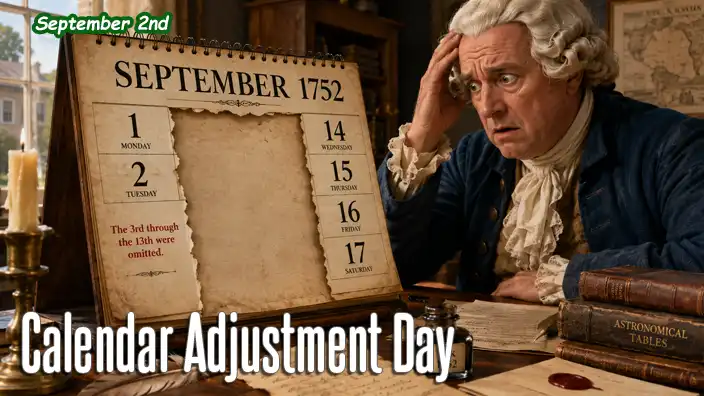
Most people occasionally lose track of time. You misplace an afternoon, forget what day it is, or suddenly realize it's already September. But imagine going to bed on September 2 and waking up on September 14.
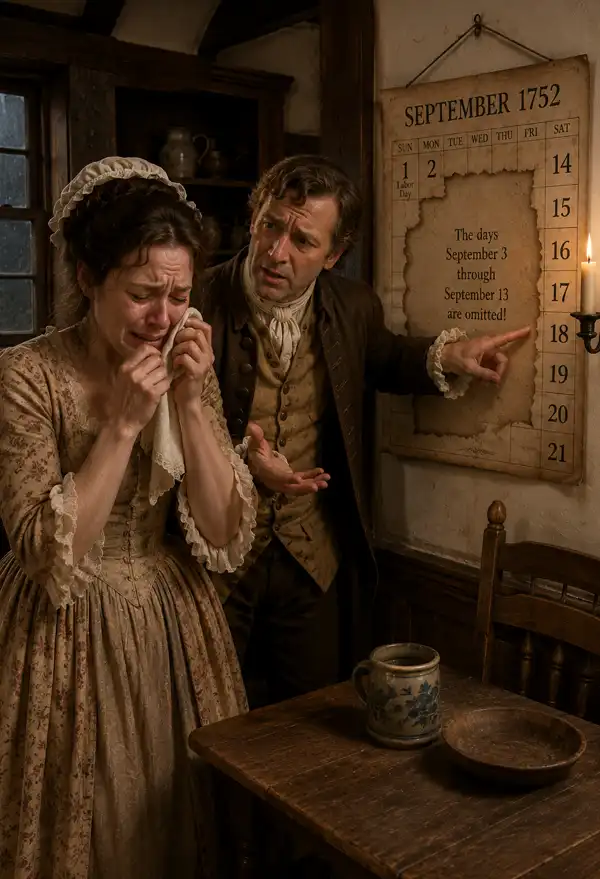
That is exactly what happened in Great Britain and its American colonies in 1752 when the government adopted the Gregorian calendar. To correct centuries of accumulated error in the older Julian calendar, eleven days were removed from the month of September. The day after September 2 became September 14, and a nation collectively lost nearly two weeks overnight.
Calendar Adjustment Day, observed annually on September 2, commemorates this unusual moment in history. It serves as a reminder that calendars are not simply pages hanging on a wall. They are carefully designed systems that occasionally require adjustments to stay aligned with the Earth's journey around the Sun. Fortunately for us, modern calendar corrections are much less dramatic than erasing eleven days and hoping everyone keeps up.
What Is Calendar Adjustment Day?
Calendar Adjustment Day is a historical observance that celebrates one of the most significant calendar reforms ever implemented in the English-speaking world. While it may sound like the sort of event only accountants and historians would get excited about, the day marks a change that affected every person in Great Britain and its American colonies.
The observance recognizes the importance of accurate timekeeping and the surprisingly complicated challenge of matching human calendars to the movements of the Earth and Sun. As simple as a calendar may appear, creating one that remains accurate year after year has challenged astronomers, mathematicians, and governments for thousands of years.
Today, Calendar Adjustment Day serves as a reminder that many things we take for granted—dates, seasons, holidays, and even birthdays—depend on a calendar system that has been carefully refined over centuries. Without occasional corrections and reforms, spring would gradually drift toward summer, summer toward autumn, and eventually Christmas sweaters might become beachwear.
More than anything, the day highlights humanity's ongoing effort to bring order to the passage of time. It's a celebration of precision, practicality, and the rare moment when an administrative adjustment became memorable enough to earn its own place on the calendar.
Which is rather fitting when you think about it. Most calendar changes are quickly forgotten. This one became a day worth remembering.
Why the Calendar Needed Fixing
The problem with calendars is that the Earth stubbornly refuses to orbit the Sun in a nice, tidy number of days. If a year lasted exactly 365 days, life would be wonderfully simple. Unfortunately, nature rarely consults mathematicians before making important decisions.
Under the Julian calendar, introduced by Julius Caesar in 45 BC, a year was calculated as 365.25 days long. To account for the extra quarter day, a leap day was added every four years. It was an impressive improvement for its time and served much of Europe for more than 1,600 years. There was just one small problem. The actual solar year is slightly shorter than 365.25 days. The difference amounts to only about eleven minutes each year, which sounds insignificant until you remember that calendars don't get to start over every January with a clean slate.
Those extra minutes accumulated century after century. By the 1700s, the calendar had drifted by approximately eleven days. Astronomers, religious leaders, and governments noticed that important dates tied to the seasons were no longer occurring when they should. Spring was still arriving on schedule; the calendar was the thing getting confused. The Gregorian calendar solved this problem by slightly adjusting the rules for leap years. Most years divisible by four remain leap years, but century years are treated differently unless they are also divisible by 400. It sounds complicated because, frankly, it is. Timekeeping is one of those subjects that becomes increasingly complicated the moment someone says, "Let's keep this simple."
The important thing is that the new system was far more accurate. The challenge was convincing entire countries to switch to it. As history would soon demonstrate, fixing the calendar turned out to be much easier than explaining the fix to everyone else.
The Switch from Julian to Gregorian
By the middle of the eighteenth century, Great Britain found itself in an awkward position. Much of Europe had already adopted the Gregorian calendar, while Britain and its colonies continued using the older Julian system. This meant that dates in Britain were now eleven days behind those used by many of its neighbors.
For merchants, diplomats, sailors, and anyone conducting international business, the situation could be frustrating. Imagine arranging a meeting with someone in France only to discover that the two of you were technically living on different dates. It was rather like showing up for an appointment and finding out your calendar and theirs were having an argument.
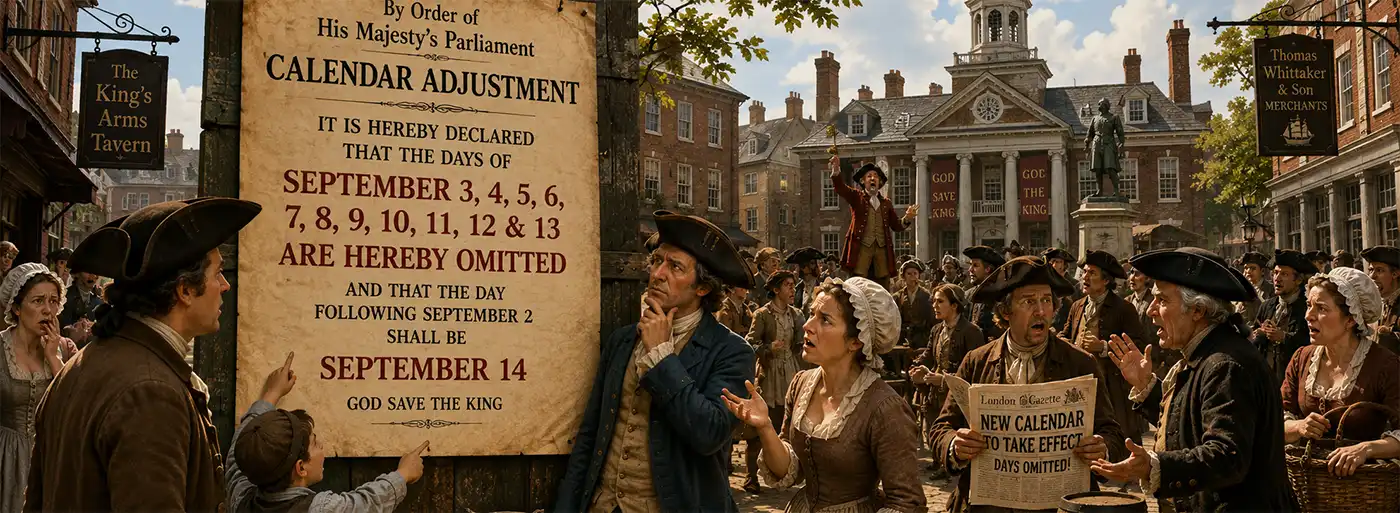
The Gregorian calendar had been introduced by Pope Gregory XIII in 1582 to correct the growing inaccuracies in the Julian calendar. Many Catholic countries adopted the new system quickly, but Protestant nations were slower to follow. Religious tensions of the era meant that some governments were not especially eager to embrace a calendar associated with the Pope, even if the mathematics made perfect sense, but eventually, practicality won the debate. In 1751, Parliament passed the Calendar (New Style) Act, setting the stage for the transition. The following year, Britain and its American colonies officially adopted the Gregorian calendar.
The change involved more than simply skipping eleven dates. Another adjustment affected the beginning of the legal year. Under the old system, the new year officially began on March 25, known as Lady Day. With the reform, January 1 became the official start of the year, bringing Britain into line with much of Europe.
The transition was remarkably successful. Businesses adapted, governments updated their records, and everyday life continued with surprisingly little disruption. Despite the confusion that must have accompanied the change, people quickly learned that the Sun still rose in the east, dinner still arrived at the usual time, and taxes remained just as unavoidable as before.
In the end, the switch to the Gregorian calendar was one of history's most successful administrative updates. It corrected centuries of accumulated error and helped synchronize Britain with much of the world—although it probably generated a mountain of paperwork large enough to blot out the Sun.
The Mystery of the Missing Eleven Days
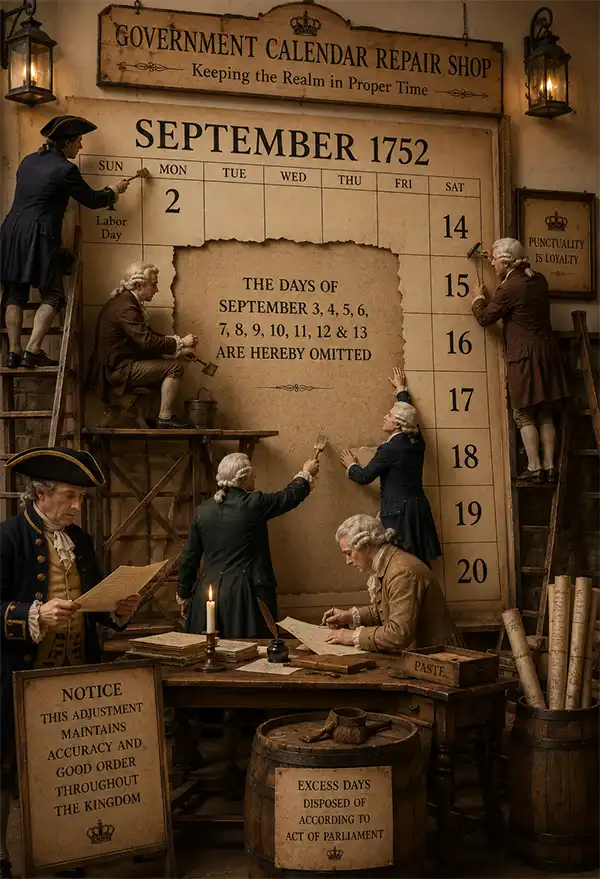
The most famous part of Britain's calendar reform is the eleven dates that seemingly vanished in September 1752. According to the new calendar, Wednesday, September 2 was immediately followed by Thursday, September 14. On paper, eleven dates had disappeared overnight. Naturally, this led to confusion, questions, and no shortage of grumbling. After all, people organize their lives around dates. Birthdays, anniversaries, court appearances, business contracts, and rent payments all depend on knowing exactly where you are on the calendar.
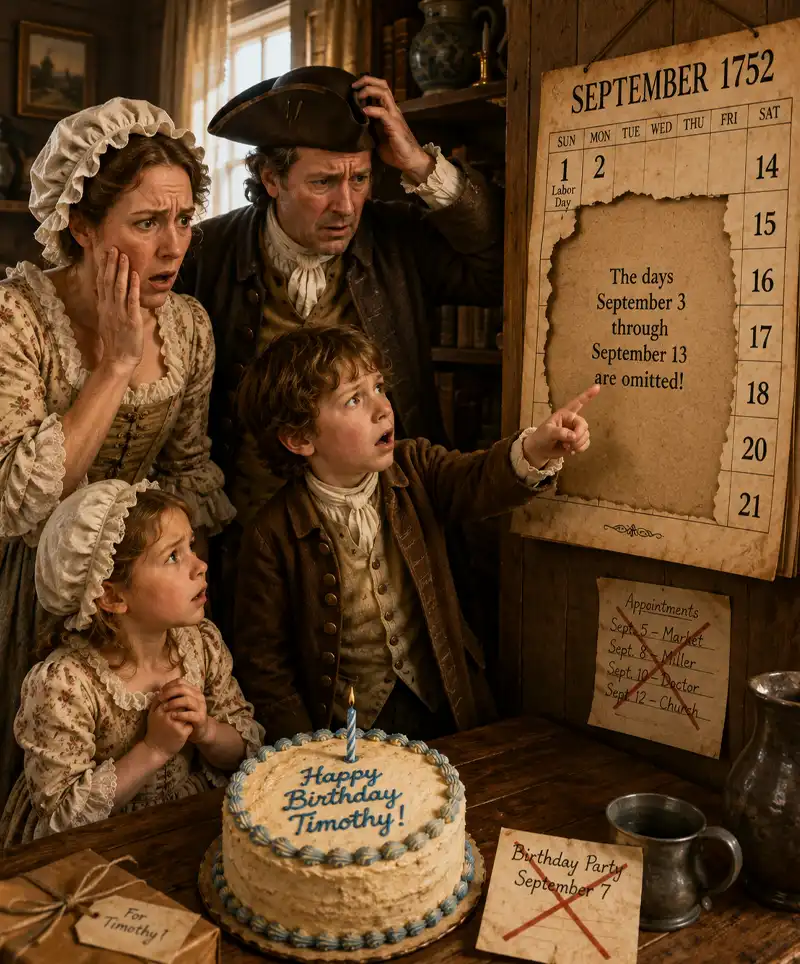
The good news is that nobody actually lost eleven days of their life. The Earth continued orbiting the Sun, clocks kept ticking, and people still had breakfast, lunch, and dinner every day. The only thing that changed was the numbering assigned to those days. The dates disappeared; the days themselves carried on as usual. That said, some people undoubtedly had legitimate complaints. Imagine discovering that your birthday was scheduled to occur on September 8, a date that no longer existed that year. Did you celebrate early? Celebrate late? Demand two birthdays to compensate? Reparations? History is frustratingly silent on this important question.
Anniversaries may have caused similar headaches. One can imagine a husband explaining, "I didn't forget our anniversary. Parliament moved it." Whether that excuse improved the situation is equally absent from the historical record.
Businesses also had to adapt. Contracts, payment schedules, and official records all required adjustment. Fortunately, most people understood that the purpose of the reform was to correct the calendar rather than provide a convenient way to avoid paying debts for eleven days.
One of the most enduring stories surrounding the reform is the famous slogan, "Give us our eleven days!" While the phrase became widely associated with the calendar change, historians continue to debate how widespread such protests actually were. It appears that later political cartoons may have helped turn a few complaints into a much larger legend.
Today, the missing eleven days remain one of history's most unusual calendar curiosities. They serve as a reminder that something as ordinary as a date can become surprisingly complicated when mathematics, astronomy, politics, and human nature all decide to occupy the same page on the calendar.
And if you've ever forgotten a birthday or anniversary, take comfort in knowing that at least you didn't have to explain that the date had been removed by an Act of Parliament.
How the Gregorian Calendar Works Today
The Gregorian calendar introduced in the sixteenth century is still the calendar used by most of the world today. While it may look simple hanging on a kitchen wall, it is actually a carefully engineered system designed to keep our dates aligned with the Earth's orbit around the Sun.
Like the older Julian calendar, the Gregorian calendar uses leap years to account for the fact that a solar year is slightly longer than 365 days. Most years contain 365 days, while leap years contain 366. The extra day is added to February, giving us February 29 every four years. However, the Gregorian calendar adds an important twist. Years divisible by 100 are not leap years unless they are also divisible by 400. That means 1700, 1800, and 1900 were not leap years, while 2000 was. If your eyes glazed over while reading that sentence, you're not alone. Generations of students have had the same reaction.
These special rules make the Gregorian calendar remarkably accurate. The calendar year averages 365.2425 days, which is extremely close to the actual solar year of approximately 365.2422 days. At that rate, the calendar drifts by only about one day every 3,300 years.
In practical terms, that means the seasons stay where they belong. Spring remains in spring, summer remains in summer, and Christmas continues arriving at the same inconvenient speed every year.
Modern timekeeping still requires occasional fine-tuning. Scientists have sometimes added leap seconds to keep highly precise clocks synchronized with the Earth's slightly irregular rotation. Fortunately, these adjustments are measured in seconds rather than days, which means nobody wakes up to discover that next Tuesday has been moved to next month.
For most of us, the Gregorian calendar does its job so well that we rarely think about it. Yet every date we write, every holiday we celebrate, and every birthday we remember depends on a system refined over centuries by astronomers, mathematicians, and people who apparently enjoyed arguing about calendars.
Given the alternatives, it's probably best not to complain about February having only 28 days.
Surprising Calendar Facts
Most of us glance at a calendar every day without giving it a second thought. Yet calendars are packed with oddities, historical quirks, and enough strange facts to make even the most organized planner scratch their head.
- Britain once had its shortest year on record. In 1752, the omission of eleven calendar dates made the year feel considerably shorter than usual. No, people didn't age more slowly, but anyone waiting for their birthday may have felt slightly cheated.
- January 1 wasn't always New Year's Day. Before calendar reforms, the legal new year in Britain began on March 25, known as Lady Day. Imagine writing checks in February and having to remember you were technically still in the previous year.
- Leap years aren't as simple as they seem. Most people know a leap year happens every four years, but century years are only leap years if they can be divided by 400. That's why 2000 was a leap year while 1900 was not. Somewhere, a mathematics teacher is very pleased by this fact.
- The Gregorian calendar is incredibly accurate. It would take more than 3,000 years for the calendar to drift by a single day relative to the solar year. That's a level of long-term planning most homeowners never achieve.
- Not every country adopted the Gregorian calendar at the same time. Different nations made the switch over several centuries, which occasionally created confusion when comparing dates in historical records.
- Some calendars have thirteen months. Several cultures and organizations have experimented with calendars containing thirteen equal months of twenty-eight days each. While mathematically neat, they never gained widespread acceptance. People can be surprisingly attached to the calendars they already complain about.
- Leap seconds have occasionally been added to official timekeeping. These tiny adjustments help keep atomic clocks aligned with the Earth's rotation. Fortunately, they are measured in seconds rather than days, which keeps the paperwork manageable.
- The ancient Romans had a calendar with only ten months. Early Roman calendars began in March and ended in December. The months of January and February were added later, proving that even ancient civilizations occasionally looked at their calendars and thought, "This could use some work."
- The names of several months no longer match their numbers. September comes from the Latin word for seven, October for eight, November for nine, and December for ten. They made perfect sense before January and February were inserted into the calendar. History has been confusing people ever since.
- The world has used hundreds of different calendars. Throughout history, civilizations have developed calendars based on the Sun, the Moon, or a combination of both. Humanity has spent thousands of years trying to answer one surprisingly difficult question: "What day is it?"
The next time you glance at a calendar, remember that it represents centuries of astronomy, mathematics, politics, and occasional confusion. Keeping track of time sounds simple until you actually try doing it.
Ways to Celebrate Calendar Adjustment Day
Calendar Adjustment Day may not come with fireworks, parades, or giant cakes shaped like clocks, but there are plenty of entertaining ways to mark this unusual piece of history. After all, any observance based on eleven missing calendar dates deserves at least a little recognition.
- Check Your Calendar
Start by taking a moment to appreciate the calendar hanging on your wall, sitting on your desk, or glowing from your phone screen. Most of us rely on calendars every day without giving much thought to the centuries of effort that went into making them accurate. - Learn About Calendar History
Explore the fascinating story of how different civilizations measured time. From Roman calendars and lunar calendars to the Gregorian system we use today, humanity has spent thousands of years trying to organize days, months, and years into something that makes sense. - Find Your "Missing" Birthday
For a bit of fun, see where your birthday would have fallen during Britain's 1752 calendar adjustment. If you happened to be born between September 3 and September 13, congratulations—you've just discovered a historical excuse for celebrating your birthday whenever you feel like it. - Organize Your Schedule
Since the day celebrates keeping calendars in order, it's the perfect excuse to tidy your planner, update your calendar, schedule appointments, or finally write down those dates you've been trying to remember. Future-you will be grateful. - Visit a Historical Site
Many museums, libraries, and historical societies have exhibits related to local history, astronomy, navigation, or timekeeping. You might be surprised how much effort humanity has invested in answering the seemingly simple question, "What day is it?" - Watch the Clock
Spend a few moments appreciating how precisely modern timekeeping works. Between atomic clocks, satellites, and highly accurate calendars, today's systems make the calendar reform of 1752 look like a giant software update performed with quill pens. - Share a Calendar Fact
Tell friends or family about the missing eleven dates, leap years, or why September is named after the number seven even though it's the ninth month. Whether they find the information fascinating or begin quietly backing away is entirely up to them. - Declare an Extra Day
If you're feeling particularly adventurous, borrow a page from history and announce your own calendar adjustment. Perhaps today has been cancelled due to rain, excessive heat, or a shortage of motivation. Just don't expect your employer, bank, or tax office to recognize the change.
The best way to celebrate Calendar Adjustment Day is simply to appreciate the remarkable system that keeps our lives organized. It may not be perfect, but considering the alternatives, the calendar does a surprisingly good job of keeping humanity on the same page.
Calendar Adjustment Day FAQ
Calendars may seem straightforward, but their history is surprisingly complicated. Calendar Adjustment Day commemorates one of the most unusual changes ever made to the calendar, and it often raises plenty of questions. Here are some of the most common.
When is Calendar Adjustment Day?
Calendar Adjustment Day is observed annually on September 2.
What is Calendar Adjustment Day?
Calendar Adjustment Day commemorates the adoption of the Gregorian calendar by Great Britain and its American colonies in 1752. The change corrected errors that had accumulated in the older Julian calendar.
Why were eleven days removed from the calendar?
The Julian calendar was slightly longer than the actual solar year. Over many centuries, this small difference caused the calendar to drift out of alignment with the seasons. Eleven calendar dates were omitted in September 1752 to restore accuracy.
Did people actually lose eleven days of their lives?
No. Time continued normally, and the Earth kept orbiting the Sun. Only the calendar dates changed. The days themselves still occurred; they were simply assigned different dates.
What happened after September 2, 1752?
In Great Britain and its American colonies, September 2, 1752, was followed by September 14, 1752. The dates September 3 through September 13 were omitted from the calendar.
What is the difference between the Julian and Gregorian calendars?
The Gregorian calendar uses more precise leap-year rules than the Julian calendar, making it much more accurate over long periods of time and helping keep the calendar aligned with the solar year.
Why did Britain wait so long to adopt the Gregorian calendar?
Many European countries adopted the Gregorian calendar shortly after its introduction in 1582. Britain delayed the change for more than 170 years due to political, religious, and administrative considerations.
Is the Gregorian calendar still used today?
Yes. The Gregorian calendar is the most widely used civil calendar in the world and remains the standard calendar for most countries.
Are leap years part of the Gregorian calendar?
Yes. Leap years help keep the calendar synchronized with the Earth's orbit around the Sun. Most years divisible by four are leap years, with special exceptions for certain century years.
How can I celebrate Calendar Adjustment Day?
You can celebrate by learning about calendar history, exploring the 1752 calendar reform, organizing your schedule, visiting a museum, sharing interesting calendar facts, or simply appreciating the system that keeps track of the days, months, and years.
Will we ever need another eleven-day calendar adjustment?
Probably not. The Gregorian calendar is extremely accurate and would take more than 3,000 years to drift by a single day. Any future adjustments are likely to be much smaller and considerably less dramatic.
One More Day Before You Go
Calendar Adjustment Day celebrates a moment when governments, astronomers, and mathematicians came together to solve a problem that most people didn't even realize existed. While the solution may have seemed unusual—simply removing eleven calendar dates—it helped create the accurate system we continue to rely on today.
The story serves as a reminder that calendars are more than just tools for tracking appointments and remembering birthdays. They represent centuries of observation, calculation, debate, and occasional compromise, all designed to keep human timekeeping aligned with the natural world.
Perhaps the most remarkable thing about the 1752 adjustment is how ordinary it feels now. What was once a major reform has become a curious historical footnote, while the Gregorian calendar quietly continues doing its job day after day, year after year.
So, as September 2 rolls around, take a moment to appreciate the calendar hanging on your wall, sitting on your desk, or glowing from your phone screen. It may not be perfect, but it has done a remarkably good job of keeping us all on the same page for centuries.
And if you ever find yourself running behind schedule, remember the lesson of Calendar Adjustment Day: sometimes the easiest way to fix a problem is simply to skip ahead. Unfortunately, your boss, your spouse, and the tax authorities may not be quite as understanding as Parliament was in 1752.