August 21, 1936, in Philadelphia, Pennsylvania
 October 12, 1999, in Bel-Air, California
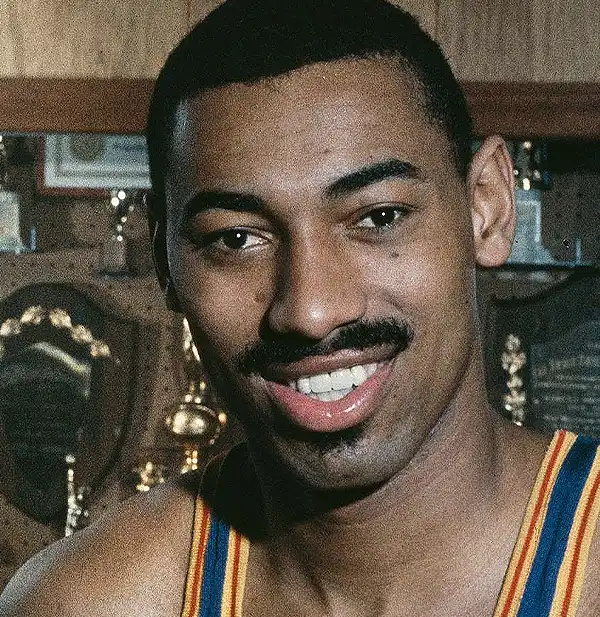
Wilt Chamberlain was 7 feet 1 inch tall, astonishingly strong, remarkably athletic and so dominant that basketball occasionally responded by changing its rules. He scored 100 points in one NBA game, averaged more than 50 points for an entire season and once collected 55 rebounds in a single night. If Wilt had appeared in a basketball movie, audiences might have complained that the writers had made the character completely unrealistic. Fortunately, he did it for real, so the statisticians simply had to find larger columns.
Wilton Norman Chamberlain was born on August 21, 1936, in Philadelphia, Pennsylvania, one of nine children in a working-class family. Surprisingly, basketball was not his first great sporting interest. As a youngster he preferred track and field and reportedly regarded basketball as something of a game for weaklings. Then he grew. And grew. And continued growing until ignoring basketball became rather like owning a racehorse and refusing to let it run. By the time Chamberlain attended Overbrook High School in Philadelphia, his extraordinary combination of height, strength and athletic ability had turned him into one of the most sought-after young basketball players in America.
At Overbrook, Chamberlain became a schoolboy sensation, scoring at a rate that foreshadowed the numerical absurdity of his professional career. Major colleges competed intensely to recruit him, and he ultimately chose the University of Kansas. Because NCAA rules at the time prohibited freshmen from playing varsity basketball, Chamberlain spent his first college year on the freshman team. His arrival nevertheless created enormous interest, and when he finally joined the varsity Jayhawks for the 1956–57 season, he immediately demonstrated why. Kansas reached the NCAA championship game, where North Carolina defeated the Jayhawks 54–53 in triple overtime. Despite the loss, Chamberlain was named the tournament's Most Outstanding Player.
College basketball presented Chamberlain with a problem that would follow him throughout his career: opponents often designed their entire strategy around stopping him. Teams slowed games, surrounded him with defenders and sometimes seemed more interested in preventing Chamberlain from touching the ball than actually playing conventional basketball. Frustrated by the style of play and unable to enter the NBA until his college class was eligible, Chamberlain left Kansas after his junior season and joined the Harlem Globetrotters for the 1958–59 season.
The Globetrotters might seem an unusual stop for one of basketball's greatest competitors, but Chamberlain later spoke fondly of the experience. He traveled extensively, entertained enormous crowds and played alongside some superb basketball talent. The experience also showcased an aspect of his personality that raw statistics often obscure: Chamberlain enjoyed entertaining people. He could be imposing and intensely competitive on the court, but he also possessed charisma, humor and a flair for spectacle. Spending a season with the world's most famous basketball entertainers was not such a strange fit after all.
Chamberlain entered the NBA in 1959 with his hometown Philadelphia Warriors, and the league immediately discovered that it had a problem. As a rookie he averaged an astonishing 37.6 points and 27 rebounds per game. He was named both Rookie of the Year and NBA Most Valuable Player, becoming only the second player in league history to win MVP as a rookie. Most players spend their first professional season adjusting to stronger, faster competition. Wilt apparently decided that the competition needed to adjust to him.
His numbers became even more ridiculous from there. During the 1960–61 season, Chamberlain averaged 38.4 points and 27.2 rebounds per game. Then came 1961–62, one of the most extraordinary individual seasons in the history of professional sports. Chamberlain averaged 50.4 points and 25.7 rebounds per game, scored more than 4,000 points and averaged 48.5 minutes per game. Regulation NBA games last only 48 minutes, but Chamberlain played virtually every available minute and accumulated additional playing time through overtime. He missed only eight possible minutes during the entire regular season. Apparently even the bench had difficulty getting an appointment with him.
And then came March 2, 1962.
The Philadelphia Warriors were playing the New York Knicks in Hershey, Pennsylvania, before a crowd of just 4,124 spectators. Nothing about the setting suggested that one of the most famous events in basketball history was about to occur. The game was not nationally televised, and no complete video recording of it exists. What survives is radio audio from part of the contest, photographs, eyewitness accounts and a box score containing a number that still looks ridiculous more than six decades later.
Chamberlain scored 23 points in the first quarter and had 41 by halftime. He added 28 in the third quarter, bringing him to 69, and by then the crowd understood what might be happening. Philadelphia began deliberately feeding Chamberlain the ball while New York attempted to keep it away from him. The final minutes became a strange strategic battle, with the Warriors trying to create opportunities for Wilt and the Knicks attempting to prevent the record from happening.
With 46 seconds remaining, Chamberlain scored his 100th point.
The Warriors defeated the Knicks 169–147. Chamberlain had made 36 of 63 field-goal attempts and, remarkably for a player who struggled throughout his career at the foul line, converted 28 of 32 free throws. He also collected 25 rebounds. After the game, Warriors publicist Harvey Pollack wrote “100” on a sheet of paper and handed it to Chamberlain. The photograph of Wilt sitting in the locker room holding that simple handwritten sign became one of the most recognizable images in sports history.
The 100-point record remains untouched. Kobe Bryant came closest for many years with 81 points against Toronto in 2006, but Chamberlain's performance remains alone at the top of the NBA record book. Even more astonishingly, the 100-point game was not some isolated statistical explosion from a player who occasionally got hot. Chamberlain scored 50 or more points 118 times during his career and 60 or more points 32 times. He also owns the NBA single-game rebounding record with 55, set against a Boston Celtics team featuring his greatest rival, Bill Russell.
Russell and Chamberlain became the defining individual rivalry of their era. Chamberlain possessed the more spectacular individual statistics, while Russell's Boston Celtics dominated the championship standings. Russell's teams repeatedly frustrated Chamberlain in the postseason, which helped create the lasting argument over whether individual statistical dominance or championship success should carry greater weight when evaluating greatness. The two men competed ferociously but also developed a friendship away from basketball, adding another dimension to one of the greatest rivalries in sports history.
Chamberlain's extraordinary physical gifts sometimes caused critics to dismiss his accomplishments as merely the inevitable result of being enormous. That overlooks what made him so unusual. Plenty of very tall men have played basketball; very few combined Chamberlain's height with his speed, coordination, stamina and strength. He had been an accomplished track-and-field athlete, competing in sprinting, jumping and throwing events, and his athleticism remained evident throughout his basketball career. Opposing teams frequently resorted to extremely physical defense because ordinary methods simply did not work.
His dominance actually helped change basketball's rules. The lane was widened, offensive goaltending rules were introduced, and regulations involving inbounding and free throws were modified partly in response to what Chamberlain could do. At one point, his athletic ability allowed him to take a running start at the free-throw line and leap toward the basket before releasing the ball. Basketball authorities understandably concluded that perhaps they ought to write something down about that.
Chamberlain moved with the Warriors when the franchise relocated to San Francisco in 1962, but returned to Philadelphia in 1965 when he was traded to the 76ers. There, his game began evolving. He had already proved beyond reasonable argument that he could score whenever he pleased, so he increasingly concentrated on rebounding, defense and passing. During the 1966–67 season, the 76ers produced a 68–13 regular-season record and defeated Russell's Celtics in the Eastern Division Finals before beating the San Francisco Warriors for the NBA championship.
The following season provided another wonderfully Wilt-like response to criticism. Chamberlain had been accused of shooting too much and not involving his teammates sufficiently, so he essentially decided to demonstrate that he could pass too. In 1967–68, he recorded 702 assists, the highest total in the NBA that season, while averaging 8.6 assists per game. A 7-foot-1 center who had previously led the league in scoring seven consecutive times had now become its leader in total assists. Chamberlain seemed to regard conventional basketball limitations as personal challenges.
In 1968, Chamberlain was traded to the Los Angeles Lakers, joining stars Jerry West and Elgin Baylor. The Lakers reached the NBA Finals several times before finally winning the championship in 1972. That team produced a then-record 33-game winning streak and finished the regular season 69–13. Chamberlain, now in his mid-30s and no longer required to carry the scoring burden, concentrated on rebounding and defense. The transformation illustrated an important aspect of his career that can disappear beneath all those scoring records: he adapted his game substantially as his teams and circumstances changed.
Chamberlain retired from the NBA in 1973 after 14 seasons. His career numbers remain staggering: 31,419 points, an average of 30.1 points per game, and 23,924 rebounds, still the most in NBA history. He won four regular-season MVP awards, two NBA championships, seven scoring titles and 11 rebounding titles, and was selected to 13 NBA All-Star Games. He was inducted into the Naismith Memorial Basketball Hall of Fame in 1979.
Life after basketball was hardly quiet. Chamberlain remained a highly recognizable celebrity and pursued numerous interests, including business, volleyball and acting. He became seriously involved with professional volleyball and was inducted into the International Volleyball Hall of Fame for his contributions to the sport. In 1984, he appeared alongside Arnold Schwarzenegger in Conan the Destroyer, playing the warrior Bombaata. Putting Wilt Chamberlain beside Schwarzenegger was one of the relatively few ways Hollywood could make Arnold look as though he had encountered somebody his own size.
Chamberlain also became famous for the stories surrounding his private life, some of which he enthusiastically encouraged. His 1991 autobiography generated enormous publicity after he claimed to have had sexual relationships with approximately 20,000 women. The assertion became one of the most discussed and controversial details associated with him, although there is obviously no practical way to independently verify such a number. It became another example of how Chamberlain's public image often seemed to operate on the same gigantic scale as his basketball statistics.
Yet the fascination with Wilt Chamberlain ultimately returns to the basketball court because so many of his achievements still sound impossible. A 100-point game. Fifty-five rebounds in another. More than 4,000 points in a season. An average of 50.4 points per game. An average of 48.5 minutes when regulation games lasted 48. And, just to demonstrate that scoring was not his only trick, leading the entire league in total assists.
Wilt Chamberlain died on October 12, 1999, at his home in Los Angeles at the age of 63. By then, basketball had changed enormously from the game he entered four decades earlier, and Chamberlain himself had been one of the people responsible for changing it. The sport literally rewrote rules in response to his abilities, while generations of centers who followed were inevitably compared with the enormous man from Philadelphia.
Arguments about the greatest basketball player of all time will continue forever because sports fans require something to do between games. Different eras, rules, teammates and styles make definitive comparisons virtually impossible. But Wilt Chamberlain occupies a category that is almost entirely his own. Other players have won more championships, and some have surpassed portions of his career scoring total, but nobody has duplicated the statistical extremes of his career.
And there remains that handwritten piece of paper.
"100!" No elaborate trophy was necessary. No computer graphics. No social media announcement. Just Wilt Chamberlain sitting in a locker room after a basketball game, holding a piece of paper containing a number nobody else in NBA history has ever been able to match.