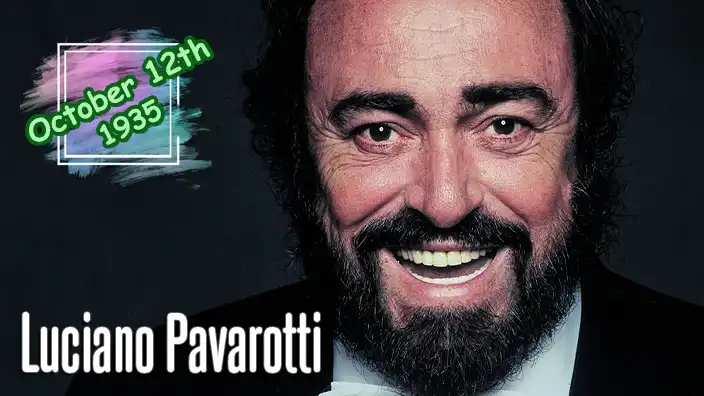
October 12, 1935, in Modena, Italy
 September 6, 2007, in Modena, Italy
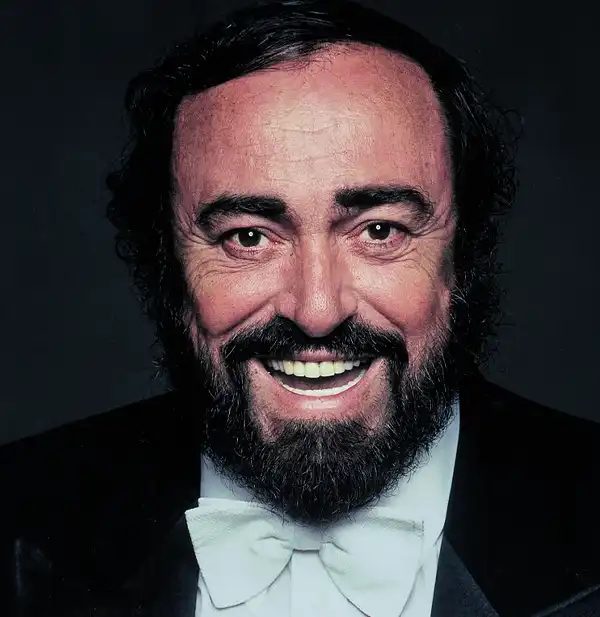
Luciano Pavarotti was born on October 12, 1935, in Modena, Italy, and became one of the most celebrated operatic tenors in the history of classical music. Renowned for his brilliant high notes, exceptional vocal clarity, and remarkable ability to communicate emotion through song, Pavarotti helped introduce opera to audiences who might otherwise never have ventured inside an opera house. His performances of celebrated arias, particularly Nessun dorma from Giacomo Puccini's Turandot, became internationally recognizable, while his concerts with The Three Tenors brought classical singing to enormous stadium audiences and millions of television viewers. With his unmistakable beard, trademark white handkerchief, and warm, larger-than-life personality, Pavarotti became a cultural ambassador for Italian opera. He possessed the extraordinary ability to make a centuries-old musical tradition feel immediate, exciting, and accessible, even to listeners who couldn't understand a single word of Italian.
Luciano Pavarotti grew up in a modest household in Modena, a city in northern Italy famous for its culinary traditions, historic architecture, and association with the Italian motor industry. His father, Fernando Pavarotti, worked as a baker and possessed a fine amateur tenor voice, while his mother, Adele Venturi, worked in a cigar factory. Music was an important part of family life, and Fernando's enthusiasm for opera introduced his son to recordings by celebrated singers including Enrico Caruso, Beniamino Gigli, Tito Schipa, and Giovanni Martinelli. The young Luciano listened carefully to these recordings, developing an appreciation for the beauty and expressive possibilities of the human voice. The family had limited financial resources, and the hardships of the Second World War forced them to spend time living in the countryside outside Modena. Despite these difficulties, Pavarotti remembered his childhood with affection, particularly the musical influence of his father, whose enthusiasm helped establish the foundations of his son's extraordinary career.
Although Luciano Pavarotti would eventually become synonymous with opera, his early ambitions were not exclusively musical. As a youngster, he enjoyed soccer and dreamed of becoming a professional goalkeeper, a position requiring quick reactions, courage, and the willingness to throw oneself toward rapidly approaching objects. His mother encouraged him to consider teaching, and he eventually trained as an elementary school teacher, working in education for approximately two years. He also spent time selling insurance, an occupation considerably less glamorous than performing before royalty and international audiences. These early experiences provided practical employment while he considered whether singing could become a realistic profession. Fortunately for the world of opera, Pavarotti eventually decided that protecting a soccer goal or explaining insurance policies was unlikely to provide the same satisfaction as delivering a magnificent high C before an appreciative audience.
Pavarotti began studying singing seriously under the guidance of Arrigo Pola, an experienced tenor and vocal teacher who helped him develop the foundations of his technique. He later continued his studies with Ettore Campogalliani, a respected teacher whose pupils included several distinguished opera singers. His training required patience, discipline, and careful attention to breathing, phrasing, vocal placement, and the physical demands of sustained singing. Unlike many popular music performers who achieve success through recording studios and electronic amplification, operatic singers must develop the ability to project their voices across large theaters and orchestras without microphones. Pavarotti's naturally beautiful voice provided exceptional potential, but years of careful study were necessary to transform that gift into a reliable professional instrument. The process was demanding, and his eventual success demonstrated that even extraordinary natural talent requires considerable work before it can fill an opera house.
A decisive turning point arrived in 1961 when Pavarotti won the Achille Peri International Singing Competition in Reggio Emilia, Italy. The victory opened the door to his professional operatic debut on April 29, 1961, when he portrayed Rodolfo in Giacomo Puccini's La bohème at the Teatro Municipale in Reggio Emilia. The opera tells the story of struggling young artists living in Paris, exploring love, friendship, poverty, and heartbreak through some of Puccini's most beautiful music. Pavarotti's portrayal of the romantic poet Rodolfo immediately demonstrated the lyrical beauty and expressive warmth that would become hallmarks of his career. His performance attracted attention from the Italian opera community and helped establish him as a promising young tenor. It was the beginning of a professional journey that would eventually carry him from relatively modest Italian theaters to the most prestigious musical stages in the world.
Pavarotti's international reputation developed rapidly during the early 1960s. In 1963, he received an important opportunity when he replaced the celebrated tenor Giuseppe Di Stefano in a production of La bohème at London's Royal Opera House, Covent Garden. His performance as Rodolfo impressed audiences and critics, helping establish his reputation beyond Italy. He subsequently appeared at major European opera houses and began building relationships with leading conductors, singers, and theatrical directors. His American debut came in 1965, when he performed in Donizetti's Lucia di Lammermoor in Miami, appearing alongside the renowned Australian soprano Joan Sutherland. Their collaboration became especially important to his development, as Sutherland's extraordinary command of bel canto singing provided valuable inspiration for the young tenor. Pavarotti later acknowledged the influence of her breathing technique and vocal discipline, demonstrating that even a singer blessed with a remarkable voice could benefit from observing another master at work.
The partnership between Luciano Pavarotti and Joan Sutherland became one of the most celebrated collaborations in twentieth-century opera. Together they performed and recorded works by composers including Gaetano Donizetti and Vincenzo Bellini, whose demanding vocal writing requires exceptional agility, precision, and control. Sutherland, frequently celebrated for her extraordinary soprano technique, helped introduce Pavarotti to important aspects of the bel canto tradition, an Italian style emphasizing beautiful tone, expressive phrasing, and technical brilliance. Their performances demonstrated how two exceptional voices could complement one another, producing moments of remarkable musical beauty. Pavarotti's bright, ringing tenor blended effectively with Sutherland's powerful soprano, and their recordings remain important examples of the operatic repertoire. Their professional relationship also reflected the international nature of opera, bringing together an Italian tenor and an Australian soprano to perform music that had already been delighting audiences for generations.
Luciano Pavarotti made his debut at Milan's legendary Teatro alla Scala in 1965, appearing in La bohème under the direction of Herbert von Karajan. La Scala was among the world's most prestigious opera houses, and performing there represented an important achievement for any Italian singer. His association with the theater continued throughout his career, alongside appearances at London's Covent Garden, the Vienna State Opera, and numerous other internationally respected venues. In 1968, he made his Metropolitan Opera debut in New York, again portraying Rodolfo in La bohème. The Metropolitan Opera would become one of the most important institutions in his professional life, providing the setting for many of his greatest performances. Audiences increasingly recognized his distinctive combination of vocal power, effortless-sounding high notes, and emotional sincerity. He was developing into the kind of performer whose arrival onstage could generate excitement before the orchestra had played its opening phrase.
One of the most famous moments in Pavarotti's career occurred on February 17, 1972, during a Metropolitan Opera performance of Gaetano Donizetti's La fille du régiment, known in English as The Daughter of the Regiment. Portraying the character Tonio, Pavarotti performed the demanding aria Ah! mes amis, quel jour de fête!, which requires the tenor to sing nine high Cs. These notes represent a formidable technical challenge, demanding extraordinary vocal control, breath support, and confidence. Pavarotti delivered them with remarkable brilliance, producing an audience reaction that became part of operatic history. He reportedly received seventeen curtain calls, an extraordinary demonstration of appreciation that helped establish his international reputation as the King of the High Cs. For anyone unfamiliar with opera, imagine a performer hitting nine exceptionally difficult notes and then being repeatedly summoned back to the stage by an audience that apparently had no intention of allowing him to go home.
Pavarotti's vocal abilities made him especially admired in the Italian operatic repertoire. His performances in Puccini's La bohème, Donizetti's L'elisir d'amore, Verdi's Rigoletto, and Bellini's I puritani demonstrated his command of lyrical expression and technically demanding singing. He was particularly celebrated for his ability to maintain clarity and beauty of tone while reaching the uppermost notes of the tenor range. Unlike singers who rely primarily on dramatic intensity, Pavarotti possessed a distinctive brightness and natural warmth that made his voice immediately recognizable. His Italian diction was exceptionally clear, allowing listeners familiar with the language to follow the emotional meaning of his performances. Even those who did not understand the words could recognize the tenderness, sorrow, joy, or desperation conveyed through his singing. His voice had the rare ability to communicate directly with audiences across linguistic and cultural boundaries.
Among the many works associated with Luciano Pavarotti, few became more famous than Nessun dorma, the celebrated aria from Giacomo Puccini's final opera, Turandot. The title translates approximately as "None Shall Sleep," and the aria is sung by Prince Calaf as he confidently anticipates victory in his quest to win the love of Princess Turandot. Its soaring melody and triumphant conclusion provide one of opera's most dramatic moments, culminating in the repeated Italian word Vincerò, meaning "I shall win." Pavarotti's interpretation became internationally famous for its combination of emotional intensity, beautiful phrasing, and magnificent final notes. Although the aria had been performed by distinguished tenors long before him, his recordings and concert performances introduced it to an enormous new audience. For many listeners, Nessun dorma became their first memorable encounter with opera, proving that a musical composition written decades earlier could still create excitement in a modern stadium.
The association between Nessun dorma and international sporting events became particularly important during the 1990 FIFA World Cup in Italy. The BBC selected Pavarotti's recording as the theme music for its television coverage of the tournament, bringing the aria into millions of homes throughout Britain and beyond. Its triumphant conclusion seemed perfectly suited to the drama of international soccer, where victory, disappointment, national pride, and emotional excess are all considered perfectly normal parts of the afternoon. The recording became a major commercial success, reaching the upper levels of the British singles chart and introducing classical singing to listeners who might ordinarily have preferred rock, pop, or football commentary. The association transformed Nessun dorma into an unofficial anthem of sporting triumph and established Pavarotti as a familiar voice far beyond traditional opera audiences. It was a remarkable achievement for a singer who had once dreamed of becoming a soccer goalkeeper.
Another historic moment arrived on July 7, 1990, when Luciano Pavarotti joined fellow tenors Plácido Domingo and José Carreras for a concert at the ancient Baths of Caracalla in Rome. Conducted by Zubin Mehta, the performance took place on the eve of the World Cup final and marked the beginning of the internationally celebrated Three Tenors phenomenon. The concert combined familiar operatic arias with popular songs, allowing the three performers to demonstrate their individual talents while sharing the stage in a spirit of musical celebration. The event was originally connected with Carreras's return to performing after treatment for leukemia, adding an emotional dimension to the occasion. Its recording became an enormous international success and helped transform classical vocal music into mainstream entertainment. Suddenly, three opera singers were attracting the kind of attention more commonly associated with major rock groups, although their stage costumes were considerably more formal.
The Three Tenors continued performing together at major international events, including concerts associated with subsequent FIFA World Cup tournaments. Their 1994 concert at Dodger Stadium in Los Angeles became another landmark performance, attracting enormous attention through television broadcasts and recordings. The combination of Pavarotti's brilliant Italian tenor, Domingo's rich and dramatic voice, and Carreras's lyrical warmth created a distinctive musical partnership. Their concerts were not without criticism from classical music purists, some of whom questioned the commercialization of opera and the use of popular arrangements. Nevertheless, the performances introduced millions of people to operatic singing and demonstrated that classical music could attract enthusiastic audiences outside traditional concert halls. Whatever the arguments about artistic presentation, the sight of three distinguished tenors commanding an enormous stadium suggested that opera had discovered a rather effective way of escaping the velvet seats and expensive balconies.
Pavarotti's popularity also allowed him to perform concerts on a scale rarely associated with classical singers. In 1991, he appeared before approximately 150,000 spectators in London's Hyde Park, where heavy rain failed to discourage the audience. Among those attending were Prince Charles and Princess Diana, who joined the crowds enduring the British weather in pursuit of exceptional music. Two years later, Pavarotti performed in New York's Central Park before an estimated audience of more than 500,000 people, with millions more watching through television broadcasts. These enormous outdoor concerts demonstrated his ability to connect with listeners who might never have attended a conventional opera performance. His relaxed stage presence, humor, and enthusiastic communication helped create an atmosphere that felt more like a public celebration than an intimidating classical music recital. Even when the audience numbered in the hundreds of thousands, Pavarotti seemed capable of making the occasion feel personal.
His trademark white handkerchief became one of the most recognizable accessories in classical music. Pavarotti frequently carried it during performances, sometimes holding it loosely while singing or using it to wipe perspiration from his face beneath the bright stage lights. He explained that the handkerchief helped him manage nervousness and gave his hands something familiar to do while performing. Over time, the simple accessory became inseparable from his public image, appearing in photographs, television broadcasts, and countless concert memories. His black formal attire, distinctive beard, and cheerful expression completed a stage appearance that audiences could recognize immediately. Unlike performers who relied on elaborate costumes, complicated choreography, or dramatic lighting effects, Pavarotti required relatively little theatrical decoration. A magnificent voice, a white handkerchief, and a confident smile were usually more than sufficient.
Luciano Pavarotti also developed a reputation for enjoying the pleasures of Italian life, particularly good food and convivial company. His enthusiasm for pasta, traditional Modenese cooking, and generous meals became a familiar subject in interviews and public appearances. He frequently spoke affectionately about his hometown and maintained strong connections with the region's cultural traditions. Modena is famous for foods including traditional balsamic vinegar, Parmigiano Reggiano cheese, and filled pasta, all of which form part of the culinary heritage of Emilia-Romagna. Pavarotti's appreciation for these traditions reflected his broader affection for Italian culture, which he celebrated through both his music and his personality. His love of food occasionally became the subject of affectionate jokes, but it also reinforced his reputation as a warm, approachable performer who enjoyed life beyond the opera stage. In Pavarotti's world, a fine aria and an excellent plate of pasta were apparently both worthy of serious appreciation.
Beyond opera and classical concerts, Pavarotti developed an interest in collaborating with performers from other musical genres. His Pavarotti & Friends concerts, organized in Modena beginning in the 1990s, brought together internationally recognized artists from pop, rock, soul, and other musical traditions. Participants over the years included Bono, Sting, Elton John, Eric Clapton, Celine Dion, Mariah Carey, and many others. These collaborations sometimes surprised traditional opera enthusiasts, particularly when Pavarotti's magnificent tenor appeared alongside electric guitars, contemporary rhythms, and popular songs. However, the performances reflected his belief that music could transcend stylistic boundaries and unite audiences with different tastes. His willingness to experiment helped introduce opera to new listeners while demonstrating respect for performers whose musical backgrounds differed considerably from his own.
The Pavarotti & Friends concerts also served important humanitarian purposes, raising funds for charitable organizations and relief initiatives supporting children and communities affected by war, poverty, and humanitarian emergencies. Beneficiaries included projects assisting people in Bosnia, Kosovo, Cambodia, Guatemala, and other regions experiencing hardship. Pavarotti worked with international humanitarian organizations and used his celebrity status to attract attention to causes that might otherwise receive limited public support. His charitable efforts extended beyond occasional fundraising appearances, becoming an important part of his later career. In 1998, he was appointed a United Nations Messenger of Peace, recognizing his contribution to humanitarian causes. He subsequently received the United Nations High Commissioner for Refugees' Nansen Refugee Award in 2001 for his work supporting displaced people. These honors reflected the influence he exercised beyond music, using his extraordinary public profile to encourage compassion and practical assistance.
Pavarotti's achievements earned him numerous prestigious awards throughout his career. According to the Recording Academy, he received five competitive Grammy Awards and fifteen nominations, along with special honors including the Grammy Legend Award in 1998. His recordings achieved extraordinary commercial success, and his collaborations with The Three Tenors helped establish records for classical music sales. He was also named MusiCares Person of the Year in 1998 and received Kennedy Center Honors in 2001. His international recognition included distinguished Italian and foreign honors acknowledging his contributions to music and culture. These awards reflected both his technical excellence as an operatic performer and his unusual ability to expand the audience for classical singing. While many great opera singers achieve admiration within the classical music community, Pavarotti became a familiar name to people who had never purchased an opera recording or attended a theatrical performance.
His recording career was especially important in preserving his musical achievements for future generations. Pavarotti recorded complete operas, collections of celebrated arias, sacred music, traditional Italian songs, and popular concert performances. His association with Decca Records produced an extensive catalog that includes recordings of Puccini, Verdi, Donizetti, Bellini, and numerous other composers. These recordings allow listeners to appreciate different aspects of his artistry, from the delicate phrasing required for lyrical passages to the thrilling brilliance of his most demanding high notes. They also document the development of his voice across several decades, providing valuable material for singers, teachers, historians, and music enthusiasts. His recordings remain widely available through physical collections and digital streaming services, ensuring that audiences can continue discovering his performances long after his final appearance onstage.
Although Pavarotti became one of the most admired singers in the world, his career was not entirely free from criticism or controversy. His enormous popularity sometimes led to disagreements with opera administrators, particularly over scheduling, cancellations, and the physical demands of maintaining a demanding international performance calendar. He acquired a reputation for occasionally withdrawing from performances, frustrating theater managers and disappointed audiences. Critics also debated his acting abilities, with some arguing that his dramatic stage presence did not always equal the exceptional quality of his singing. Nevertheless, his vocal achievements remained widely respected, and his ability to communicate musical emotion frequently overcame reservations about theatrical interpretation. Pavarotti's career demonstrated that even the greatest performers encounter professional difficulties, particularly when their schedules require them to travel constantly while maintaining an instrument as delicate and demanding as the human voice.
Pavarotti's personal life attracted considerable public attention, particularly as his international celebrity grew. He married Adua Veroni in 1961, and the couple had three daughters, Lorenza, Cristina, and Giuliana. Their marriage eventually ended in divorce after many years together. Pavarotti later married Nicoletta Mantovani in 2003, and they had a daughter, Alice. His family relationships, public appearances, and personal interests became regular subjects of media coverage, reflecting the unusual level of celebrity he achieved for a classical musician. Despite the demands of his career and the attention surrounding his private life, Modena remained an important personal and cultural home. His connection to the city continued throughout his life, and its association with his musical legacy remains significant.
During his later years, Pavarotti gradually reduced his appearances in complete opera productions while continuing to perform concerts and special events. His final staged operatic performance took place at the Metropolitan Opera in New York on March 13, 2004, when he appeared as Mario Cavaradossi in Puccini's Tosca. The occasion marked the conclusion of an extraordinary relationship with the institution, where he had performed many of his most celebrated roles. He subsequently embarked on a farewell concert tour intended to provide audiences around the world with a final opportunity to hear him perform. Although health difficulties eventually disrupted the schedule, his farewell appearances attracted considerable attention and emotional responses from admirers who understood that an important chapter in operatic history was drawing to a close.
One of Pavarotti's final great public appearances came on February 10, 2006, during the opening ceremony of the Winter Olympic Games in Turin, Italy. Performing Nessun dorma, he delivered a stirring rendition of the aria most closely associated with his international fame. The performance became one of the ceremony's defining moments, with his powerful voice providing a fitting musical celebration of Italian culture before a worldwide television audience. It was later disclosed that the vocal performance had been prerecorded because of the difficult outdoor conditions and concerns surrounding his health. Nevertheless, the occasion remained a moving public farewell and a reminder of the extraordinary connection between Pavarotti and the music of Puccini. The final triumphant Vincerò carried a special emotional significance, symbolizing a lifetime devoted to bringing the beauty of opera to the world.
In July 2006, Luciano Pavarotti was diagnosed with pancreatic cancer and underwent surgery in New York. His illness forced the cancellation of remaining concert appearances and brought an end to plans for further performances. Despite treatment, his health continued to deteriorate, and he died at his home in Modena on September 6, 2007. His death prompted tributes from musicians, political leaders, cultural organizations, and admirers around the world. Thousands gathered in Modena to pay their respects, while his funeral at the city's cathedral became an international event attended by prominent figures and broadcast to audiences beyond Italy. The ceremony celebrated not only his extraordinary musical achievements but also his contribution to introducing Italian opera to generations of listeners. The loss was felt far beyond the classical music community, reflecting the unusual place Pavarotti had occupied in international popular culture.
Luciano Pavarotti's legacy continues through his recordings, charitable work, and the institutions dedicated to preserving his memory. The Luciano Pavarotti Foundation supports musical education, cultural activities, and the promotion of young artists, reflecting his belief in encouraging future generations of performers. The Casa Museo Luciano Pavarotti in Modena allows visitors to explore aspects of his personal and professional life, including photographs, costumes, awards, and memorabilia associated with his career. His achievements have also been celebrated through documentaries, exhibitions, and commemorative performances. In 2019, director Ron Howard released Pavarotti, a documentary examining the singer's life through archival footage, interviews, and musical performances. The film introduced his story to another generation while exploring the remarkable combination of talent, ambition, personality, and personal challenges that shaped his career.
The continuing popularity of Nessun dorma, The Three Tenors recordings, and Pavarotti's extensive operatic catalog demonstrates the enduring appeal of his voice. His influence extends to contemporary classical singers who admire his technique, musicians who explore collaborations across genres, and audiences who discover opera through recordings and broadcasts. He helped challenge the perception that classical music belonged exclusively to a privileged or highly educated audience, demonstrating that beautiful singing could communicate directly with anyone willing to listen. His performances encouraged countless people to explore the works of Puccini, Verdi, Donizetti, and other composers whose music had already endured for generations. In this respect, Pavarotti served not only as an exceptional performer but also as an enthusiastic ambassador for an artistic tradition that continues to enrich musical culture.
As the world remembers Luciano Pavarotti on his October 12 birthday, his remarkable life offers an opportunity to celebrate one of the most distinctive voices in musical history. From his modest beginnings in Modena to the world's greatest opera houses, from nine thrilling high Cs at the Metropolitan Opera to enormous concerts with The Three Tenors, he achieved a level of international recognition rarely experienced by a classical singer. His generosity, humor, passion for Italian culture, and willingness to share opera with unfamiliar audiences helped make him a beloved public figure. Although his final curtain call came in 2007, his recordings ensure that the magnificent sound of his voice remains available to future generations. Somewhere, someone hearing Nessun dorma for the first time will undoubtedly stop what they are doing, listen in amazement, and discover why Luciano Pavarotti was known as the King of the High Cs. And when that final Vincerò rings out, it is difficult not to believe that the great tenor has won the audience over once again.