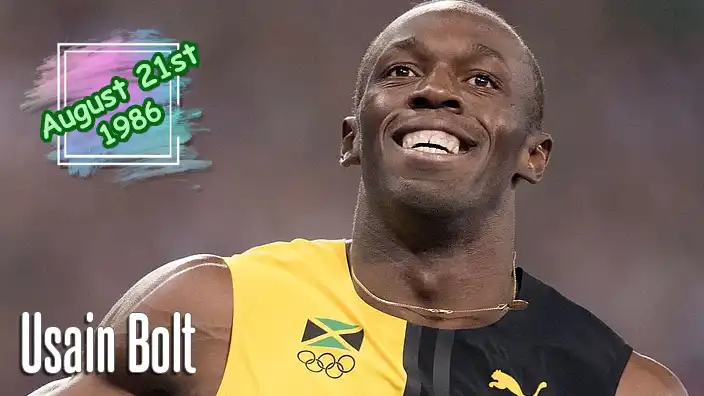
August 21, 1986, in Sherwood Content, Jamaica
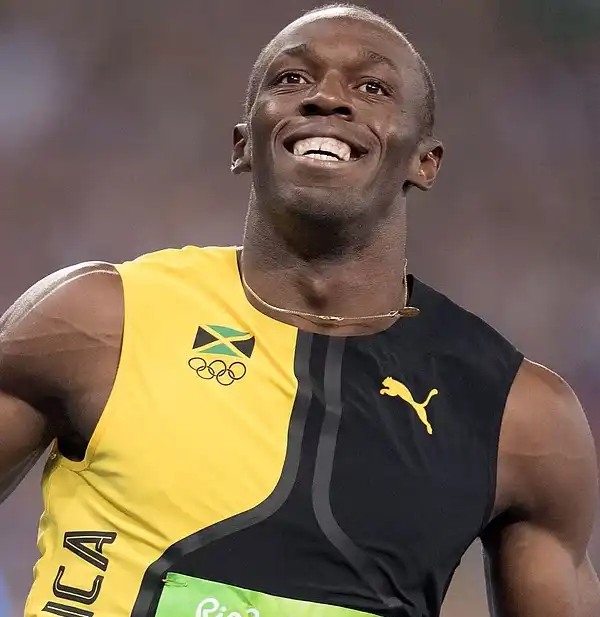
Usain Bolt made a career out of turning the world's fastest sprinters into people who appeared to be running for a bus they had already missed. The Jamaican superstar won eight Olympic gold medals, set world records in the 100 and 200 meters that still stand, and occasionally had enough time during major races to look around and see where everybody else had gone. Appropriately nicknamed “Lightning Bolt,” he didn't merely become the fastest man in history—he somehow made being impossibly fast look entertaining.
Usain St. Leo Bolt was born on August 21, 1986, in Sherwood Content, a small community in Jamaica's Trelawny Parish. His parents, Wellesley and Jennifer Bolt, operated a grocery store, and young Usain grew up playing cricket and soccer with his brother. Sprinting was not initially some carefully mapped childhood ambition. Like many Jamaican youngsters, Bolt simply enjoyed sports, and cricket was one of his particular favorites. It was reportedly a cricket coach who noticed something rather important: the lanky youngster could run extremely fast.
Bolt attended William Knibb Memorial High School, where his speed became increasingly impossible to ignore. He initially concentrated on the 200 meters and quickly developed into one of Jamaica's most promising young sprinters. He was unusually tall for a sprinter and would eventually reach 6 feet 5 inches, creating early questions about whether his height might make it difficult to explode quickly enough from the starting blocks. Those concerns eventually became rather academic. Once Bolt got moving, everybody else had a considerably larger problem.
His first major international appearance came at the 2001 CARIFTA Games, where the 14-year-old Bolt won silver medals in the 200 and 400 meters. A year later, Jamaica hosted the 2002 World Junior Championships in Kingston. Bolt won the 200 meters at just 15 years old, becoming the youngest world junior gold medalist at the time. Performing before an enthusiastic home crowd gave Jamaica its first substantial look at a young athlete who would eventually become one of the country's most famous citizens.
Bolt continued collecting junior titles, but his transition into senior competition was not entirely smooth. Injuries interfered with his early professional career, and his relaxed attitude toward training occasionally frustrated coaches. Bolt possessed enormous natural talent, but natural talent at the international level still requires considerable discipline. Glen Mills, who became his coach in 2004, helped develop that talent while improving Bolt's conditioning, technique and approach to competition.
For years, Bolt concentrated primarily on the 200 meters. He repeatedly expressed interest in running the shorter 100-meter sprint, while Mills initially believed he needed to demonstrate sufficient commitment before being allowed to make the switch. Bolt eventually got his opportunity, and it turned out that allowing Usain Bolt to run the 100 meters was a reasonably good decision.
In May 2008, Bolt ran 9.72 seconds in New York, breaking the 100-meter world record. Suddenly, only months before the Beijing Olympics, Jamaica possessed not merely an outstanding 200-meter runner but the fastest 100-meter sprinter the world had ever seen.
Beijing turned him into a global superstar.
In the 100-meter Olympic final on August 16, 2008, Bolt exploded away from the field and began celebrating before he had even crossed the finish line. He spread his arms, slapped his chest and appeared almost absurdly relaxed while still running faster than any human being had officially run the distance. He won in 9.69 seconds, breaking his own world record despite clearly easing off before the finish.
The performance produced an obvious question: how fast could he run if he actually continued sprinting all the way to the line?
Bolt wasn't finished in Beijing. Four days later, he won the 200 meters in 19.30 seconds, breaking Michael Johnson's 12-year-old world record of 19.32. Johnson's mark had been considered one of athletics' most formidable records, yet Bolt erased it while completing an unprecedented Olympic sprint double of world records in both the 100 and 200 meters.
Jamaica also originally won the 4×100-meter relay in world-record time, giving Bolt what appeared to be three gold medals from Beijing. Years later, however, teammate Nesta Carter's retested sample from the Games was found positive for a prohibited substance. The Jamaican relay team was disqualified in 2017, and Bolt was required to return that gold medal. It reduced his official Olympic total from nine gold medals to eight, although it did nothing to diminish what he personally accomplished in the individual events.
If Beijing established Bolt as the world's fastest man, the 2009 World Championships in Berlin established just how ridiculously fast he could be.
On August 16, exactly one year after his Beijing 100-meter triumph, Bolt ran the 100 meters in 9.58 seconds.
The performance reduced his own world record by eleven hundredths of a second, an enormous improvement in an event where records are normally shaved by tiny fractions. Bolt reached a top speed estimated at nearly 28 miles per hour during the race. His 9.58 remains the world record.
Four days later, he attacked the 200-meter record.
Bolt won in 19.19 seconds, again destroying his own world mark by eleven hundredths. That record also remains standing. In the space of several days, the world's fastest man had established the two measurements by which every elite male sprinter since has been judged.
The 2011 World Championships in Daegu provided one of the strangest moments of Bolt's career. He was overwhelming favorite for the 100 meters but false-started in the final. Under the rules then in effect, one false start meant immediate disqualification. The fastest man in the world therefore lost a 100-meter championship without officially running 100 meters.
Bolt responded in a manner that became characteristic of his career: he came back and won everything else he could. He captured the 200-meter world title and helped Jamaica set a world record in the 4×100-meter relay. Even his major failures tended to be followed rather quickly by another gold medal.
The London Olympics in 2012 presented a different challenge. Bolt was no longer the astonishing newcomer from Beijing. He was now the defending Olympic champion and one of the most famous athletes on Earth, while Jamaican teammate Yohan Blake had emerged as a serious rival. Blake had beaten Bolt at the Jamaican Olympic trials in both the 100 and 200 meters, creating genuine speculation that the king of sprinting might be vulnerable.
He wasn't.
Bolt won the Olympic 100-meter final in 9.63 seconds, setting an Olympic record. He followed by winning the 200 meters in 19.32, leading a Jamaican sweep of the medals with Blake second and Warren Weir third. Bolt then joined Jamaica's 4×100-meter relay team, which won gold in a world-record 36.84 seconds. Three events, three gold medals, and the questions about whether he could repeat Beijing had been answered rather efficiently.
Bolt's personality was almost as important to his popularity as his speed. Elite sprinting had traditionally been presented as an intensely serious business involving silent concentration, intimidating stares and athletes preparing as though the starting gun might initiate a military operation. Bolt grinned at cameras, joked with officials, interacted with crowds and performed his famous “Lightning Bolt” pose. Then the gun fired and the comedian disappeared.
That combination made him enormously popular. Bolt understood that sport was entertainment as well as competition, but his showmanship worked because the performance underneath it was extraordinary. Celebrating before winning would have looked foolish if somebody had actually caught him. Usually nobody did.
He continued dominating major championships. At the 2013 World Championships in Moscow, Bolt won gold in the 100 meters, 200 meters and 4×100 relay. He repeated the triple at the 2015 World Championships in Beijing, defeating American sprinter Justin Gatlin in a highly anticipated 100-meter final before winning the 200 and relay as well.
By the 2016 Rio de Janeiro Olympics, Bolt was attempting something unprecedented: winning both individual sprint events at three consecutive Olympic Games. At 29, he was older than many elite sprinters, and injuries had interrupted portions of his preparation. Nevertheless, when the Olympic finals arrived, so did Bolt.
He won the 100 meters in 9.81 seconds, becoming the first athlete to win the Olympic men's 100 meters three consecutive times. He then won the 200 meters in 19.78 and joined Jamaica in winning the 4×100-meter relay. The three victories completed what became known as the “Triple Triple”—three sprinting gold medals at three consecutive Olympics—although the later disqualification of Jamaica's 2008 relay team officially reduced his career Olympic total to eight gold medals.
The individual achievement remained untouched. Bolt had won the Olympic 100-meter and 200-meter titles at Beijing, London and Rio. Across three Olympics and six individual sprint finals, nobody beat him.
His final major competition came at the 2017 World Championships in London. This time, the fairy-tale ending refused to cooperate. Bolt finished third in the 100 meters behind Justin Gatlin and Christian Coleman, earning bronze in his final individual race. In the 4×100-meter relay final, Bolt pulled up with an injury during the anchor leg and collapsed onto the track.
It was a painful ending, but perhaps an oddly appropriate reminder that even Usain Bolt was human after all.
He retired from competitive athletics in 2017 with an extraordinary collection of achievements. In addition to his eight Olympic gold medals, Bolt won 11 World Championship gold medals and established world records that transformed expectations of what was possible in sprinting. His 9.58 in the 100 meters and 19.19 in the 200 meters remain the benchmarks against which the world's fastest runners are measured.
Bolt's physical characteristics helped make his success particularly fascinating. At 6 feet 5 inches, he was exceptionally tall for an elite sprinter. His height meant that his first strides out of the blocks were not always as quick as those of shorter rivals, and Bolt was rarely regarded as the world's greatest starter. Once upright, however, his enormous stride length and extraordinary speed allowed him to cover ground with frightening efficiency. Rivals could occasionally be ahead of him during the opening meters. The problem was what happened next.
Research into Bolt's performances has helped illustrate just how remarkable they were. During his 9.58 world-record race in Berlin, he covered 100 meters in only about 41 strides. His combination of stride length, frequency, power and the ability to maintain enormous speed made him uniquely difficult to beat. At full flight, the 6-foot-5 Jamaican looked less like a conventional sprinter than somebody who had accidentally been given longer legs than the rules intended.
Bolt's influence extended well beyond athletics. He became one of the most recognizable athletes in the world and an international symbol of Jamaica. His distinctive victory pose appeared in photographs, advertisements and celebrations everywhere, while his personality helped bring enormous attention to track and field outside Olympic years.
After retiring, Bolt pursued several business and sporting interests. He made a serious attempt to become a professional soccer player, training with clubs including Borussia Dortmund and Australia's Central Coast Mariners. In a 2018 preseason match for the Mariners, he even scored twice. A professional soccer contract ultimately did not materialize, but the experiment demonstrated that retirement had not diminished his appetite for competition—or his confidence.
He also became involved in music, business ventures and charitable work. Through the Usain Bolt Foundation, he has supported educational and cultural opportunities for children and young people, particularly in Jamaica. Bolt has remained closely associated with his home country despite becoming one of the most internationally recognizable sports figures of his generation.
The statistics explain much of Usain Bolt's greatness, but they do not completely explain his impact. Sprinting is one of sport's simplest competitions. There is no complicated scoring system, no tactical substitution and very little equipment. Eight men line up, somebody fires a gun and everyone discovers who can reach the other end first.
For nearly a decade, when the world's best sprinters lined up for the biggest races, that person was usually Usain Bolt.
He did it while smiling, joking, posing for cameras and occasionally beginning the celebration before everyone else had finished running. Yet beneath the showmanship was one of the most extraordinary competitive records in Olympic history: six individual Olympic sprint finals across three Games and six victories.
The world has produced many magnificent sprinters, and eventually somebody may run 100 meters faster than 9.58 seconds or 200 meters faster than 19.19. Records exist to be challenged, even records that have survived for many years.
Until that happens, however, the description remains wonderfully simple.