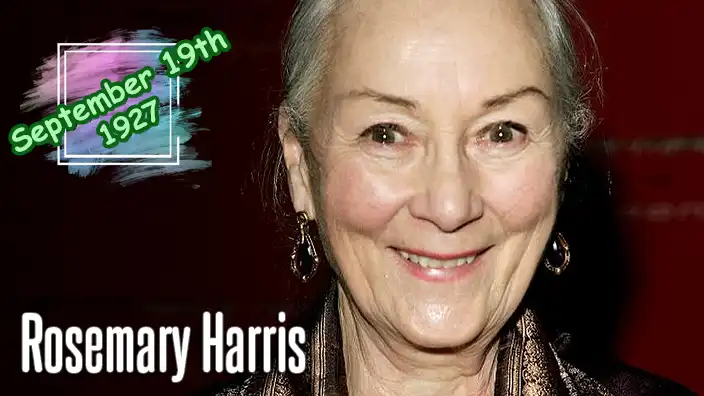
September 19, 1927, in Ashby-de-la-Zouch, England
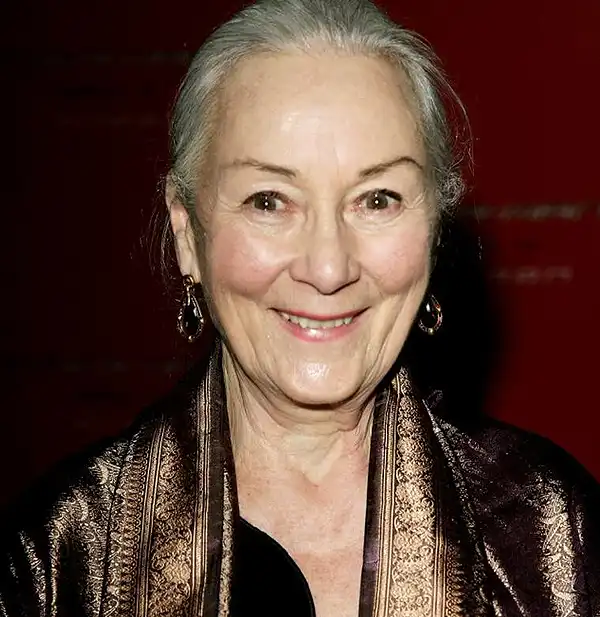
Born Rosemary Ann Harris on September 19, 1927, in England, Harris experienced an unusually international childhood. Her father, Stafford Berkeley Harris, served with the Royal Air Force, and his postings meant that part of her childhood was spent in India. She was educated at convent schools before eventually turning toward the profession that would occupy much of her life. Acting was not simply something Harris tried for a few years before wandering off in search of something more sensible. Once she stepped onto a stage, she more or less stayed there.
Her professional stage career began in 1948, when she appeared in repertory theater. Repertory was an unforgiving but extraordinarily effective training ground for actors: learn the part, perform it, learn another one, perform that, and try not to walk onto the stage wearing the costume from the wrong play. Harris subsequently studied at London's Royal Academy of Dramatic Art, better known as RADA, giving formal polish to abilities she had already begun developing through practical experience.
America soon came calling. Harris made her Broadway debut in Moss Hart's The Climate of Eden in 1952 and received a Theatre World Award for her performance. It was the beginning of an association with the New York stage that would continue across decades. Broadway audiences came to know Harris as an actress capable of combining intelligence, elegance and emotional depth without ever appearing to strain for effect.
Britain, however, had hardly lost her. Harris worked extensively in classical theater, including engagements with the Bristol Old Vic and London's Old Vic. Her classical credentials became formidable. She played Desdemona opposite Richard Burton in Othello and later became part of the National Theatre Company during its formative years under Laurence Olivier.
One particularly notable assignment placed Harris opposite Peter O'Toole in Hamlet, with Harris as Ophelia. She also appeared as Yelena in Olivier's production of Chekhov's Uncle Vanya. These were not minor appearances tucked away in the corner of a résumé. Harris was working alongside some of the defining figures of 20th-century British theater while establishing a reputation that placed her comfortably among them.
Her Broadway career reached an important milestone when she originated the role of Eleanor of Aquitaine in James Goldman's The Lion in Winter. The performance earned Harris the Tony Award for Best Actress in a Play in 1966. Eleanor is not a character who benefits from timidity. She is intelligent, formidable, politically astute and perfectly capable of turning a family Christmas into something resembling armed negotiations. Harris had precisely the authority the role demanded.
Hollywood later made The Lion in Winter into a celebrated film, but Harris was not chosen to repeat her role. Katharine Hepburn was cast as Eleanor instead and went on to win an Academy Award for the performance. It is one of those fascinating theatrical footnotes: Harris created the role on Broadway and won a Tony for it, while Hepburn transformed it into one of her most famous screen performances.
Harris continued building an extraordinary Broadway record. Her work brought Tony nominations for productions including Harold Pinter's Old Times, The Royal Family, George Bernard Shaw's Heartbreak House, Pack of Lies, Noël Coward's Hay Fever, Edward Albee's A Delicate Balance and Waiting in the Wings. She eventually accumulated nine competitive Tony nominations and was honored with a Special Tony Award for Lifetime Achievement in the Theatre in 2019.
Television provided Harris with another medium in which to demonstrate that good acting does not require scenery that can be reached from backstage. She portrayed the French novelist George Sand in the television serial Notorious Woman, a performance that earned her the Primetime Emmy Award for Outstanding Lead Actress in a Limited Series.
A few years later came the landmark American television miniseries Holocaust. Harris portrayed Berta Palitz Weiss, the matriarch of the Weiss family whose lives are devastated by Nazi persecution. The production brought the horrors of the Holocaust into millions of homes and became a significant television event. Harris's performance earned her the Golden Globe for Best Actress in a Television Series – Drama.
With a Tony, an Emmy and a Golden Globe already occupying the metaphorical mantelpiece, Harris continued moving between theater, television and film. She appeared in productions ranging from The Boys from Brazil to an adaptation of Virginia Woolf's To the Lighthouse, consistently demonstrating the ability to make supporting characters feel fully inhabited rather than merely positioned conveniently around the leading actors.
Her family life also produced an intriguing acting partnership. Harris married American novelist John Ehle in 1967, and their daughter, Jennifer Ehle, became an acclaimed actress in her own right. Mother and daughter occasionally found themselves sharing characters as well as DNA.
In the television adaptation of The Camomile Lawn, Jennifer Ehle portrayed the younger Calypso while Harris played the character later in life. They repeated the idea in István Szabó's Sunshine, portraying the same character, Valerie Sonnenschein, at different stages of her life. Most casting directors spend weeks trying to find performers who plausibly resemble one another. In this case, genetics did a considerable amount of the preliminary work.
Harris received one of the greatest recognitions of her film career for Tom & Viv, the 1994 drama about poet T. S. Eliot and his first wife, Vivienne Haigh-Wood Eliot. Harris portrayed Vivienne's mother, Rose Robinson Haigh-Wood, and earned an Academy Award nomination for Best Supporting Actress. After decades of distinguished theater and television work, Hollywood's biggest awards ceremony had finally placed her among its nominees.
Then something rather different happened.
A radioactive spider bit Peter Parker.
When Sam Raimi brought Spider-Man to cinemas in 2002, Harris was cast as Aunt May Parker opposite Tobey Maguire's Peter Parker and Cliff Robertson's Uncle Ben. Suddenly, an actress associated with Shakespeare, Chekhov, Pinter and Albee was appearing in one of the biggest superhero franchises in cinema.
And she fit beautifully.
Harris's Aunt May provided the films with warmth and emotional grounding. While superheroes were swinging between skyscrapers, battling villains and discovering that New York apparently suffers an alarming shortage of competent insurance adjusters, Aunt May represented home, family and conscience. Harris avoided turning the character into a simple sweet old relative dispensing convenient wisdom. Her May Parker possessed dignity, humor, vulnerability and considerable strength.
She returned for Spider-Man 2 in 2004 and Spider-Man 3 in 2007, becoming Aunt May for an entire generation of moviegoers. For many younger viewers, Rosemary Harris was Aunt May long before they discovered that she had spent decades commanding some of the world's most prestigious stages.
Her film work during this period remained varied. She appeared in Being Julia, Before the Devil Knows You're Dead and other productions while continuing to return to the theater. Harris never seemed particularly interested in allowing one successful role to define everything that followed it.
Broadway remained a professional home. One of her later major stage appearances came in Lincoln Center Theater's revival of My Fair Lady, in which she played Mrs. Higgins. It was a wonderfully appropriate role for an actress whose command of the stage had been refined across decades. By then, audiences were watching someone whose own career had become part of Broadway history.
Harris's contribution to American theater was formally recognized through her induction into the American Theater Hall of Fame, while her 2019 Special Tony Award for Lifetime Achievement acknowledged an extraordinary body of work stretching back to the early years of her Broadway career.
What makes Rosemary Harris's career particularly impressive is not simply its length. Longevity is admirable, but longevity combined with consistently substantial work is considerably rarer. She moved between classical theater and contemporary drama, between London and New York, and between stage, television and cinema without appearing trapped by any particular medium.
There is also something wonderfully improbable about the audiences her career has connected. Theater enthusiasts may remember Eleanor of Aquitaine, Ophelia, Desdemona or her performances in the works of Pinter, Coward and Albee. Television viewers may remember George Sand or Berta Weiss. Film audiences may remember Tom & Viv or Sunshine.
And millions of others simply know her as Aunt May.
That is not a bad legacy for an actress who began in British repertory theater in the 1940s. Rosemary Harris built a career in which Shakespeare and Spider-Man somehow occupy neighboring shelves, and remarkably, neither seems remotely out of place.