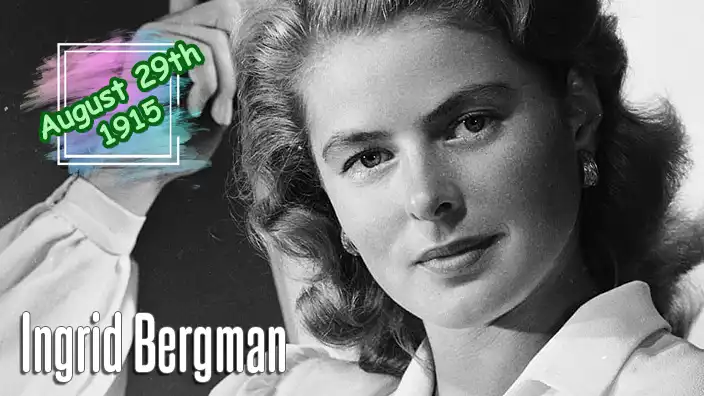
August 29, 1915, in Stockholm, Sweden
 August 29, 1982, in London, England
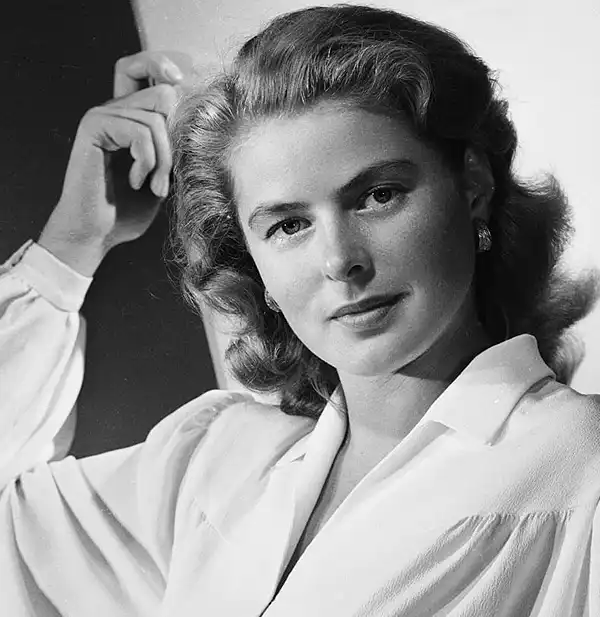
Ingrid Bergman was one of the defining actresses of twentieth-century cinema, an international star whose performances combined emotional intensity with a remarkably natural screen presence. Born on August 29, 1915, in Stockholm, Sweden, she built an extraordinary career on both sides of the Atlantic and appeared in films including Casablanca, Gaslight, Notorious, Spellbound, Anastasia and Murder on the Orient Express. She won three Academy Awards, two Emmy Awards and a Tony Award, placing her among the comparatively small group of performers who achieved major honors in film, television and theater.
Her childhood contained considerable sadness. Bergman's mother, Friedel, died when Ingrid was only a toddler, and her father, Justus Bergman, died when she was thirteen. She subsequently lived with relatives. Her father had owned a photography shop and enjoyed photographing and filming his daughter, leaving behind images of the future actress long before professional cameras began following her.
Bergman decided early that she wanted to act. She studied briefly at Stockholm's Royal Dramatic Theatre School, an institution with a formidable theatrical tradition. However, film opportunities arrived quickly, and she left formal training to begin working professionally.
During the 1930s, Bergman became an increasingly prominent figure in Swedish cinema. Her early films included Munkbrogreven, Swedenhielms and Intermezzo. It was Intermezzo, released in Sweden in 1936, that changed the direction of her career.
Hollywood producer David O. Selznick saw Bergman's performance and brought her to the United States to appear in an English-language remake of Intermezzo opposite Leslie Howard. Released in 1939 as Intermezzo: A Love Story, the film introduced Bergman to American audiences.
Hollywood had acquired a new leading lady, although Bergman did not initially resemble the carefully manufactured stars normally produced by the studio system. She became known for a comparatively natural appearance and resisted some of the industry's attempts to transform her. Her height, minimal makeup and unaffected acting style became part of her appeal.
Her American career accelerated rapidly. Bergman appeared opposite Spencer Tracy in Dr. Jekyll and Mr. Hyde and received her first Academy Award nomination for For Whom the Bell Tolls, the 1943 adaptation of Ernest Hemingway's novel starring Gary Cooper.
But before that nomination came the film that would permanently attach Ingrid Bergman to cinema history.
In 1942, she played Ilsa Lund in Casablanca.
Directed by Michael Curtiz, the film starred Humphrey Bogart as Rick Blaine, an American expatriate operating a nightclub in Vichy-controlled Casablanca during the Second World War. Bergman's Ilsa arrives unexpectedly with her husband, resistance leader Victor Laszlo, played by Paul Henreid.
Unfortunately, Ilsa and Rick have history.
Quite a lot of history.
The resulting romantic triangle became one of cinema's most famous love stories. Bergman's performance gave Ilsa an emotional complexity that prevented the character from becoming merely the woman standing between two men. Her feelings for Rick are genuine, but so is her loyalty to Laszlo and the cause he represents.
Bergman and Bogart produced remarkable chemistry despite the famously complicated production. The screenplay continued evolving while filming was underway, and Bergman later recalled that she wasn't always certain which man Ilsa would ultimately end up with.
Perhaps that uncertainty helped. Ilsa spends much of the film appearing emotionally torn because Bergman herself wasn't entirely sure where the screenplay was taking her.
Casablanca won the Academy Award for Best Picture and became increasingly celebrated in the decades following its release. Bergman's scenes with Bogart remain among the most recognizable moments in classic Hollywood cinema.
The film also produced one of the most famous movie quotations never actually spoken.
“Play it again, Sam” does not appear in Casablanca. Ilsa says, “Play it, Sam,” while Rick later says, “Play it.” Popular culture apparently decided the original dialogue needed editing and has been confidently getting it wrong ever since.
Bergman soon demonstrated that Casablanca was no fortunate accident.
In 1944, she starred opposite Charles Boyer in George Cukor's psychological thriller Gaslight. Bergman played Paula Alquist, a woman whose husband systematically manipulates her into questioning her own sanity.
Her performance earned her the Academy Award for Best Actress.
The film became culturally influential far beyond Bergman's performance. The term “gaslighting,” now commonly used to describe psychological manipulation intended to make someone doubt their own perceptions or memories, derives from the stage play and its film adaptations.
Bergman next entered the wonderfully unsettling cinematic world of Alfred Hitchcock.
She starred opposite Gregory Peck in Hitchcock's 1945 psychological thriller Spellbound. Peck played a man suspected of being an impostor and possibly a murderer, while Bergman played psychoanalyst Dr. Constance Petersen. The film included a famous dream sequence designed by surrealist artist Salvador Dalí, because apparently Alfred Hitchcock decided ordinary nightmares weren't quite complicated enough.
The following year brought Notorious, one of Bergman's finest films.
She starred as Alicia Huberman, the daughter of a convicted Nazi spy who is recruited by American intelligence to infiltrate a group of Nazis operating in Brazil. Cary Grant played government agent T. R. Devlin, with Claude Rains portraying Alexander Sebastian, the man Alicia is instructed to marry.
The film combined espionage, romance and psychological tension, and Bergman's performance remains one of the most acclaimed of her career. Hitchcock used her ability to express conflicting emotions with remarkable subtlety, particularly as Alicia becomes trapped between her dangerous assignment and her feelings for Devlin.
By the late 1940s, Ingrid Bergman was one of Hollywood's biggest stars.
Then her life changed dramatically.
Bergman became fascinated by the work of Italian director Roberto Rossellini, particularly his influential neorealist films Rome, Open City and Paisan. She wrote to Rossellini offering to work with him, famously mentioning that she spoke English, German and French, knew only a few words of Italian, and was prepared to make a film with him.
Rossellini accepted.
They made Stromboli, released in 1950.
During production, Bergman and Rossellini began a relationship. The problem, at least as far as 1950 America was concerned, was substantial: both were married to other people.
Bergman became pregnant with Rossellini's child before her divorce from her first husband, Swedish surgeon Petter Lindström, was finalized. The resulting scandal was enormous.
Today it may be difficult to appreciate just how ferocious the reaction became. Bergman had been presented to American audiences as wholesome and virtuous, and newspapers treated her private life as a public betrayal. She was denounced from pulpits, attacked in the press and even condemned on the floor of the United States Senate.
Senator Edwin C. Johnson of Colorado described her as a powerful influence for evil, an extraordinary amount of congressional attention for an actress having an affair with a film director.
Bergman remained in Europe.
She and Rossellini married in 1950 and had three children together: son Roberto and twin daughters Isotta Ingrid and Isabella. Isabella Rossellini would later become an internationally successful actress and model in her own right.
Artistically, Bergman's collaboration with Rossellini represented a dramatic departure from Hollywood. Their films together included Stromboli, Europa '51, Journey to Italy, Fear and Joan of Arc at the Stake.
Several received mixed or hostile responses at the time, particularly from audiences expecting the polished storytelling of Bergman's Hollywood films. In later decades, however, works such as Journey to Italy were reassessed and became highly influential among filmmakers and critics.
Bergman's marriage to Rossellini eventually deteriorated, and they divorced in 1957.
Meanwhile, something remarkable had happened to her American career.
Hollywood wanted her back.
Bergman starred in Anastasia in 1956, playing a troubled woman who may—or may not—be Grand Duchess Anastasia, daughter of Russia's last tsar. Yul Brynner co-starred.
Her performance won Bergman her second Academy Award for Best Actress.
The comeback was unmistakable. Only a few years after being publicly condemned in the United States, she had returned triumphantly and collected another Oscar. Hollywood, having apparently finished being outraged, rediscovered that Ingrid Bergman was an exceptionally good actress.
She continued working internationally rather than simply returning permanently to the Hollywood system. Her films included Indiscreet, which reunited her with Cary Grant, The Inn of the Sixth Happiness, The Yellow Rolls-Royce and Cactus Flower.
Bergman also worked extensively on stage and television. She won a Tony Award for her performance in the Broadway production of Joan of Lorraine and later earned Emmy Awards for television performances, demonstrating that her abilities were hardly dependent upon a cinema screen.
Another Academy Award arrived in 1975.
Bergman played missionary Greta Ohlsson in Sidney Lumet's lavish adaptation of Agatha Christie's Murder on the Orient Express. The enormous cast included Albert Finney, Lauren Bacall, Sean Connery, John Gielgud, Vanessa Redgrave, Anthony Perkins and several other performers whose combined résumés could have filled a library.
Bergman's role was relatively small, but her performance was memorable. She won the Academy Award for Best Supporting Actress, giving her a third Oscar.
Her acceptance speech became characteristic of Bergman's generosity toward other performers. She suggested that fellow nominee Valentina Cortese should have won for Day for Night, praising Cortese's performance while standing onstage holding the Oscar herself.
By then Bergman was already dealing with a serious illness. She had been diagnosed with breast cancer in the 1970s and underwent treatment while continuing to work.
One of her most significant late performances came in Ingmar Bergman's 1978 film Autumn Sonata. Despite sharing a surname, actress and director were unrelated.
Ingrid Bergman played Charlotte, a celebrated concert pianist whose emotionally neglected daughter, played by Liv Ullmann, confronts her after years of resentment. The film offered Bergman one of the most demanding dramatic roles of her career.
Her performance earned another Academy Award nomination for Best Actress.
Her final acting role came in the 1982 television miniseries A Woman Called Golda, in which she portrayed Israeli Prime Minister Golda Meir. Bergman was seriously ill during production but completed the demanding role.
Her performance earned her a posthumous Emmy Award.
Ingrid Bergman died in London on August 29, 1982—her 67th birthday.
The coincidence gives her life an unusual symmetry: she entered the world and left it on the same calendar date, with 67 remarkable years between.
Her legacy reaches far beyond Casablanca, enormous though that film remains. Bergman worked in Swedish, American, British and Italian productions, collaborated with directors including Alfred Hitchcock, Roberto Rossellini, George Cukor, Sidney Lumet and Ingmar Bergman, and repeatedly took risks when a safer career would have been much easier.
She also survived one of Hollywood's most notorious public scandals and returned not merely to acceptance but to the very top of her profession.
Her three Academy Awards place her among the most honored actresses in Oscar history. Yet awards explain only part of her lasting appeal.
Bergman's acting frequently feels strikingly modern. There is a natural quality to her performances that distinguishes her from some of the more theatrical acting styles associated with early Hollywood. Her characters think, hesitate, reconsider and conceal emotions rather than simply announcing them.
That quality made Ilsa Lund unforgettable.
More than eight decades after Casablanca premiered, audiences still watch Rick and Ilsa standing together in a foggy airport while history, duty and heartbreak decide their future.
The aircraft eventually leaves.
The film ends.
And Ingrid Bergman remains.