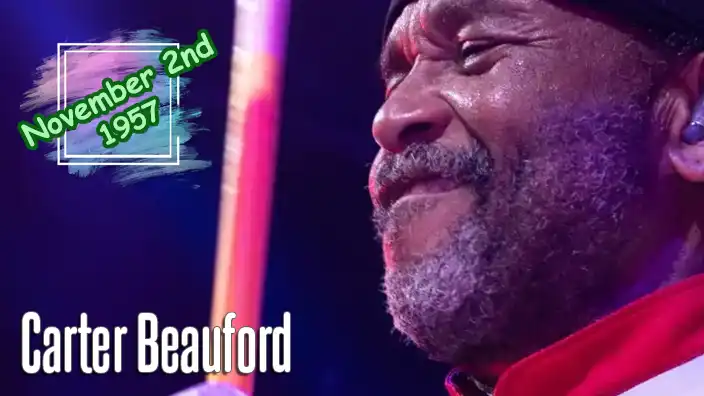
November 2, 1957, in Charlottesville, Virginia

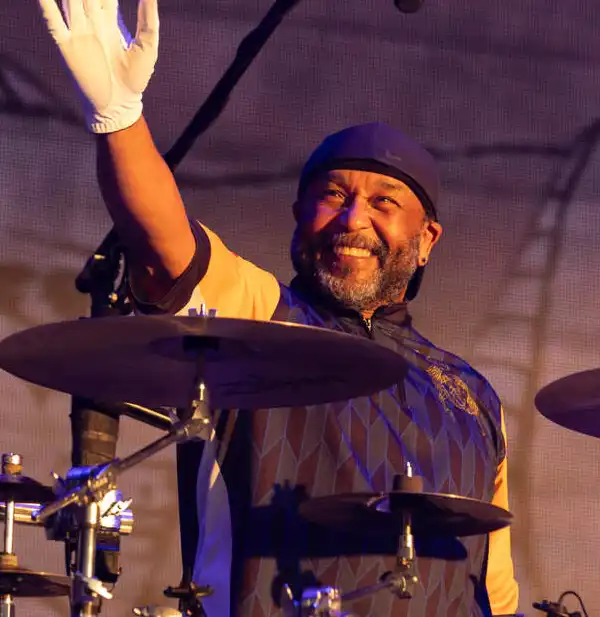
Carter Anthony Beauford was born on November 2, 1957, in Charlottesville, Virginia, where music was an important part of everyday family life. His father was a jazz trumpet player, his mother played piano, and other family members also played instruments. The household was filled with everything from jazz and gospel to rhythm and blues, rock, and popular music. This remarkable musical environment exposed Beauford to different styles long before he began developing his own distinctive approach to drumming. Rather than growing up with a single musical influence, he absorbed a wide variety of sounds that would eventually help him become one of the most versatile drummers in contemporary rock music.
One of the most important moments in Beauford's life occurred when he was just three years old. His father had tickets to see legendary jazz drummer Buddy Rich perform but was unable to find a babysitter, so young Carter accompanied him to the concert. What might have been an inconvenient evening for another child became a life-changing experience. Beauford was captivated by Rich's extraordinary speed, technical ability, and commanding stage presence. Watching the celebrated drummer perform inspired a fascination with percussion that would shape the rest of his life. It was an unusually successful babysitting arrangement, although his father probably had no idea that he was witnessing the beginning of a major musical career.
Recognizing his son's enthusiasm, Beauford's father bought him a small Roy Rogers drum kit made with tin shells and paper drumheads. It was hardly the elaborate collection of drums and cymbals that Beauford would eventually use on international concert tours, but it provided everything he needed to begin experimenting with rhythm. He practiced enthusiastically, attempting to reproduce the sounds and movements of the professional drummers he admired. His early dedication was remarkable, and by the time he was nine, he had already begun performing professionally with a jazz-fusion group led by musician Big Nick Nicholas.
Beauford's early musical influences extended far beyond Buddy Rich. He admired jazz drummers including Tony Williams and Papa Jo Jones, whose technical abilities and rhythmic creativity helped shape modern drumming. He also listened to rock, funk, soul, and gospel music, absorbing the different approaches used by musicians in each genre. Artists such as James Brown, Sly and the Family Stone, and the Beatles contributed to his understanding of rhythm and musical arrangement. This broad musical education helped him develop an approach that could move comfortably between gentle accompaniment, powerful rock rhythms, and complicated jazz-inspired passages.
One of Beauford's most recognizable characteristics is his unusual open-handed drumming technique. Most right-handed drummers cross their right arm over their left when playing the hi-hat cymbals and snare drum. Beauford frequently avoids this crossed-arm position, using his left hand to lead on the hi-hat while maintaining a conventional right-handed drum-kit arrangement. The technique allows him greater freedom of movement and makes it easier to move between different drums and cymbals. His remarkable coordination also enables him to perform complicated rhythmic patterns that would challenge many accomplished musicians.
The origins of this unusual technique can be traced to his childhood practice habits. Beauford has explained that he would position his drum kit in front of a mirror and attempt to imitate the movements of his favorite drummers. Because the mirror reversed the image, he developed a playing approach that differed from the conventional right-handed method. What began as a childhood attempt to copy musical heroes gradually became one of his greatest technical advantages. It is a wonderful example of how an innocent mistake can lead to something extraordinary, particularly when the person making the mistake possesses an exceptional amount of talent and determination.
As his musical abilities developed, Beauford became an established performer in the Virginia jazz scene. He played with several groups, including Secrets, a jazz-fusion band based in Richmond, Virginia. The group featured talented musicians such as saxophonist LeRoi Moore, keyboardist Butch Taylor, and trumpeter John D'earth. Secrets performed throughout Virginia, developing a reputation for adventurous arrangements and accomplished musicianship. The experience gave Beauford valuable opportunities to experiment with different rhythms and interact with musicians whose styles challenged him to continue improving.
Beauford also performed with the jazz group Blue Indigo, further strengthening his connection to the Charlottesville music community. These performances helped establish him as a highly respected drummer long before the Dave Matthews Band became internationally famous. His work required the ability to respond quickly to musical changes, improvise during performances, and support fellow musicians without overwhelming them. These skills would later become essential to the Dave Matthews Band's distinctive sound, particularly during the extended instrumental passages that became a defining feature of its concerts.
The circumstances surrounding the formation of the Dave Matthews Band began taking shape in Charlottesville during the early 1990s. Dave Matthews, a South African-born musician working as a bartender at Miller's, had been writing songs and was looking for experienced musicians to help develop his material. Beauford and LeRoi Moore were already well known in the local jazz community, and Matthews approached them about recording some of his compositions. Their early collaboration revealed an unusual musical chemistry, combining Matthews' distinctive songwriting with Beauford's adventurous rhythms and Moore's expressive saxophone playing.
In 1991, Beauford became a founding member of the Dave Matthews Band, joining Matthews, Moore, bassist Stefan Lessard, and violinist Boyd Tinsley in the group's early lineup. The musicians brought different backgrounds and influences to the project, creating a sound that resisted easy classification. Elements of rock, jazz, funk, folk, and world music blended together in arrangements that frequently featured unusual rhythms and extended instrumental sections. Beauford's drumming became central to this musical identity, providing a rhythmic foundation that was both technically sophisticated and immediately recognizable.
The band began performing in clubs and small venues around Charlottesville, gradually attracting an enthusiastic local following. Their concerts quickly became known for energetic performances and a willingness to explore different musical directions. Unlike groups that attempted to reproduce their studio recordings exactly, the Dave Matthews Band encouraged improvisation, allowing songs to develop and change during live performances. Beauford's jazz background made him particularly well suited to this approach, as he could adjust his rhythms in response to the other musicians while maintaining the underlying structure of each composition.
The band's early success was built largely through live performances and word-of-mouth recommendations. Fans began exchanging recordings of concerts, helping introduce the group to audiences beyond Virginia. This grassroots approach became an important part of the Dave Matthews Band's identity, creating a dedicated community of listeners who appreciated the differences between individual performances. For Beauford, the extended concerts provided opportunities to demonstrate his technical ability, explore rhythmic variations, and occasionally remind the audience that the drummer was perfectly capable of stealing the show.
In 1993, the group released Remember Two Things, an independently issued album that captured much of its developing live sound. The recording included performances that demonstrated the band's unusual musical arrangements and growing confidence. Although the album did not initially receive the same national attention as later releases, it helped establish the foundation for the group's commercial breakthrough. The band's willingness to combine accessible songwriting with instrumental complexity attracted listeners who wanted something different from the conventional rock music dominating radio playlists.
The Dave Matthews Band achieved major commercial success with its 1994 album Under the Table and Dreaming. Produced by Steve Lillywhite, the album introduced the group to a national audience and featured popular songs including "What Would You Say," "Ants Marching," and "Satellite." Beauford's drumming was a crucial part of the album's distinctive sound, particularly on "Ants Marching," where his energetic rhythms helped drive one of the band's most recognizable songs. The album eventually achieved multi-platinum sales and established the group as a major force in American popular music.
Beauford's contribution to Under the Table and Dreaming demonstrated how technical drumming could enhance popular songs without making them inaccessible. His performances incorporated unexpected accents, intricate fills, and rhythmic variations while maintaining a strong connection to the melodies and vocals. Rather than simply providing a steady beat, he interacted with the other instruments, adding musical details that rewarded repeated listening. For aspiring drummers, the album became an introduction to a style that combined the discipline of jazz with the energy of rock music.
The band's next studio album, Crash, arrived in 1996 and further expanded its popularity. Featuring songs such as "Crash Into Me," "Too Much," "So Much to Say," and "Tripping Billies," the album demonstrated the group's growing confidence and musical versatility. Beauford's drumming remained central to the arrangements, shifting between delicate passages and powerful rhythmic sections. His ability to support Matthews' distinctive guitar playing while responding to Moore's saxophone and Tinsley's violin helped create a sound unlike that of most mainstream rock bands.
The song "So Much to Say" earned the Dave Matthews Band a Grammy Award for Best Rock Vocal Performance by a Duo or Group at the 1997 ceremony. The recognition marked an important milestone for the musicians, whose unconventional approach had developed from performances in small Virginia clubs into an internationally successful recording and touring career. Although Beauford was not the band's lead singer, his rhythmic contributions were an essential part of the musical arrangements that distinguished the group from its contemporaries.
In 1998, the Dave Matthews Band released Before These Crowded Streets, an album that explored darker themes and more adventurous musical arrangements. The recording featured complex instrumental passages, unusual textures, and collaborations with guest musicians. Beauford's drumming demonstrated his ability to navigate demanding compositions while preserving the emotional impact of the songs. Tracks such as "The Stone," "Rapunzel," and "The Dreaming Tree" showcased the band's willingness to experiment beyond conventional rock structures.
As the group's reputation grew, its concerts became increasingly elaborate and ambitious. Beauford developed a large drum setup featuring multiple toms, cymbals, and percussion instruments, allowing him to produce a broad range of sounds during performances. His distinctive Yamaha drum kits became familiar to fans, while his ability to move rapidly around the instruments made his performances visually impressive. Watching Beauford perform could be exhausting for anyone attempting to follow every movement, although he frequently appeared to be enjoying himself enormously.
One of the most important aspects of Beauford's playing is his ability to maintain a strong musical groove while incorporating complex rhythms. He frequently uses syncopation, placing accents in unexpected positions to create movement and excitement. His performances also include rapid drum fills, carefully controlled cymbal work, and changes in rhythmic emphasis that help songs develop naturally. These techniques reflect his jazz training, but they are applied within a musical setting that also draws heavily upon rock, funk, and popular music.
Beauford's musical approach has earned admiration from professional drummers and music educators around the world. His open-handed technique has become a subject of particular interest among percussion students, many of whom study recordings of his performances to understand how he coordinates different rhythmic patterns. Although his style is technically demanding, Beauford has consistently emphasized the importance of listening to other musicians and serving the song rather than simply demonstrating speed or complexity. His playing illustrates that impressive technique is most effective when it contributes to the overall musical performance.
In 1997, Beauford released the instructional video Under the Table and Drumming, providing viewers with an opportunity to observe his technique and learn about his musical approach. The program featured demonstrations of his playing style and discussions about his influences, practice methods, and approach to performance. For drummers accustomed to conventional right-handed techniques, the video offered an especially interesting look at his unusual coordination and open-handed playing. It also helped establish him as an influential educator whose knowledge could benefit musicians beyond the Dave Matthews Band's audience.
Throughout the 2000s, Beauford continued recording and touring with the band as it released albums including Everyday (2001), Busted Stuff (2002), and Stand Up (2005). These recordings explored different production techniques and musical directions while retaining the instrumental interplay that had become central to the group's identity. Beauford adapted his performances to suit the changing arrangements, sometimes emphasizing restrained rhythmic support and at other times delivering the energetic drumming that fans had come to expect.
The band's live recordings also became an important part of its musical legacy. Releases such as Live at Red Rocks 8.15.95, Listener Supported, and the extensive Live Trax series documented the group's concerts and demonstrated how individual songs could evolve through improvisation. Beauford's performances were particularly important in these recordings because his rhythmic creativity helped guide extended instrumental passages. His ability to anticipate musical changes and respond immediately to fellow performers contributed to the spontaneous atmosphere that made the band's concerts so popular.
Outside his work with the Dave Matthews Band, Beauford has collaborated with numerous respected musicians. His credits include performances with Carlos Santana, John Popper of Blues Traveler, bassist Victor Wooten, and other artists representing different musical traditions. These collaborations have allowed him to explore styles that differ from the band's familiar arrangements, keeping his playing fresh and encouraging continued experimentation. Beauford has explained that working with other musicians provides creative inspiration that he can bring back to his primary group.
His work with Santana was particularly appropriate given the guitarist's long-standing interest in combining rock, Latin rhythms, jazz, and other musical influences. Beauford's ability to move between styles made him a natural collaborator for artists who valued rhythmic experimentation. Similarly, his association with Victor Wooten connected him with one of the most respected bassists in contemporary instrumental music. Such collaborations demonstrated that Beauford's reputation extended well beyond the audience of the Dave Matthews Band.
The death of founding saxophonist LeRoi Moore in August 2008 was a devastating loss for the group. Moore had been one of Beauford's longtime musical collaborators, and their friendship stretched back to the Virginia jazz scene before the band's formation. His death affected both the musicians and their devoted fans, leaving a significant gap in the band's musical identity. The group continued performing while honoring Moore's contribution, and its 2009 album Big Whiskey & the GrooGrux King became a tribute to his memory.
For Beauford, Moore's death represented the loss of a musician whose playing had been closely connected to his own for many years. The rhythmic interaction between drums and saxophone had been a distinctive element of the band's early sound, and their shared musical history helped shape the group's approach to improvisation. Continuing without Moore required adjustments, but the band remained committed to preserving the adventurous musical spirit that had defined its performances.
The Dave Matthews Band continued releasing successful albums, including Away from the World (2012), Come Tomorrow (2018), and Walk Around the Moon (2023). Each recording reflected changes in the group's musical direction while retaining the distinctive rhythmic character established during its early years. Beauford remained a central member of the ensemble, providing continuity through lineup changes, evolving production styles, and decades of touring. His performances continued to demonstrate the same enthusiasm and technical confidence that had attracted attention during the band's earliest concerts.
In 2024, the Dave Matthews Band was inducted into the Rock & Roll Hall of Fame, recognizing its contribution to American popular music and its extraordinary success as a live touring act. The honor celebrated the group's recordings, musical originality, and dedicated fan community. Beauford's role as a founding member was an essential part of that achievement, reflecting decades of performances that helped establish the band's reputation. For a musician whose career began with a childhood visit to a Buddy Rich concert, induction into one of rock music's most recognized institutions marked another remarkable milestone.
The band's success has also been distinguished by its sustained popularity as a touring act. Rather than relying exclusively on radio singles or occasional reunion concerts, the Dave Matthews Band has maintained an extensive live performance tradition. Its concerts attract devoted audiences who appreciate the opportunity to hear familiar songs performed in different ways. Beauford's improvisational ability is particularly valuable in this environment, allowing him to contribute new rhythmic ideas while maintaining the musical connection between band members.
Beauford's influence can also be heard in the work of drummers who grew up studying his performances. His distinctive open-handed approach has encouraged musicians to reconsider traditional drum-kit techniques and experiment with different ways of coordinating their hands and feet. His career demonstrates that technical innovation does not always require abandoning established musical traditions. Instead, his style developed through a combination of jazz education, personal experimentation, and the practical demands of performing with other musicians.
Despite his reputation for extraordinary technical ability, Beauford has consistently emphasized the importance of enjoying music. His performances are frequently accompanied by a broad smile, suggesting that even the most complicated rhythmic passages are an opportunity for pleasure rather than a difficult assignment. This enthusiasm has become one of his trademarks, helping create a connection with audiences who may not understand every technical detail but can certainly recognize the excitement of a musician completely absorbed in his craft.
His dedication to musical education also reflects the encouragement he received from his own family. Beauford has spoken about the importance of allowing children to discover their interests naturally rather than forcing them into musical activities. His father's willingness to introduce him to live music and support his early enthusiasm played a decisive role in his development. The story provides a reminder that encouraging a child's curiosity can sometimes have extraordinary consequences, although parents should probably be prepared for a considerable amount of noise if that curiosity involves a drum kit.
Carter Beauford's achievements extend beyond record sales, awards, and sold-out concerts. His greatest contribution may be the distinctive musical identity he helped create with the Dave Matthews Band, combining jazz-inspired creativity with the energy and accessibility of contemporary rock. His drumming has become so closely associated with the group's sound that it is difficult to imagine its best-known songs without his inventive rhythms and expressive performances.
For fans of the Dave Matthews Band, Carter Beauford is far more than the musician sitting behind the drum kit. He is a founding member, creative collaborator, rhythmic innovator, and essential part of the group's enduring success. From his early fascination with Buddy Rich to international concert stages and Rock & Roll Hall of Fame recognition, his career demonstrates what can happen when natural talent meets dedication, curiosity, and a genuine love of music. And while most drummers are perfectly content keeping time, Carter Beauford seems determined to make time work a little harder for its living.
References & Sources