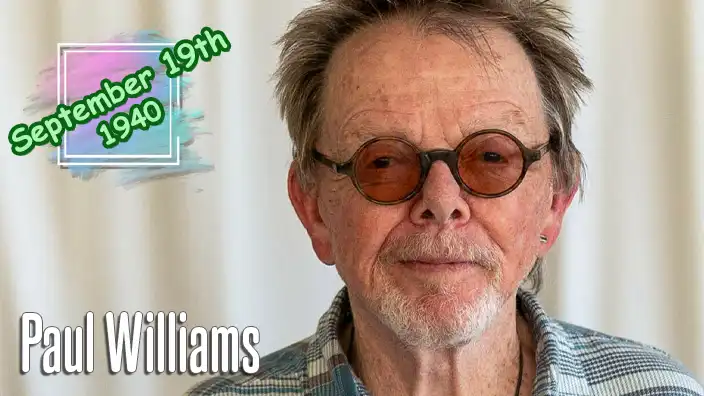
September 19, 1940, in Omaha, Nebraska
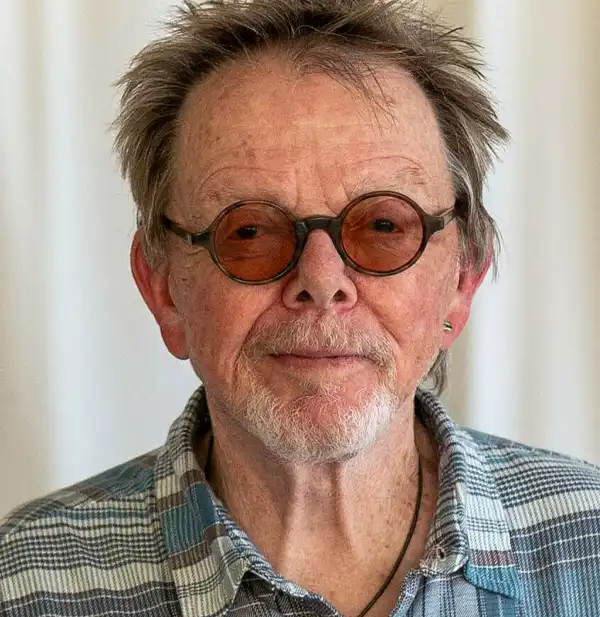
Paul Hamilton Williams Jr. was born on September 19, 1940, in Omaha, Nebraska. His father, Paul Hamilton Williams, was an architectural engineer, and his mother, Bertha Mae, was a homemaker. Williams's father died in an automobile accident when Paul was a teenager, after which the family circumstances changed dramatically. Williams eventually moved to California, where the entertainment business would provide him with a home — although it took a little while to decide precisely which corner of the entertainment business belonged to him.
His first ambition was acting. Williams pursued roles in Hollywood during the 1960s and appeared in the 1965 film The Loved One, but his diminutive stature made him difficult for casting directors to categorize as a conventional leading man. Hollywood's loss turned out to be popular music's considerable gain.
Williams discovered that songwriting did not care how tall the person sitting at the piano happened to be.
His emergence as a major songwriter was closely connected with composer Roger Nichols. Together, Nichols and Williams developed a songwriting partnership that produced some of the most recognizable soft-rock and pop recordings of the era. Williams supplied lyrics with an unusual ability to express complicated emotions in language that sounded simple and conversational, while Nichols provided melodies perfectly suited to them.
One of their earliest breakthroughs came from a very unlikely source: a bank commercial.
Williams and Nichols wrote “We've Only Just Begun” for a television advertisement promoting Crocker National Bank. The commercial featured a young couple beginning their married life, and the song accompanied images suggesting all the possibilities awaiting them.
Richard Carpenter saw the commercial and recognized that there was considerably more potential in the song than selling checking accounts.
The Carpenters recorded a full version, with Karen Carpenter's unmistakable voice turning it into one of the duo's defining recordings. Released in 1970, “We've Only Just Begun” became a major hit and eventually a standard. A song conceived for a bank advertisement had somehow become a popular wedding song.
Williams and Nichols supplied the Carpenters with another enduring hit, “Rainy Days and Mondays.” Once again, Karen Carpenter's melancholy delivery proved perfectly suited to Williams's lyrics. The partnership also produced “I Won't Last a Day Without You” and “Let Me Be the One.”
But the Carpenters were only part of the story.
Three Dog Night recorded Williams's “An Old Fashioned Love Song,” while Helen Reddy had success with “You and Me Against the World.” Williams's songs were subsequently recorded by an extraordinary range of performers, including Frank Sinatra, Elvis Presley, Ray Charles, Ella Fitzgerald, Tony Bennett, Diana Ross, Willie Nelson, Luther Vandross and David Bowie.
It is an impressive list.
Then there is Kermit the Frog.
Williams developed a particularly fruitful relationship with Jim Henson's Muppets. With composer Kenneth Ascher, he wrote the songs for The Muppet Movie in 1979. Among them was “Rainbow Connection,” performed by Kermit while sitting in a swamp with a banjo.
On paper, a frog singing quietly about dreams and rainbows does not necessarily sound like the raw material for a popular music standard.
Nobody told the frog.
“Rainbow Connection” became one of the most beloved songs associated with the Muppets and earned Williams and Ascher an Academy Award nomination for Best Original Song. Decades later, the song continues to be performed by artists far removed from children's entertainment, proof that Williams and Ascher had written something much larger than the scene for which it was created.
Williams's relationship with the Muppets continued through numerous projects. He wrote songs for The Muppet Christmas Carol, Emmet Otter's Jug-Band Christmas and later A Muppets Christmas: Letters to Santa. His musical sensibility suited Jim Henson's creations remarkably well: sincere without becoming syrupy, sentimental without being embarrassed about it, and usually carrying a quiet wink somewhere nearby.
Before Kermit, however, came one of Williams's most unusual achievements.
Brian De Palma's 1974 film Phantom of the Paradise was a bizarre mixture of The Phantom of the Opera, Faust, rock music, horror, satire and enough 1970s excess to make subtlety file for early retirement.
Williams wrote the film's songs and score and also played its villain, Swan, a powerful and manipulative record producer who controls musicians through contracts that make ordinary entertainment lawyers seem positively cuddly.
The film was not a major American box-office success on its original release, but it developed a devoted cult following. Williams's music received an Academy Award nomination for Best Original Song Score and Adaptation, further establishing him as a composer for film as well as a pop songwriter.
His greatest awards success arrived with another movie.
For the 1976 version of A Star Is Born, starring Barbra Streisand and Kris Kristofferson, Williams collaborated with Streisand on “Evergreen,” formally titled “Love Theme from A Star Is Born.” Streisand composed the music and Williams wrote the lyrics.
The song became a number-one hit and won the Academy Award for Best Original Song. Williams and Streisand also received the Grammy Award for Song of the Year.
Williams had gone from writing lyrics for a bank advertisement to accepting an Oscar in only a handful of years.
Fortunately, he was not remotely finished being peculiar.
Alongside his enormously successful songwriting career, Williams became one of the most recognizable television personalities of the 1970s. He appeared frequently on talk shows, variety programs and game shows, particularly The Tonight Show Starring Johnny Carson. His wit, distinctive appearance and willingness to poke fun at himself made him a natural television guest.
He also acted regularly.
In 1973, Williams disappeared beneath extensive makeup to play Virgil, an intelligent orangutan, in Battle for the Planet of the Apes. It is worth pausing to appreciate the career trajectory here. Williams could write songs for the Carpenters during the week and spend another day dressed as an ape discussing the future of civilization.
Show business used to offer tremendous variety.
Then came Smokey and the Bandit.
Williams played Little Enos Burdette, the son of wealthy Texan Big Enos Burdette, played by Pat McCormick. The two challenge Burt Reynolds's Bandit to illegally transport Coors beer from Texas to Georgia within a specified time, setting off one of cinema's great excuses for destroying police cars.
Little Enos was arrogant, irritating and wonderfully funny, and Williams returned to the role in the film's sequels. For audiences who had no idea he wrote some of the era's most romantic songs, Paul Williams was simply that aggravating little fellow in the cowboy hat making bets with Burt Reynolds.
He also wrote lyrics for another cultural institution of the period: The Love Boat. Charles Fox composed the music and Williams supplied the lyrics to the television show's theme. The result introduced viewers to Captain Stubing and his crew week after week while promising romance, adventure and the possibility that Charo might appear before the final commercial break.
Williams wrote the songs for the 1976 musical gangster film Bugsy Malone, in which children played Prohibition-era gangsters and fired cream-firing “splurge guns” at one another. The film starred a young Jodie Foster and Scott Baio and became especially popular in Britain. Once again, Williams demonstrated his unusual ability to write songs that worked for younger audiences without talking down to them.
His success during the 1970s was extraordinary, but the following decade brought serious personal difficulties. Williams has spoken openly about his problems with alcohol and drugs and the effect addiction had on both his personal life and career. As his substance abuse worsened, his once-constant public presence diminished dramatically.
Eventually, he entered recovery.
Sobriety did considerably more than rescue Williams personally. It opened an entirely new chapter of his life. He studied at UCLA and became a certified drug rehabilitation counselor, later working as an advocate for people dealing with addiction and recovery. His experiences became part of the book Gratitude and Trust: Six Affirmations That Will Change Your Life, written with Tracey Jackson.
Williams's career also began enjoying renewed attention.
The documentary Paul Williams Still Alive, directed by Stephen Kessler, examined the curious contrast between Williams's enormous 1970s celebrity and his later disappearance from mainstream public view. The title itself played with the reaction Kessler encountered when mentioning Williams: many people apparently assumed that because they had stopped seeing him constantly on television, he must have died.
He hadn't.
In fact, he was preparing another wonderfully unexpected career turn.
Daft Punk — the French electronic music duo famous for appearing publicly in robot helmets — invited Williams to collaborate on their 2013 album Random Access Memories. Williams co-wrote “Touch” and “Beyond” and performed vocals on “Touch.”
The collaboration sounded improbable only until one remembered that this was Paul Williams. A man who had written for Kermit the Frog, played an orangutan and antagonized Burt Reynolds was unlikely to be frightened by two robots.
Random Access Memories won the Grammy Award for Album of the Year, giving Williams another Grammy as a featured artist decades after his first major awards triumphs.
Meanwhile, Williams had become deeply involved in protecting the rights of songwriters and composers. In 2009, he was elected president and chairman of the board of ASCAP, the American Society of Composers, Authors and Publishers. His role placed him at the center of debates surrounding copyright, streaming, digital distribution and compensation for music creators.
It was an appropriate position for someone whose own work demonstrated exactly why songwriting matters. Performers change, formats change and technology changes, but a good song can keep earning new audiences long after the circumstances of its creation have been forgotten.
Williams was inducted into the Songwriters Hall of Fame in 2001. In 2022, the organization presented him with its Johnny Mercer Award, its highest honor for a songwriter or songwriting team already inducted into the Hall.
His catalogue is difficult to summarize because it occupies so many different corners of popular culture.
He helped give the Carpenters some of their defining songs. He wrote for Three Dog Night and Helen Reddy. He supplied Barbra Streisand with Oscar-winning lyrics. He gave Kermit the Frog one of the most enduring songs ever written for a film. He wrote for The Love Boat, Bugsy Malone and The Muppet Christmas Carol. He acted opposite Burt Reynolds and inside an ape costume. He became a recovery advocate, represented songwriters through ASCAP and eventually made an award-winning album with Daft Punk.
Few careers have traveled quite that route.
Paul Williams may have spent much of the 1970s joking about being the shortest fellow in the room, but when it came to American popular songwriting, he became one of the towering figures.
And somewhere, Kermit is still sitting on that log with his banjo.