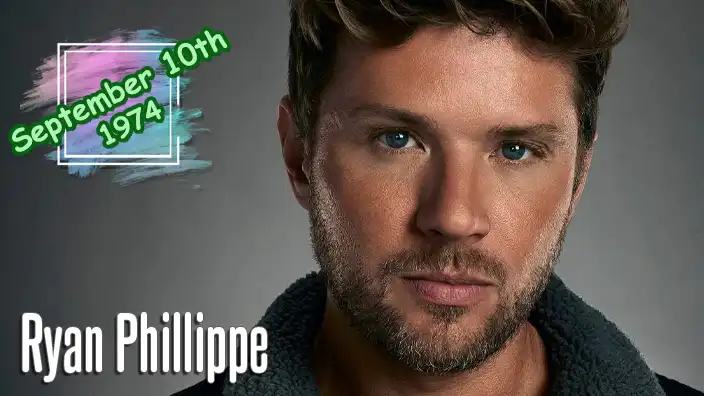
September 10, 1974, in New Castle, Delaware
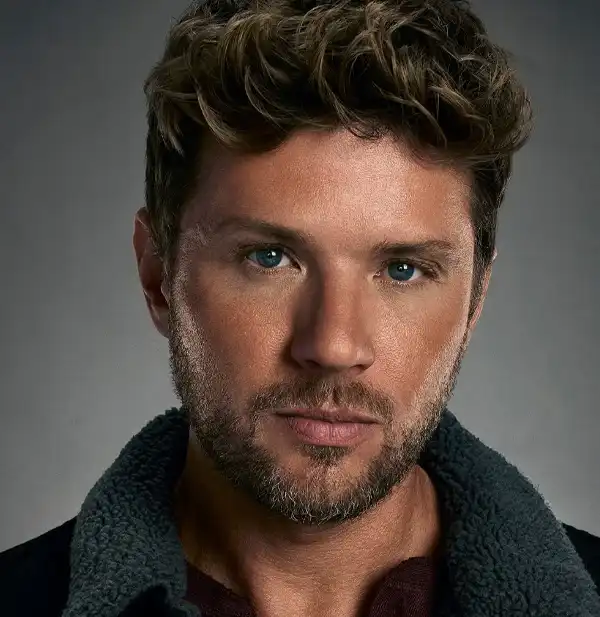
Ryan Phillippe was born Matthew Ryan Phillippe on September 10, 1974, in New Castle, Delaware. He grew up in a family with three sisters, and his parents, Susan and Richard Phillippe, worked as a nurse and a chemist, respectively. His childhood was spent far from the Hollywood world in which he would eventually become famous, although he developed an interest in acting while still young. As a teenager, he was discovered by a casting agent while getting his hair cut, an encounter that led to modeling and acting opportunities. It was an unusually convenient beginning to a career, particularly for anyone who has ever left a barbershop with nothing more exciting than a questionable haircut.
Phillippe attended New Castle Baptist Academy and became involved in acting during his teenage years. His early interest in performance eventually led him to New York, where he began pursuing professional opportunities. Like many young actors, he had to learn how to navigate auditions, casting decisions, and the uncertainty of an industry in which talent is important but timing can be equally decisive. His youthful appearance and natural screen presence helped him attract attention, but his early roles also required him to demonstrate that he could handle material beyond the conventional teenage heartthrob.
His first major television role came in 1992 when he joined the ABC daytime soap opera One Life to Live as Billy Douglas. The character was notable as one of the first openly gay teenagers portrayed on American daytime television, and the storyline addressed issues of sexuality, family acceptance, and prejudice. Phillippe’s performance attracted attention and gave him an important early opportunity to work with emotionally challenging material. The role also demonstrated that he was willing to take on characters whose stories carried social significance, rather than limiting himself to parts designed simply to make teenage viewers put his photograph on their bedroom walls.
After leaving One Life to Live, Phillippe moved to Los Angeles and began building his film career. He appeared in the 1995 submarine drama Crimson Tide, directed by Tony Scott and starring Denzel Washington and Gene Hackman. Although his role was relatively small, the film provided valuable experience on a major Hollywood production. He also appeared in White Squall in 1996, directed by Ridley Scott, playing one of the young men aboard a sailing ship whose voyage becomes a test of courage and survival. These early films introduced him to large-scale productions and established him as a promising young actor capable of working alongside established performers.
His breakthrough arrived in 1997 with I Know What You Did Last Summer, the horror thriller directed by Jim Gillespie and based on the novel by Lois Duncan. Phillippe played Barry Cox, one of four friends whose lives are transformed after they become involved in a fatal accident and attempt to conceal what happened. The film also starred Jennifer Love Hewitt, Sarah Michelle Gellar, and Freddie Prinze Jr., and became a major commercial success. It arrived during a renewed wave of teen-oriented horror films following the success of Scream, helping establish Phillippe as one of the recognizable faces of the genre.
Barry Cox was not the most sympathetic member of the group, but Phillippe’s performance gave the character a convincing mixture of arrogance, fear, and vulnerability. The film’s central premise relied on the consequences of a terrible decision, and Barry’s behavior often demonstrated how quickly panic can turn a bad situation into a much worse one. The role introduced Phillippe to a wide international audience and helped establish his reputation as a young actor capable of portraying characters whose attractive appearance concealed less appealing qualities. It also offered a useful cinematic lesson: if a mysterious person begins sending messages about a secret you thought was buried, it may be time to reconsider your holiday plans.
In 1998, Phillippe appeared in 54, a drama set against the backdrop of New York City’s legendary Studio 54 nightclub. He played Shane O’Shea, a young man from New Jersey who becomes involved in the glamorous and often destructive world of the late-1970s disco scene. The film featured Mike Myers as nightclub co-owner Steve Rubell, along with Salma Hayek and Neve Campbell. Although the original theatrical release received mixed reviews, the film later attracted renewed interest, particularly after a director’s cut restored material that had been removed from the initial version. Phillippe’s performance captured the fascination and disillusionment of a young man drawn into a world where fame, excess, and opportunity were closely intertwined.
The following year brought the film that would become one of the defining roles of his early career. In Cruel Intentions, released in 1999, Phillippe played Sebastian Valmont, a wealthy and manipulative teenager who becomes involved in a dangerous wager with his stepsister Kathryn Merteuil, played by Sarah Michelle Gellar. The film was a modern adaptation of Pierre Choderlos de Laclos’s eighteenth-century novel Les Liaisons dangereuses, relocating its themes of seduction, power, and betrayal to the world of privileged New York teenagers. Reese Witherspoon and Selma Blair also starred, creating an ensemble that would become closely associated with late-1990s popular culture.
Sebastian Valmont was a particularly important role for Phillippe because it required him to balance charm, arrogance, cruelty, and emotional vulnerability. The character begins as a confident manipulator who treats relationships as a game, but the story gradually exposes the limitations of his carefully constructed persona. Phillippe’s performance helped make Sebastian both objectionable and compelling, allowing audiences to understand the character without necessarily approving of his behavior. The film’s sharp dialogue, provocative themes, and memorable soundtrack contributed to its lasting popularity, while its central performances helped establish it as a cult favorite.
Cruel Intentions also became closely associated with Phillippe’s personal life because he and Reese Witherspoon, who played Annette Hargrove, were romantically involved during the production. The couple married in June 1999 and later had two children, Ava and Deacon. Their marriage attracted considerable media attention, particularly as both actors’ careers developed. They separated in 2006 and finalized their divorce in 2008, but have continued to share responsibilities as parents. Phillippe has generally emphasized the importance of family in his life, even while acknowledging the difficulties of maintaining personal relationships under the scrutiny of celebrity publicity.
The success of Cruel Intentions helped establish Phillippe as a leading actor, but he soon began seeking roles that would allow him to move beyond the teen-oriented films that had made him famous. In 2000, he starred in The Way of the Gun, a crime thriller written and directed by Christopher McQuarrie. Phillippe played Parker, one of two criminals who become involved in a kidnapping scheme that rapidly develops into a violent and complicated situation. The film also starred Benicio del Toro, Juliette Lewis, and James Caan, and offered Phillippe an opportunity to work in a darker, more adult genre.
He followed this with Antitrust in 2001, playing Milo Hoffman, a talented young computer programmer recruited by a powerful technology company whose activities prove considerably more sinister than they initially appear. The film explored themes of corporate power, intellectual property, and the dangers of placing too much trust in an organization that appears to offer the perfect career opportunity. Although the film received mixed reviews, it reflected the growing public interest in technology and the influence of major software companies. It also demonstrated that a young programmer in a Hollywood thriller should probably become suspicious when the company headquarters looks suspiciously like the headquarters of a supervillain.
Phillippe continued exploring different genres with Gosford Park in 2001, directed by Robert Altman. The ensemble mystery drama featured an extraordinary cast, including Maggie Smith, Michael Gambon, Kristin Scott Thomas, Helen Mirren, and Clive Owen. Phillippe played Henry Denton, an American actor posing as a Scottish valet while researching a role. The film’s intricate social relationships, upstairs-downstairs setting, and carefully observed dialogue provided a very different acting environment from the contemporary thrillers in which he had previously appeared. Gosford Park received widespread critical acclaim and won the Academy Award for Best Original Screenplay.
His work in Gosford Park demonstrated his ability to contribute to a large ensemble without relying on the leading-man status that had characterized some of his earlier films. The role required a degree of restraint and attention to the film’s social dynamics, while the character’s deception added another layer to the story’s exploration of class and identity. Working with Robert Altman also exposed Phillippe to a filmmaking approach that emphasized ensemble interaction and overlapping dialogue, offering valuable experience for an actor seeking to broaden his range.
In 2004, Phillippe appeared in The I Inside, a psychological thriller involving memory, identity, and a man attempting to understand the circumstances surrounding his own life. He also starred in Crash, the ensemble drama directed by Paul Haggis, playing Officer Tom Hansen, a young Los Angeles police officer whose experiences expose him to the film’s interconnected stories of racial tension, prejudice, and moral conflict. The film featured a large cast including Don Cheadle, Sandra Bullock, Matt Dillon, Thandiwe Newton, and Terrence Howard, and went on to win the Academy Award for Best Picture.
Crash became one of the most discussed films of its era, receiving both praise for its examination of social issues and criticism for its approach to race and storytelling. Phillippe’s character was central to several of the film’s moral dilemmas, particularly as he attempted to distinguish himself from the prejudices and behavior of other officers. The role required him to portray a man whose good intentions did not necessarily prevent him from making serious mistakes. It was a significant departure from the romantic and teen-thriller roles that had initially brought him fame, and it demonstrated his willingness to participate in challenging ensemble material.
In 2006, Phillippe starred in Flags of Our Fathers, directed by Clint Eastwood and based on the book by James Bradley and Ron Powers. He portrayed John “Doc” Bradley, a Navy corpsman associated with the famous photograph of the flag raising on Iwo Jima during the Second World War. The film explored the experiences of the men who became national symbols and the complicated relationship between wartime reality and public heroism. Phillippe’s performance required him to convey the emotional burden carried by a young serviceman who had experienced the violence of battle and then found himself presented to the public as a heroic figure.
The film was particularly demanding because it combined large-scale war sequences with quieter scenes examining memory, trauma, and the pressures of public expectation. Phillippe’s portrayal of Bradley contributed to the film’s exploration of the difference between the heroic image presented to the public and the experiences of the individuals involved. Flags of Our Fathers received critical recognition and demonstrated Phillippe’s ability to carry a serious historical drama under the direction of one of Hollywood’s most respected filmmakers.
He continued his work in historical drama with Breach in 2007, playing FBI agent Eric O’Neill opposite Chris Cooper as Robert Hanssen. The film was based on the real-life investigation into Hanssen, an FBI agent who had spent years spying for the Soviet Union and Russia. Phillippe’s character was assigned to work with Hanssen while secretly helping investigators gather evidence against him. The role required a restrained performance built around tension, observation, and the psychological pressure of maintaining a deception in close proximity to a dangerous and highly intelligent suspect.
Breach received positive reviews, with particular praise for Chris Cooper’s performance and the film’s controlled atmosphere. Phillippe’s work provided an effective counterbalance, portraying a young agent whose professional responsibilities placed him in an increasingly difficult position. The film demonstrated that suspense does not always require car chases or explosions; sometimes it can be created by two men sitting in an office, one of whom knows considerably more than he is supposed to, while the other is trying very hard not to look nervous.
Phillippe’s later film work included Stop-Loss in 2008, directed by Kimberly Peirce, in which he played a soldier returning from Iraq who faces the possibility of being sent back into military service. The film explored the effects of war on service members and their families, as well as the controversial military policy from which it took its title. He also appeared in Franklyn in 2008, MacGruber in 2010, and The Lincoln Lawyer in 2011, continuing to move between independent productions, thrillers, and more commercially oriented films.
In The Lincoln Lawyer, Phillippe played Louis Roulet, a wealthy client accused of assault, opposite Matthew McConaughey as defense attorney Mickey Haller. The film, based on Michael Connelly’s novel, became a critical and commercial success. Phillippe’s performance required him to portray a character whose polished appearance and privileged background concealed a more troubling personality. It was a role that made effective use of his ability to suggest that a seemingly respectable person might be considerably less trustworthy than he appeared. Once again, Hollywood had discovered that Ryan Phillippe could make a charming smile look like evidence that someone should call their lawyer.
He also appeared in The Bang Bang Club in 2010, portraying real-life photojournalist Greg Marinovich in a drama about photographers covering the violence surrounding South Africa’s transition from apartheid. The film explored the ethical and emotional challenges faced by journalists documenting conflict, as well as the personal consequences of working in dangerous environments. Phillippe’s performance reflected his continuing interest in roles based on real events and characters confronting difficult moral circumstances.
Television became an increasingly important part of his career during the 2010s. In 2015, he starred in the ABC mystery series Secrets and Lies, playing Ben Crawford, a family man who becomes the principal suspect in a child’s murder investigation. The series followed the consequences of the accusation as Ben’s personal life and relationships came under intense scrutiny. Phillippe’s performance centered on a character attempting to maintain his innocence while facing public suspicion and the gradual collapse of his ordinary life. The role allowed him to explore sustained psychological tension across an entire television season.
In 2016, Phillippe took on the lead role in Shooter, the USA Network action thriller based on Stephen Hunter’s Bob Lee Swagger novels and the 2007 film starring Mark Wahlberg. He played Bob Lee Swagger, a former Marine sniper who becomes involved in a conspiracy after being recruited to help prevent an assassination. The series combined action, political intrigue, and military themes, giving Phillippe a physically demanding role that required extensive preparation. He also served as a producer on the series, becoming involved in aspects of the production beyond his performance.
Shooter ran for three seasons and became one of Phillippe’s most substantial television projects. The role required him to portray a character with specialized military skills, a strong sense of loyalty, and a determination to protect his family while navigating dangerous conspiracies. Phillippe undertook firearms and physical training for the part, and the series allowed him to develop the character over an extended period. It also demonstrated his ability to carry an action-oriented television production, a different challenge from the ensemble dramas and independent films that had occupied much of his earlier career.
His television work continued with appearances in Big Sky, the ABC crime drama created by David E. Kelley, and MacGruber, the Peacock series based on the comedy character played by Will Forte. Phillippe reprised his role as Dixon Piper in the latter, returning to the deliberately absurd world of the action-comedy parody. The contrast between Shooter and MacGruber illustrated his willingness to move between serious action and broad comedy, even when the two genres required very different approaches to performance. One involved carefully planned tactical operations; the other involved a character whose plans were considerably less likely to survive contact with reality.
Phillippe has also worked as a director and producer. He made his feature directorial debut with Catch Hell, released in 2014, a thriller in which he also starred as an actor who is kidnapped while working on a film in Louisiana. The project allowed him to explore filmmaking from behind the camera and take greater control over the creative process. Directing presented a different set of responsibilities from acting, requiring him to consider the entire production rather than focusing primarily on one character. It also provided an opportunity to discover that the person responsible for making every difficult decision on a film set is not always the person who gets to leave early.
His more recent film work has included The 2nd, One Shot, American Murderer, and Summit Fever, demonstrating his continued interest in action, thriller, and independent projects. He has also remained active in television and streaming productions, adapting to an entertainment industry in which opportunities increasingly extend beyond traditional theatrical releases. His career has been characterized by a willingness to take on different kinds of roles rather than relying exclusively on the youthful image that first made him famous.
Outside acting, Phillippe has maintained an interest in fitness, martial arts, and physical training, activities that have also supported his work in action-oriented roles. He has spoken about the importance of exercise and maintaining a disciplined routine, particularly as the physical demands of certain productions have increased. He is also a father of three children: Ava and Deacon, from his marriage to Reese Witherspoon, and Kai, from a later relationship with Alexis Knapp. His family life has remained an important part of his personal identity, even as his professional career has continued to evolve.
Phillippe’s public image has changed considerably since the late 1990s, when he was frequently described as a teen idol or heartthrob. While those labels helped establish his early popularity, they also created expectations that could be difficult to escape. His later work in films such as Gosford Park, Crash, Flags of Our Fathers, and Breach demonstrated his ability to handle more complex material, while his television roles allowed him to explore characters over longer periods. His career illustrates the challenges faced by actors who become famous young and must then persuade audiences and casting directors to see them in a different light.
The longevity of his career is particularly notable given the rapid changes in the entertainment industry since his debut. Phillippe began working professionally during an era when daytime television and theatrical films were among the principal routes to recognition. He later experienced the rise of cable drama, streaming services, and the increasing importance of international distribution. His ability to move between these different environments has allowed him to remain active across several decades, even as the types of projects available to actors have changed.
Ryan Phillippe’s legacy is closely associated with the films that helped define late-1990s popular culture, but his career extends well beyond that period. I Know What You Did Last Summer and Cruel Intentions remain important parts of his filmography, while his later performances have demonstrated a broader range that includes historical drama, crime thrillers, action, and television. His work reflects the persistence required to build a lasting career in an industry that often moves quickly from one generation of young stars to the next.
On September 10, his birthday offers an opportunity to revisit the performances that made him famous and explore the many roles that followed. Whether watching the teenage suspense of I Know What You Did Last Summer, the dangerous romantic games of Cruel Intentions, the wartime drama of Flags of Our Fathers, or the action of Shooter, audiences can appreciate an actor who has continued to develop beyond his early image. And if his films offer one useful lesson, it is that when Ryan Phillippe’s character appears charming, wealthy, and completely trustworthy, it may be wise to wait until the final act before making up your mind.