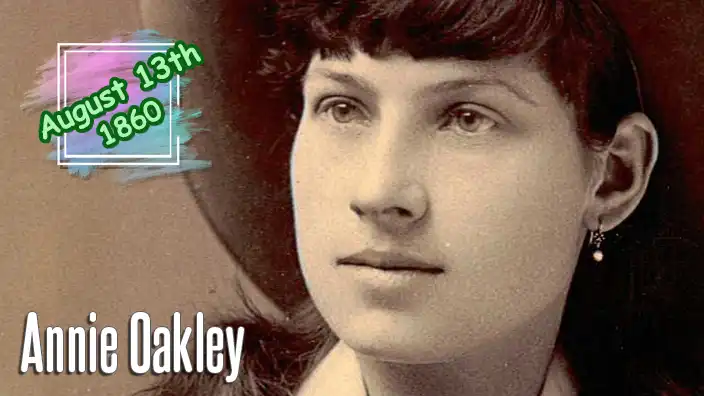
August 13, 1860, in Darke County, Ohio
 Greenville, Ohio, on November 3, 1926
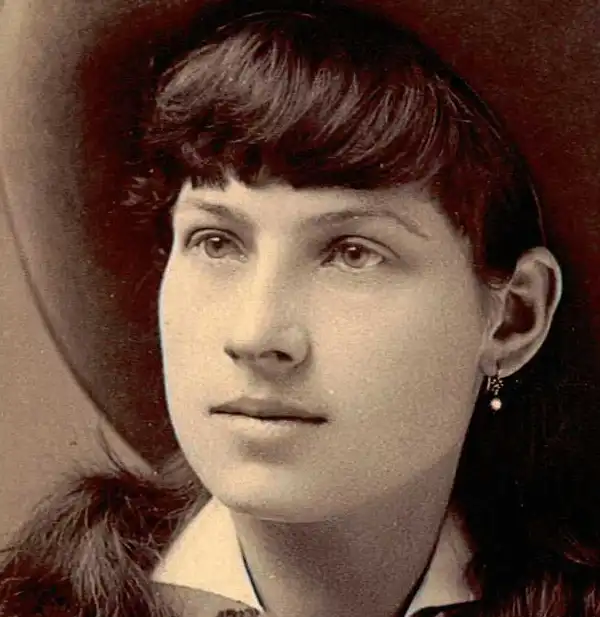
Annie Oakley didn't need to swagger into a saloon, challenge the local outlaw and dramatically push back her hat before reaching for a revolver. Give her a rifle, a few playing cards and something inconveniently small flying through the air, and she'd take care of the entertainment herself. She became internationally famous by shooting targets most people would have difficulty seeing, all while maintaining the sort of polite composure suggesting she might apologize afterward for making everybody else look bad.
Phoebe Ann Moses was born on August 13, 1860, in Darke County, Ohio, to Jacob and Susan Moses. The girl who would become internationally famous as Annie Oakley entered the world far removed from theatrical stages, European royalty and Buffalo Bill's celebrated Wild West exhibition. Her childhood was difficult, particularly after her father died while she was still young, leaving her mother struggling to support a large family. Her mother remarried, but her second husband also died, creating further financial hardship.
The family became desperately poor, and young Annie learned very quickly that putting food on the table was not an abstract adult problem. She began trapping and hunting while still a child and became such an accurate hunter that she was able to supply game to local residents, shops, hotels and restaurants. Rather than simply helping feed her family, her shooting ability became a source of income. While other children were learning ordinary household responsibilities, Annie was developing the skill that would eventually make her one of the world's most recognizable performers.
Her childhood also included a particularly grim period when she was sent to work for another family. Oakley later referred to them as "the wolves" and described being physically and emotionally abused while living with them. She eventually escaped that situation and returned to her family, where shooting remained one of the few reliable ways she could contribute financially. Her extraordinary accuracy soon became well known locally.
Then Frank Butler came to town.
Butler was a professional exhibition shooter who traveled around the country performing and accepting challenges from local marksmen. During a visit to the Cincinnati area, a shooting match was arranged between Butler and the teenage Annie. Presumably Butler expected another straightforward victory. Instead, Oakley hit all 25 of her targets while Butler missed one.
Annie won.
It is difficult to imagine a more appropriate beginning to their relationship. Frank Butler arrived expecting to demonstrate his superiority with a firearm and instead discovered that the teenage girl standing opposite him could outshoot him. He apparently took the defeat rather well because the two became romantically involved and married. Their marriage would last approximately half a century, developing into both a personal and professional partnership.
In an era when successful husbands generally expected their wives to remain in supporting roles, something interesting happened between Frank Butler and Annie Oakley: Frank realized his wife was better. Instead of resenting her ability or attempting to compete with her, Butler increasingly supported Oakley's career, eventually becoming her assistant and manager. It was an extraordinarily effective partnership.
Oakley initially appeared as Butler's assistant in his shooting act. When his regular partner became unavailable, Annie stepped into a larger performing role, and audiences quickly noticed her. She possessed extraordinary accuracy and gradually developed an exhibition routine filled with seemingly impossible shots. She could hit glass balls thrown into the air, shoot objects while looking into a mirror, split playing cards and strike extremely small moving targets.
One of her celebrated demonstrations involved shooting a playing card edge-on. Most people would have been pleased to hit the card. Oakley apparently regarded the broad side as unnecessarily generous. She became skilled at shooting while standing in unusual positions and performing tricks specifically designed to demonstrate that ordinary marksmanship was simply too easy.
Her stage presentation was equally distinctive. Oakley did not dress like a stereotypical gunslinger. She generally wore modest outfits, often homemade and decorated in a Western style, presenting herself as respectable, feminine and approachable. That image mattered because late 19th-century America maintained very restrictive ideas about what women should and should not do, and shooting firearms professionally while traveling around the world was not high on the conventional list of acceptable female occupations.
Oakley found a way to challenge those expectations without publicly rejecting femininity. She could dress modestly, behave politely and then proceed to outshoot practically every man standing nearby. It was difficult to argue with the results.
In 1884, Oakley met the famous Lakota leader Sitting Bull, who had become internationally known following the Battle of the Little Bighorn and later toured as part of Buffalo Bill Cody's Wild West exhibition. After watching Oakley's shooting, Sitting Bull was deeply impressed by her skill. He developed an affectionate relationship with her and reportedly gave her the name "Little Sure Shot," a nickname that followed her for the remainder of her career and was certainly accurate.
In 1885, Oakley and Butler joined Buffalo Bill's Wild West, and that changed everything. William F. "Buffalo Bill" Cody had created one of the most successful entertainment spectacles of the late 19th century. His enormous traveling exhibition presented romanticized versions of frontier life, combining riding demonstrations, shooting exhibitions, reenactments, Native American performers, cowboys, horses and elaborate theatrical spectacles. It was not a circus in the conventional sense, although modern audiences often describe it that way. Buffalo Bill called it the Wild West.
Annie Oakley became one of its biggest stars. Audiences were fascinated by the contrast between her appearance and her ability. She was barely five feet tall, politely mannered and often smiling. Then she picked up the gun.
Oakley's exhibitions included a remarkable variety of trick shots. She shot targets thrown into the air, hit objects behind her using a mirror and demonstrated extraordinary speed and precision. One particularly famous trick involved Frank Butler holding a playing card while Annie shot it. Another involved shooting a cigarette held in someone's mouth, with Frank occasionally participating in that demonstration too.
Marriage requires trust. The Butler-Oakley version simply required considerably more than most. There are husbands who complain about taking out the garbage. Frank Butler allowed his wife to fire bullets toward his face for a living.
Oakley's fame expanded rapidly through Buffalo Bill's Wild West, and she became an international celebrity. The company traveled to Europe, where she performed before enormous crowds and members of royalty. In 1887, Buffalo Bill's Wild West traveled to Britain during celebrations associated with Queen Victoria's Golden Jubilee, bringing an American frontier spectacle directly to European audiences fascinated by romantic images of the American West.
According to one famous story, Oakley performed for Crown Prince Wilhelm of Germany, who later became Kaiser Wilhelm II. Wilhelm reportedly volunteered to hold a cigarette while Oakley shot it from his mouth, and she successfully hit the cigarette. Years later, after Germany and the United States found themselves on opposing sides during World War I, Oakley was said to have regretted not having missed. The story accumulated embellishments over time, as good stories involving royalty, guns and cigarettes tend to do, but the shooting demonstration itself became an enduring part of Oakley folklore.
Her European appearances transformed her into something larger than an American entertainment celebrity. She became an international symbol of the American West, although Oakley herself was considerably more complicated than the frontier mythology surrounding Buffalo Bill's production.
Oakley strongly supported teaching women to shoot. For her, firearms proficiency was not merely entertainment; she believed women could benefit from knowing how to defend themselves and encouraged them to learn shooting skills. She reportedly instructed thousands of women during her lifetime. Her philosophy was straightforward: women were perfectly capable of learning skills traditionally reserved for men. She had, after all, spent most of her professional life proving the point in public.
Oakley also offered her services to the United States government. During the Spanish-American War, she proposed organizing a group of female sharpshooters to assist the military, but the government declined. Later, during World War I, she again offered to help, including training American soldiers in marksmanship. Again, the government declined. One suspects Annie Oakley was accustomed to people underestimating women and had long since stopped being surprised by it.
Her long association with Buffalo Bill's Wild West eventually ended following an accident. In 1901, Oakley was injured in a train wreck involving the company, and the accident contributed to her decision to reduce the exhausting touring schedule that had dominated much of her adult life. She later appeared on stage in a melodrama called The Western Girl, playing a character who used a pistol, rifle and rope to rescue others. This probably did not require a tremendous amount of imaginative casting.
Then, in 1903, Oakley faced a very different opponent. Newspapers began publishing a sensational story claiming that Annie Oakley had been arrested in Chicago for stealing in order to support a cocaine habit. There was one significant problem: it wasn't Annie Oakley. The woman involved had reportedly used Oakley's name, and newspapers around the country repeated the story.
Oakley was furious. Her reputation had been built over decades around discipline, professionalism and respectable public behavior, and the allegation threatened everything she had carefully created. So Annie did something about it.
She sued.
Oakley pursued libel cases against newspapers that had printed the false story, spending years attempting to clear her name. She ultimately prevailed in the overwhelming majority of the cases she pursued. The litigation reportedly cost her considerable money, sometimes more than she recovered in damages, but money was not the central issue. Her reputation was.
William Randolph Hearst's newspaper organization had been among those publishing the allegations, making Oakley's legal battle part of a larger confrontation with the sensational journalism of the period. She might have been only about five feet tall, but newspaper publishers learned that Annie Oakley was considerably more dangerous when somebody handed her a lawyer.
Oakley and Butler continued performing and demonstrating shooting skills as they grew older. Even after major injuries, she repeatedly returned to shooting. In 1922, the couple was involved in a serious automobile accident that left Oakley requiring extensive recovery, yet she eventually resumed shooting. Reports from her later years describe her continuing to demonstrate astonishing accuracy despite her age and physical setbacks. The woman simply did not appear particularly interested in becoming ordinary.
Annie and Frank had no children, but their marriage endured through decades of constant travel, performances, business pressures, injuries and celebrity. Frank's willingness to support his wife's superior professional abilities remains one of the most appealing parts of their story. He had begun as the professional marksman. She defeated him, married him and became the star while he helped manage her career. There is something wonderfully uncomplicated about that progression.
Oakley's health declined during the 1920s, and she eventually returned to Ohio. Annie Oakley died on November 3, 1926, in Greenville, Ohio, at the age of 66. Frank Butler was devastated and died only weeks later. They had spent approximately 50 years together.
By the time of her death, Annie Oakley had become far more than an exhibition shooter. She was part of American folklore, and her fame continued through books, movies, television programs and stage productions. The Broadway musical Annie Get Your Gun, with music and lyrics by Irving Berlin, premiered in 1946 and helped introduce a heavily fictionalized version of Oakley's story to another generation.
The musical produced enduring songs including "There's No Business Like Show Business" and "Anything You Can Do." The latter is particularly appropriate for Annie Oakley. Anything you can do, she could quite possibly do better — at least if it involved a firearm.
Hollywood also repeatedly portrayed Oakley, transforming her into an increasingly romanticized Western character. The real Annie Oakley, however, did not need much embellishment. She rose from severe childhood poverty by developing an extraordinary practical skill, supported her family through hunting, defeated a professional marksman, married him, became the star while he became her manager, joined one of the largest entertainment spectacles of her era and performed before royalty.
She traveled internationally, advocated teaching women to shoot, challenged conventional assumptions about women's abilities and, when newspapers falsely accused her of criminal behavior, spent years making them answer for it in court. That is enough material without Hollywood adding anything.
Oakley's importance also extends beyond marksmanship. At a time when women lacked many basic legal and political rights, she demonstrated female independence before enormous audiences. She earned her own money, possessed a highly specialized professional skill and became more famous than her husband — while her husband supported her success.
Yet Oakley did not consider herself a radical social revolutionary. Her views did not always align neatly with the developing women's rights movements of her time, and her public image remained deliberately traditional in many respects. That contradiction makes her more historically interesting. She expanded the boundaries of what women could publicly accomplish while presenting herself in a manner acceptable enough to contemporary audiences that they enthusiastically paid to watch her do it.
She did not need to lecture an audience about whether a woman could compete with men. She picked up a rifle, and the argument tended to end shortly afterward.
The mythology of the American West contains countless gunfighters, cowboys, lawmen and outlaws whose reputations became considerably larger than their documented accomplishments. Annie Oakley presents almost the opposite problem. Strip away the exaggerations and theatrical mythology and the documented woman underneath remains extraordinary.
She really was that good. She really did become internationally famous, and she really did outperform male marksmen while building a career that lasted for decades.
Annie Oakley began life as Phoebe Ann Moses, a poor Ohio girl who learned to hunt because her family needed food and money. She ended it as one of the most famous American women of her generation.
The distance between those two lives was enormous.
Fortunately, Annie Oakley rarely missed.