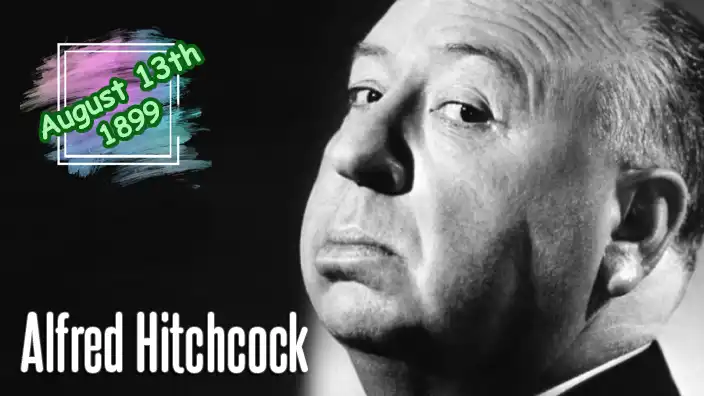
August 13, 1899, in London, England
 April 29, 1980, in Bel Air, California
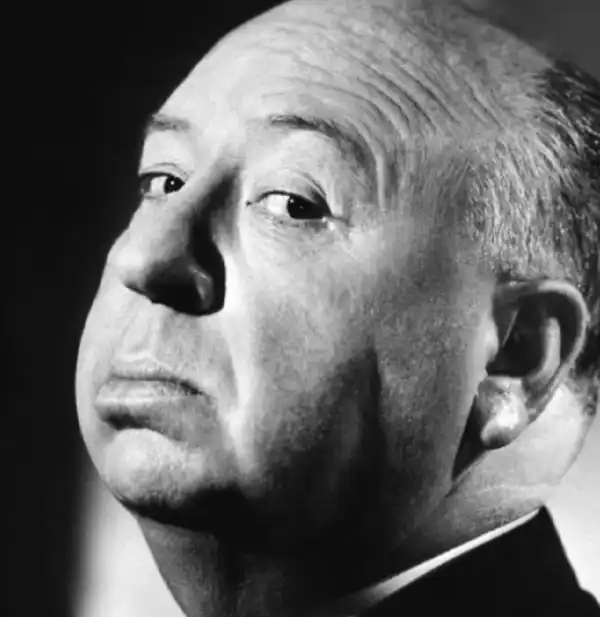
Alfred Hitchcock understood that frightening an audience did not necessarily require monsters, explosions or somebody waving a knife around for two hours. Sometimes all you needed was a shower curtain, a flock of birds, an apartment window, a suspicious husband or Cary Grant being chased across an empty field by an airplane. Hitchcock could turn perfectly ordinary things into reasons to reconsider leaving the house, and he usually did it while looking as though he had just been mildly inconvenienced by lunch.
Alfred Joseph Hitchcock was born on August 13, 1899, in Leytonstone, then part of Essex and now within Greater London. He was the youngest child of William Hitchcock, a greengrocer and poultry dealer, and Emma Jane Hitchcock. The family was Roman Catholic, and Hitchcock attended Catholic schools, including St. Ignatius College in London.
His childhood has become surrounded by stories that seem almost suspiciously appropriate for the future director of Psycho. One of the best known involves Hitchcock claiming that when he was a small boy, his father sent him to a local police station carrying a note. According to Hitchcock, an officer read the note, locked the boy briefly in a cell and then released him with a warning about what happened to people who behaved badly. Hitchcock later said the experience contributed to his lifelong fear of the police.
Whether every detail survived childhood memory untouched is difficult to know, but fear, guilt, punishment and innocent people trapped by circumstances would eventually become recurring themes throughout his filmmaking.
Hitchcock initially trained in technical subjects rather than filmmaking. He studied engineering and navigation and later worked for the Henley Telegraph and Cable Company. He became interested in art and design and eventually moved into advertising work, developing visual skills that would prove useful once he entered the rapidly expanding film industry.
His movie career began during the silent era. Around 1920, Hitchcock started working for the London branch of the American company Famous Players-Lasky, designing title cards for silent films. It was an ideal apprenticeship because filmmaking at the time required employees to perform numerous jobs rather than staying within rigid specialties. Hitchcock learned about writing, art direction, editing, production and eventually directing.
He worked his way through the British film industry during the 1920s, serving as assistant director, screenwriter and art director before receiving directing opportunities of his own. His first completed feature as director was The Pleasure Garden, made in the mid-1920s, although its release history was complicated.
The film that began establishing the recognizable Hitchcock style was The Lodger: A Story of the London Fog in 1927. The silent thriller concerned a mysterious lodger suspected of being a serial killer. It contained themes Hitchcock would revisit repeatedly: suspicion, mistaken assumptions, sexual anxiety, danger hidden within ordinary surroundings and an innocent or possibly innocent man caught in circumstances beyond his control.
The Lodger also contributed another Hitchcock tradition almost by accident. Hitchcock appeared briefly onscreen because an extra was needed during production. Over the years, these appearances evolved into one of his most famous trademarks. He ultimately made cameo appearances in roughly 40 of his films, sometimes walking through a scene, boarding transportation, carrying an instrument or simply occupying the background long enough for attentive viewers to spot him.
The cameos eventually became so popular that Hitchcock worried audiences would spend the first half of a movie waiting for him instead of paying attention to the story. He therefore began placing many of his appearances near the beginning. Few directors have ever faced the problem of being too distracting merely by walking across their own set.
Hitchcock's reputation continued growing with early sound films including Blackmail, released in 1929 and frequently described as Britain's first successful feature-length sound film. He quickly demonstrated that sound could be used for more than recorded dialogue. In Hitchcock's hands, noises, repeated words, music and sudden silence could all become tools for manipulating tension.
During the 1930s, he directed a remarkable sequence of British thrillers that attracted international attention. The Man Who Knew Too Much, The 39 Steps, Sabotage and The Lady Vanishes established many ingredients associated with Hitchcock: ordinary people caught in extraordinary danger, espionage, mistaken identity, trains, sinister strangers and carefully controlled suspense.
The 39 Steps became particularly influential. Its story follows a seemingly ordinary man accused of murder who must flee across Britain while attempting to expose a spy organization. The plot involves a device Hitchcock often called the "MacGuffin," something extremely important to the characters but not necessarily important to the audience beyond its ability to propel the story forward.
Hitchcock eventually attracted the attention of Hollywood producer David O. Selznick and moved to the United States at the end of the 1930s. His first American film was Rebecca, released in 1940 and starring Laurence Olivier and Joan Fontaine. Based on Daphne du Maurier's novel, the atmospheric psychological drama told the story of a young woman haunted by the memory of her husband's dead first wife.
Rebecca won the Academy Award for Best Picture, although Hitchcock himself did not receive the directing Oscar. That would become one of the great curiosities of Academy Awards history: one of cinema's most celebrated directors was nominated five times for Best Director but never won the competitive award. His directing nominations came for Rebecca, Lifeboat, Spellbound, Rear Window and Psycho.
Fortunately, Hitchcock did not require a small gold statue to prove he knew which end of a camera was which.
Throughout the 1940s, he directed films including Foreign Correspondent, Suspicion, Shadow of a Doubt, Lifeboat, Spellbound, Notorious and Rope. These films demonstrated his growing fascination with psychologically complicated characters and morally uncertain situations.
Shadow of a Doubt, released in 1943, was particularly important to Hitchcock, who repeatedly identified it as one of his personal favorites. The film concerns a young woman gradually discovering that her charming Uncle Charlie may actually be a murderer. Hitchcock transformed an apparently peaceful American town into a place where evil could arrive by train wearing a good suit and behaving politely.
Notorious, released in 1946 and starring Ingrid Bergman and Cary Grant, combined espionage with a complicated romantic relationship. Hitchcock repeatedly demonstrated that suspense worked best when audiences cared about the people involved. A locked door or hidden key becomes considerably more exciting when the emotional consequences of discovering what lies beyond it matter just as much as the physical danger.
By the 1950s, Hitchcock entered what many critics regard as the most celebrated period of his career. He worked repeatedly with major stars including James Stewart, Cary Grant, Grace Kelly and Ingrid Bergman, and his films became increasingly elaborate exercises in visual storytelling.
Strangers on a Train appeared in 1951, built around the chilling proposition that two strangers could exchange murders, eliminating the obvious motive connecting each killer to the victim. It was exactly the kind of premise Hitchcock enjoyed: simple enough to explain in one sentence and psychologically unpleasant enough to occupy an entire movie.
In 1954 came Rear Window, starring James Stewart as photographer L.B. "Jeff" Jefferies, temporarily confined to his apartment with a broken leg. Bored, Jeff watches the neighbors through their windows and gradually becomes convinced that one of them has murdered his wife.
The film turns the audience into Jeff's accomplice. We know he should probably stop watching his neighbors, yet naturally we continue watching him watch them. Hitchcock understood voyeurism particularly well and repeatedly explored the uneasy relationship between looking, curiosity and guilt. The British Film Institute has highlighted voyeurism as a major concern running through films including Rear Window, Psycho and Vertigo.
Grace Kelly starred opposite Stewart in Rear Window and appeared in two other Hitchcock films, Dial M for Murder and To Catch a Thief. Hitchcock became famous for casting elegant, seemingly controlled blonde actresses whose characters often found themselves facing danger, obsession or secrets beneath beautifully composed surfaces.
In 1955, Hitchcock expanded his celebrity through television with Alfred Hitchcock Presents. Each episode opened with his famous silhouette and deadpan introduction, allowing Hitchcock to transform himself from director into television personality.
His introductions often involved macabre jokes delivered with complete seriousness. Hitchcock's distinctive voice, solemn expression and ability to discuss murder as though explaining a minor inconvenience made him enormously popular. The program helped make him one of the most recognizable filmmakers in the world, even among viewers who might not have known what a director actually did.
Then came Vertigo.
Released in 1958 and starring James Stewart and Kim Novak, Vertigo follows former police detective Scottie Ferguson, whose fear of heights becomes entangled with obsession, identity and psychological manipulation. The film was not universally embraced when first released, but its reputation grew enormously over subsequent decades.
In the British Film Institute's 2012 Sight and Sound critics' poll, Vertigo was voted the greatest film of all time, replacing Orson Welles's Citizen Kane, which had occupied the top position for decades.
Hitchcock followed it with North by Northwest in 1959, one of the most entertaining examples of the innocent-man-in-danger story he had refined throughout his career. Cary Grant plays advertising executive Roger Thornhill, who is mistaken for a government agent and pursued across the country.
The movie contains several sequences that have become part of cinema history, including Grant being chased by a crop-dusting airplane across an almost completely empty landscape and the climactic pursuit across Mount Rushmore.
It is difficult to imagine another filmmaker looking at Mount Rushmore and thinking, "Wonderful. Now somebody should nearly fall off it."
In 1960, Hitchcock released Psycho, and taking a shower in a motel would never again seem quite as routine.
The film starred Janet Leigh as Marion Crane, a secretary who steals money and stops overnight at the remote Bates Motel, where she encounters the shy and unsettling Norman Bates, played by Anthony Perkins.
Hitchcock deliberately challenged audience expectations. Janet Leigh was the movie's major established star, yet her character was killed relatively early in the story during the now-famous shower sequence. Audiences accustomed to following the leading character through an entire film suddenly had no idea what would happen next.
The shower scene became one of the most analyzed sequences in cinema. Hitchcock combined rapid editing, carefully framed images and Bernard Herrmann's shrieking string score to suggest considerably more violence than the camera actually showed. The scene demonstrated Hitchcock's understanding that the audience's imagination could frequently produce something more disturbing than explicit imagery.
Psycho also benefited from one of Hitchcock's most successful publicity campaigns. He insisted that audiences not be admitted after the film began, helping generate curiosity and encouraging people to see the movie from the beginning rather than casually wandering into theaters midway through a screening.
Norman Bates and the Bates Motel became permanent fixtures of popular culture, while Hitchcock once again proved capable of transforming an everyday location into somewhere audiences might suddenly prefer not to visit.
Three years later, he performed a similar trick with birds.
The Birds, released in 1963 and starring Tippi Hedren and Rod Taylor, begins almost casually before birds inexplicably begin attacking people in the California coastal town of Bodega Bay. Hitchcock never provides a comforting explanation for the attacks.
That absence of explanation is part of what makes the film unsettling. There is no villain to arrest, secret organization to expose or monster whose weakness can conveniently be discovered during the final reel. The birds simply attack.
Suddenly every seagull in the parking lot looked suspicious.
Hitchcock continued directing through the 1960s and 1970s with films including Marnie, Torn Curtain, Topaz, Frenzy and Family Plot. While not every later film achieved the impact of his celebrated 1950s and early-1960s work, Frenzy in 1972 was widely regarded as a strong return to darker thriller territory.
Family Plot, released in 1976, became Hitchcock's final completed film.
His influence on filmmaking extends far beyond individual titles. Hitchcock meticulously planned sequences before shooting, using storyboards and careful visual design to determine where the audience would look and what information they would receive. Suspense depended not simply upon what happened but upon when the audience learned something.
One of his most famous explanations distinguished suspense from surprise. If a bomb unexpectedly explodes, audiences experience a brief shock. If audiences know there is a bomb beneath a table while the characters continue an ordinary conversation without knowing it, the same situation can create several minutes of tension.
That principle became fundamental to Hitchcock's filmmaking. He often gave audiences enough information to worry while withholding just enough to keep them uncertain.
His movies repeatedly explored recurring themes: mistaken identity, wrongful accusation, voyeurism, guilt, sexuality, obsession, respectable people hiding dangerous secrets and ordinary individuals suddenly trapped within circumstances they cannot control.
Hitchcock also understood the visual possibilities of cinema exceptionally well. Dialogue could explain what someone was thinking, but he frequently preferred camera movement, editing, framing, lighting and point-of-view shots to place audiences inside a character's experience.
The famous "Vertigo effect," created through a combination of camera movement and changing focal length, visually expresses Scottie's fear of heights and became one of the most widely imitated camera techniques in cinema.
Hitchcock's working methods and treatment of actors have also been extensively debated. His carefully controlled productions could be demanding, and later accounts from performers, particularly Tippi Hedren, raised serious questions about his behavior and exercise of power on set. Those accounts have complicated the popular image of the genial television host and are an important part of modern assessments of Hitchcock's career.
His relationship with his wife, Alma Reville, was central to his professional life. The pair married in 1926 and remained together until Hitchcock's death. Reville was an accomplished film editor, screenwriter and script supervisor whose judgment Hitchcock trusted enormously. She contributed to numerous productions, frequently reviewing scripts, performances and edits.
Their daughter, Patricia Hitchcock, became an actress and appeared in several of her father's projects, including Stage Fright, Strangers on a Train and Psycho.
As Hitchcock's reputation grew, so did formal recognition of his career. In 1968, the Academy of Motion Picture Arts and Sciences presented him with the Irving G. Thalberg Memorial Award. Hitchcock famously kept his acceptance remarks remarkably short.
He received the BAFTA Fellowship in 1971 and the American Film Institute's Life Achievement Award in 1979. AFI described Hitchcock as a filmmaker who had become almost without equal in the suspense genre.
Hitchcock was appointed a Knight Commander of the Order of the British Empire in the 1980 New Year Honours, making him Sir Alfred Hitchcock shortly before his death.
His health had declined during his final years, and plans for another film, The Short Night, were abandoned. Alfred Hitchcock died at his home in Bel Air, California, on April 29, 1980, at the age of 80. He was survived by Alma and their daughter Patricia.
By then, Hitchcock had already changed cinema.
His influence can be found throughout suspense, horror, mystery and psychological thrillers, but simply copying his plots was never enough. What filmmakers learned from Hitchcock was how carefully an audience could be manipulated through information, perspective, timing and expectation.
He understood that viewers participate in suspense. We worry because we know something the character doesn't know, or because we desperately want to know something Hitchcock refuses to reveal.
He also understood that humor and fear could coexist. Many Hitchcock films contain unexpectedly funny moments, often arriving when audiences are already uncomfortable. The laughter does not eliminate the tension; it frequently makes the tension stronger.
That combination mirrored Hitchcock's own public personality. He cultivated the image of a solemn, rotund English gentleman discussing murder, corpses and assorted unpleasantness with impeccable manners.
Even his famous silhouette became a piece of branding long before filmmakers routinely thought of themselves that way.
Generations of audiences learned to watch for Hitchcock's cameo, recognize his profile and imitate his slow, formal manner of speaking. Few directors before or since have achieved such public recognition.
Yet the films remain the real reason his reputation endures. Rebecca, Shadow of a Doubt, Notorious, Strangers on a Train, Rear Window, Vertigo, North by Northwest, Psycho and The Birds continue to be watched, discussed and studied many decades after their release.
Nine Hitchcock films have been selected for preservation in the United States National Film Registry, while several regularly appear on lists of the greatest films ever made.
That continuing popularity says something important about Hitchcock's approach to suspense. Technology changes. Fashion changes. Acting styles change. Audiences change.
But knowing that something terrible may happen in a moment while being completely unable to stop it?
That still works.
Alfred Hitchcock spent much of his career proving that the most frightening place in a movie is often not a haunted castle or distant planet. It might be the apartment across the courtyard, the motel beside the highway, the train compartment next door or an ordinary shower.
And if a portly gentleman in a dark suit happens to stroll through the background while you're worrying about it, you've probably found the director.