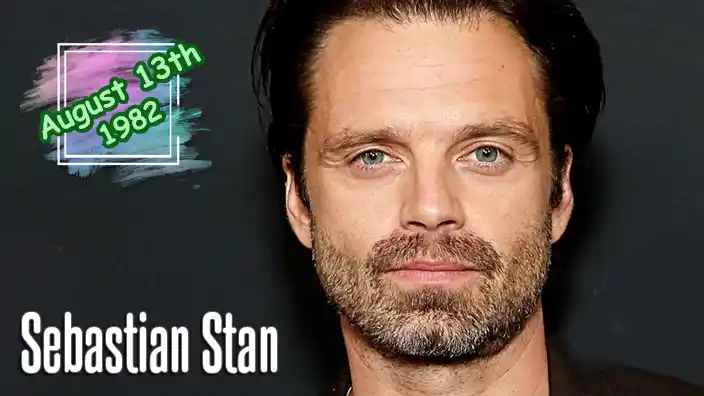
August 13, 1982, in Constanța, Romania
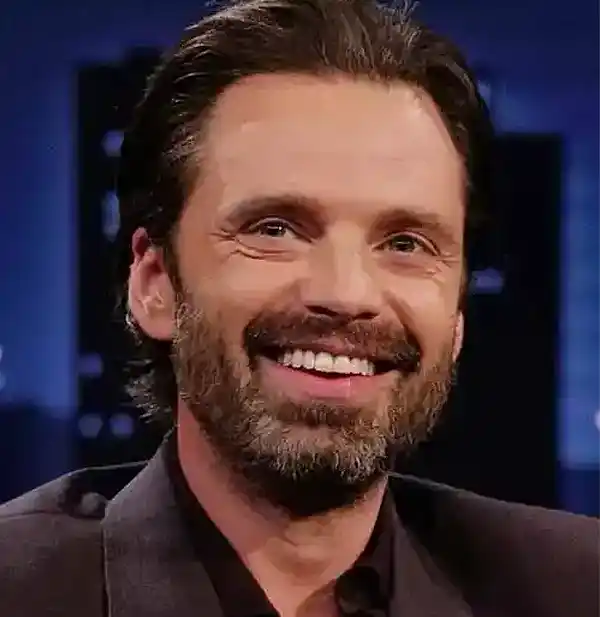
Sebastian Stan has built a career playing characters who can be brooding, dangerous, vulnerable, charming, and occasionally all four before the scene is over. Best known internationally as Bucky Barnes, the Winter Soldier of the Marvel Cinematic Universe, Stan transformed what might have been a conventional superhero supporting role into a long-running portrait of friendship, trauma, identity, and redemption — assisted, when circumstances require it, by a remarkably effective metal arm.
Born on August 13, 1982, in Constanța, Romania, Stan spent his early childhood during the final years of Nicolae Ceaușescu's communist regime. His parents divorced when he was young, and when Stan was eight, he and his mother moved to Vienna, Austria, where she worked as a pianist.
Several years later, another move brought him to the United States after his mother married an American school headmaster. Stan settled in Rockland County, New York, and began becoming involved in acting while attending school. Performing offered an outlet for a young immigrant who was simultaneously adapting to another country, another culture, and another language.
His interest in acting became increasingly serious. Stan participated in school productions and attended the Stagedoor Manor performing arts summer camp, an experience that helped convince him that acting could become more than an extracurricular activity. He eventually enrolled at New York University's Tisch School of the Arts, where he studied acting and graduated in 2005.
His training also included time at Shakespeare's Globe in London, providing experience with classical theater before Hollywood came calling.
Stan's early professional career developed gradually through film, television, and theater. He appeared in the 2006 film The Covenant and began accumulating television credits, but one of his first widely recognized roles came as Carter Baizen on Gossip Girl. The recurring character was wealthy, manipulative, unpredictable, and effortlessly capable of causing trouble — qualities Stan managed to make considerably more interesting than they had any right to be.
He followed with roles in television productions including Kings and the miniseries Political Animals, continuing to demonstrate an ability to play morally complicated characters. Stan also worked on Broadway, appearing in productions including Talk Radio and later Picnic, ensuring that his career remained connected to the stage even as film and television opportunities increased.
Then Steve Rogers needed a best friend.
Stan made his Marvel Cinematic Universe debut in 2011's Captain America: The First Avenger as James Buchanan "Bucky" Barnes, the childhood friend of Steve Rogers. Initially, Bucky appeared to be the more confident and worldly of the two young men, serving alongside the newly transformed Captain America during World War II.
The character apparently died during a mission, which in superhero stories should always be regarded as a temporary administrative condition.
Bucky returned dramatically in Captain America: The Winter Soldier in 2014. Captured, manipulated, and repeatedly brainwashed by HYDRA, he had been transformed into the Winter Soldier, an extraordinarily effective assassin with little memory of his former identity.
Stan's performance was crucial to making the story work. The Winter Soldier needed to be frightening enough to represent a genuine threat to Captain America while still allowing glimpses of the person buried beneath decades of conditioning. Stan accomplished much of that with relatively little dialogue, relying instead on physical performance, expressions, and moments of confusion and recognition.
The character subsequently became an important part of the larger Marvel story. Stan returned as Bucky in Captain America: Civil War, Avengers: Infinity War, Avengers: Endgame, and other Marvel projects, gradually taking the character from brainwashed assassin to recovering survivor and reluctant hero.
His role expanded considerably in the Disney+ series The Falcon and the Winter Soldier, where Bucky was paired with Anthony Mackie's Sam Wilson. The series explored Bucky's attempts to live with the consequences of actions committed while under HYDRA's control, while the frequently argumentative relationship between Bucky and Sam supplied much of the show's humor.
Stan's Marvel work earned him a devoted international following, but he deliberately pursued roles outside the superhero universe that demonstrated a considerably broader acting range.
In I, Tonya, he portrayed Jeff Gillooly, the former husband of figure skater Tonya Harding. Opposite Margot Robbie and Allison Janney, Stan disappeared beneath a mustache, unfortunate hairstyles, and the personality of a man whose decision-making abilities could politely be described as questionable. The darkly comic performance helped demonstrate that audiences who knew him primarily as Bucky Barnes had been seeing only one part of his abilities.
Stan continued choosing unconventional projects. He appeared in Steven Soderbergh's Logan Lucky, the action thriller The 355, the drama The Devil All the Time, and the dark comedy thriller Fresh. In the latter, Stan played Steve, a charming man encountered through the modern dating world who turns out to have interests considerably more disturbing than anything likely to appear on his dating profile.
One of his most transformative performances came in the limited series Pam & Tommy, in which he portrayed Mötley Crüe drummer Tommy Lee opposite Lily James as Pamela Anderson. The role required Stan to recreate Lee's appearance, mannerisms, physical energy, and larger-than-life personality. His performance earned major awards recognition and further established his willingness to disappear into characters far removed from his Marvel persona.
Stan continued pushing into increasingly ambitious territory with A Different Man, playing Edward, a man with neurofibromatosis who undergoes a medical procedure that dramatically changes his appearance. The dark, unconventional film gave Stan an opportunity to explore identity, insecurity, obsession, and the complicated relationship between appearance and self-worth.
He then underwent another striking transformation to portray a young Donald Trump in The Apprentice. Rather than offering an impersonation, Stan approached the role as a dramatic character study, depicting Trump's emergence in the New York real-estate world and his relationship with attorney Roy Cohn. The performance brought Stan some of the strongest critical recognition of his career, including an Academy Award nomination for Best Actor.
That recognition marked an important stage in Stan's evolution as a performer. For years, he had successfully balanced major franchise work with smaller and frequently riskier projects. Increasingly, those projects demonstrated that he was not simply attempting to escape being identified with Bucky Barnes; he was deliberately seeking characters capable of challenging both himself and the audience.
Stan's immigrant background has also remained an important part of his story. He became a United States citizen in 2002 while retaining connections to his Romanian heritage, and he has spoken about the experience of arriving in America and building a life in a country that initially felt unfamiliar.
His career has consequently followed an unusual path: Romanian childhood, Austrian school years, American adolescence, classical acting training, Broadway, teen television, independent films, Marvel blockbusters, and increasingly demanding dramatic performances.
Sebastian Stan could easily have spent his career comfortably riding the enormous popularity of the Winter Soldier. Instead, he has repeatedly selected roles that make comfort seem almost beside the point.
Bucky Barnes may have given him international fame and enough convention appearances to last several lifetimes, but Sebastian Stan has spent the years since proving that the metal arm was only the beginning.