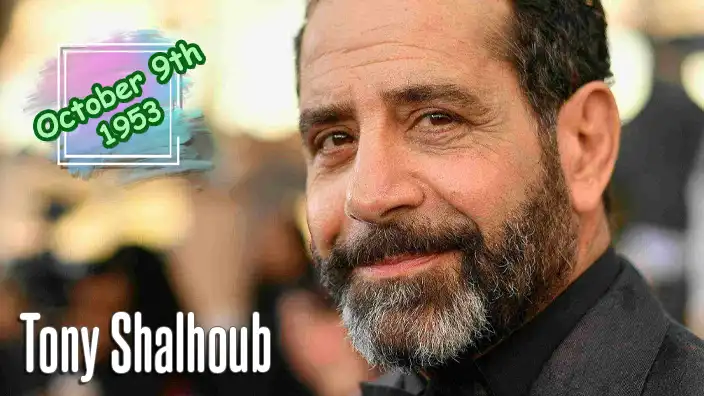
October 9, 1953, in Green Bay, Wisconsin


Tony Shalhoub was born Anthony Marc Shalhoub on October 9, 1953, in Green Bay, Wisconsin, into a large Lebanese-American family. Long before he became one of television's most recognizable character actors, he was a Wisconsin youngster surrounded by siblings, family traditions, and the ordinary bustle of American life. His father, Joseph, had emigrated from Lebanon as a child and eventually established a grocery business, while his mother, Helen Seroogy, came from a Lebanese-American family. Tony was the ninth of ten children, which probably provided excellent preparation for the entertainment industry. After all, anyone who can make himself heard in a household that size has already mastered the fundamentals of projecting his voice.
Shalhoub's introduction to acting came through a school production of The King and I when he was six. What might have been a passing childhood adventure developed into a lifelong interest in theater. After attending Green Bay East High School, he studied drama at the University of Southern Maine before earning a Master of Fine Arts degree from the Yale School of Drama. His training emphasized the discipline of stage performance, character development, and the ability to inhabit roles far removed from his own personality. These skills would eventually allow him to portray everything from nervous taxi drivers to obsessive detectives and eccentric intellectuals without making any of them seem like variations of the same man.
Before Hollywood came calling, Shalhoub built his reputation in the theater. He spent several years with the American Repertory Theater in Cambridge, Massachusetts, gaining valuable experience in classical and contemporary productions. His Broadway debut came in 1985 in The Odd Couple, starring opposite established performers in a production that introduced him to New York audiences. Theater remained an important part of his professional life, even as television and film offered increasingly prominent opportunities. Unlike actors who leave the stage behind once Hollywood discovers them, Shalhoub continued returning to live performance, demonstrating an enduring affection for the craft that launched his career.
His early television appearances included a recurring role on The Equalizer, but his breakthrough arrived with the NBC sitcom Wings, which followed the employees and passengers of a small airline operating from Nantucket, Massachusetts. Shalhoub joined the series as Antonio Scarpacci, an Italian immigrant who worked as a taxi driver and frequently found himself caught in the peculiar adventures of the show's central characters. Antonio was earnest, unlucky in love, occasionally bewildered, and almost impossibly lovable. While the Hackett brothers dealt with airline troubles and romantic complications, Antonio seemed to specialize in discovering new ways for ordinary life to become unnecessarily difficult. Shalhoub played him with warmth and impeccable comic timing, transforming what might have been a minor supporting character into one of the show's most memorable personalities.
During his years on Wings, Shalhoub demonstrated a particular gift for portraying people whose eccentricities concealed genuine humanity. Antonio could be painfully awkward, hopelessly optimistic, and spectacularly unfortunate, but he was never merely a collection of jokes. His disappointments mattered because Shalhoub made audiences care about him. The character also allowed the actor to develop the understated facial expressions, careful pauses, and precise reactions that would become hallmarks of his performances. Sometimes Antonio could earn a laugh simply by looking at another character as though the entire world had temporarily abandoned common sense. Considering the company he kept, that expression was frequently justified.
Although television brought Shalhoub widespread recognition, his film career was already gathering momentum. He appeared in the Coen brothers' Barton Fink in 1991 and subsequently developed a reputation as a dependable and versatile supporting actor. In Big Night (1996), he starred alongside Stanley Tucci as Primo, a gifted Italian chef struggling to maintain his artistic standards while operating a restaurant with his brother. The film became a celebrated exploration of food, family, immigration, and the tension between commercial success and personal integrity. Shalhoub's restrained performance was especially effective because Primo expressed himself more comfortably through cooking than conversation. Anyone who has ever encountered a passionate chef knows that criticizing the sauce can be considerably more dangerous than insulting the furniture.
His film appearances continued with Men in Black (1997), in which he played Jeebs, an alien disguised as a pawnshop owner whose head has the unfortunate habit of being blown off and regenerating. He returned for Men in Black II (2002), once again proving that an actor does not necessarily need an intact head to deliver an entertaining performance. In Galaxy Quest (1999), Shalhoub portrayed Fred Kwan, a remarkably relaxed actor caught up in an actual interstellar adventure inspired by a fictional television science-fiction series. Surrounded by panic, danger, and alien technology, Fred maintained an almost supernatural calm. The performance was a delightful contrast to the anxiety-ridden characters for which Shalhoub would later become famous.
Other notable film credits included The Siege (1998), The Man Who Wasn't There (2001), Spy Kids (2001), and the supernatural thriller 1408 (2007). He also contributed his distinctive voice to animated productions, most notably portraying Luigi, the enthusiastic Italian tire-shop owner in Pixar's Cars franchise. Luigi's passion for Ferrari automobiles was so overwhelming that practically everything else in the automotive universe seemed like an unfortunate misunderstanding. Shalhoub's ability to communicate personality through voice alone added another dimension to a career already distinguished by physical comedy, dramatic restraint, and character acting.
In 2002, Shalhoub accepted the role that would become his defining television achievement: Adrian Monk, the brilliant former San Francisco police detective at the center of USA Network's Monk. The character possessed extraordinary observational abilities but also lived with obsessive-compulsive disorder, numerous phobias, and profound grief following the murder of his wife, Trudy. Monk's unusual habits frequently complicated his investigations, yet his attention to detail enabled him to notice evidence that other detectives overlooked. His talent for solving mysteries was remarkable, although his ability to tolerate an improperly arranged desk was considerably less impressive.
Monk succeeded because it combined an engaging detective format with comedy, emotional vulnerability, and an unusually complicated central character. Shalhoub resisted the temptation to portray Monk simply as a collection of compulsions and fears. Beneath the repeated handwashing, carefully arranged objects, and discomfort with physical contact was a lonely, intelligent man struggling to navigate a world that frequently overwhelmed him. His grief over Trudy provided the series with an emotional foundation that distinguished it from conventional television mysteries. The audience laughed at Monk's predicament while also recognizing the suffering beneath his behavior, and Shalhoub maintained that delicate balance throughout the show's eight seasons.
The supporting cast contributed significantly to the series' popularity, particularly Bitty Schram as Sharona Fleming, Traylor Howard as Natalie Teeger, Ted Levine as Captain Leland Stottlemeyer, and Jason Gray-Stanford as Lieutenant Randy Disher. Their characters helped Monk confront situations he could not comfortably manage alone, while their occasional frustration with his demands produced some of the program's funniest moments. The show's mysteries were often clever, but its lasting appeal came from the relationships between its characters. Monk might have been able to identify a murderer from a misplaced object, but persuading him to enter a crowded elevator required an entirely different investigative strategy.
Shalhoub's portrayal earned three Primetime Emmy Awards for Outstanding Lead Actor in a Comedy Series, winning in 2003, 2005, and 2006. He also received a Golden Globe Award and Screen Actors Guild Awards for the role. The recognition reflected the difficulty of delivering a performance that required physical comedy, emotional authenticity, and consistent characterization across a long-running series. When Monk concluded in 2009, its final episodes resolved the mystery surrounding Trudy's death, providing viewers with a satisfying conclusion to a story that had shaped the character from the beginning. The series left behind a devoted audience and established Adrian Monk as one of television's most distinctive fictional detectives.
The character returned in the 2023 Peacock production Mr. Monk's Last Case: A Monk Movie, which reunited Shalhoub with several familiar cast members. Set against a changed world, the film explored Monk's continuing struggles while presenting another mystery involving people close to him. The return offered longtime viewers an opportunity to revisit a character whose unusual behavior, remarkable intelligence, and emotional vulnerability had made him so memorable. Shalhoub also served as an executive producer, and the production received a Primetime Emmy nomination for Outstanding Television Movie. For Monk, returning to investigative work meant confronting another complicated mystery. For his admirers, it meant the welcome return of a detective who could probably identify a criminal by examining how neatly the suspect folded a napkin.
Following the original conclusion of Monk, Shalhoub continued expanding his career rather than allowing one successful character to define his future. He appeared in numerous television and theatrical productions before joining Amazon Prime Video's acclaimed comedy-drama The Marvelous Mrs. Maisel in 2017. In the series, he portrayed Abraham "Abe" Weissman, the intellectually demanding father of aspiring stand-up comedian Miriam "Midge" Maisel, played by Rachel Brosnahan. Abe was a mathematics professor whose devotion to logic, routine, and academic achievement frequently collided with the unpredictable behavior of his family. He could approach a domestic disagreement with the seriousness of a scientific conference, apparently convinced that every emotional problem would disappear if someone produced the correct equation.
As Abe Weissman, Shalhoub once again demonstrated his ability to find humor in characters who take themselves extraordinarily seriously. His precise delivery, expressive reactions, and talent for conveying bewilderment made Abe a favorite among viewers. Yet the character was more than an amusingly rigid intellectual. Throughout the series, Abe confronted changes in his family, career, and understanding of the world, gradually revealing greater emotional complexity. Shalhoub's performance earned the 2019 Primetime Emmy Award for Outstanding Supporting Actor in a Comedy Series, adding another major television honor to his collection. It also demonstrated that his success as Monk had been no accident: he could create an entirely different eccentric personality without sacrificing the emotional truth that made his characters believable.
The theater provided another major career milestone in 2018 when Shalhoub won the Tony Award for Best Leading Actor in a Musical for The Band's Visit. Based on the Israeli film of the same name, the musical tells the story of an Egyptian police orchestra that mistakenly arrives in a small Israeli desert town. Shalhoub portrayed Tewfiq Zakaria, the reserved conductor whose unexpected encounter with the town's residents gradually reveals the personal sorrow beneath his disciplined exterior. The production was praised for its understated storytelling, emotional sensitivity, and exploration of human connection across cultural boundaries. Its success also demonstrated Shalhoub's remarkable range, particularly his ability to command a Broadway stage without relying on exaggerated gestures or theatrical fireworks.
The Tony Award was especially meaningful because Shalhoub had spent decades maintaining a connection with live theater. His Broadway work also included Conversations with My Father, Golden Boy, and Act One, each offering different opportunities to explore complex characters. His performance in The Band's Visit showed how effectively he could communicate through silence, restraint, and carefully measured emotion. It was a fitting achievement for an actor whose career had repeatedly demonstrated that the quietest person in a room can sometimes deliver its most powerful performance. Besides, winning a Tony Award while being named Tony is the sort of coincidence that practically demands a standing ovation.
Away from the cameras, Shalhoub has maintained a comparatively private family life. He married actress Brooke Adams in 1992, and the couple have two daughters, Josie Lynn and Sophie. Adams has enjoyed a successful acting career of her own, appearing in films including Days of Heaven and Invasion of the Body Snatchers. She also made guest appearances on Monk, giving the couple opportunities to share the screen professionally. Their marriage has remained an enduring part of Shalhoub's personal story, even as his career has taken him between Hollywood productions, television studios, and Broadway theaters.
Shalhoub's Lebanese-American heritage has also been an important element of his background. Growing up in a large immigrant family exposed him to traditions, experiences, and perspectives that contributed to his understanding of human behavior. Throughout his career, he has portrayed characters from numerous cultural backgrounds, often bringing sensitivity and individuality to roles that might otherwise have been reduced to stereotypes. His work illustrates the importance of allowing characters to possess their own personalities, contradictions, and emotional lives rather than defining them solely through nationality or occupation. Whether portraying an Italian taxi driver, an Egyptian musician, or a Jewish-American mathematics professor, Shalhoub has consistently emphasized the recognizable human qualities beneath each character's outward identity.
One of the most impressive aspects of Shalhoub's career is his willingness to embrace supporting roles alongside leading performances. He has never appeared particularly concerned with whether his name occupies the largest space on a movie poster. Instead, his work suggests an actor interested in finding the personality, humor, and emotional possibilities within each assignment. This approach has allowed him to move comfortably between independent films, major Hollywood productions, animated features, television comedies, detective mysteries, and Broadway musicals. Few performers can convincingly portray a troubled detective, a nervous immigrant taxi driver, an alien pawnshop owner, and a dignified orchestra conductor without making audiences wonder whether someone has accidentally switched the actors.
Tony Shalhoub's career demonstrates the lasting value of versatility, patience, and careful attention to character. His performances have entertained audiences across generations while earning recognition from the television, film, and theater industries. From the comic misfortunes of Antonio Scarpacci to the complicated brilliance of Adrian Monk and the intellectual stubbornness of Abe Weissman, he has created characters whose imperfections make them memorable. On October 9, admirers celebrate an actor who has proved that extraordinary talent does not always require spectacular entrances, heroic speeches, or perfectly combed hair. Sometimes all it takes is an expressive face, impeccable timing, and the ability to make a simple request for a disinfectant wipe seem like the most important moment in television history.