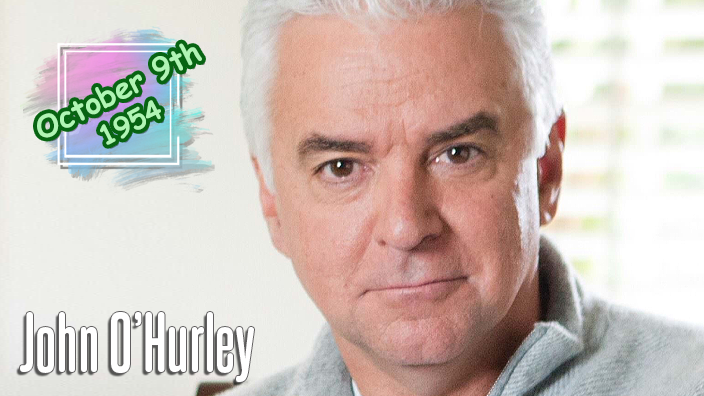
October 9, 1954, in Kittery, Maine

John George O'Hurley Jr. was born on October 9, 1954, in Kittery, Maine, into a family that valued education, discipline, and professional achievement. His father, John George O'Hurley, was an ear, nose, and throat surgeon, while his mother, Jean, managed the household and raised the children. Growing up in New England and Pennsylvania, John developed interests in theater, music, and public performance, eventually discovering that his naturally commanding voice and instinctive sense of humor were valuable assets. Those qualities would become central to a career spanning television comedy, dramatic acting, Broadway musicals, game shows, animation, and even the occasional appearance alongside some extraordinarily well-groomed dogs.
O'Hurley's childhood included moves between several communities, and he attended schools in Massachusetts, Connecticut, and Pennsylvania. He eventually graduated from Cardinal Gibbons High School in Pennsylvania before enrolling at Providence College in Rhode Island. There, he studied theater, earning his Bachelor of Arts degree in 1976. His college experience helped establish the technical foundations of his acting career, including stage movement, vocal projection, and the discipline required for live performance. Unlike performers who arrive in Hollywood with little formal preparation, O'Hurley developed an appreciation for theatrical tradition and the importance of communicating clearly with an audience. His distinctive speaking voice would eventually become one of his most recognizable professional qualities, making even an ordinary announcement sound as though it deserved a brass fanfare.
A deeply personal experience during his youth also influenced his later charitable activities. His older sister, Carol, died in 1970 following complications associated with epilepsy. The loss affected his family profoundly and contributed to his subsequent involvement with organizations supporting epilepsy research, education, and awareness. Throughout his public career, O'Hurley has used his recognition to support charitable causes, particularly those connected with neurological conditions and animal welfare. His willingness to participate in such activities reflects a side of his life that audiences might not immediately associate with the flamboyant characters he has portrayed.
After completing his education, O'Hurley pursued professional acting, gradually building a career through theater and television. His early work included appearances in dramatic productions and daytime serials, where he developed the ability to handle demanding schedules and complicated scripts. Soap operas provided particularly useful experience because actors frequently had to learn substantial amounts of dialogue and perform emotional scenes with limited rehearsal time. These assignments also introduced O'Hurley to a broad television audience long before he became associated with one of the most famous sitcoms in American entertainment history.
Among his early television roles was Keith Lane in the ABC daytime drama Loving, which premiered in 1983. The series followed the intertwined personal and professional lives of residents in the fictional community of Corinth, Pennsylvania. O'Hurley's participation helped establish him as a reliable dramatic performer capable of portraying sophisticated, occasionally complicated characters. He also appeared in other television productions during the 1980s, gradually expanding his professional opportunities. Although these roles did not immediately make him a household name, they allowed him to develop the screen presence and confident delivery that would eventually become central to his success.
O'Hurley continued working in television throughout the late 1980s and early 1990s, appearing in programs such as The Young and the Restless, Murder, She Wrote, and Baywatch. His ability to portray authoritative professionals, wealthy businessmen, and polished antagonists made him particularly useful to casting directors. He possessed a refined appearance and a distinctive baritone that suggested confidence, intelligence, and perhaps a slightly excessive opinion of his own importance. Those qualities could be employed in serious dramatic roles, but they also contained considerable comic potential. Hollywood had not yet discovered just how funny O'Hurley could be when allowed to exaggerate them.
His defining television opportunity arrived in 1995 when he joined the NBC sitcom Seinfeld as Jacopo Peterman, usually known simply as J. Peterman. The series, created by Jerry Seinfeld and Larry David, had already become one of television's most influential comedies, following the everyday frustrations and questionable decisions of four New Yorkers. O'Hurley's character was introduced as the eccentric owner of the J. Peterman clothing catalog and the employer of Elaine Benes, played by Julia Louis-Dreyfus. Peterman possessed an extraordinary talent for transforming ordinary business conversations into elaborate declarations filled with exotic locations, dramatic memories, and philosophical observations. He seemed incapable of discussing a shirt without suggesting that its history involved danger, romance, and an expedition through some distant corner of the world.
The character was inspired by the real J. Peterman, an entrepreneur whose clothing catalog featured unusual garments accompanied by elaborate descriptions. Rather than relying on conventional advertising language, the catalog presented merchandise through imaginative stories about travel, adventure, and discovery. The fictional Peterman exaggerated this approach into a magnificent form of corporate absurdity. O'Hurley portrayed him as a man utterly convinced of his own sophistication, delivering every observation with the seriousness of an explorer describing a dangerous expedition. The humor emerged from the contrast between his theatrical language and the trivial situations surrounding him. A misplaced office document could become a matter of international significance, while a questionable fashion decision might inspire a speech worthy of a historical epic.
O'Hurley's performance was particularly effective because he refused to acknowledge the absurdity of his character. Peterman never appeared to believe that he was being funny. He regarded his own elaborate statements as perfectly reasonable contributions to everyday conversation, even when everyone else in the room looked thoroughly bewildered. This unwavering confidence made the character hilarious, allowing O'Hurley to deliver outrageous dialogue with complete sincerity. His carefully measured pauses, commanding posture, and resonant voice gave Peterman an unmistakable personality. The character seemed permanently prepared to deliver a lecture about the mysteries of the Orient, even when Elaine merely wanted permission to leave work early.
One of the most memorable elements of Peterman's personality was his tendency to treat Elaine as a participant in adventures that existed primarily within his imagination. He frequently assigned her unusual responsibilities, misinterpreted ordinary situations, and expected her to appreciate his elaborate philosophical observations. Elaine's increasingly frustrated reactions provided the perfect contrast to his unshakable confidence. Julia Louis-Dreyfus and O'Hurley developed an entertaining comic relationship in which Peterman's theatrical seriousness collided with Elaine's impatience and skepticism. Their scenes became highlights of the series' later seasons, demonstrating how a supporting character could become unforgettable through distinctive writing and carefully controlled performance.
Peterman appeared in episodes involving memorable situations such as the infamous Urban Sombrero, Elaine's attempts to manage the catalog, and the extraordinary complications surrounding Peterman's personal adventures. The Urban Sombrero became particularly famous as an example of Elaine's questionable business judgment. Intended as a fashionable accessory, the oversized hat became an object of ridicule, inspiring one of the series' most recognizable visual jokes. Peterman's response reflected his characteristic dramatic personality, treating a ridiculous fashion item as though it represented a catastrophic failure of civilization. The joke would eventually acquire an unexpected second life when the real J. Peterman company explored producing the fictional accessory.
O'Hurley appeared as J. Peterman throughout the final seasons of Seinfeld, from 1995 until the series concluded in 1998. Although the character was not part of the original principal cast, he became one of the show's most memorable recurring personalities. His distinctive delivery and eccentric behavior helped establish Peterman alongside other celebrated supporting characters, including Newman, Frank Costanza, and David Puddy. The series' enormous popularity ensured that O'Hurley's performance continued reaching new audiences through syndication and streaming services. Even viewers who could not immediately remember the actor's name often recognized his voice and the exaggerated authority of the fictional catalog owner.
The success of Seinfeld brought O'Hurley widespread recognition and opened opportunities in television, theater, and commercial entertainment. His portrayal of Peterman also contributed to the ensemble's Screen Actors Guild recognition, connecting him with one of the most critically celebrated sitcoms in television history. Yet the role presented an interesting professional challenge: how could an actor develop a career beyond a character so distinctive that audiences immediately associated him with it? O'Hurley's solution was to embrace the qualities that made Peterman memorable while demonstrating that they could be adapted to many different forms of entertainment.
Perhaps the most remarkable development came when fiction unexpectedly became reality. The J. Peterman Company was a genuine clothing business founded by entrepreneur John Peterman, and the fictional character had helped introduce the brand to millions of television viewers. O'Hurley eventually met the real Peterman, and the two developed a friendship. When the company encountered financial difficulties and entered bankruptcy in 1999, Peterman later worked to revive the business. In 2001, O'Hurley invested in the relaunched company, becoming a part-owner and member of its board. The actor who had spent years pretending to operate the catalog business was suddenly involved in operating the real one. It was an extraordinary example of professional life imitating television comedy, although presumably the company's accountants preferred somewhat less theatrical explanations of its financial position.
O'Hurley has frequently joked about the unusual circumstances surrounding his involvement with the J. Peterman Company. His association with the fictional character provided publicity for the genuine business, while his investment demonstrated a personal appreciation for the brand's unconventional approach to marketing. The relationship between actor and entrepreneur became a fascinating example of how popular culture can influence commercial identity. Customers sometimes confused O'Hurley with the real Peterman, creating situations that seemed almost perfectly suited to the humor of Seinfeld. Few performers have enjoyed the experience of portraying a fictional businessman and subsequently receiving an opportunity to become involved in the business that inspired him.
After Seinfeld, O'Hurley continued appearing in television productions, including the science-fiction drama The X-Files. In the 1997 episode "The Post-Modern Prometheus," he portrayed Dr. Francis Pollidori, a scientist involved in a story inspired by the traditions of Frankenstein. The episode, directed by series creator Chris Carter, became one of the show's most distinctive installments, featuring black-and-white photography and an unusual mixture of horror, comedy, and romantic fantasy. O'Hurley's performance demonstrated that his authoritative screen presence could be adapted to darker and more eccentric material. A character who might have sounded perfectly comfortable describing an exotic shirt was now involved in scientific experiments with considerably more alarming consequences.
His other television work included appearances in Sabrina the Teenage Witch, Drake & Josh, Wizards of Waverly Place, and various dramatic and comedic productions. These roles allowed him to reach audiences across different generations and genres. O'Hurley became particularly effective at portraying eccentric authority figures whose confident personalities concealed questionable judgment. His ability to deliver absurd dialogue with complete seriousness made him a natural choice for family comedies and programs that relied on exaggerated characters. He could make a school administrator, businessman, or supernatural official sound as though he were announcing the beginning of an international summit.
O'Hurley's commanding voice also made him a popular choice for animation and voice-over work. Among his best-known animated roles is King Neptune in SpongeBob SquarePants, where his booming delivery suited the powerful and frequently temperamental ruler of the sea. The character's exaggerated authority provided opportunities for the same theatrical style that had made J. Peterman so entertaining. In animation, however, O'Hurley could expand his performance even further, unconstrained by the physical limitations of live-action television. His voice could convey outrage, dignity, confusion, and grandiose self-importance with remarkable effectiveness, even when the character delivering the speech was a cartoon monarch living beneath the ocean.
He also voiced Roger Doofenshmirtz, the mayor of Danville and brother of the eccentric villain Heinz Doofenshmirtz, in Disney's animated comedy Phineas and Ferb. Roger's polished public personality contrasted amusingly with his brother's endless attempts to develop elaborate inventions and take over the surrounding metropolitan area. O'Hurley's vocal performance added another distinctive authority figure to his collection of characters, demonstrating his ability to create memorable personalities through sound alone. His animated credits have also included appearances in productions associated with Scooby-Doo, Disney animation, and superhero programming.
Another important chapter of O'Hurley's career involved television game shows. In 2000, he became the host of a syndicated revival of To Tell the Truth, the classic panel program in which celebrities attempted to identify a genuine individual from a group of contestants making competing claims. The format required a host capable of maintaining order, explaining rules clearly, and encouraging entertaining interactions without overwhelming the participants. O'Hurley's confident delivery and natural sense of humor made him well suited to the assignment. He brought an elegant, slightly theatrical personality to the program, helping distinguish the revival from earlier versions while respecting the established format.
The revival of To Tell the Truth continued until 2002, providing O'Hurley with valuable experience as a television host. Unlike scripted acting, game-show hosting requires quick reactions, spontaneous humor, and the ability to manage unpredictable situations. Contestants do not always behave as expected, celebrity panelists occasionally become distracted, and the host must maintain the program's rhythm while ensuring that everyone understands what is happening. O'Hurley's theatrical training and television experience helped him navigate these challenges. His distinctive voice also proved useful when announcing contestants and revealing answers, giving even relatively ordinary moments an air of suspense.
In 2005, O'Hurley participated in the inaugural season of ABC's Dancing with the Stars, partnering with professional ballroom dancer Charlotte Jørgensen. The competition paired celebrities with accomplished dancers, challenging them to learn demanding routines while performing before a national television audience. O'Hurley's participation surprised viewers who primarily associated him with sophisticated comic characters and game-show hosting. He demonstrated considerable elegance, musicality, and determination, becoming one of the season's most popular contestants. His performances emphasized traditional ballroom style, combining controlled movement with the theatrical confidence developed throughout his career.
The competition concluded with actress Kelly Monaco and her professional partner Alec Mazo winning the first season, while O'Hurley and Jørgensen finished as runners-up. The result generated considerable discussion among viewers, many of whom believed O'Hurley had delivered the stronger ballroom performances. ABC subsequently organized a special dance-off between the finalists, giving audiences another opportunity to vote. O'Hurley and Jørgensen won the rematch, earning a victory that became an important part of the program's early history. The experience demonstrated his ability to succeed in an entertainment format requiring genuine physical discipline rather than simply comic personality. It also provided a satisfying outcome for anyone who believed a gentleman wearing formal evening clothes should occasionally be allowed to settle an argument with a waltz.
His success on Dancing with the Stars introduced O'Hurley to a new audience and reinforced his reputation as a versatile entertainer. The program's enormous popularity helped create renewed interest in ballroom dancing, while his participation demonstrated that performers could develop unexpected talents outside their established professional specialties. O'Hurley approached the competition with enthusiasm and humor, acknowledging the physical demands of training while appreciating the opportunity to learn a sophisticated art form. His performances also reflected the musical background that would become increasingly important in his theatrical career.
In 2006, O'Hurley was selected to host the syndicated game show Family Feud, succeeding Richard Karn. The program, originally introduced in 1976 with Richard Dawson as host, challenges competing families to identify popular responses to survey questions. O'Hurley brought a polished, good-humored style to the familiar format, combining his authoritative voice with an ability to react spontaneously to unexpected answers. Hosting Family Feud required a delicate balance between maintaining the competition's structure and allowing contestants' personalities to create entertainment. Families frequently offered answers that were surprising, confusing, or spectacularly inappropriate, and O'Hurley's reactions became part of the fun.
His tenure lasted from 2006 until 2010, during which he became a familiar presence on daytime television. He emphasized the family-oriented nature of the program, maintaining a style that balanced friendly teasing with respect for contestants. His experience in comedy proved useful when survey questions produced unusual responses, while his theatrical confidence helped keep the program moving through moments of confusion or disagreement. Unlike J. Peterman, who could spend several minutes describing the philosophical significance of an ordinary garment, O'Hurley as host generally needed contestants to provide answers before the commercial break.
O'Hurley departed Family Feud in 2010 and was succeeded by comedian Steve Harvey, whose more expressive and improvisational approach introduced another chapter in the program's history. O'Hurley later discussed his concerns about changes in the show's humor and the practical demands of its production schedule. His years as host nevertheless represented a substantial achievement, demonstrating his ability to maintain the appeal of an established television franchise while bringing his own personality to the role. The experience further expanded his public recognition beyond scripted comedy and established him as a respected television presenter.
Another major part of O'Hurley's career began in 2002 when he became co-host of NBC's annual National Dog Show, presented by Purina and broadcast on Thanksgiving Day. Working alongside expert dog-show commentator David Frei, O'Hurley helped introduce audiences to the world of competitive dog showing. The program features purebred dogs competing across different breed groups, with judges evaluating their appearance, movement, and conformity to established standards. O'Hurley's role combines entertainment, commentary, and interviews, providing viewers with an accessible introduction to an activity that might otherwise seem mysterious to people unfamiliar with dog-show traditions.
The partnership between O'Hurley and Frei became an important part of the broadcast's appeal. Frei contributes extensive knowledge of dog breeds and competitive judging, while O'Hurley provides humor, curiosity, and an engaging television presence. Their contrasting styles help make the program entertaining for both dedicated dog enthusiasts and families watching casually during the Thanksgiving holiday. O'Hurley's affection for dogs is genuine, and he frequently discusses their personalities, loyalty, and importance as family companions. His enthusiasm gives the broadcast warmth and prevents it from becoming an overly technical discussion of canine anatomy and grooming standards. The dogs, meanwhile, generally appear far better behaved than the contestants on Family Feud.
Over the years, the National Dog Show has become a Thanksgiving television tradition for many American families, providing entertainment between holiday preparations, meals, and football games. O'Hurley's familiar voice and relaxed humor have helped establish continuity across its broadcasts. His involvement has also allowed him to support organizations concerned with animal welfare, rescue, and responsible pet ownership. For a performer who once portrayed a man obsessed with elaborate clothing descriptions, discussing the merits of a beautifully groomed Afghan Hound seems like a remarkably natural career development.
O'Hurley's theatrical career has remained an important part of his professional identity. He has appeared as Billy Flynn in the long-running Broadway musical Chicago, portraying the charismatic defense attorney whose courtroom performances resemble carefully staged entertainment productions. The character's confidence, polished appearance, and talent for persuasive language made him an excellent fit for O'Hurley's abilities. Billy Flynn approaches the legal profession with the theatrical instincts of a show-business promoter, treating public opinion as something that can be manipulated through charm, spectacle, and a well-timed musical number. O'Hurley's commanding voice and stage presence allowed him to bring both humor and sophistication to the role.
He also portrayed King Arthur in productions of the musical comedy Spamalot, inspired by the film Monty Python and the Holy Grail. The production combines medieval adventure with absurdist comedy, elaborate musical numbers, and the distinctive humor associated with Monty Python. O'Hurley's theatrical style proved particularly suitable for King Arthur, a monarch whose dignity is continually undermined by the ridiculous circumstances surrounding him. The role required singing, dancing, comic timing, and the ability to maintain royal authority while participating in situations that make very little logical sense. Having spent years portraying J. Peterman, O'Hurley was already well prepared to deliver absurd statements with complete confidence.
His appearances in Spamalot included productions in Las Vegas and Los Angeles, allowing him to reach theater audiences outside New York. The musical's blend of traditional Broadway spectacle and deliberately ridiculous humor suited his established comic personality. O'Hurley demonstrated that his talents were not limited to television, performing before live audiences who could respond immediately to his timing and delivery. Stage work also provided opportunities to use his singing abilities, an aspect of his career that viewers familiar only with Seinfeld might not have appreciated.
Music has been a continuing interest throughout O'Hurley's life. He is an accomplished pianist and composer who has released instrumental recordings, including the album Peace of Our Minds. His musical work reflects an interest in melody, reflection, and the expressive possibilities of instrumental performance. The ability to compose and perform music adds another dimension to his career, demonstrating that his theatrical voice is only one of the instruments he uses to communicate with audiences. His musical background has also contributed to his success in stage productions and ballroom dancing, where rhythm and timing are essential.
O'Hurley has expanded his creative activities into writing, publishing books that combine humor, personal observations, and his affection for animals. His 2006 book It's Okay to Miss the Bed on the First Jump: And Other Life Lessons I Learned from Dogs became a New York Times bestseller. The book explores the lessons people can learn from canine behavior, using entertaining stories to reflect on loyalty, patience, friendship, and the importance of enjoying ordinary experiences. O'Hurley approaches the subject with warmth and humor, suggesting that dogs possess a practical understanding of life that humans sometimes complicate unnecessarily. Given the number of people who spend their days worrying about things their pets have never considered, he may have a point.
He followed with Before Your Dog Can Eat Your Homework, First You Have to Do It: Life Lessons from a Wise Old Dog to a Young Boy, published in 2007. The book presents observations about responsibility, character, and personal development through the perspective of a dog's relationship with a young boy. It reflects O'Hurley's interest in communicating meaningful ideas through accessible humor and storytelling. His ability to move between sophisticated comedy and family-oriented writing demonstrates the range of audiences he has sought to entertain.
In 2013, he published the children's book The Perfect Dog, exploring the idea that a dog's value cannot be measured entirely through appearance or competitive achievement. The story emphasizes affection, companionship, and the qualities that make animals important members of a family. It subsequently inspired a children's musical of the same name, expanding O'Hurley's creative work into another theatrical format. The project brought together his interests in storytelling, music, stage performance, and animal welfare, demonstrating how different aspects of his career could complement one another.
His affection for dogs has also influenced his charitable activities. O'Hurley has supported rescue organizations and animal-welfare initiatives, encouraging responsible adoption and assistance for shelters caring for abandoned animals. He has served as an ambassador for the Puppy Food Bank, an organization that helps provide food to animal rescue groups and shelters. His involvement reflects a genuine interest in improving the lives of animals beyond the carefully groomed competitors featured on the National Dog Show. He recognizes that the affection and companionship offered by a rescue dog can be every bit as meaningful as the achievements of a champion purebred.
O'Hurley's career has also included commercial voice-over work, where his recognizable baritone has been used to promote products and services. Advertising producers frequently seek performers whose voices convey confidence, warmth, and authority, qualities he possesses in abundance. His delivery can make an ordinary commercial announcement sound unusually important, an ability that has provided professional opportunities across radio and television. The same vocal characteristics that transformed J. Peterman into a memorable comic creation have therefore proved useful in an entirely different part of the entertainment industry.
He has appeared in films and independent productions throughout his career, including the comedy An American Carol and the gambling-themed film 7 Days to Vegas. These assignments have allowed him to explore characters outside his familiar television and hosting roles. His extensive acting credits reflect a willingness to accept varied opportunities, from dramatic guest appearances to broad comedy and voice performances. Although many viewers will always associate him with Seinfeld, his professional résumé reveals a much wider range of work.
O'Hurley has also developed a one-man stage production titled A Man with Standards, which combines music, humor, and stories from his life in entertainment. The show draws on his experiences in television, theater, and popular culture while celebrating the music and performance traditions that influenced him. Through songs and personal anecdotes, he offers audiences a more intimate understanding of his career and artistic interests. The production demonstrates his ability to sustain an evening of entertainment without relying on an ensemble cast or elaborate television production. A piano, a microphone, and a collection of good stories are apparently sufficient equipment for a man who once required an entire fictional catalog company to explain his wardrobe.
His personal life has included two marriages. He was previously married to actress Eva LaRue, known for her work in daytime television and crime dramas. In 2004, he married Lisa Mesloh, and the couple welcomed a son, William, in 2006. Fatherhood became another important part of his life, influencing his interest in family-oriented entertainment and children's literature. His books frequently reflect themes of responsibility, kindness, and the value of relationships, subjects that connect naturally with his experiences as a parent.
Throughout his career, O'Hurley has maintained a distinctive public personality combining traditional elegance with a willingness to embrace absurdity. His polished appearance and carefully controlled speaking style might initially suggest a performer interested primarily in dignified roles, yet many of his most memorable characters are thoroughly ridiculous. This contrast is central to his comic appeal. He understands that humor often becomes more effective when an absurd statement is delivered with absolute seriousness. J. Peterman would be considerably less entertaining if he acknowledged that his elaborate speeches were nonsense. O'Hurley's refusal to break character allows audiences to appreciate the full ridiculousness of the situation.
His versatility also reflects an appreciation for the different demands of entertainment formats. Scripted comedy requires precision and consistency, while game-show hosting demands spontaneity and quick reactions. Musical theater combines acting, singing, and physical performance, while animation relies heavily on vocal expression. Writing requires a different kind of creativity, and live hosting involves the unpredictable behavior of contestants, guests, and occasionally animals. O'Hurley has demonstrated the ability to adapt to these different requirements without losing his recognizable personality.
The lasting popularity of Seinfeld continues introducing J. Peterman to new generations of viewers. The show's observations about social behavior, personal vanity, and everyday frustrations remain influential, while its supporting characters have become part of television comedy history. O'Hurley's contribution was relatively modest in terms of total screen time compared with the principal cast, but the character's impact was enormous. Peterman became memorable because every appearance felt like an event, transforming ordinary workplace scenes into miniature theatrical performances. His elaborate descriptions and grandiose confidence remain among the show's most recognizable comic devices.
Perhaps the most unusual aspect of O'Hurley's professional journey is the way his fictional and real-life careers have occasionally overlapped. He portrayed a catalog entrepreneur and subsequently invested in the actual business. He played dignified authority figures and became a television host whose professional responsibilities required maintaining order. He developed a reputation for theatrical elegance and then demonstrated genuine ballroom dancing ability before a national audience. He frequently voiced exaggerated animated personalities while maintaining a public identity associated with traditional manners and sophistication. His career seems almost deliberately designed to challenge the distinction between performance and reality.
O'Hurley's work also demonstrates the importance of recognizing opportunities beyond a single successful role. Rather than allowing J. Peterman to define the limits of his career, he used the character's popularity as a foundation for new experiences. His achievements in game-show hosting, musical theater, writing, animation, and live entertainment have allowed him to remain professionally active across changing television trends. His career illustrates how a distinctive talent can become valuable in numerous settings when supported by preparation, curiosity, and a willingness to try something different.
John O'Hurley has become one of American television's most recognizable character actors and presenters, admired for his commanding voice, precise comic timing, and ability to bring elegance to even the most ridiculous circumstances. From the elaborate adventures of J. Peterman to the lively competition of Family Feud, the ballroom performances of Dancing with the Stars, and the Thanksgiving tradition of the National Dog Show, he has entertained audiences through an unusually varied collection of roles. His creative interests in music, writing, and theater have added further dimensions to a career built on versatility and personality. On October 9, admirers celebrate a performer who has demonstrated that dignity and absurdity can coexist quite happily, particularly when delivered in a magnificent baritone. And somewhere, one suspects, J. Peterman is preparing a seventeen-page catalog description of the occasion, beginning with an unforgettable journey through the foothills of an obscure mountain range in search of the perfect birthday necktie.