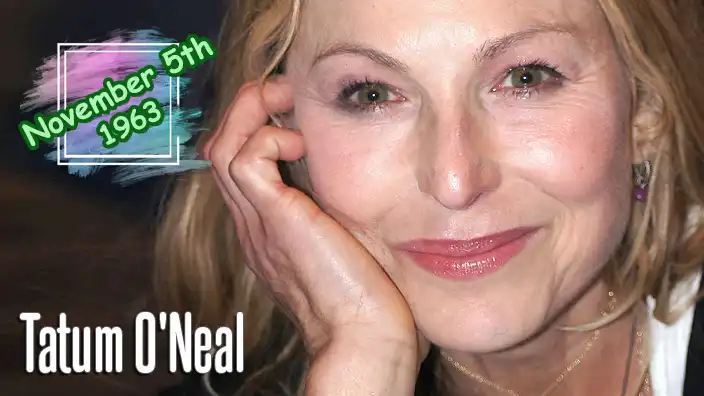
November 5, 1963, in Los Angeles, California


Tatum Beatrice O'Neal was born on November 5, 1963, in Los Angeles, California, into a family already deeply connected to the entertainment industry. Her father, Ryan O'Neal, was a rising Hollywood actor who would become internationally famous for his performances in Love Story, Barry Lyndon, and numerous other films. Her mother, Joanna Moore, was an accomplished actress whose career included appearances in Touch of Evil, Follow That Dream, and popular television productions. With two professional actors as parents, Tatum grew up surrounded by the language, personalities, and unpredictable routines of show business. Her younger brother, Griffin O'Neal, also pursued acting, making the family something of a Hollywood institution. Unfortunately, the family's private life was considerably more complicated than the polished image audiences often associated with successful film stars.
Tatum's childhood was marked by family instability, parental separation, and difficulties that would later become important subjects in her autobiographical writing. Ryan O'Neal and Joanna Moore divorced in 1967, and the children experienced a turbulent upbringing influenced by their parents' personal struggles and demanding careers. Despite these circumstances, Tatum displayed a remarkable natural ability to perform. Unlike many child actors who spend years attending auditions and appearing in television commercials before receiving significant opportunities, she entered the film industry with a role that would immediately establish her place in cinema history. Her introduction to Hollywood came through director Peter Bogdanovich, who recognized that the young O'Neal possessed an unusual combination of intelligence, confidence, and emotional authenticity. What followed was one of the most extraordinary acting debuts of the twentieth century.
In 1973, Tatum O'Neal appeared alongside her father in Paper Moon, a black-and-white comedy-drama directed by Peter Bogdanovich and based on Joe David Brown's novel Addie Pray. Set during the Great Depression, the film follows Moses Pray, a traveling con man played by Ryan O'Neal, who becomes responsible for transporting a young girl named Addie Loggins to relatives following her mother's death. The pair travel through the American Midwest, becoming involved in elaborate schemes involving the sale of overpriced Bibles to grieving widows. Although Moses initially regards Addie as an inconvenience, the sharp-witted girl quickly demonstrates that she possesses an exceptional talent for recognizing dishonesty, negotiating deals, and manipulating situations to her advantage. In fact, Addie frequently proves herself a considerably more capable operator than the supposedly experienced adult accompanying her.
Tatum's performance as Addie Loggins was remarkable for its confidence, subtle humor, and emotional depth. She delivered dialogue with impeccable timing, matched her father's performance scene for scene, and created a character who could appear tough, vulnerable, calculating, and affectionate without losing credibility. Her scenes with Ryan O'Neal benefited from their real-life familiarity, producing a convincing relationship between two characters who spend much of the film arguing, scheming, and gradually developing genuine affection for one another. The movie's period setting, striking black-and-white cinematography, and carefully observed humor helped establish Paper Moon as one of the defining American films of the 1970s. Yet it was Tatum's extraordinary debut that attracted some of the strongest praise, with critics recognizing that the young actress was not merely holding her own alongside established performers. She was frequently stealing the entire picture.
At the 46th Academy Awards ceremony on April 2, 1974, Tatum O'Neal won the Oscar for Best Supporting Actress for her performance in Paper Moon. The achievement made her the youngest person ever to receive a competitive Academy Award, a distinction she continues to hold. The award was presented by Charles Bronson and Jill Ireland, and the moment became one of the most memorable milestones in Academy Awards history. Although Shirley Temple had previously received a special Juvenile Academy Award, O'Neal's achievement was different because she won in a regular competitive acting category against adult performers. Her victory transformed her almost overnight from a promising newcomer into an internationally recognized Hollywood star. Most children celebrate their first major achievements with a certificate or a ribbon. Tatum received a gold-plated statuette and the distinction of making Academy Awards history.
The success of Paper Moon brought additional recognition, including a Golden Globe Award for Most Promising Newcomer and a nomination for Best Actress in a Motion Picture – Musical or Comedy. These honors confirmed that her performance was regarded as far more than a charming novelty. Critics admired her ability to create a believable character without the exaggerated mannerisms sometimes associated with child performers. The film also demonstrated the commercial and artistic possibilities of giving young actors substantial, intelligent roles rather than limiting them to sentimental supporting characters. Nevertheless, becoming an Oscar winner so early in a career created enormous expectations. Every subsequent performance would inevitably be compared with the achievement that had made her famous, an unusually demanding burden for someone still discovering the world beyond the movie set.
Tatum O'Neal returned to the screen in 1976 with The Bad News Bears, one of the most popular sports comedies of the decade. Directed by Michael Ritchie, the film starred Walter Matthau as Morris Buttermaker, a disillusioned former baseball player who reluctantly agrees to coach a struggling Little League team. O'Neal portrayed Amanda Whurlitzer, a talented young pitcher whose exceptional abilities help transform the team's fortunes. Her character was confident, competitive, independent, and entirely unimpressed by adults who underestimated her. The role allowed O'Neal to demonstrate her talent for sharp dialogue and dry humor while participating in a film that challenged conventional expectations about children's sports movies. Amanda was not a decorative addition to the team; she was one of its most important players, and she had absolutely no intention of pretending otherwise.
The Bad News Bears became a major box-office success and developed a lasting reputation as a classic American sports comedy. Its combination of irreverent humor, unconventional characters, and unexpectedly touching moments appealed to audiences who appreciated a story about imperfect children learning to work together. O'Neal's performance was central to the film's success, particularly in her scenes with Matthau, whose gruff coaching style provided an entertaining contrast to Amanda's determination. The film also reinforced her reputation as an actress capable of portraying intelligent, independent young women who refused to accept traditional limitations. During this period, O'Neal became one of the most commercially valuable child performers in Hollywood, commanding unusually substantial compensation for her work. It was an impressive achievement, although the responsibility of carrying major motion pictures was considerably greater than the average school homework assignment.
Later in 1976, Tatum reunited with Ryan O'Neal and director Peter Bogdanovich for Nickelodeon, a comedy set during the early days of the American motion picture industry. The film followed aspiring filmmakers struggling to establish themselves during Hollywood's silent-film era, combining historical references with affectionate humor about the chaotic beginnings of commercial cinema. O'Neal played Alice Forsyte, appearing alongside a cast that included Burt Reynolds and Stella Stevens. Although Nickelodeon did not achieve the same critical or commercial success as Paper Moon, it provided another opportunity for Tatum to work with established performers and explore a different kind of historical comedy. The production also reunited the father-daughter partnership that had become so memorable to audiences, even though repeating the extraordinary success of their first collaboration proved difficult.
In 1978, O'Neal starred in International Velvet, a sequel to the beloved 1944 film National Velvet, which had helped establish Elizabeth Taylor as a major young actress. Tatum portrayed Sarah Brown, an American girl who travels to England following the death of her parents and becomes involved in the competitive world of equestrian sports. The film featured Christopher Plummer and Nanette Newman and explored themes of grief, personal ambition, family relationships, and determination. O'Neal's character develops a passion for horse riding and pursues the demanding goal of competing at an international level. The role offered a more emotionally serious challenge than some of her earlier performances, allowing her to portray a young woman navigating loss while developing independence and confidence. It also demonstrated that Hollywood remained interested in presenting O'Neal as a leading performer capable of carrying major productions.
Her next significant film success came with Little Darlings in 1980, a coming-of-age comedy-drama in which she starred opposite Kristy McNichol. Set at a summer camp, the movie follows two teenage girls from different backgrounds who become involved in a competition centered on their romantic and sexual experiences. O'Neal played Ferris Whitney, a sophisticated and privileged camper whose confident exterior conceals considerable insecurity. McNichol portrayed Angel Bright, a more outspoken girl whose background and personality differ sharply from Ferris's. The film explored adolescent friendships, peer pressure, identity, and the uncomfortable transition from childhood into adulthood. Although some aspects of its subject matter reflected the changing social attitudes of the period, the movie became a recognizable example of early 1980s teenage cinema and helped introduce O'Neal to audiences who had not experienced her earlier childhood performances.
As Tatum O'Neal moved into adult roles, her career became less predictable. The transition from celebrated child performer to established adult actress has challenged many Hollywood stars, and O'Neal encountered the additional complications of intense media attention and personal difficulties. She appeared in the 1985 action drama Certain Fury, alongside Irene Cara, portraying one of two young women attempting to escape dangerous circumstances after becoming involved in a criminal investigation. The film represented a considerable departure from the family-oriented and coming-of-age productions associated with her earlier career. Although it did not become a major commercial success, it demonstrated her willingness to explore more mature and unconventional material rather than remain permanently associated with the characters who had made her famous.
During the following decades, O'Neal continued working in film and television, gradually building a varied collection of supporting roles, independent productions, and guest appearances. She appeared in the 1996 biographical drama Basquiat, directed by Julian Schnabel, which explored the life of influential artist Jean-Michel Basquiat and featured an ensemble cast including Jeffrey Wright, David Bowie, and Dennis Hopper. She also appeared in The Scoundrel's Wife and other independent films, pursuing opportunities outside the major studio productions that had defined her early success. Her later work demonstrated that she remained interested in acting even when the industry's attention shifted toward newer generations of performers. Maintaining a career in Hollywood after an extraordinary childhood debut required adaptability, persistence, and a willingness to accept roles very different from the one that had originally brought international recognition.
Television provided additional opportunities for O'Neal to demonstrate her versatility. She made guest appearances in popular series including Sex and the City, 8 Simple Rules, and Law & Order: Criminal Intent. Between 2006 and 2007, she played Blythe Hunter in the dramatic television series Wicked Wicked Games, a production built around complicated relationships, revenge, and family conflict. She also appeared in the critically acclaimed FX drama Rescue Me, portraying Maggie Gavin, the sister of Denis Leary's character, firefighter Tommy Gavin. Her recurring work on the series allowed her to participate in a darker, character-driven television environment that explored addiction, grief, family dysfunction, and the emotional consequences of traumatic experiences. The role offered a different showcase for her abilities and demonstrated that her acting career extended well beyond the youthful performances most closely associated with her name.
O'Neal also participated in several film productions during the 2010s, including The Runaways in 2010, a biographical drama about the pioneering all-female rock band featuring Kristen Stewart and Dakota Fanning. She portrayed the mother of Cherie Currie, contributing to a film examining the pressures and complicated relationships surrounding young performers in the entertainment industry. Her later credits included This Is 40, She's Funny That Way, God's Not Dead: A Light in Darkness, and Not to Forget. These appearances reflected a continued willingness to work across different genres, from comedy and drama to independent filmmaking. Although none repeated the extraordinary cultural impact of Paper Moon, they contributed to a professional career that encompassed changing generations of American cinema and television.
Beyond her acting career, Tatum O'Neal became widely known for her marriage to professional tennis star John McEnroe, one of the most successful and outspoken players in the history of the sport. The couple married in 1986 and had three children: Kevin, Sean, and Emily. Their relationship attracted substantial media attention because both were prominent public figures with demanding professional lives and strong personalities. The marriage ended in divorce in 1994, and the family's private difficulties subsequently became subjects of public discussion. Despite the intense attention surrounding her personal relationships, O'Neal has frequently emphasized the importance of her children and family connections. Her experiences as a mother have also played a significant role in her later reflections on personal responsibility, recovery, and the challenges of maintaining relationships under extraordinary circumstances.
In 2005, O'Neal published her memoir A Paper Life, offering a candid account of her childhood, acting career, family relationships, and struggles with substance dependence. The book attracted considerable attention because of its frank descriptions of growing up in a famous but troubled Hollywood family. She discussed the emotional consequences of early success, difficult relationships with her parents, and the personal problems that complicated her adult life. The memoir presented a very different perspective from the glamorous public image traditionally associated with Academy Award winners. Rather than treating Hollywood success as a guarantee of happiness, O'Neal described the difficulties of navigating fame without the stability and support that many children take for granted. The book also demonstrated her willingness to examine painful experiences publicly, even when doing so attracted controversy.
O'Neal returned to autobiographical writing in 2011 with Found: A Daughter's Journey Home, which explored recovery, personal growth, and her attempts to rebuild important family relationships. That same year, she appeared alongside her father in the reality television series Ryan & Tatum: The O'Neals, which documented their efforts to address longstanding conflicts and reconnect after years of estrangement. The program offered viewers an unusually personal look at a relationship that had fascinated Hollywood observers since their celebrated collaboration in Paper Moon. Although reconciliation proved complicated, the series reflected O'Neal's willingness to confront difficult family history rather than simply ignore it. Ryan O'Neal died in December 2023, bringing another significant chapter of her personal and professional story to a close.
One of the most serious challenges in O'Neal's later life occurred in May 2020, when a drug overdose led to a medical emergency involving cardiac arrest, seizures, and a stroke. She spent approximately six weeks in a coma and subsequently faced a lengthy rehabilitation process involving difficulties with speech, memory, reading, and physical movement. The experience was life-threatening and required extensive medical care and support from her family. In interviews published during 2023, O'Neal and her children discussed the severity of the crisis and the difficult process of recovery. Her experience brought renewed attention to the consequences of substance dependence, chronic pain, and the importance of long-term rehabilitation. Rather than concealing the circumstances, she spoke publicly about the challenges she had faced and her determination to rebuild her life.
Reports and public appearances during 2025 and 2026 indicated that O'Neal continued making progress while remaining focused on her health and family relationships. She shared occasional updates and photographs, and she was seen attending events with family members, including her daughter Emily. Her recovery has been a gradual process rather than a simple return to normality, reflecting the serious nature of the medical complications she experienced. Throughout these challenges, the support of her children has remained an important part of her story. The actress who once captivated audiences with her extraordinary confidence in Paper Moon has faced circumstances requiring a very different kind of determination, one measured not in awards or box-office receipts but in the difficult work of rebuilding everyday abilities.
Tatum O'Neal's place in Hollywood history remains secure because of an achievement that continues to distinguish her from generations of performers. Her Academy Award victory for Paper Moon was not simply remarkable because of her youth; it recognized a genuinely exceptional performance that remains entertaining and emotionally convincing more than half a century after the film's release. Her portrayal of Addie Loggins helped establish a new standard for what young actors could accomplish when given intelligent material and meaningful characters. Subsequent performances in The Bad News Bears, International Velvet, and Little Darlings demonstrated that her early success was supported by genuine talent and screen presence. Although her personal journey has included considerable hardship, her professional accomplishments remain an important part of American film history.
Today, Tatum O'Neal is remembered as an Academy Award-winning actress, author, and former child star whose remarkable career began with one of cinema's most memorable debuts. Her story combines the extraordinary rewards of early artistic achievement with the complicated realities of growing up in the public eye. From a quick-witted Depression-era con artist's companion to a determined Little League pitcher and a wide range of adult characters, she has demonstrated an ability to bring intelligence, personality, and emotional authenticity to the screen. The Oscar she received in 1974 remains an enduring symbol of her contribution to cinema, but her wider story includes decades of performances, family experiences, and personal perseverance. Hollywood may have handed Tatum O'Neal its highest honor before she had finished elementary school, but the remarkable journey that followed has proved considerably longer, more complicated, and more human than any acceptance speech could possibly explain.
References & Sources