August 27, 1908, in Stonewall, Texas
 January 22, 1973, in Stonewall, Texas
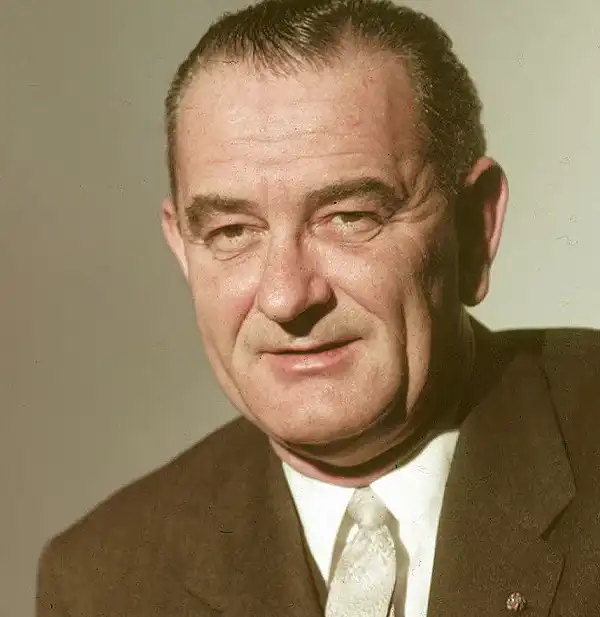
Lyndon Baines Johnson was born on August 27, 1908, near Stonewall, Texas, in the rugged Texas Hill Country. His parents were Samuel Ealy Johnson Jr., a farmer and politician who served in the Texas legislature, and Rebekah Baines Johnson, a well-educated woman who encouraged her children academically. The Johnson family knew periods of financial difficulty, an experience that helped shape Lyndon's later interest in poverty, education, and economic opportunity.
Johnson was not immediately enthusiastic about higher education. After graduating from Johnson City High School in 1924, he spent some time working various jobs before enrolling at Southwest Texas State Teachers College, now Texas State University. He borrowed money to attend and worked as a janitor and office assistant to help pay his expenses.
One of the most important experiences of his young life came when he temporarily left college to teach at a segregated Mexican-American school in Cotulla, Texas. Johnson taught fifth, sixth, and seventh grades and served as principal. He later spoke about the poverty he witnessed among his students and credited the experience with influencing his belief that education could provide a route out of hardship.
Politics, however, soon proved irresistible.
Johnson entered Washington politics as a congressional secretary before winning a special election to the U.S. House of Representatives in 1937. He represented Texas in the House until 1949, apart from a brief period of military service during World War II.
In 1948, Johnson ran for the United States Senate in one of the most controversial elections in Texas political history. He won the Democratic runoff by just 87 votes, producing the enduring nickname "Landslide Lyndon." In a state the size of Texas, 87 votes was less a landslide than a particularly enthusiastic shuffle, but political nicknames have never been required to submit themselves to mathematical inspection.
Once in the Senate, Johnson demonstrated an extraordinary ability to understand both the institution and the people occupying it. He became Democratic whip in 1951, Democratic leader in 1953 and Senate majority leader when Democrats regained control in 1955.
His method of persuasion became famous as the "Johnson Treatment." Johnson was a large man—about six feet three inches tall—and he was perfectly willing to use every inch of it. He would stand extremely close to another politician, lean over him, point, cajole, flatter, threaten, reason and continue talking until resistance began to look considerably more exhausting than agreement.
It was not subtle.
It was, however, frequently effective.
Johnson used his mastery of Senate politics to help move legislation through a chamber that could be remarkably resistant to movement. His years as majority leader established him as one of the most powerful Senate leaders of the 20th century.
Johnson sought the Democratic presidential nomination in 1960 but lost to Senator John F. Kennedy. Kennedy then surprised many observers by selecting Johnson as his running mate. The choice made political sense: Kennedy was a young Massachusetts senator from the Northeast, while Johnson was an experienced Texan with considerable influence among Southern Democrats.
Kennedy and Johnson won the election, and Johnson became the 37th vice president of the United States in January 1961.
For a man accustomed to controlling the Senate, the vice presidency was not necessarily a natural habitat. Johnson attempted to retain influence over his former Senate colleagues, but senators were not particularly interested in having their former leader continue running things from across the Capitol.
Everything changed on November 22, 1963.
President Kennedy was assassinated in Dallas, Texas, and Johnson was sworn in as president aboard Air Force One at Dallas Love Field. Jacqueline Kennedy, still wearing the clothes she had worn during the assassination, stood beside him. The photograph of Johnson taking the oath remains one of the most haunting images in American presidential history.
Johnson suddenly inherited a grieving country, a presidency he had not expected to assume that day, and Kennedy's unfinished legislative agenda.
He immediately set about using the political skills he had developed during decades in Washington.
One of his greatest achievements was the Civil Rights Act of 1964, which prohibited discrimination in public accommodations and employment on the basis of race, color, religion, sex or national origin and strengthened the federal government's ability to confront segregation.
Johnson understood Congress extraordinarily well. He knew which lawmakers needed persuasion, which needed reassurance, which needed political cover and which simply needed the presidential equivalent of being cornered until surrender became attractive.
He signed the Civil Rights Act into law on July 2, 1964.
Johnson followed it with another landmark measure, the Voting Rights Act of 1965, aimed particularly at discriminatory practices that had prevented Black Americans from exercising their constitutional right to vote.
Civil rights legislation became one of the defining achievements of Johnson's presidency and fundamentally altered the legal landscape of the United States.
Meanwhile, Johnson was developing an even larger domestic agenda.
He called his vision the Great Society, and modesty was clearly not involved in the naming process.
Johnson wanted the federal government to attack poverty, expand educational opportunities, improve health care, protect consumers, support the arts, conserve natural resources and improve American cities.
His administration launched the War on Poverty, and Congress created or expanded numerous programs associated with the Great Society.
Among the most enduring were Medicare and Medicaid, established in 1965. Medicare provided health insurance primarily for older Americans, while Medicaid created a federal-state health program for qualifying low-income Americans.
Johnson also signed major education legislation, including the Elementary and Secondary Education Act of 1965. His personal experience teaching poor children in Cotulla decades earlier remained an important part of his thinking about education.
The Great Society also included environmental measures, consumer protections, urban development initiatives, immigration reform and support for cultural institutions. Johnson signed the National Foundation on the Arts and the Humanities Act in 1965, helping establish the National Endowment for the Arts and National Endowment for the Humanities.
Few presidents have presided over such an intense period of domestic legislation.
In the presidential election of 1964, Johnson defeated Republican Senator Barry Goldwater by an overwhelming margin, winning more than 60 percent of the popular vote. It appeared that LBJ had received a formidable mandate for his domestic program.
But while Johnson was building the Great Society at home, another issue was steadily consuming his presidency abroad, Vietnam.
American involvement in Vietnam had begun before Johnson became president, but he dramatically expanded it. Following the Gulf of Tonkin incidents in 1964, Congress overwhelmingly approved the Gulf of Tonkin Resolution, giving Johnson broad authority to use military force in Southeast Asia.
American troop levels increased dramatically, bombing intensified and the Vietnam War became an increasingly dominant part of American political life.
Johnson hoped military pressure would force North Vietnam toward a settlement. Instead, the conflict continued, casualties mounted and public support deteriorated.
The war also produced an uncomfortable contradiction at the heart of Johnson's presidency. The president who wanted to eliminate poverty and racial injustice at home was spending enormous amounts of money and political capital on an increasingly unpopular war overseas.
By the late 1960s, American society was deeply divided.
Antiwar demonstrations became increasingly common. Johnson himself became the target of the chant, "Hey, hey, LBJ, how many kids did you kill today?"
For a politician who had spent his career believing almost every problem could eventually be solved through negotiation, pressure and personal persuasion, Vietnam proved brutally resistant to the Johnson Treatment.
Then came the Tet Offensive in early 1968. Although communist forces suffered enormous military losses, the scale of the offensive shocked Americans who had been told that progress was being made.
Johnson's political position weakened considerably.
On March 31, 1968, during a nationally televised address concerning Vietnam, he stunned the country by announcing that he would neither seek nor accept his party's nomination for another term as president.
Lyndon Johnson left the White House in January 1969 and returned to his beloved ranch in Texas.
His retirement was relatively brief.
Years of heavy smoking, stress and heart problems had taken their toll. Johnson had suffered a serious heart attack in 1955 while serving in the Senate, and his health declined after leaving office.
Lyndon Baines Johnson died of a heart attack at his Texas ranch on January 22, 1973. He was 64 years old.
His presidency remains one of the most consequential and complicated in American history.
The domestic achievements were enormous. Civil rights legislation, voting rights protections, Medicare, Medicaid, federal education programs, environmental laws and numerous Great Society initiatives reshaped the relationship between Americans and their federal government.
At the same time, Vietnam casts an enormous shadow across Johnson's record. The conflict cost tens of thousands of American lives during his presidency and many more Vietnamese lives, divided the United States and damaged public confidence in government.
That contradiction makes Lyndon Johnson difficult to squeeze into a simple historical category.
He could be compassionate and intimidating, idealistic and ruthlessly political, extraordinarily effective and spectacularly frustrated. He understood power perhaps better than almost any politician of his generation and believed government could be used aggressively to improve people's lives.
Sometimes it worked.
Sometimes it very much did not.
But Lyndon B. Johnson certainly did not occupy the presidency quietly. From civil rights and Medicare to the Great Society and Vietnam, decisions made during his administration continue to shape American politics and society decades after the tall Texan returned to his ranch.