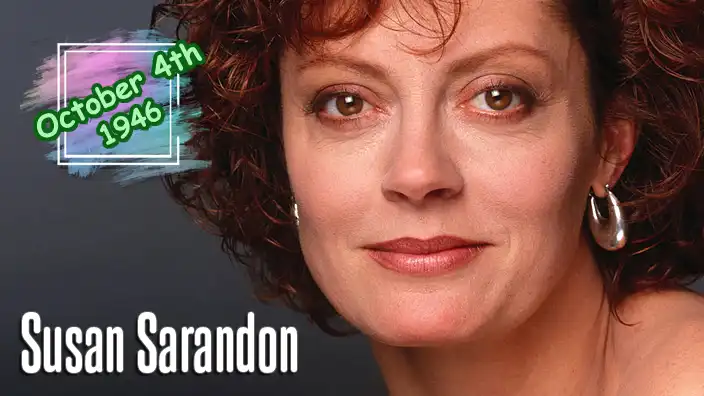
October 4, 1946, in New York City
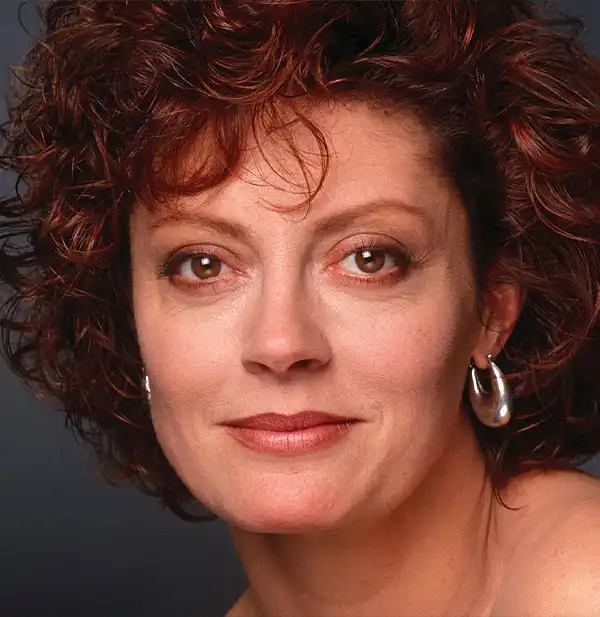
Susan Sarandon has spent decades demonstrating that Hollywood women do not have to behave themselves, disappear quietly or wait patiently for somebody else to get the interesting dialogue. From The Rocky Horror Picture Show and Bull Durham to Thelma & Louise and Dead Man Walking, she built a career playing women who usually have something to say — and frequently say it.
Susan Abigail Tomalin was born on October 4, 1946, in New York City and grew up in a large family in New Jersey. She attended the Catholic University of America in Washington, D.C., where she studied drama and met actor Chris Sarandon. The couple married in 1967, and although the marriage later ended, Susan retained Sarandon as her professional name.
Her entrance into motion pictures was hardly the result of a carefully engineered Hollywood campaign. Sarandon accompanied her husband to an audition for the 1970 film Joe. He did not receive a role, but she did. It was the sort of accidental career development that must make years of carefully prepared five-year plans feel rather unnecessary.
Sarandon played Susan Compton, a troubled young woman whose disappearance helps propel the film's story. Joe, starring Peter Boyle and Dennis Patrick, dealt with the social and generational tensions of its era and gave Sarandon a substantial role in her first feature film. More work followed in movies and television, although it would take time before she became one of the industry's most recognizable leading actresses.
During the early 1970s, Sarandon appeared in productions including The Pursuit of Happiness, Lovin' Molly and Billy Wilder's The Front Page. Then, in 1975, she accepted a role in a peculiar musical comedy about a newly engaged couple, an isolated mansion, a convention of unusual visitors and a scientist wearing attire that Brad and Janet had definitely not anticipated.
The film was The Rocky Horror Picture Show.
Sarandon played Janet Weiss opposite Barry Bostwick's Brad Majors and Tim Curry's unforgettable Dr. Frank-N-Furter. The movie was not initially a conventional box-office triumph, but conventional behavior was never going to be its particular department. Through midnight screenings, audience participation and an extraordinarily devoted following, The Rocky Horror Picture Show developed into one of cinema's great cult phenomena.
For Sarandon, Janet became an early signature role, although her later career would travel in almost every imaginable direction. The film also demonstrated a willingness to take chances that became characteristic of her choices. Safe and predictable roles were available. Sarandon frequently seemed more interested in the ones with sharp edges.
She worked with director Louis Malle on Pretty Baby in 1978 and reunited with him for Atlantic City, released in 1980. The latter provided one of the first major demonstrations of the dramatic depth that would eventually bring Sarandon repeated Academy Award recognition.
In Atlantic City, Sarandon plays Sally Matthews, a waitress working in an oyster bar while studying to become a casino dealer. Burt Lancaster plays Lou, an aging man whose memories of being an important gangster are rather more impressive than the reality of his life. Their stories become intertwined amid crime, money and the changing landscape of Atlantic City.
Sarandon's restrained performance earned her first Academy Award nomination for Best Actress. It also marked an important stage in her development from promising actress to performer capable of carrying demanding dramatic roles. She did not win that year, but Hollywood had unquestionably noticed.
Throughout the 1980s, Sarandon continued moving between mainstream productions and unusual material. She appeared opposite Catherine Deneuve and David Bowie in Tony Scott's stylish vampire film The Hunger, played a teacher drawn into an unusual relationship in Compromising Positions, and joined Jack Nicholson, Cher and Michelle Pfeiffer in The Witches of Eastwick.
Then came baseball.
In 1988, Sarandon starred as Annie Savoy in Bull Durham, writer-director Ron Shelton's romantic comedy about minor-league baseball. Kevin Costner played veteran catcher Crash Davis, while Tim Robbins played talented but erratic pitcher Ebby Calvin “Nuke” LaLoosh. Annie is a devoted student of baseball who approaches the game with a mixture of philosophy, ritual, romance and the confidence of someone who has absolutely no intention of being relegated to the bleachers.
Sarandon actively pursued the role. It proved an excellent decision. Annie Savoy became one of her most popular characters, and Bull Durham developed an enduring reputation as one of the most successful combinations of baseball movie, romantic comedy and philosophical discussion ever to emerge from a minor-league clubhouse.
The film also changed Sarandon's personal life. She and Tim Robbins began a long relationship and eventually had two sons together. Sarandon also has a daughter, actress Eva Amurri, from her earlier relationship with Italian filmmaker Franco Amurri.
Sarandon's career entered an especially strong period as the 1980s gave way to the 1990s. She increasingly found substantial roles at a point when Hollywood has historically had a regrettable tendency to become less imaginative about what women can do on screen.
Then Ridley Scott put Susan Sarandon and Geena Davis in a 1966 Ford Thunderbird convertible and sent them down the road.
Thelma & Louise, released in 1991, became one of the defining films of Sarandon's career. She played Louise Sawyer, a waitress who sets out for a weekend trip with her friend Thelma Dickinson, played by Davis. What begins as an escape from ordinary life turns into a flight from the law after Louise shoots a man who attacks Thelma.
The movie develops from road film into crime drama and finally into something much larger: a story about friendship, freedom, consequences and two women refusing to surrender control of their lives. Sarandon's Louise is practical, guarded and initially the stronger of the pair, while Thelma gradually changes as their journey becomes increasingly desperate.
Their chemistry was crucial. Sarandon and Davis created characters who could argue, laugh, panic and make increasingly terrible logistical decisions while remaining completely believable as friends. The film also featured a young Brad Pitt in one of his breakthrough roles, although Thelma's encounter with him does very little to improve the women's financial position.
The final sequence became one of the most recognizable endings in modern American cinema. Rather than surrender to the police, Thelma and Louise clasp hands and drive toward the edge of the Grand Canyon. The image of their Thunderbird suspended in the air became permanently associated with the film.
Both Sarandon and Davis received Academy Award nominations for Best Actress. The fact that two actresses from the same film competed in the same leading category reflected just how central both performances were to its success.
Sarandon followed Thelma & Louise with another Oscar-nominated performance in Lorenzo's Oil. Directed by George Miller, the 1992 drama told the true story of Augusto and Michaela Odone, whose son Lorenzo developed adrenoleukodystrophy, a rare neurological disease. Sarandon played Michaela opposite Nick Nolte as Augusto.
The role demanded something completely different from Louise Sawyer. Michaela is a mother driven by determination, anger and desperation as she and her husband challenge medical assumptions and search for a treatment. Sarandon received another Best Actress nomination, confirming an extraordinary run of performances.
She was nominated again for The Client in 1994. Based on John Grisham's novel, the legal thriller cast Sarandon as Reggie Love, an attorney representing a boy who possesses dangerous information connected to organized crime. Tommy Lee Jones played the federal prosecutor pursuing the case, while Brad Renfro made his film debut as young Mark Sway.
Reggie Love was another character ideally suited to Sarandon's ability to combine toughness with vulnerability. She could confront prosecutors and criminals while remaining convincingly protective of her young client. The performance brought her another Academy Award nomination.
By this point, Sarandon had accumulated four Best Actress nominations without winning. Hollywood had clearly decided she was very good at this business but apparently wished to make absolutely certain.
Then came Dead Man Walking.
Released in 1995 and directed by Tim Robbins, the film was based on the experiences of Sister Helen Prejean, a Roman Catholic nun known for her work with death-row prisoners and her opposition to capital punishment. Sarandon played Prejean opposite Sean Penn as Matthew Poncelet, a convicted murderer awaiting execution.
The role avoided easy sentimentality. Sister Helen does not excuse the brutality of Poncelet's crimes, nor does the film ignore the suffering of his victims' families. Instead, the story forces its characters — and the audience — to confront guilt, punishment, compassion, responsibility and death without providing comfortable places to hide.
Sarandon's performance is deliberately restrained. There are no grand cinematic heroics required. Much of the role depends upon listening, observing and remaining emotionally present as Poncelet approaches execution. The quietness of the performance made it all the more powerful.
At the 68th Academy Awards, Susan Sarandon won the Academy Award for Best Actress for Dead Man Walking. Sean Penn was nominated for Best Actor, while Robbins received a directing nomination. After years of nominations, Sarandon finally took home the Oscar.
Winning an Academy Award did not send her into a comfortable retirement of dignified supporting appearances. She simply continued working.
In 1998, she starred opposite Julia Roberts in Stepmom, playing Jackie Harrison, a mother dealing with cancer while confronting the difficult reality that another woman may eventually help raise her children. The film could easily have descended into straightforward melodrama, but Sarandon brought humor, anger and emotional complexity to the role.
Her ability to move between drama and comedy remained an important part of her career. She appeared in Anywhere but Here, Igby Goes Down, Moonlight Mile, Shall We Dance?, Elizabethtown and numerous other films while also taking television roles and voice performances.
A new generation encountered her as Queen Narissa in Disney's Enchanted in 2007. The film playfully dismantled traditional fairy-tale conventions, and Sarandon clearly enjoyed portraying a villain who regarded subtlety as something that happened to other people. Narissa eventually transforms into a dragon, which is one way of ensuring that nobody leaves the theater complaining that the finale lacked commitment.
Sarandon also became familiar to television audiences through guest appearances and larger dramatic projects. She portrayed actress Bette Davis opposite Jessica Lange's Joan Crawford in the 2017 television series Feud: Bette and Joan. The production examined the legendary rivalry between the two Hollywood stars during the making of What Ever Happened to Baby Jane?
Playing Bette Davis required Sarandon to portray not merely a famous actress but one of the most recognizable personalities in Hollywood history. Rather than attempting simple imitation, the performance explored Davis as a working actress confronting rivalry, aging, ambition and an industry that had become far less generous with opportunities.
Sarandon's career has been unusually resistant to easy categorization. She has played romantic leads, mothers, lawyers, nuns, witches, royalty, criminals, performers and women who decide that driving away from their problems is preferable to remaining politely seated beside them.
She has also remained publicly involved in political and humanitarian causes throughout much of her career. Her activism has sometimes attracted as much attention and controversy as her acting, particularly because Sarandon has rarely shown much interest in keeping her opinions private merely because doing so might be professionally convenient.
That independence parallels many of her best screen characters. Annie Savoy knows exactly what she thinks. Louise Sawyer does not wait for permission. Reggie Love refuses to be intimidated. Sister Helen Prejean walks into places most people would rather avoid.
Yet Sarandon's strongest performances are not simply exercises in toughness. Her characters frequently combine confidence with uncertainty, strength with fear and humor with vulnerability. Louise is capable but haunted. Jackie in Stepmom can be cuttingly funny while facing mortality. Sister Helen possesses conviction while repeatedly confronting situations for which there can be no easy emotional preparation.
That complexity helped Sarandon build something considerably more durable than conventional movie-star celebrity. She became an actress audiences could expect to make interesting choices, even when the characters themselves made extremely questionable ones.
Her longevity is equally remarkable. The young actress who stumbled into Joe, the wide-eyed Janet Weiss of The Rocky Horror Picture Show, Annie Savoy lecturing minor-league baseball players, Louise behind the wheel of a Thunderbird and Sister Helen walking toward a death-row execution chamber all belong to the same extraordinary career.
And she continued adding to it.
IMDb lists a body of work extending across film, television, producing and voice acting, demonstrating just how broad her professional career became. She has worked through enormous changes in Hollywood while avoiding the comfortable trap of simply repeating whatever had previously succeeded.
That may be the most appropriate way to understand Susan Sarandon's place in film history. She did not build her career around a single screen persona. She built it around curiosity, independence and the willingness to play complicated people.
Some actors spend an entire career searching for one role audiences will remember. Susan Sarandon has Janet Weiss, Annie Savoy, Louise Sawyer, Reggie Love, Sister Helen Prejean and Jackie Harrison waiting in the wings before we even begin arguing about the rest.
Not bad for someone who originally went along to somebody else's audition.