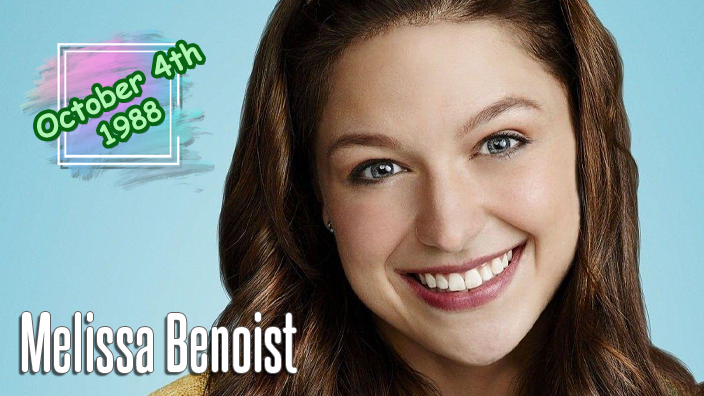
October 4, 1988, in Houston, Texas
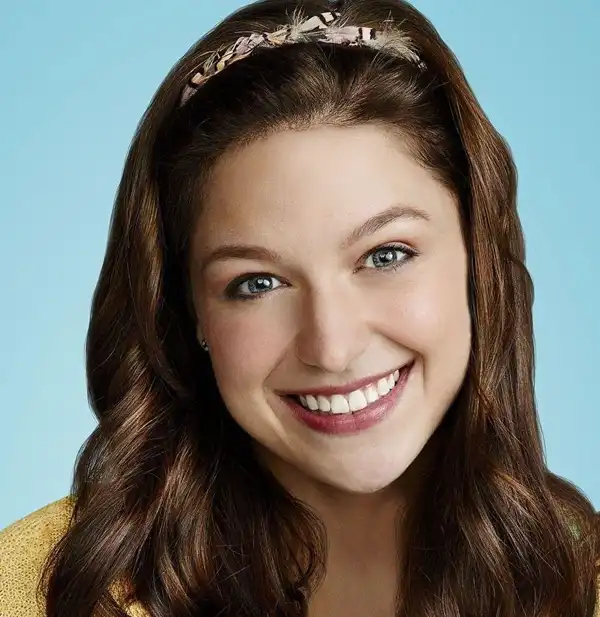
Melissa Benoist spent six seasons proving that saving the world while wearing a cape is considerably more complicated than it looks. Best known as Kara Danvers, otherwise known as Supergirl, Benoist brought warmth, humor and humanity to one of DC Comics' most powerful heroes — while somehow making flying around National City appear almost like a reasonable career choice.
Melissa Marie Benoist was born on October 4, 1988, in Houston, Texas, and grew up in Colorado. Her interest in performing began early, particularly through dance and theater, and she participated in community and school productions before pursuing acting professionally. She later attended Marymount Manhattan College in New York City, graduating with a degree in theatre arts. Like many performers who eventually become closely identified with television, Benoist's path to a starring role involved years of training, auditions and smaller appearances rather than the convenient Hollywood tradition of being discovered while drinking a milkshake.
Her early professional work included television appearances on series such as Law & Order: Criminal Intent, Blue Bloods, The Good Wife and Homeland. These were relatively small roles, but they provided valuable screen experience while Benoist continued auditioning for larger opportunities. The significant breakthrough arrived when she joined the cast of Glee, the musical comedy-drama that had already become a television phenomenon by the time she entered the series.
Benoist joined Glee in 2012 as Marley Rose, a shy but talented student who becomes part of the next generation of performers in the fictional William McKinley High School glee club. Marley is introduced as a naturally gifted singer whose modest background and insecurities contrast with the enormous personalities surrounding her. The role gave Benoist an opportunity to combine acting and singing on national television and placed her inside a series famous for demanding both from its performers, often while simultaneously requiring choreography, emotional drama and the ability to behave as though bursting spontaneously into a fully arranged musical number was perfectly ordinary school policy.
Her work on Glee considerably raised Benoist's profile. Marley became a central member of the show's newer cast, and Benoist performed numerous songs during her time with the series. The part also demonstrated the qualities that would later become particularly important to Supergirl: an approachable screen presence, strong musical ability and a talent for playing fundamentally decent characters without making them bland.
Benoist's film career also began expanding. She appeared in Whiplash, Damien Chazelle's intense 2014 drama about the relationship between ambitious jazz drummer Andrew Neiman, played by Miles Teller, and the terrifying instructor Terence Fletcher, played by J.K. Simmons. Benoist played Nicole, Andrew's girlfriend, whose relationship with him becomes another casualty of his obsessive pursuit of musical greatness. Although her role is relatively small compared with the central confrontation between Teller and Simmons, Whiplash became one of the year's most acclaimed films and won three Academy Awards, including Best Supporting Actor for Simmons.
Then came the role that would transform Benoist's career.
In 2015, she was cast as Kara Zor-El, Superman's Kryptonian cousin, in Supergirl. The character had existed in DC Comics since the 1950s and had previously appeared in film and television, but the new series placed Kara at the center of her own weekly superhero story. Benoist therefore faced the challenge of portraying an established comic-book character while creating a version capable of carrying an ongoing television series.
Kara's story begins years after she was sent from the doomed planet Krypton to protect her younger cousin Kal-El. Her spacecraft is knocked off course, and by the time she eventually reaches Earth, Kal-El has grown up and become Superman. Kara is raised by the Danvers family and initially hides her abilities, living as Kara Danvers and working in National City. Eventually she decides to use her Kryptonian powers publicly and becomes Supergirl.
Benoist's version of Kara deliberately avoided becoming simply a female copy of Superman. She possessed many of the familiar Kryptonian abilities — flight, super strength, heat vision, super speed and near invulnerability — but the series built its identity around Kara's relationships, optimism and continuing effort to balance an ordinary life with responsibilities that were anything but ordinary. She could stop a speeding vehicle, confront an alien invasion and then discover that navigating the office was somehow still capable of ruining her afternoon.
The supporting cast became crucial to that balance. Chyler Leigh played Kara's adoptive sister Alex Danvers, and their relationship became one of the emotional foundations of the series. David Harewood appeared as J'onn J'onzz, the Martian Manhunter, while Mehcad Brooks played James Olsen and Jeremy Jordan portrayed Winn Schott. Calista Flockhart played media executive Cat Grant, Kara's formidable employer, whose ability to dominate a room occasionally suggested that superpowers might not actually be necessary.
Benoist's chemistry with the ensemble helped give Supergirl an identity distinct from darker superhero productions. The series certainly included villains, destruction and enormous threats, but hope remained central to Kara's character. Benoist played her as someone whose greatest strength was not merely the ability to lift extremely heavy objects but her determination to believe that people could make better choices.
Supergirl originally premiered on CBS before moving to The CW beginning with its second season. That move placed the series firmly within the network's expanding collection of interconnected DC superhero programs commonly known as the Arrowverse. Kara subsequently crossed paths with characters from Arrow, The Flash, Legends of Tomorrow and Batwoman, participating in increasingly ambitious crossover events that eventually involved alternate Earths, parallel universes and enough superheroes to make scheduling the filming almost as impressive as saving the multiverse.
The crossovers also paired Benoist frequently with Grant Gustin's Barry Allen, the Flash. Their characters shared an upbeat quality that made their interactions particularly enjoyable, and the musical crossover episode “Duet” took advantage of the performers' musical backgrounds. Benoist and Gustin had both appeared on Glee, and suddenly the superhero universe discovered a perfectly reasonable excuse to have people sing. Considering everything else that happens in comic books, this was hardly the strangest development.
One of the largest Arrowverse events was Crisis on Infinite Earths, which brought together characters from across The CW's DC programs and incorporated references and appearances connected to decades of DC television and film. Benoist's Supergirl occupied an important place in the enormous story, demonstrating how far the character had traveled from the comparatively self-contained first season.
Benoist remained with Supergirl for six seasons, portraying both Kara Danvers and her superhero identity through a long-running story involving family, friendship, journalism, romance, political conflict, alien threats and the occasional attempt to prevent complete planetary destruction. Maintaining a character over that length of time requires something different from performing in a two-hour film. Benoist had to allow Kara to change while preserving the recognizable optimism that defined her from the beginning.
She also stepped behind the camera during the series, making her directorial debut with the episode “Deus Lex Machina.” Directing an established television production while also starring in it added another dimension to her involvement with the series and reflected a growing interest in work beyond acting alone.
Benoist's musical and theatrical background remained important throughout her career. In 2018, she made her Broadway debut as Carole King in the musical Beautiful: The Carole King Musical. Taking on the role meant portraying one of America's best-known singer-songwriters while performing songs that had become part of popular music history. Broadway also returned Benoist to the kind of live performance environment in which she had trained before television made her internationally recognizable.
She later appeared in the Paramount Network miniseries Waco, based on the 1993 confrontation involving federal authorities and the Branch Davidian compound near Waco, Texas. Benoist played Rachel Koresh, wife of David Koresh, portrayed by Taylor Kitsch. The production was far removed from the bright superhero world of Supergirl, allowing Benoist to work within a grim historical drama alongside performers including Michael Shannon, Andrea Riseborough and John Leguizamo.
Following the conclusion of Supergirl, Benoist continued exploring television roles outside the superhero genre. She starred as journalist Sadie McCarthy in The Girls on the Bus, a political drama inspired by Amy Chozick's book about reporters covering presidential campaigns. Benoist also served as a producer on the series. The role again placed her at the center of an ensemble, but without heat vision available whenever an interview became difficult.
Her voice work has kept her connected to fantasy and comic-book storytelling as well. Benoist voiced Teela in the animated series Masters of the Universe: Revolution, joining a franchise populated by He-Man, Skeletor and characters who have been resolving disagreements with swords, sorcery and exceptionally dramatic declarations since the 1980s. Voice acting required Benoist to create the performance without the physical tools available in live action, relying entirely upon vocal expression to give the character personality and emotional weight.
The lasting importance of Supergirl to Benoist's career is difficult to overstate. Superhero roles carry unusual expectations because audiences often arrive with decades of existing affection for the character. The costume matters, the mythology matters and inevitably someone somewhere has very strong feelings about the cape. Yet the actor still has to create a believable human being beneath all of it.
Benoist succeeded largely because Kara Danvers remained central to her performance. Supergirl could fly, lift enormous objects and survive attacks that would end an ordinary person's day rather abruptly, but Kara still worried about her sister, friendships, work and whether she was making the right choices. The extraordinary abilities became more interesting because Benoist kept the ordinary person visible underneath them.
That approach also allowed Supergirl to emphasize optimism without becoming entirely naïve. Kara frequently encountered situations where strength alone could not solve the problem. She had to persuade, forgive, compromise and occasionally accept that being capable of punching through a wall did not mean punching through the wall was a particularly intelligent opening strategy.
Benoist's own career has followed an interesting path from musical theater training to television musicals, acclaimed independent film, superhero stardom, Broadway, historical drama, directing and producing. For an actress still most immediately recognized by a red cape and the large “S” across her costume, she has steadily built a body of work demonstrating that the cape represents one part of the story rather than the whole thing.
Still, Kara Danvers will understandably remain the role most strongly associated with Melissa Benoist. For six seasons she carried a television series built around one of the most recognizable superhero symbols in popular culture and made the character distinctly her own. Her Supergirl was powerful without becoming remote, optimistic without being foolish and heroic without losing the awkwardness and humor that made Kara enjoyable when she was not busy preventing another catastrophe.
Plenty of actors can look impressive while standing dramatically in a superhero costume.
Melissa Benoist made audiences care about the woman wearing it.
And considering that Kara Danvers spent six seasons dealing with aliens, supervillains, alternate universes, workplace problems and an extended family that included Superman, she handled the whole arrangement remarkably well. Most of us have had more difficulty getting through a Monday morning without even once being required to save National City.