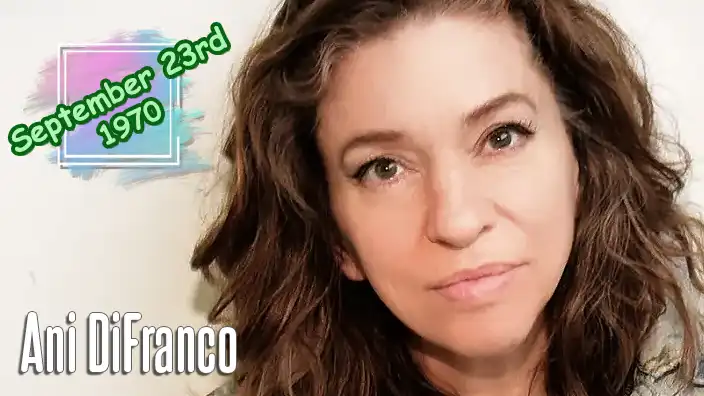
September 23, 1970, in Buffalo, New York
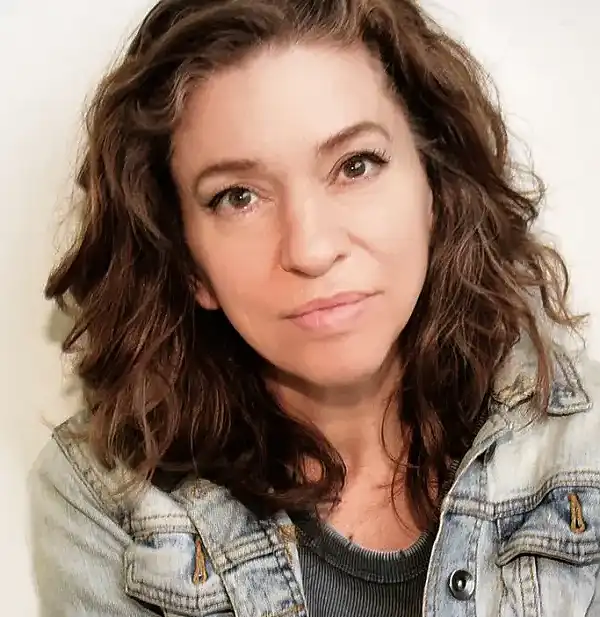
Angela Maria DiFranco was born on September 23, 1970, in Buffalo, New York, and began playing music remarkably early. She started learning Beatles songs on guitar as a child and soon found herself performing in local establishments with the encouragement and guidance of musician Michael Meldrum. Buffalo's bars and coffeehouses became an unconventional training ground, giving DiFranco practical experience in front of audiences while most children her age were considerably more concerned with homework.
Music quickly became more than a childhood hobby. DiFranco developed as a guitarist and songwriter while absorbing folk traditions without allowing herself to be restricted by them. The acoustic guitar remained central to her sound, but she approached it with an unusually aggressive rhythmic style, using alternate tunings, percussive attacks and rapid strumming patterns that could make one instrument sound considerably larger than expected. Anyone imagining the stereotypical gentle folk singer quietly strumming three chords by the fireplace was advised to move the furniture back.
As a teenager, DiFranco was already performing her own material. She later moved to New York City, where she continued developing as a songwriter and performer while studying at the New School. Rather than waiting for a conventional record contract, she began considering how she might release her own music independently. That decision would become one of the defining elements of her career.
In 1990, DiFranco released her self-titled debut album through Righteous Babe Records, the independent label she had created. Starting one's own label was far less routine for an emerging artist at the beginning of the 1990s than it later became in the age of digital distribution and social media. Recording, manufacturing, promoting and distributing music required physical infrastructure, money and considerable persistence. DiFranco nevertheless chose independence over surrendering control of her work to a major label.
Righteous Babe Records gradually developed from a practical means of releasing her own music into a functioning independent record company. Its existence allowed DiFranco to retain substantial control over her recordings, artwork, marketing and career decisions. As her audience grew, major record labels reportedly expressed interest, but DiFranco remained independent. She had already built the machinery she needed and saw little reason to hand over the keys.
Her early recording schedule was remarkably productive. Albums including Not So Soft, Imperfectly, Puddle Dive and Out of Range arrived during the first half of the 1990s, documenting a songwriter developing at high speed. The songs were intensely personal but frequently connected private experience with broader questions involving relationships, gender, sexuality, politics and social expectations.
DiFranco's lyrics became known for their conversational directness. She could move from intimate confession to social criticism without making the transition feel artificial because, in her songwriting, the personal and political were rarely separate territories. Relationships, independence, reproductive rights, economic inequality, sexuality and institutional power could coexist within the same body of work because they also coexist in ordinary life.
Her guitar playing was equally distinctive. DiFranco frequently used alternate tunings and an intensely rhythmic approach that blurred the distinction between accompaniment and percussion. The acoustic guitar could snap, buzz and pound beneath her vocals rather than politely remaining in the background. Her technique became influential among singer-songwriters who discovered that an acoustic instrument did not have to behave acoustically.
Constant touring helped build her audience without the traditional machinery of mainstream radio promotion. DiFranco developed a particularly devoted following through live performance, often playing hundreds of shows during periods of her early career. Word of mouth became an important promotional tool. Fans brought friends, recordings circulated, venues became larger and the independent operation kept growing.
The approach anticipated aspects of the music industry that would become increasingly important years later. Direct relationships between artists and audiences, independent distribution, ownership of recordings and control over touring and merchandising are now familiar subjects in discussions about musicians' careers. DiFranco was building a business around those principles when the Internet still made noises while connecting.
Her 1995 album Not a Pretty Girl became an important breakthrough. The title track was characteristically defiant, rejecting expectations about how women should present themselves and behave. Other songs continued DiFranco's mixture of personal observation and social commentary, while the album helped expand her reputation beyond the independent folk circuit.
The following year brought Dilate, one of her most commercially successful albums. Its songs examined complicated relationships with a degree of emotional exposure that could be uncomfortable precisely because DiFranco did not tidy the feelings into convenient conclusions. Desire, anger, vulnerability, jealousy and independence all appeared without being forced to behave themselves.
By this point, describing DiFranco simply as a folk musician had become increasingly inadequate. Her recordings incorporated rock, funk, jazz and experimental elements, while her arrangements expanded beyond solo acoustic guitar. Bass, drums, horns, keyboards and other instrumentation appeared as her music evolved. The folk tradition remained part of the foundation, but she treated genre boundaries more as suggestions than regulations.
Her live performances became particularly important to her reputation. DiFranco's songs often changed onstage as arrangements stretched, rhythms shifted and interactions with musicians altered familiar material. Her humor between songs also became part of the experience. The intensity of the lyrics did not mean every concert had to resemble a solemn committee meeting.
In 1997, she released the live album Living in Clip, capturing the energy that had made touring central to her career. The album showcased not only the songs but the relationship between performer and audience that had helped create her success. It subsequently became one of the recordings most closely associated with DiFranco's 1990s work.
Her independence attracted almost as much attention as the music. At a time when success was commonly measured by obtaining a major-label contract, DiFranco demonstrated another model. Righteous Babe Records handled her releases while her touring operation cultivated an audience directly. Rather than using independent status as a temporary waiting room before joining a larger corporation, she treated independence as the destination.
Righteous Babe also expanded beyond DiFranco's own recordings, releasing music by other artists. The label became part of a broader community centered on Buffalo and DiFranco's artistic network. Its growth demonstrated that the original decision to self-release an album had developed into something considerably more substantial than a homemade workaround.
DiFranco eventually established Righteous Babe's headquarters in a remarkable Buffalo building: a former Gothic Revival church that was restored and transformed into a performance and cultural space known as Babeville. The complex includes the concert venue Asbury Hall and the smaller Ninth Ward performance space. A building once designed for sermons therefore became home to an independent record company, live music and Ani DiFranco, which seems like a fairly efficient reuse of excellent acoustics.
Her prolific recording career continued with albums including Little Plastic Castle, Up Up Up Up Up Up, To the Teeth, Revelling/Reckoning, Evolve, Educated Guess and many others. Each reflected different combinations of folk, rock, jazz, funk, electronic textures and spoken-word performance. DiFranco's catalogue became less a straight stylistic progression than an extended conversation between songwriting and whatever musical tools seemed useful at the time.
Little Plastic Castle, released in 1998, became one of her best-known albums and received significant critical attention. The record arrived during a period when DiFranco's independent career had become impossible for the mainstream music industry to ignore. She had built a large audience while retaining control over her work, challenging conventional assumptions about what an artist needed in order to sustain a successful career.
DiFranco's music has also been closely associated with feminism and political activism. She has supported causes involving reproductive rights, LGBTQ+ rights, racial justice, environmental issues and opposition to war, among others. Benefit performances and collaborations with activist organizations became recurring features of her career. Her politics were not an accessory added after commercial success; social commentary had been embedded in her songwriting from the beginning.
Her willingness to address controversial subjects inevitably brought disagreement as well as admiration. DiFranco has sometimes faced criticism over decisions, language and political positions, and she has publicly responded to controversies during her career. Her relationship with activism has therefore been neither simple nor insulated from scrutiny. For an artist who built a reputation around speaking openly, the resulting conversations have sometimes been uncomfortable.
One important musical and political relationship was with folk legend Pete Seeger. DiFranco performed with Seeger and participated in projects connected with the folk tradition of combining music and social engagement. That connection placed her within a lineage of American musicians who regarded songwriting not simply as entertainment but as a means of participating in public life.
DiFranco also collaborated with Utah Phillips, the folk singer, storyteller, labor historian and activist. Their albums The Past Didn't Go Anywhere and Fellow Workers combined Phillips' spoken stories with DiFranco's musical arrangements. The projects linked labor history and oral storytelling with contemporary production, allowing the voice of an older radical folk tradition to reach DiFranco's audience.
Fellow Workers received a Grammy nomination, while DiFranco's album Evolve later earned the Grammy Award for Best Recording Package. The latter honor was particularly appropriate for an artist whose independent operation had always treated the presentation and ownership of recordings as part of the creative process rather than merely packaging supplied by somebody else's marketing department.
Her collaborations have ranged widely across the musical landscape. DiFranco has worked or performed with artists including Prince, Maceo Parker, Cyndi Lauper and many others, while her influence has extended across folk, alternative rock and the singer-songwriter community. Prince in particular shared her interest in artistic ownership and independence, making their musical connection especially fitting.
DiFranco's relationship with labels such as “folk singer,” “feminist musician” or “alternative artist” has always been complicated by the breadth of her work. Each description captures something real while leaving something else behind. Her catalogue contains intimate acoustic songs, dense band arrangements, political spoken word, jazz-influenced performances and material that approaches funk or rock. The common element is less genre than authorship.
Motherhood eventually became another subject within her work and changed aspects of her touring and creative life. As throughout her career, personal experience entered the songs without being separated neatly from broader observations. DiFranco's writing has often functioned like an ongoing record of a life being reconsidered while it is happening rather than a carefully polished autobiography written afterward.
She expanded that autobiographical impulse into prose with her memoir No Walls and the Recurring Dream, published in 2019. The book recounts her childhood, musical development, relationships, political awakening and the creation of an independent career. Its title reflects one of the central themes running through DiFranco's work: suspicion of barriers, whether they are imposed by the music business, social convention or personal expectation.
Her later recordings have shown little inclination toward becoming comfortably nostalgic. Albums such as Binary, Revolutionary Love and Unprecedented Sh!t continued engaging with contemporary political and personal subjects while exploring new arrangements and production approaches. DiFranco has never seemed particularly interested in spending the rest of her career simply recreating the sound of her most commercially successful period.
In 2024, she returned prominently to the theatrical world by joining the Broadway production of Hadestown, playing Persephone. The casting brought another dimension of DiFranco's career full circle because she had participated in an early studio recording connected with Anaïs Mitchell's developing Hadestown project years before it became a Broadway phenomenon. Stepping into Persephone's shoes on Broadway therefore represented less a random celebrity casting than a return to a musical world with which she already had a history.
Perhaps the most important element of DiFranco's legacy is the business model she demonstrated. Independent musicians existed long before Righteous Babe Records, of course, but DiFranco became one of the most visible examples of an artist building a substantial career without treating a major record contract as the ultimate prize. She showed that ownership, control and a direct relationship with an audience could be central to artistic success.
That independence came with additional responsibility. Running an organization, touring, producing records and maintaining control means dealing with decisions that artists signed to large companies can delegate. DiFranco nevertheless regarded those responsibilities as the price of freedom rather than an unfortunate distraction from making music.
Her influence can consequently be measured in more than albums or songs. Generations of independent musicians entered an industry in which self-release, artist-owned labels and direct audience relationships became increasingly practical. Technology helped create that environment, but performers such as DiFranco had already demonstrated the philosophy behind it: make the work, own the work and find the people who want to hear it.
Ani DiFranco has spent decades doing precisely that. The guitar tunings changed, the arrangements expanded, the subjects evolved and the audiences grew, but the basic principle remained remarkably consistent. She did not ask the music industry for permission to have a career. She built one, named the record company Righteous Babe, and got back to work.