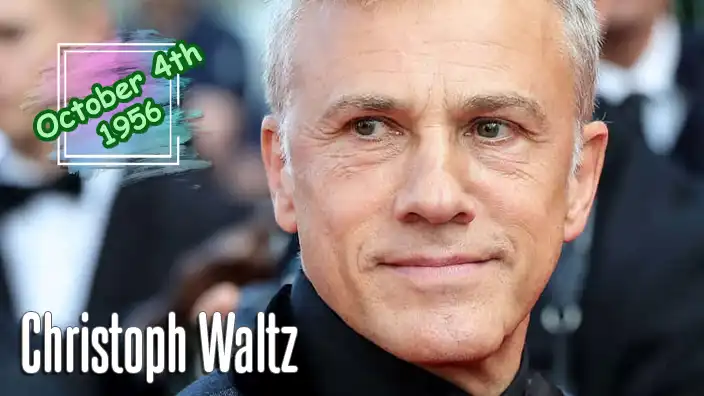
October 4, 1956, in Vienna, Austria
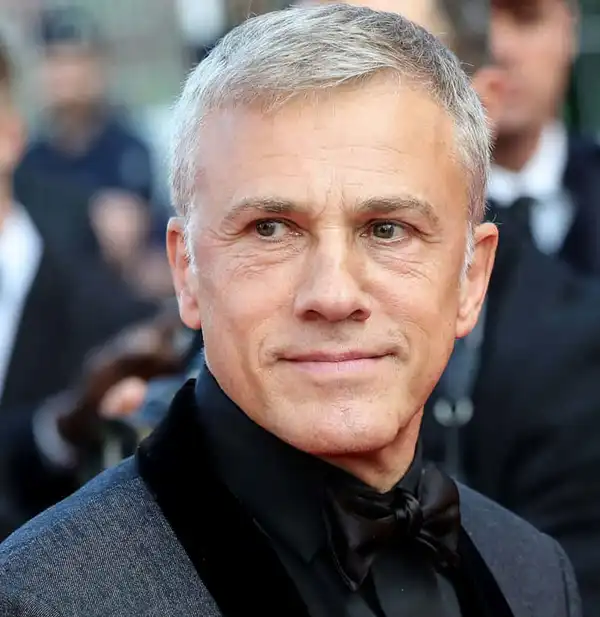
Christoph Waltz has perfected the unnerving art of smiling politely while making everyone in the room wonder whether they should leave immediately. After decades of European television and film work, he became an international star almost overnight, winning two Academy Awards and proving that impeccable manners can occasionally be considerably more frightening than shouting.
Christoph Waltz was born on October 4, 1956, in Vienna, Austria, into a family deeply connected with theater and film. His mother, Elisabeth Urbancic, worked as a costume designer, while his father, Johannes Waltz, was a stage and set designer. His grandparents also worked in the theatrical world. Consequently, the performing arts were not some mysterious profession Waltz discovered from a distance; they were part of the environment in which he grew up.
He initially studied acting at Vienna's Max Reinhardt Seminar before continuing his training in New York at the Lee Strasberg Theatre and Film Institute. His early ambitions also included opera, and he studied singing before eventually recognizing that acting offered the stronger professional path. The musical training was hardly wasted. Waltz's later performances would frequently demonstrate an extraordinary awareness of rhythm, pauses, emphasis and the musical possibilities hidden inside ordinary conversation.
Long before Hollywood discovered him, Waltz had already built an extensive career in European television, theater and film. Beginning in the late 1970s, he appeared in German-language productions and gradually became a familiar working actor in Austria and Germany. He played an enormous variety of characters across television movies, series and theatrical productions.
For years, however, international movie stardom remained somewhere beyond the horizon.
Then Quentin Tarantino needed someone to order a glass of milk.
Tarantino was preparing Inglourious Basterds, his alternative-history World War II film, and had written the role of SS Colonel Hans Landa, an extraordinarily intelligent, multilingual Nazi officer nicknamed “The Jew Hunter.” The character was crucial to the entire film. Landa needed to be charming, funny, frightening and linguistically agile, sometimes all within the same conversation.
Finding the right actor proved difficult.
Waltz changed everything.
Inglourious Basterds opens with one of the finest demonstrations of his particular acting ability. Landa arrives at a French farmhouse occupied by dairy farmer Perrier LaPadite and his family. He is courteous. He compliments the farmer. He requests milk. He smiles. He chats pleasantly.
And the audience rapidly realizes that something dreadful is happening.
The scene lasts far longer than a conventional movie villain's entrance, and that is precisely why it works. Landa does not need to wave a weapon or raise his voice. Waltz gradually changes the atmosphere through language, observation and pauses. His character already knows considerably more than he initially reveals, and the farmer slowly understands that the conversation is actually an interrogation.
Eventually Landa reveals why he has come. A Jewish family is hiding beneath the floorboards.
The scene established Waltz's Hans Landa as one of modern cinema's most memorable villains. What makes the performance particularly disturbing is Landa's pleasure in his own intelligence. He enjoys conversation, languages, deduction and psychological manipulation. Violence is available to him, but he frequently seems to prefer demonstrating that he has already won before anybody realizes they were playing.
Waltz moves effortlessly among German, French, English and Italian during the film, making Landa's multilingual ability part of the character's power. The infamous restaurant scene involving badly pronounced Italian names becomes both hilarious and deeply uncomfortable because Landa understands perfectly well what is happening.
For an actor who had spent decades working primarily in Europe, the reaction was extraordinary.
Waltz won the Best Actor award at the Cannes Film Festival for his performance. He then collected major awards throughout the season, culminating in the Academy Award for Best Supporting Actor. Hollywood had suddenly discovered Christoph Waltz, although Christoph Waltz had been acting professionally for decades.
That distinction matters. Inglourious Basterds was not the emergence of an inexperienced performer who happened to find the perfect part. It was the international breakthrough of a highly trained actor who had spent years developing his craft outside mainstream American cinema.
The role also created an interesting problem.
How do you follow Hans Landa?
Waltz entered Hollywood productions including The Green Hornet, Water for Elephants and Roman Polanski's Carnage. In Water for Elephants, he played August Rosenbluth, the controlling and increasingly dangerous owner of a traveling circus. Once again, Waltz demonstrated his ability to make charm feel like something requiring a nearby emergency exit.
In Carnage, however, he was part of an ensemble including Jodie Foster, Kate Winslet and John C. Reilly. Adapted from Yasmina Reza's play, the story confines two sets of parents to an apartment after their children have been involved in a fight. Civilized discussion gradually deteriorates into something considerably less civilized.
Waltz plays Alan Cowan, an attorney permanently attached to his mobile phone and seemingly far more interested in business than parental diplomacy. The film gave him an opportunity to display dry comedy rather than outright menace. His ability to remain detached while everyone around him becomes increasingly emotional proved wonderfully suited to the material.
Then Quentin Tarantino called again.
In Django Unchained, released in 2012, Waltz played Dr. King Schultz, a German dentist who has abandoned dentistry for the considerably livelier profession of bounty hunting. Early in the film, Schultz purchases the freedom of Django, played by Jamie Foxx, because Django can identify three wanted men Schultz intends to find.
It would have been easy for Waltz's second major Tarantino character to resemble Hans Landa. Both men are intelligent, articulate, European, impeccably polite and capable of sudden violence.
Yet Schultz is fundamentally different.
Hans Landa uses intelligence to dominate people. King Schultz uses it to navigate a brutal world while maintaining a personal moral code. He can kill wanted men without hesitation, but slavery increasingly disgusts him. His relationship with Django evolves from practical arrangement into partnership and genuine friendship.
Waltz again uses language as a weapon, but this time audiences are generally delighted when he wins the argument.
Schultz is also extremely funny. He travels in a wagon topped with a giant bouncing tooth, speaks with elaborate courtesy and has a habit of explaining unpleasant realities in beautifully constructed sentences. He can transform a bounty hunt into something resembling a philosophical discussion, right up until somebody makes the unfortunate discovery that Schultz has already calculated the legal consequences.
The performance earned Waltz his second Academy Award for Best Supporting Actor.
It was an extraordinary achievement. Within a relatively short period, two Quentin Tarantino films had transformed Waltz from a respected European actor into a two-time Oscar winner and internationally recognizable movie star.
The two performances also demonstrate his range better than their superficial similarities might suggest. Landa is a monster hiding behind civilization. Schultz is a civilized man operating inside a monstrous system. Waltz uses many of the same tools — language, humor, stillness, intelligence and sudden changes of tone — to create completely different moral characters.
Hollywood naturally wanted more.
Waltz portrayed Walter Keane in Tim Burton's Big Eyes, the story of artist Margaret Keane, played by Amy Adams, whose distinctive paintings became enormously popular while her husband falsely claimed credit for creating them. Waltz's Walter is charming, ambitious and increasingly outrageous as his deception expands.
The role allowed Waltz to push his theatrical instincts toward comedy and absurdity. Walter Keane is not Hans Landa quietly controlling a farmhouse interrogation. He is a man constructing an enormous performance around himself and becoming increasingly desperate to keep everybody watching it.
Waltz subsequently entered the James Bond universe in Spectre. He played Franz Oberhauser, later revealed as Ernst Stavro Blofeld, one of the most famous villains in the Bond franchise. Daniel Craig's James Bond therefore found himself across the table from Christoph Waltz, which rarely indicates that refreshments will proceed without incident.
Waltz returned as Blofeld in No Time to Die, continuing the character's complicated connection with Bond. The performances placed him within a cinematic tradition stretching back decades, joining actors including Donald Pleasence, Telly Savalas and Charles Gray who had previously portrayed versions of Bond's legendary adversary.
His other work has demonstrated that villainy is merely one section of the toolbox. Waltz appeared in Terry Gilliam's The Zero Theorem, Alexander Payne's Downsizing, Robert Rodriguez's Alita: Battle Angel and Wes Anderson's The French Dispatch. Each offered very different surroundings for his distinctive screen presence.
In Alita: Battle Angel, he played Dr. Dyson Ido, a scientist and cybernetic surgeon who becomes a father figure to the title character. The role allowed audiences accustomed to Waltz's more dangerous characters to see the warmth and tenderness he could bring to a performance.
He has also moved behind the camera. Waltz directed and starred in Georgetown, a crime drama inspired by real events. His willingness to direct was a natural extension of a career grounded not merely in celebrity but in decades of theatrical and screen experience.
Part of Waltz's appeal comes from his voice. He rarely needs volume to command attention. His delivery can be precise, deliberate and almost musical, allowing him to turn an apparently harmless sentence into something loaded with implication.
Then there is the smile.
A Christoph Waltz smile can mean genuine amusement, intellectual satisfaction, mild irritation or the possibility that somebody has approximately thirty seconds remaining to reconsider a very poor decision.
That ambiguity has made him especially effective in morally complicated roles. Audiences learn quickly not to assume that politeness means kindness. His characters frequently understand the social rules perfectly well; whether they have any intention of obeying them is another matter.
His international background has also contributed substantially to his career. Waltz speaks multiple languages and has worked across European and American productions. In an industry where accents and nationality can sometimes restrict casting, his linguistic ability has frequently expanded the possibilities available to him.
Yet the most remarkable aspect of Christoph Waltz's career may still be its timing.
Hollywood loves stories about overnight success, but Waltz's breakthrough provides a useful correction to the idea. By the time most international audiences first encountered him as Hans Landa, he had already spent decades acting professionally.
The overnight success had taken roughly thirty years.
That experience was visible immediately. The confidence required to sit quietly through Tarantino's long stretches of dialogue, allowing tension to accumulate without forcing the performance, came from an actor who understood that doing less can sometimes accomplish considerably more.
His two Academy Awards confirmed the extraordinary impact of that breakthrough. The Academy honored Waltz as Best Supporting Actor for Inglourious Basterds and again for Django Unchained. Two enormously different characters, two collaborations with Tarantino and two Oscars.
There is a wonderful irony in the fact that Christoph Waltz became internationally famous by playing characters who talk so much. Silent menace has a long cinematic tradition, but Waltz often does the opposite. He keeps talking. He asks questions. He tells stories. He discusses languages, customs, business and etiquette.
And everyone becomes increasingly nervous.
That is a rare acting skill. Plenty of performers can frighten an audience by behaving violently. Christoph Waltz can do it while smiling, complimenting the furniture and asking whether anyone would care for another drink.
Which, come to think of it, is considerably worse.