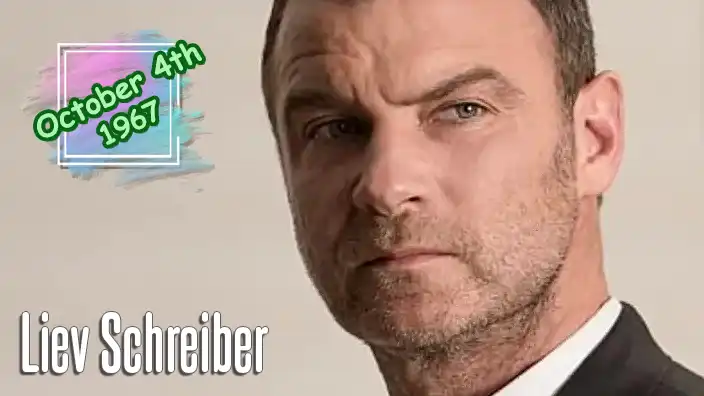
October 4, 1967, in San Francisco, California

Liev Schreiber has the sort of voice that could make reading instructions from a lawnmower manual sound like the opening of a historical epic. Add formidable stage credentials, an extensive film career and years spent cleaning up other people's catastrophes as Ray Donovan, and he has quietly become one of the most versatile actors of his generation.
Isaac Liev Schreiber was born on October 4, 1967, in San Francisco, California, and spent much of his childhood in New York City after his parents separated. His upbringing was unconventional, intellectually rich and frequently difficult, but New York exposed him to theater, literature and art at an early stage. Acting eventually became his direction, although the serious theatrical career that followed was built through considerable formal training rather than a lucky encounter with a casting director while ordering coffee.
Schreiber attended Hampshire College in Massachusetts before studying drama at the Yale School of Drama, where he earned a Master of Fine Arts degree. He also studied at the Royal Academy of Dramatic Art in London. That classical background became fundamental to his career, particularly because Schreiber developed into an accomplished interpreter of Shakespeare while simultaneously building the film and television career for which a much larger audience would eventually know him. Hollywood might know him as a fixer with family problems, but the theater knew perfectly well that he could handle iambic pentameter without requiring emergency assistance.
His early screen work arrived during the 1990s, when Schreiber began appearing in independent films and supporting roles. One of his first widely recognized movie characters was Cotton Weary in Wes Craven's Scream, released in 1996. Cotton had been accused of murdering the mother of Neve Campbell's Sidney Prescott, making him an important part of the elaborate backstory behind the film's mixture of horror, mystery and dark comedy. Schreiber returned for Scream 2 and Scream 3, with Cotton evolving from suspicious figure to celebrity as the increasingly self-aware franchise gleefully dismantled the conventions of horror movies while continuing to employ them.
The Scream films gave Schreiber mainstream visibility, but his career was already demonstrating considerable variety. He appeared in Walking and Talking, Ransom, A Walk on the Moon, Hamlet and other productions while continuing to work extensively on stage. Unlike performers who leave theater behind once film roles begin arriving, Schreiber repeatedly returned to it, building a reputation particularly through Shakespearean performances. His stage work included roles in Hamlet, Cymbeline, Henry V, Macbeth and Othello, demonstrating an ability to move between contemporary screen acting and classical theater without treating either as a sideline.
In 1999, Schreiber took on one of his most ambitious early screen roles when he portrayed Orson Welles in the HBO television film RKO 281. The drama explored the battle surrounding the making of Citizen Kane, particularly the conflict between Welles and newspaper magnate William Randolph Hearst, whose life provided substantial inspiration for the fictional Charles Foster Kane. Playing Welles meant portraying a figure whose voice, appearance, confidence and enormous personality were already deeply familiar to film historians. Schreiber's performance avoided reducing him to a collection of impressions and earned an Emmy nomination for Outstanding Lead Actor in a Miniseries or Movie.
Film roles continued accumulating through the early 2000s. Schreiber appeared with Denzel Washington and Meryl Streep in Jonathan Demme's 2004 remake of The Manchurian Candidate, playing Raymond Shaw, a decorated soldier whose apparent heroism conceals a sinister political conspiracy. The role required Schreiber to portray both controlled public confidence and an increasingly disturbing sense that something underneath the surface was profoundly wrong. Considering the company surrounding him — Washington and Streep are not performers generally known for disappearing unnoticed into the wallpaper — holding his own in the film was no small accomplishment.
Schreiber also appeared in The Sum of All Fears, Kate & Leopold, The Omen, Defiance, Repo Men and Salt, steadily establishing himself as an actor capable of playing authority figures, intellectuals, villains, soldiers and men whose emotional condition would probably benefit from several quiet weeks somewhere without firearms. In Defiance, he played Zus Bielski opposite Daniel Craig's Tuvia Bielski in the true story of Jewish resistance fighters who protected refugees from the Nazis in occupied Belarus during World War II. The role gave Schreiber a physically forceful character whose response to persecution is markedly more aggressive than that of his brother.
In 2009, Schreiber entered the world of comic-book films as Victor Creed, better known as Sabretooth, in X-Men Origins: Wolverine. Hugh Jackman played Wolverine, and Schreiber portrayed his violent half-brother and longtime adversary. The film gave Schreiber the opportunity to exchange Shakespearean soliloquies for claws, snarling and the sort of sibling disagreement that makes an awkward Christmas dinner look positively civilized. Although the movie itself received a mixed critical response, Schreiber's imposing performance as Creed became one of the more memorable elements of the production.
Alongside all of this screen work, Schreiber's theater career continued flourishing. In 2005, he won the Tony Award for Best Featured Actor in a Play for David Mamet's Glengarry Glen Ross. His stage reputation became an important part of his professional identity, particularly in New York, where his Shakespeare performances earned repeated acclaim. That theater experience helps explain the control apparent in much of his screen acting. Schreiber can be physically imposing, but he rarely needs to become noisy merely to dominate a scene. Sometimes the voice does most of the heavy lifting.
And what a voice it is. Schreiber became one of the most recognizable narrators in American documentary television, providing narration for numerous programs, particularly sports documentaries. His voice-over work has included HBO's 24/7 franchise and documentaries dealing with athletes, history and major sporting events. The Television Academy repeatedly recognized this side of his career with Emmy nominations for Outstanding Narrator. It is an unusual secondary career for a major actor, but Schreiber's deliberate, resonant delivery is so naturally suited to documentary narration that one suspects he could describe someone taking the trash cans to the curb and make it sound like the decisive final stage of an epic campaign.
Schreiber also moved behind the camera. He made his feature-film directing debut with Everything Is Illuminated in 2005, adapting Jonathan Safran Foer's novel. The film stars Elijah Wood as a young American who travels to Ukraine searching for the woman who helped save his grandfather during World War II. Schreiber also wrote the screenplay, revealing another side of a career that had already stretched well beyond straightforward acting. The film combined eccentric comedy with increasingly serious historical material, requiring a tonal balance very different from the crime dramas and thrillers in which audiences often encountered him.
Then, in 2013, came Ray Donovan.
The Showtime series cast Schreiber as its title character, a professional “fixer” working for wealthy and powerful clients in Los Angeles. When celebrities, executives and other important people found themselves in situations requiring discretion, intimidation, negotiation or occasionally methods not normally recommended in corporate training manuals, Ray Donovan was the man summoned to make the problem disappear. Unfortunately for Ray, he was considerably better at repairing other people's lives than his own.
That contradiction became the heart of the series. Ray is controlled, resourceful and intimidating in his professional world, but his family life is an ongoing collection of wounds, secrets and unresolved anger. His father, Mickey Donovan, played by Jon Voight, emerges from prison and immediately complicates matters. The relationship between Ray and Mickey becomes one of the central forces driving the series, combining resentment, loyalty, violence and the peculiar gravitational pull of family members who know precisely which buttons to press because they installed most of them.
Schreiber's performance depended heavily upon restraint. Ray Donovan is not a man inclined to explain his feelings at length. Much of the character exists in silences, expressions and the difference between what Ray says and what the audience understands he is thinking. Schreiber's physical presence makes Ray believable as someone capable of intimidation, but the performance becomes more interesting when that apparent strength collides with emotional damage he cannot simply threaten into submission.
Ray Donovan became Schreiber's defining television role and ran for seven seasons before concluding its story with Ray Donovan: The Movie. The Television Academy nominated Schreiber three consecutive times for Outstanding Lead Actor in a Drama Series, recognizing his performance in 2015, 2016 and 2017. He also received Golden Globe nominations for playing Donovan. The television movie later received an Emmy nomination for Outstanding Television Movie, with Schreiber among its executive producers. For an actor whose career had previously moved continually among theater, movies and television, the long-running series gave audiences an opportunity to watch him develop one character across years rather than hours.
During the Ray Donovan years, Schreiber continued taking substantial film roles. One of the most important was Spotlight, the 2015 drama based on The Boston Globe's investigation into sexual abuse by Catholic priests and the institutional concealment surrounding it. Schreiber played Marty Baron, the newspaper's newly arrived editor whose questions help encourage the Spotlight investigative team to pursue the story more deeply. Rather than playing Baron as a conventional inspirational newspaper editor, Schreiber gave him a quiet, analytical presence. The performance suited a film built largely around careful reporting rather than cinematic grandstanding.
Spotlight won the Academy Award for Best Picture, and its ensemble — including Michael Keaton, Mark Ruffalo, Rachel McAdams, Brian d'Arcy James, Stanley Tucci and Schreiber — became central to its success. Schreiber's Marty Baron is notably understated even among that ensemble. He enters the newsroom as an outsider, asks deceptively simple questions and refuses to be distracted by local assumptions about what should or should not be investigated. It is a fine example of Schreiber's ability to make stillness interesting.
His later work has continued across very different genres. He provided the voice of the villainous Kingpin in the acclaimed animated film Spider-Man: Into the Spider-Verse, turning Wilson Fisk into an enormous physical and vocal presence. He has appeared in films including The French Dispatch, Asteroid City and Golda, in which he portrayed U.S. Secretary of State Henry Kissinger opposite Helen Mirren's Golda Meir. The collection is typical of Schreiber's career: animation, stylized comedy, historical drama and prestige television all seem perfectly comfortable sharing space on the same résumé.
That variety makes Schreiber difficult to reduce to Ray Donovan, despite the enormous importance of the role. His career encompasses Shakespeare, horror movies, political thrillers, superhero films, historical dramas, directing and documentary narration. He can convincingly portray a gangster, newspaper editor, mutant supervillain, historical figure or professional fixer and then walk into a theater and tackle Shakespeare. There are easier ways to make a living, but apparently nobody told him.
Schreiber's career also illustrates the value of classical theatrical training in modern screen acting. The skills required to command a stage without a camera inches from one's face are different from those required for the close restraint of television, yet he has moved repeatedly between them. Ray Donovan frequently requires him to communicate through tiny reactions, while Shakespeare demands language and physical presence capable of reaching an entire theater. Schreiber has spent decades doing both.
For many viewers, however, Ray Donovan will remain the character most closely associated with him. There is something irresistibly appropriate about Schreiber's combination of physical authority, quiet intelligence and deep voice being attached to a man whose occupation is making unpleasant situations go away. Ray walks into chaos looking as though chaos has simply become another item on the afternoon schedule.
The joke, of course, is that Ray Donovan can fix almost everything except Ray Donovan.
That contradiction gave Liev Schreiber one of television's most complicated leading characters, but it represents only one chapter in a career that began on the classical stage and expanded into movies, television, writing, directing and narration. Whether he is dealing with Shakespeare, serial killers, mutants, newspaper investigations or the Donovan family, Schreiber has built his career on an ability to project enormous presence without constantly demanding attention.
And should the acting ever dry up, there is always that voice. Frankly, he could probably read the telephone directory and leave us worried about what happens when he reaches the letter M.