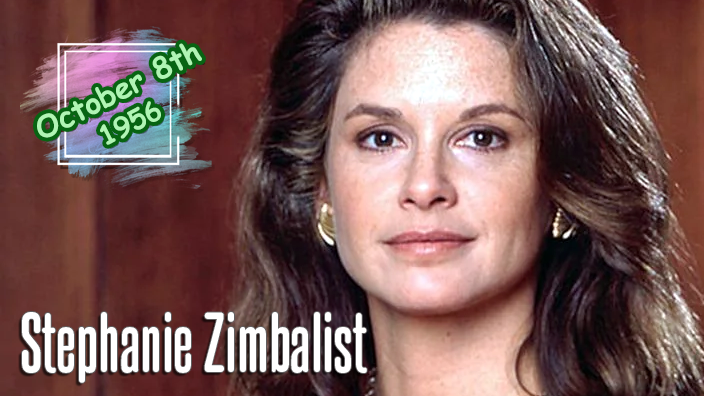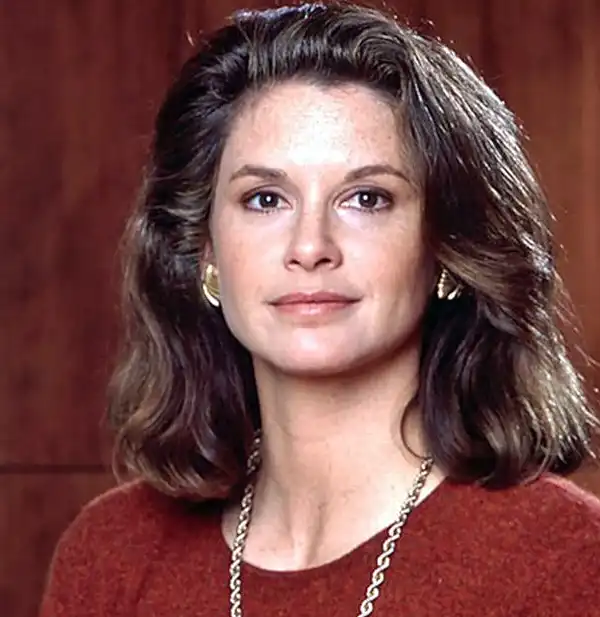
Stephanie Loranda Zimbalist was born on October 8, 1956, in New York City and grew up primarily in Los Angeles. Entertainment and the arts were deeply embedded in her family history. Her father, Efrem Zimbalist Jr., was a celebrated television actor whose long career included starring roles in 77 Sunset Strip and The F.B.I. Her paternal grandfather, Efrem Zimbalist, was an internationally renowned violinist, composer and conductor, while her paternal grandmother, Alma Gluck, was a celebrated operatic soprano. With that collection of performers gathered around the family tree, the arrival of another professional entertainer seems considerably less surprising.
Zimbalist nevertheless developed her own interest in acting rather than simply inheriting a profession. As a child she was active in sports, dance and amateur theatrics, sometimes creating her own performances. Her interest in theater grew considerably during summers spent at Brown Ledge Camp in Vermont, where she acted, sang and learned theatrical skills. By the time she completed school, acting had moved beyond childhood entertainment and become a serious ambition.
After graduating from Foxcroft School in Middleburg, Virginia, Zimbalist pursued professional dramatic training rather than a conventional university education. She attended the Juilliard School in New York, developing the stage skills that would remain important throughout her career. She later returned to Los Angeles and began making the familiar rounds of auditions while working outside acting until professional opportunities arrived.
Television provided some of those earliest opportunities. Zimbalist appeared in several television movies during the late 1970s, including The Gathering, a 1977 drama starring Ed Asner and Maureen Stapleton. The production received considerable attention and helped give the young actress useful exposure at the beginning of her career.
Her first feature-film work included The Magic of Lassie in 1978, starring James Stewart. The film offered Zimbalist the opportunity to work with one of Hollywood's most respected actors while she was still establishing herself. She later appeared in The Awakening in 1980, a supernatural horror film starring Charlton Heston. Her performance as Margaret Corbeck earned her a Saturn Award nomination for Best Supporting Actress.
One of her most important early television roles arrived with the ambitious miniseries Centennial, based on James A. Michener's sprawling novel about the history of a fictional Colorado community. Broadcast beginning in 1978, the production assembled an enormous cast and told its story across generations, mixing fictional characters with major themes from the history of the American West.
Zimbalist portrayed Elly Zendt, appearing opposite Timothy Dalton as Oliver Seccombe and working among a cast that included Richard Chamberlain, Robert Conrad, Raymond Burr, Barbara Carrera and numerous other established performers. Centennial became one of the major television miniseries of its era and provided Zimbalist with a substantial dramatic role before the series that would ultimately make her a television star.
That series arrived in 1982 with Remington Steele. Zimbalist played Laura Holt, a talented private investigator who discovers that potential clients are reluctant to hire a detective agency run by a woman. Her solution is both ingenious and potentially troublesome: she invents a fictional male superior named Remington Steele and renames her business after him.
The arrangement works wonderfully until a mysterious and sophisticated man, played by Pierce Brosnan, appears and assumes the identity of the nonexistent Remington Steele. Laura suddenly finds herself working alongside a man pretending to be the boss she invented — while clients naturally assume that he really is in charge. Workplace complications do not come much more thoroughly self-inflicted than that.
The premise allowed Remington Steele to combine detective stories with romantic comedy. Laura was the trained investigator who actually understood how to solve cases, while Steele relied heavily upon charm, improvisation, old movies and an extraordinary ability to look convincing in expensive clothes. Their contrasting approaches created the show's central relationship.
Zimbalist's performance was crucial to making the concept work. Laura Holt could not simply be the sensible woman standing beside the charismatic male lead. She needed to be intelligent, determined and capable enough for viewers to understand that the agency really belonged to her. Much of the comedy came from watching Steele receive credit while Laura knew perfectly well who had done the actual investigating.
At the same time, the attraction between Laura and Steele gave the series an ongoing romantic tension. Their relationship developed through flirtation, arguments, jealousy and cases that repeatedly placed them in dangerous situations. The program became an important example of the romantic detective format that flourished on American television during the 1980s.
Doris Roberts added another important ingredient as Mildred Krebs, whose involvement with the agency grew during the series. The chemistry among Zimbalist, Brosnan and Roberts helped give Remington Steele a personality extending beyond its weekly mysteries. The cases mattered, but viewers were often equally interested in what was happening among the people supposedly solving them.
The series ran on NBC from 1982 until 1987, with Zimbalist appearing throughout its run. The program made both Zimbalist and Brosnan widely recognizable television stars. It also became an important chapter in Brosnan's eventual path toward playing James Bond, although contractual complications involving Remington Steele famously affected his first opportunity to take the role.
Zimbalist's connection to her own family history even found its way into the series. Her father, Efrem Zimbalist Jr., made recurring appearances as Daniel Chalmers, a charming con man connected to Steele's mysterious past. It gave father and daughter an opportunity to share the screen while playing characters whose relationship added another layer to the show's already complicated assortment of identities and deceptions.
After Remington Steele, Zimbalist continued working extensively in television, film and theater. She starred in numerous television movies, demonstrating that Laura Holt had not confined her to detective stories. One particularly notable production was The Man in the Brown Suit, a 1989 adaptation of Agatha Christie's mystery novel in which Zimbalist played Anne Beddingfeld alongside Rue McClanahan and Tony Randall.
She received significant recognition for the 1990 television movie Caroline?, based upon a story by E.L. Konigsburg. Zimbalist played a mysterious woman who arrives claiming to be Caroline, the daughter of a wealthy family who had been presumed dead. The role required considerably different dramatic work from the quick exchanges and romantic sparring of Remington Steele and earned her a Golden Globe nomination.
Zimbalist also appeared in productions including The Story Lady, Incident in a Small Town and numerous other television films and guest roles. Her career became particularly notable for the sheer amount of television work produced during an era when made-for-television movies provided substantial dramatic opportunities for established actors.
The stage, however, remained an important part of her professional life. Zimbalist appeared in numerous theatrical productions, including works by major playwrights such as Tennessee Williams and Henrik Ibsen. Theater allowed her to work away from the expectations created by television fame and return to the kind of live performance that had originally attracted her to acting.
One especially meaningful theatrical collaboration involved her father. Efrem Zimbalist Jr. had largely retired from acting when Stephanie persuaded him to return to the stage with her in Tennessee Williams' The Night of the Iguana. The production allowed two generations of the Zimbalist acting family to work together in a medium both respected.
Her family heritage extended even further back than her father's distinguished television career. Her grandfather Efrem Zimbalist had been a major classical violinist and served for many years at Philadelphia's Curtis Institute of Music. Her grandmother Alma Gluck was among the prominent concert singers of the early twentieth century. Stephanie therefore represents a third generation of a family with a remarkable history in American performing arts.
Yet Zimbalist's own career developed differently from those of her famous relatives. Rather than classical music or the suave television dramas associated with her father, she became particularly identified with an intelligent female television character whose professional abilities were central to the premise of her series.
Laura Holt is especially interesting when viewed in the context of early 1980s television. The entire premise of Remington Steele begins with the assumption that Laura is perfectly capable of running a detective agency but encounters clients unwilling to trust a woman with the job. She responds not by abandoning her ambition but by inventing the man the marketplace apparently requires. The joke, of course, is that the imaginary man becomes real and immediately starts receiving the credit.
Zimbalist gave Laura enough determination to prevent that joke from becoming tiresome. She could be frustrated with Steele, attracted to him and occasionally impressed by him without allowing audiences to forget that Laura was an accomplished investigator in her own right. The partnership worked because neither character could entirely dominate the other.
There is also an amusing connection running through Zimbalist's early career. In Centennial, she worked with Timothy Dalton, who later became James Bond. In Remington Steele, she starred opposite Pierce Brosnan, who also later became James Bond. Few actresses can claim to have worked extensively with two future 007s before either gentleman received his license to kill.
Zimbalist herself remained less interested in pursuing the machinery of Hollywood celebrity than might have been expected following the success of Remington Steele. Her subsequent career frequently emphasized theater, television films and character-driven projects rather than attempting to turn Laura Holt into a springboard for conventional movie stardom.
That choice produced a career with considerable variety. She has performed mysteries, historical dramas, romantic comedies, horror, family films and stage classics while maintaining a professional identity that extends far beyond a single successful television series.
Nevertheless, Remington Steele remains the role most strongly associated with Stephanie Zimbalist, and understandably so. Laura Holt was smart, funny, capable and thoroughly aware of the absurdity of watching an invented male superior become the public face of her own business. Zimbalist made the frustration entertaining without sacrificing the character's competence.
From Centennial to Laura Holt, television movies and a substantial stage career, Stephanie Zimbalist built upon an extraordinary family tradition without simply repeating it. Her grandfather had the violin, her grandmother had the concert stage, her father had The F.B.I. and 77 Sunset Strip, and Stephanie got a detective agency with an imaginary boss who inconveniently became real.
Considering the family history, perhaps the strangest thing about the Zimbalists is that any of them ever had time to watch television.