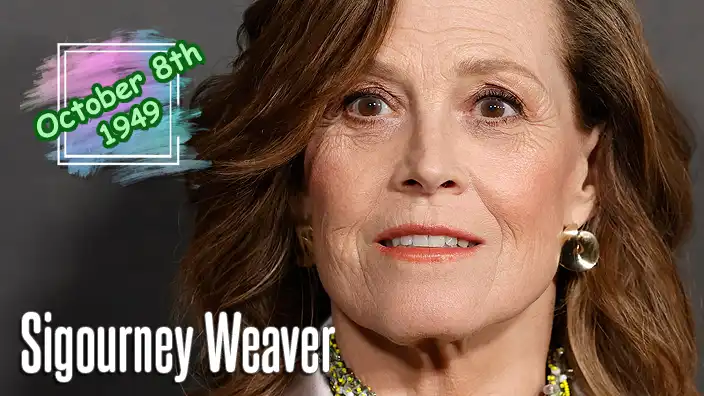
October 8, 1949, in Manhattan, New York City
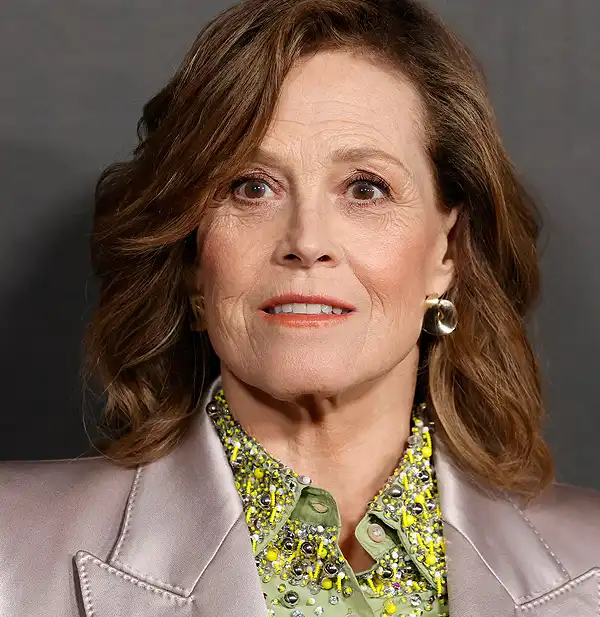
Sigourney Weaver was born Susan Alexandra Weaver on October 8, 1949, in Manhattan, New York City. Entertainment was already part of the family business. Her father, Sylvester “Pat” Weaver, was a prominent television executive, while her mother, Elizabeth Inglis, was a British actress. The future star did not remain Susan for long. As a teenager, she adopted the name Sigourney after encountering the name in F. Scott Fitzgerald’s The Great Gatsby. It was certainly more distinctive, and history suggests that Susan Weaver probably would not have sounded quite as convincing while ordering people to stay away from a Xenomorph.
Weaver attended Stanford University before studying acting at the Yale School of Drama, where she earned a master’s degree. Her early professional work included the stage, and her first professional theatrical job was in Sir John Gielgud’s production of The Constant Wife, which starred Ingrid Bergman. Weaver continued to maintain connections with theater even after Hollywood discovered that she was exceptionally good at dealing with monsters, ghosts, gorillas, crooked executives and assorted other occupational hazards.
Her first movie appearance was decidedly modest. Weaver had a small walk-on role in Woody Allen’s Annie Hall in 1977, appearing briefly near the end of the film. Two years later, modesty disappeared rather dramatically when director Ridley Scott cast her as Ellen Ripley in Alien. The science-fiction horror film followed the crew of the commercial spacecraft Nostromo after an extraterrestrial creature came aboard. What began as a space voyage rapidly became an extremely persuasive argument for stricter quarantine procedures.
Ripley became one of cinema’s defining science-fiction characters. Intelligent, practical and unwilling to ignore obvious danger simply because someone else outranked her, she survived circumstances that eliminated most of her crewmates. Weaver’s restrained performance helped make the character believable. Ripley was not presented as an invincible superhero; she was a capable professional who recognized the seriousness of the situation and kept functioning while an extraordinarily unpleasant creature crawled through the ship.
The character became even more important when Weaver returned for James Cameron’s Aliens in 1986. The sequel transformed the claustrophobic horror of the original film into a larger military science-fiction adventure while placing Ripley firmly at its center. Her determination to protect the young survivor Newt gave the character an emotional dimension beyond simple survival, while her confrontation with the Alien Queen produced one of the most celebrated showdowns in science-fiction cinema. Weaver’s performance earned her an Academy Award nomination for Best Actress, an unusually significant achievement for a performance in a science-fiction action film.
Weaver returned to the character again in Alien 3 in 1992 and Alien: Resurrection in 1997, serving as a producer as well as an actress on the later installments. Across the films, Ripley changed substantially, but Weaver remained the center of the series. Her portrayal helped demonstrate that a major action franchise did not require a conventional male action hero, and Ripley became an influential model for strong female characters in science fiction and action cinema.
Fortunately, Weaver did occasionally find employment in movies where nothing attempted to eat her. Peter Weir’s The Year of Living Dangerously paired her with Mel Gibson in a political drama set in Indonesia during the turbulent final months of President Sukarno’s rule. The film gave Weaver another opportunity to demonstrate that the actress behind Ripley was capable of moving comfortably beyond science fiction.
Then there was Ghostbusters. In the 1984 supernatural comedy, Weaver played Dana Barrett, a New York musician whose apartment developed a rather serious supernatural problem. Dana initially sought help from the Ghostbusters after strange activity began occurring in her kitchen. Things subsequently deteriorated until she became possessed by Zuul, Gatekeeper of Gozer. It was not the sort of difficulty generally covered by a building superintendent.
Working opposite Bill Murray, Dan Aykroyd, Harold Ramis and Ernie Hudson, Weaver proved equally comfortable with comedy. Her scenes with Murray’s Peter Venkman allowed her to play the sensible counterweight to his relentless wisecracking. She returned as Dana Barrett in Ghostbusters II and later appeared again in the franchise, helping connect the original films with their modern successors.
The year 1988 demonstrated Weaver’s range with remarkable clarity. She portrayed real-life primatologist Dian Fossey in Gorillas in the Mist, a dramatic account of Fossey’s work studying and protecting mountain gorillas in Rwanda. The physically demanding performance required Weaver to convey Fossey’s passion, determination and increasingly difficult relationships with the people around her. Her work earned an Academy Award nomination for Best Actress.
During that same year, Weaver played Katharine Parker in Working Girl, Mike Nichols’ workplace comedy-drama starring Melanie Griffith and Harrison Ford. Katharine was sophisticated, successful and polished, but she was hardly an ideal boss. Weaver turned the character into a memorable corporate antagonist without reducing her to a simple caricature. The performance earned Weaver an Academy Award nomination for Best Supporting Actress.
That meant Weaver received two acting Oscar nominations at the same Academy Awards ceremony — Best Actress for Gorillas in the Mist and Best Supporting Actress for Working Girl. She did not win either Oscar, but the double nomination remains one of the notable accomplishments of her career. She did, however, win Golden Globe Awards for both performances, demonstrating that 1988 had been a rather productive year at the office.
Weaver continued moving between genres throughout the 1990s. She appeared in Dave, playing the First Lady opposite Kevin Kline in the political comedy about an ordinary man recruited to impersonate the President of the United States. She took a much darker turn opposite Ben Kingsley in Roman Polanski’s Death and the Maiden and played a criminal psychologist pursued by a serial killer in the thriller Copycat. Ang Lee’s The Ice Storm provided another acclaimed dramatic role, with Weaver playing Janey Carver in a bleak examination of suburban families during the 1970s.
Then came Galaxy Quest in 1999, a film that initially appeared to be a parody of Star Trek and gradually became an affectionate celebration of science-fiction fandom. Weaver played Gwen DeMarco, an actress remembered for playing Lieutenant Tawny Madison on the fictional television series Galaxy Quest. Gwen frequently complains that her character’s only job aboard the ship is repeating whatever the computer says — and then continues doing precisely that when the fictional television crew finds itself aboard a very real spacecraft.
Weaver’s performance in Galaxy Quest allowed her to poke fun at science-fiction conventions while drawing upon her own long association with the genre. Surrounded by Tim Allen, Alan Rickman, Tony Shalhoub and Sam Rockwell, she became part of an ensemble whose increasingly desperate attempts to pretend they knew how to operate an actual spaceship produced much of the film’s comedy. The movie developed an enduring following and became one of Weaver’s most beloved comedic performances.
Director James Cameron brought Weaver back to large-scale science fiction with Avatar in 2009. She played Dr. Grace Augustine, a scientist overseeing the Avatar Program on Pandora. Grace was intelligent, blunt and deeply knowledgeable about the Na’vi and their world, making her an important counterweight to the corporate and military interests driving much of the conflict. The film became an enormous international success and reunited Weaver with the director who had guided her through Aliens more than two decades earlier.
Weaver returned to Cameron’s universe in Avatar: The Way of Water, but in a particularly unusual fashion. Rather than simply returning as Grace Augustine, Weaver portrayed Kiri, a Na’vi teenager with a mysterious connection to Grace. Casting Weaver as an adolescent character might have sounded peculiar on paper, but performance-capture technology allowed her to create a substantially different character while remaining part of the expanding Avatar story.
Her voice has also become familiar to audiences. Weaver has contributed voice performances to animated productions including WALL-E and The Tale of Despereaux. In WALL-E, she voiced the computer aboard the Axiom, an amusing bit of casting considering how many years she had spent aboard fictional spacecraft trying to survive computers, aliens and questionable decisions made by other crew members.
Throughout her career, Weaver has resisted being confined to a single type of role. Science fiction made her internationally famous, but drama, comedy, thrillers, theater and voice acting demonstrated a range extending far beyond Ellen Ripley. She could portray the emotionally intense Dian Fossey, the formidable Katharine Parker, the sophisticated Dana Barrett and the cheerfully frustrated Gwen DeMarco without any of them feeling like variations on the same character.
Her influence is particularly significant in science fiction. Ellen Ripley emerged at a time when major action and science-fiction movies were still overwhelmingly centered upon male heroes. Weaver did not merely participate in changing that convention; she helped demonstrate how unnecessary the convention had been in the first place. Ripley became memorable because she was capable, intelligent, frightened when fear made sense and extraordinarily determined when circumstances demanded it.
The recognition followed. Weaver has received three Academy Award nominations, including her Best Actress nomination for Aliens and the remarkable pair of nominations for Gorillas in the Mist and Working Girl. Her performances have also brought Golden Globe, BAFTA, Emmy and other major award nominations and honors across a career encompassing film, television and theater.
Sigourney Weaver’s longevity is partly explained by her willingness to move wherever the interesting work happened. She has never depended entirely upon one franchise, one genre or one kind of character. Ripley may have made her a science-fiction icon, but Weaver repeatedly stepped away from that enormous shadow and reminded audiences that she could be funny, frightening, vulnerable, imperious, compassionate or gloriously irritated as circumstances required.
Few performers can claim a résumé containing Alien, Ghostbusters, Gorillas in the Mist, Working Girl, Galaxy Quest and Avatar. Fewer still could make that combination appear perfectly sensible. Sigourney Weaver has spent decades demonstrating that whether the problem involves extraterrestrial predators, supernatural invaders, corporate treachery or a spaceship controlled by actors who only played astronauts on television, somebody eventually needs to behave like a responsible adult. Fortunately, she usually turns up.