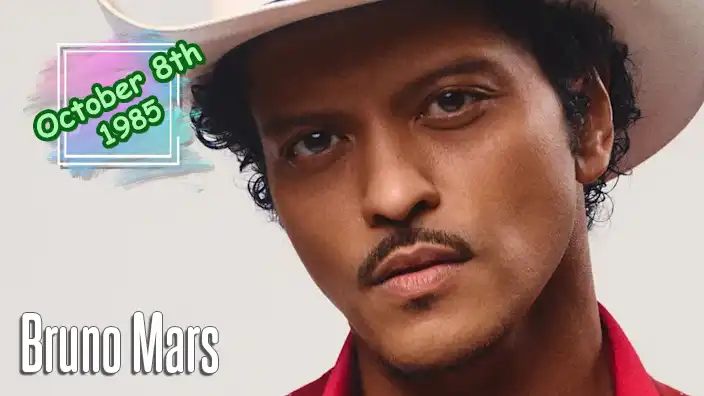
October 8, 1985, in Honolulu, Hawaii
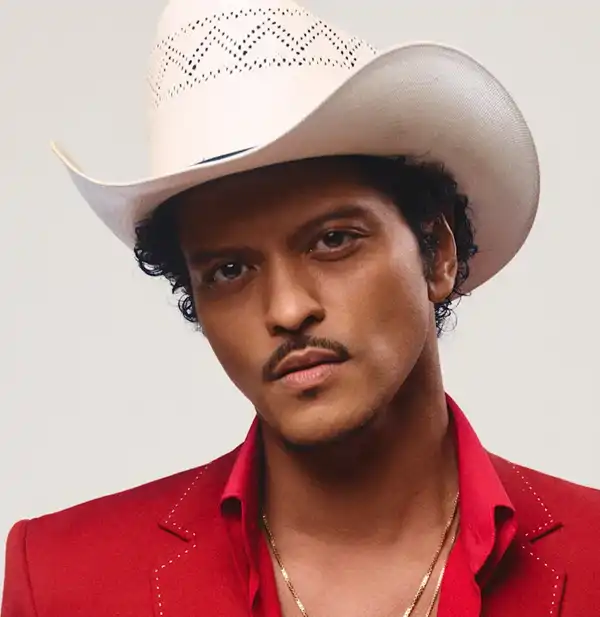
Bruno Mars was born Peter Gene Hernandez on October 8, 1985, in Honolulu, Hawaii. Music surrounded him from the beginning. His father, Peter Hernandez, was a percussionist, while his mother, Bernadette San Pedro Bayot, was a singer and dancer. His family performed together, and young Peter did not spend much time waiting for adulthood before joining the entertainment business. He was appearing onstage while most children his age were still concentrating upon considerably less demanding matters.
The nickname “Bruno” came from his father, who thought his young son resembled professional wrestler Bruno Sammartino. The “Mars” arrived later, when Hernandez was developing his professional identity. The resulting Bruno Mars was distinctive, memorable and considerably easier to fit onto an album cover than Peter Gene Hernandez. More importantly, the new name accompanied a performer determined to avoid being pushed into a narrowly defined musical category.
One of Mars’ earliest specialties was impersonating Elvis Presley. As a small child, he performed Elvis songs as part of his family’s musical act and became known locally as a remarkably convincing miniature version of the King of Rock and Roll. His childhood performances exposed him to live audiences at an unusually early stage and helped develop the confidence, timing and showmanship that would later become central to his concerts.
His Elvis connection even brought him a small appearance in the 1992 film Honeymoon in Vegas, starring James Caan, Nicolas Cage and Sarah Jessica Parker. Mars appeared as Little Elvis. It was hardly enough screen time to predict international superstardom, but it did mean that one of the biggest pop performers of the following decades had already accumulated a movie credit while still a child.
Mars attended President Theodore Roosevelt High School in Honolulu and continued performing throughout his youth. After graduating, he moved to Los Angeles to pursue music professionally. The transition was not immediately glamorous. Like countless performers before him, Mars discovered that being talented and being discovered were two entirely different stages of the entertainment business.
An early recording contract with Motown did not produce the breakthrough he hoped for, but the experience helped redirect his career toward songwriting and production. Mars joined forces with Philip Lawrence and Ari Levine as part of the songwriting and production team known as the Smeezingtons. Instead of waiting for somebody to make Bruno Mars famous, he began helping to make records for other performers.
His songwriting and production work became increasingly successful. Mars contributed to songs recorded by artists including Flo Rida, CeeLo Green and others, developing a reputation as a versatile songwriter capable of working across pop, R&B, soul and hip-hop. The behind-the-scenes work provided both experience and industry credibility, but Mars possessed a voice and performing style that were unlikely to remain behind the curtain indefinitely.
His emergence as a featured vocalist helped change that. Mars appeared on B.o.B’s “Nothin’ on You,” which became a major international hit, and on Travie McCoy’s “Billionaire.” Listeners who did not yet know Bruno Mars suddenly knew his voice. It was the musical equivalent of somebody quietly entering through the side door and discovering that the entire building had started watching him.
Mars released his debut studio album, Doo-Wops & Hooligans, in 2010. The album firmly established him as a solo performer and produced several enormous hits. “Just the Way You Are” became his first solo No. 1 single on the Billboard Hot 100, while “Grenade” also reached the top of the chart. “The Lazy Song” added a lighter, deliberately relaxed side to an album that demonstrated Mars could move easily between romantic ballads, pop, reggae influences and R&B.
“Just the Way You Are” also brought Mars his first Grammy Award, winning Best Male Pop Vocal Performance. The song’s straightforward romantic message became one of his signature recordings and helped establish a pattern that would follow him throughout his career: sophisticated production paired with melodies that sounded immediately familiar enough to sing before the song had finished.
His second album, Unorthodox Jukebox, arrived in 2012 and broadened his musical range. “Locked Out of Heaven” drew upon rock, reggae and new wave influences, while “When I Was Your Man” placed Mars at a piano for a stripped-down ballad about regret. Both songs reached No. 1 on the Billboard Hot 100, demonstrating that he did not need to repeat the sound of his debut album to maintain his success.
Mars’ stage reputation grew alongside his recording career. His concerts drew heavily upon the traditions of classic entertainers who treated singing as only one part of the job. Choreography, musicianship, costumes, audience interaction and tightly rehearsed band performances became central to his shows. The influence of performers including Elvis Presley, James Brown, Michael Jackson and Prince could be recognized, but Mars combined those traditions into a performance style distinctly his own.
That showmanship reached an enormous television audience when Mars headlined the Super Bowl XLVIII halftime show in 2014. The Red Hot Chili Peppers joined him during the performance. For an artist whose first album had appeared only a few years earlier, commanding one of the most closely watched stages in entertainment represented an extraordinary rise.
Then came “Uptown Funk.” Released in 2014 by producer Mark Ronson featuring Bruno Mars, the song became a worldwide phenomenon. Its combination of funk, pop, horns, swagger and an irresistible chorus turned it into one of the defining popular recordings of the decade. “Uptown Funk” spent 14 weeks at No. 1 on the Billboard Hot 100 and won the Grammy Award for Record of the Year.
Mars returned to the Super Bowl halftime stage in 2016 as a guest during Coldplay’s headline performance, which also featured Beyoncé. The appearance reinforced his status as one of the era’s premier live entertainers. There are not many performers who can appear alongside Beyoncé during a Super Bowl halftime show and still make people pay attention to what they are doing. Mars managed quite comfortably.
His third studio album, 24K Magic, arrived later in 2016 and leaned heavily into funk, R&B and the sounds of earlier decades. The title track announced the album with unapologetic swagger, while “That’s What I Like” became another No. 1 hit. “Versace on the Floor” offered a smoother R&B ballad, demonstrating once again that Mars was perfectly willing to move between musical styles as long as there was a strong melody waiting at the other end.
The 24K Magic era became a major awards triumph. At the 2018 Grammy Awards, Mars won all six categories in which he was nominated. The album won Album of the Year and Best R&B Album, while “24K Magic” won Record of the Year and “That’s What I Like” received Song of the Year. Sweeping the major categories in a single evening placed Mars among a comparatively small group of performers to dominate the Grammys so thoroughly.
Mars then found another musical partner in Anderson .Paak. Together they formed Silk Sonic, a project built around the sound and visual style of 1970s soul and R&B. The collaboration allowed both performers to embrace vintage clothing, elaborate arrangements, smooth harmonies and the kind of stage presentation suggesting that somebody had discovered a particularly stylish time machine.
Silk Sonic’s debut single, “Leave the Door Open,” arrived in 2021 and quickly became a major success. The song reached No. 1 on the Billboard Hot 100 and subsequently won four Grammy Awards, including Record of the Year and Song of the Year. Their album, An Evening with Silk Sonic, continued the deliberately retro approach with rich harmonies, live instrumentation and enough velvet to cause concern among furniture manufacturers.
The partnership worked because neither Mars nor Anderson .Paak treated the music as a joke. There was humor in the presentation, certainly, but the musicianship was serious. Silk Sonic drew upon decades of soul and R&B traditions while creating new songs rather than simply reproducing old recordings. Mars’ fascination with earlier musical styles had been present throughout his career, and Silk Sonic allowed him to indulge it with considerable enthusiasm.
Songwriting remains one of the most important elements of Mars’ success. Long before audiences recognized his face, he had learned how songs were constructed by writing for other performers. That foundation remained evident as his own career expanded. His recordings tend to place melody, rhythm and memorable hooks at the center, whether the finished result is a ballad, funk workout, pop anthem or soul recording.
His musical abilities extend beyond singing and songwriting. Mars plays guitar, piano, bass and drums, among other instruments, and his performances frequently demonstrate that he is a musician as much as a frontman. His background in a performing family gave him practical experience with live music from childhood, while years of songwriting and production provided an understanding of what happens behind the recording studio glass.
Mars has also proved unusually comfortable borrowing from older musical traditions without pretending they were invented yesterday. Doo-wop, funk, soul, reggae, rock and R&B all appear throughout his work. The influences can be obvious, but his strongest recordings transform them into contemporary pop rather than functioning merely as nostalgia. A Bruno Mars song might remind listeners of several different decades while still sounding entirely at home on modern radio.
His career has brought an extensive collection of awards, including numerous Grammy Awards, American Music Awards and Billboard Music Awards. Commercially, he has accumulated multiple No. 1 singles and albums while selling enormous numbers of recordings worldwide. Yet statistics only explain part of his appeal. Mars belongs to the older tradition of performers for whom making the audience enjoy itself is the central purpose of the evening.
That philosophy may explain why his live performances have become such an important part of his reputation. There is remarkably little standing around waiting for something to happen. Mars and his musicians dance, play, sing and interact with the audience in carefully constructed performances that retain the appearance of spontaneity. Making that level of polish look effortless is, naturally, the result of a tremendous amount of effort.
From a child impersonating Elvis Presley in Hawaii to an internationally successful singer, songwriter, producer and performer, Bruno Mars built his career through several different sides of the music business. He learned the stage first, then discovered the difficulties of the recording industry, became successful writing for others and finally emerged as the artist audiences now recognize around the world.
The result is a career that feels both modern and pleasantly old-fashioned. Bruno Mars understands contemporary pop, but he also understands something performers knew long before streaming, social media and digital charts arrived: if people buy a ticket, you had better put on a show. Give him a microphone, a band, a sharp suit and perhaps a hat, and Bruno Mars will apparently take care of the rest.