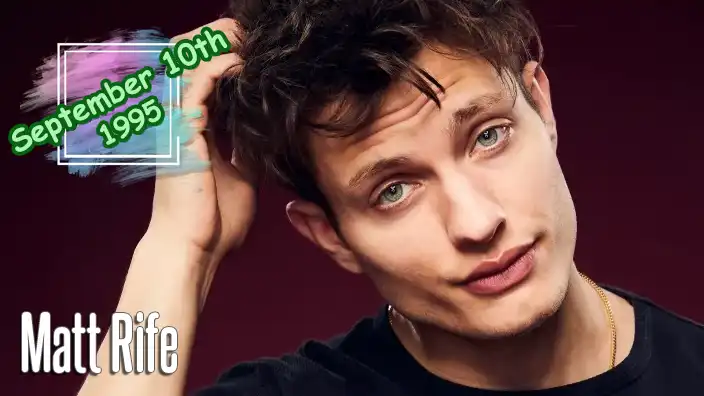
September 10, 1995, in Columbus, Ohio

Matt Rife was born Matthew Steven Rife on September 10, 1995, in Columbus, Ohio, and grew up in the state, spending much of his childhood in North Lewisburg. His early life was marked by personal difficulties, including the death of his father by suicide when Rife was a toddler. He has spoken publicly about that loss and its effect on his family, while also describing how humor became an important part of his personality. Long before millions of people were watching his comedy clips online, he was a young man who had discovered that making people laugh could provide both a sense of connection and a possible direction for his future.
Rife became interested in stand-up comedy while still in school, reportedly after learning about a talent show and deciding to try performing. He began doing stand-up as a teenager and quickly became serious about developing his skills. Rather than waiting until adulthood to discover whether comedy might suit him, he started learning the profession in front of real audiences, where a joke either works or provides immediate and occasionally painful feedback. He performed in clubs and other venues around Ohio, gaining experience at an age when many of his contemporaries were still trying to decide what they wanted to do after graduation.
His early career required persistence, travel, and the willingness to perform for audiences who had no particular reason to know his name. Stand-up comedy can look deceptively simple from the audience: one person walks onto a stage, speaks for a while, and everyone laughs. In practice, it requires writing, timing, observation, confidence, and the ability to recover when a carefully prepared joke receives the sort of silence normally associated with a library after closing time. Rife spent years developing those skills, gradually building a reputation as a young performer with an energetic stage presence and a willingness to engage directly with the people watching him.
He eventually moved to Los Angeles to pursue comedy and acting opportunities, becoming part of the competitive entertainment scene in which countless performers are trying to attract the attention of agents, producers, and audiences. His early television exposure included appearances on MTV’s Wild ’N Out, the improvisational comedy series created by Nick Cannon. Rife joined the show as a young cast member and became known for his quick responses and ability to participate in the program’s fast-paced comedy battles. The experience gave him valuable exposure and allowed him to work alongside other comedians, although it did not immediately make him a household name.
Rife also appeared on MTV’s The Challenge: Champs vs. Stars and hosted the network’s TRL reboot, adding to his television experience. His acting credits include appearances in projects such as Brooklyn Nine-Nine, Fresh Off the Boat, and the comedy series Burb Patrol. He also appeared in the 2019 horror film Black Pumpkin and later in films including North of the 10 and The Private Eye. These roles demonstrated his interest in developing a career beyond stand-up, even as live comedy remained the central focus of his professional ambitions. Acting offered a different set of challenges, including the unfamiliar experience of delivering a line exactly as written rather than immediately changing it because someone in the front row looked interesting.
For several years, Rife continued performing stand-up while building his audience through social media. His early career was not an overnight success, despite the impression that can be created when a performer suddenly appears everywhere online. He had already spent considerable time working in comedy clubs, developing material, and learning how to handle audiences before his videos began attracting widespread attention. That experience became particularly important when his online popularity accelerated, because the skills required to hold a room for an hour are rather different from those needed to make someone laugh during a thirty-second clip.
The turning point came through his crowd-work videos, particularly on TikTok and other short-form platforms. Crowd work involves interacting with audience members, asking questions, and creating comedy from their responses. It is a long-established part of stand-up, but Rife’s clips proved especially effective in the social-media environment. His quick reactions, conversational style, and ability to turn unexpected answers into jokes made the videos highly shareable. A brief exchange that might once have been enjoyed by a few hundred people in a comedy club could now reach millions of viewers around the world.
One of the advantages of crowd-work clips is that they allow a comedian to demonstrate personality and improvisational ability without revealing too much of a carefully written stand-up set. Rife used this approach to introduce himself to new audiences while preserving much of his prepared material for live performances. The strategy helped create a sense of spontaneity and encouraged viewers to imagine what might happen if they attended one of his shows. It also created a rather unusual situation for audience members, who could arrive hoping to enjoy a comedy performance and leave having accidentally become the subject of a video watched by half the internet.
His online success was particularly notable because it challenged the traditional route to stand-up fame. For decades, comedians often depended on television appearances, late-night talk shows, comedy specials, and industry connections to reach a national audience. Social media allowed Rife to build a direct relationship with viewers, promote his own performances, and demonstrate demand for his work without waiting for a major network to introduce him. The result was a rapidly expanding fan base that translated into ticket sales, larger venues, and increased attention from the entertainment industry.
Rife released his first self-produced comedy special, Only Fans, on YouTube in 2021. Despite the title, the special was not associated with the subscription platform of the same name; it was a play on words reflecting his relationship with his audience. The project allowed him to present a longer stand-up performance and demonstrate that his comedy extended beyond the short crowd-work clips that had attracted so much attention. He followed it with Matthew Steven Rife in 2023, another self-produced special that helped establish his identity as a comedian capable of sustaining a full-length show.
Later in 2023, he released Walking Red Flag, a crowd-work special filmed in Phoenix, Arizona. The project emphasized the improvisational style that had become central to his online popularity, with audience interactions providing much of the material. It also demonstrated the unpredictable nature of crowd work: the comedian can prepare questions and develop techniques, but the audience ultimately supplies the raw material. The success of these independently released specials showed that Rife could reach substantial audiences without relying exclusively on traditional television distribution.
His growing popularity led to the announcement of the ProbleMATTic World Tour, which began in 2023 and included performances across North America and internationally. Demand for tickets was enormous, with many shows selling out quickly and additional dates being added. The tour represented a major step in his career, moving him from smaller comedy venues to theaters and other large performance spaces. It also demonstrated the commercial power of an audience built through social media, although the sudden increase in demand created the familiar modern entertainment experience of fans staring at ticketing websites and wondering whether the internet had personally decided to dislike them.
In November 2023, Rife released his first Netflix stand-up special, Matt Rife: Natural Selection. Filmed at DAR Constitution Hall in Washington, D.C., the special introduced his comedy to an even broader audience and marked an important milestone in his career. It also generated controversy, particularly over an opening joke involving domestic violence. Critics argued that the material was insensitive, while Rife defended his approach and emphasized that his comedy was intended for audiences who appreciated his style. The reaction became part of a wider discussion about the boundaries of stand-up, the expectations created by social-media popularity, and the difference between a comedian’s online persona and a full-length performance.
The controversy also highlighted the challenges that can accompany rapid fame. Rife had attracted a substantial audience through clips that often emphasized flirtatious exchanges, quick improvisation, and relatively accessible humor. A full stand-up special, however, allowed him to present material that was darker or more provocative than some viewers expected. His response to criticism generated further debate, and opinions about the special varied considerably. The episode demonstrated that a large online following does not necessarily represent a single audience with identical tastes, and that the transition from viral popularity to mainstream recognition can bring intense scrutiny as well as commercial success.
Rife continued his relationship with Netflix in 2024 with Matt Rife: Lucid – A Crowd Work Special. The production focused on the audience-interaction format that had played such an important role in his rise to fame. Filmed in Charlotte, North Carolina, it featured Rife engaging with audience members and developing comedy from their responses. The special was notable as Netflix’s first crowd-work stand-up special, reflecting the growing popularity of a format that had previously been more closely associated with live comedy clubs and short online clips. It also allowed Rife to showcase the improvisational skills that had helped distinguish him from other performers in the crowded stand-up market.
Crowd work remains one of the most recognizable elements of Rife’s comedy, but it is only one part of the profession. A successful live performer must also understand pacing, structure, audience expectations, and the relationship between prepared material and spontaneous interaction. Rife’s ability to move between these approaches has contributed to his popularity, particularly among younger audiences who may have discovered stand-up through social media rather than traditional comedy television. His career illustrates how the medium through which people encounter a performer can influence the kind of comedy they expect to see.
His appearance has also become an unusually prominent part of public discussion surrounding his career. Rife’s conventionally attractive looks have attracted considerable attention online, sometimes leading to descriptions of him as a comedian with a particularly devoted female fan base. He has addressed the subject in interviews and performances, occasionally expressing frustration that his appearance can overshadow the years of work he has invested in comedy. The situation presents an unusual professional dilemma: being considered attractive may help attract attention, but it does not automatically persuade an audience to laugh at a joke. Comedy clubs, fortunately, have not yet introduced a system in which good cheekbones count as a punchline.
Rife has also spoken about the importance of his family and the support he received while pursuing his career. His mother, siblings, and other relatives have featured in his public discussions of his upbringing, and he has described the challenges of balancing personal relationships with the demands of touring. A successful comedy career can involve long periods away from home, irregular schedules, and the pressure of constantly producing new material. These realities are less visible than the glamorous photographs and sold-out venue announcements, but they form an important part of the professional life of a touring performer.
His interest in acting has continued alongside his stand-up success. IMDb lists a range of film and television credits, including comedy, drama, and horror projects, reflecting his willingness to explore different kinds of roles. Although his acting career has not achieved the same level of recognition as his stand-up work, it remains an important part of his professional ambitions. The transition between comedy and acting is a familiar one in entertainment, but it requires performers to adapt their skills to different settings. A comedian who can command a theater audience must learn to work within the more controlled environment of a film set, where the audience may not see the finished performance until months or years later.
Rife’s career has also demonstrated the increasing importance of independent production and direct audience engagement. By releasing specials on YouTube, maintaining an active social-media presence, and promoting tours through his own channels, he helped build a business around his comedy before securing major streaming opportunities. This approach has become increasingly common among performers who recognize that an online audience can provide both creative freedom and commercial leverage. It does not eliminate the difficulties of the entertainment industry, but it can allow comedians to develop their careers without depending entirely on traditional gatekeepers.
His rapid rise has brought both admiration and criticism, as is often the case with performers who become highly visible in a short period. Supporters praise his improvisational ability, stage presence, and willingness to engage directly with audiences, while critics have questioned aspects of his material and the relationship between his viral persona and his longer performances. These differing reactions are part of the broader conversation surrounding contemporary stand-up comedy, where social media can amplify both enthusiasm and controversy. Rife’s career provides a particularly clear example of how quickly a performer can move from relative obscurity to international recognition in the digital era.
What makes his story distinctive is the combination of traditional comedy-club experience and modern online distribution. Rife did not begin with millions of followers; he spent years performing, developing material, and learning how to handle the unpredictable nature of live audiences. Social media then provided a platform through which those skills could reach people who might never have encountered him otherwise. The resulting success was dramatic, but it rested upon a foundation of professional experience that had been developing long before the viral clips appeared.
On September 10, Matt Rife’s birthday offers an opportunity to recognize a comedian whose career reflects the changing nature of entertainment. From teenage performances in Ohio to MTV, independent specials, sold-out tours, and Netflix, he has followed a path that combines persistence with an instinct for reaching audiences through new media. Whether viewers prefer his prepared stand-up, his crowd-work exchanges, or his acting appearances, his rise demonstrates the power of finding an audience and developing a recognizable style. And if you ever attend one of his shows, remember that sitting in the front row may come with an unexpected speaking part. It is probably best to have an answer ready.