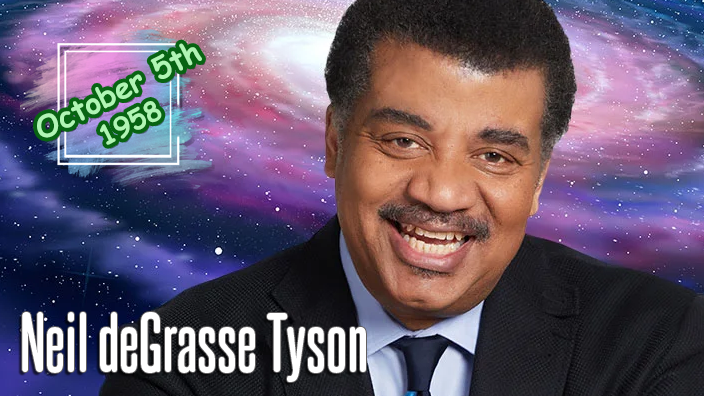
October 5, 1958, in New York City
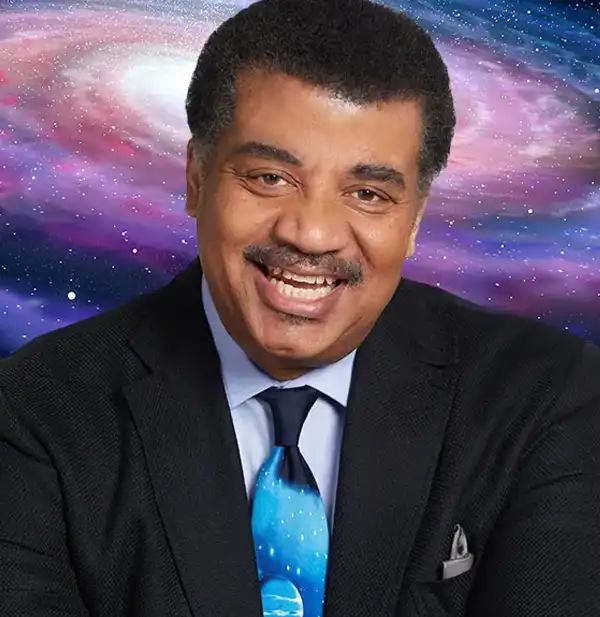
Neil deGrasse Tyson was born on October 5, 1958, in New York City and grew up in the Bronx. His fascination with astronomy began during childhood, and one location would prove particularly important. When Tyson first visited the Hayden Planetarium at the American Museum of Natural History at the age of nine, its representation of the night sky astonished him. Growing up beneath New York City's light-polluted skies, he had never seen anything resembling the enormous number of stars displayed across the planetarium dome.
That experience did more than impress him. Tyson began looking upward with purpose. He observed the Moon through binoculars from the roof of his family's apartment building, acquired a telescope and began attending astronomy classes at the Hayden Planetarium. By the age of eleven, he had recognized that understanding what he saw in the sky would require serious mathematics and physics rather than simply owning increasingly powerful equipment and pointing it upward.
At fourteen, Tyson attended an astronomy camp in Arizona, where he encountered a genuinely dark night sky far removed from New York City's light pollution. The experience confirmed that the spectacular sky he had seen projected inside the Hayden Planetarium was not artistic exaggeration. The universe really had been hiding all those stars from the Bronx.
Tyson attended the Bronx High School of Science, an institution with a long history of producing scientists, academics and other exceptionally curious people. Astronomy had already become more than a childhood hobby, and he continued developing his knowledge while also displaying interests well beyond science.
After high school, Tyson attended Harvard University, earning a bachelor's degree in physics in 1980. He subsequently studied astronomy at the University of Texas at Austin, receiving a master's degree in 1983. His graduate education eventually brought him back to New York, where he continued his studies at Columbia University and earned a doctorate in astrophysics.
Tyson's doctoral research examined aspects of the Milky Way's galactic bulge, including its chemical composition, abundance patterns and structure. His wider scientific interests have included star formation, stellar evolution, dwarf galaxies and the structure of our galaxy. Those subjects are somewhat less likely to produce celebrity gossip than Hollywood, although exploding stars at least know how to make an entrance.
After completing his doctorate, Tyson conducted postdoctoral research at Princeton University. His career then brought him back to the institution that had helped inspire it in the first place: the American Museum of Natural History and the Hayden Planetarium.
Tyson joined the Hayden Planetarium as a staff scientist in 1994 and became its director in 1996. The progression contained an almost suspicious degree of narrative neatness. A boy walks into a planetarium, becomes fascinated by the universe, studies astrophysics and eventually returns to run the place. Had it happened in a movie, somebody might have complained that the ending was a little too convenient.
As director, Tyson became closely involved in the enormous redevelopment of the Hayden Planetarium and creation of the Rose Center for Earth and Space. The reconstructed facility opened in 2000 and provided visitors with a dramatically modernized environment for exploring astronomy and astrophysics. Tyson became the first occupant of the Frederick P. Rose Directorship and remains closely associated with both the planetarium and the American Museum of Natural History.
The rebuilt planetarium also helped place Tyson near the center of one of astronomy's most unexpectedly emotional controversies: Pluto.
For generations of schoolchildren, the Solar System contained nine planets, and Pluto occupied the final position. When the Rose Center opened, however, its displays grouped Pluto differently from the eight major planets. Tyson and his colleagues emphasized Pluto's relationship with icy objects of the outer Solar System rather than simply presenting it as another planet equivalent to Earth, Jupiter or Neptune.
This did not go unnoticed.
The argument over Pluto intensified as astronomers discovered additional objects in the distant Solar System and debated exactly what should qualify as a planet. In 2006, the International Astronomical Union formally defined the term “planet” in a way that classified Pluto as a dwarf planet.
Tyson did not personally demote Pluto with a large celestial rubber stamp, but his prominent role in explaining the issue made him one of the public faces of the controversy. He subsequently wrote The Pluto Files: The Rise and Fall of America's Favorite Planet, exploring both the science and the extraordinary emotional attachment people had developed toward a small icy world billions of miles away.
Pluto supporters have not necessarily forgiven him.
Tyson's growing public profile reflected his ability to explain difficult scientific ideas without requiring his audience to arrive carrying an astrophysics textbook. From 1995 to 2005, he wrote a regular “Universe” column for Natural History magazine, discussing astronomy and science for general readers. His essays and other writings eventually contributed to a substantial collection of books intended to make the universe accessible beyond professional scientific circles.
His books include The Sky Is Not the Limit: Adventures of an Urban Astrophysicist, Origins: Fourteen Billion Years of Cosmic Evolution, written with Donald Goldsmith, Death by Black Hole and Other Cosmic Quandaries, Space Chronicles: Facing the Ultimate Frontier, Astrophysics for People in a Hurry, Letters from an Astrophysicist and Starry Messenger: Cosmic Perspectives on Civilization.
The title Astrophysics for People in a Hurry neatly summarizes Tyson's approach to popular science. The universe is approximately 13.8 billion years old. The reader has a dentist appointment at three. Something clearly has to be condensed.
Television considerably expanded Tyson's audience. He hosted the PBS program NOVA ScienceNOW, bringing scientific research and discoveries to viewers in an approachable format. The program covered subjects far beyond Tyson's own astrophysical specialty and reinforced his role as a general science communicator rather than simply an astronomer appearing whenever somebody needed a black hole explained.
In 2009, Tyson launched StarTalk, initially as a radio program and later as a podcast and television series. The format deliberately mixed science with comedy, popular culture and conversations with guests from outside traditional academic science. Actors, comedians, musicians, athletes and other public figures could find themselves discussing physics, space, technology or the scientific implications of subjects they had probably not expected to encounter that afternoon.
The approach reflected Tyson's belief that science communication need not resemble a university lecture. Humor and popular culture could provide an entrance into serious ideas. A discussion might begin with a superhero movie and somehow end with orbital mechanics. If Superman insists on flying, sooner or later somebody has to ask about the physics.
Tyson's connection with Carl Sagan provides another interesting thread through his career. When Tyson was a teenager considering universities, Sagan—already a prominent astronomer at Cornell University—personally encouraged him to consider Cornell. Tyson ultimately chose Harvard, but he later recalled Sagan's kindness and generosity toward a young student.
Decades later, Tyson inherited one of Sagan's most famous television legacies.
In 2014, Tyson hosted Cosmos: A Spacetime Odyssey, a continuation of Sagan's landmark 1980 television series Cosmos: A Personal Voyage. The new production combined scientific explanations, visual effects, historical stories and journeys through the universe aboard an updated version of the “Ship of the Imagination.”
The series was broadcast internationally and introduced another generation to subjects ranging from cosmic evolution and gravity to biological evolution and humanity's place in the universe. Tyson later returned as host of Cosmos: Possible Worlds, continuing the effort to combine large-scale scientific ideas with visually ambitious television.
Tyson has also contributed to public discussions about America's space program. He served on a presidential commission examining the future of the United States aerospace industry and later on another commission considering implementation of American space exploration policy. NASA subsequently appointed him to its Advisory Council.
NASA awarded Tyson its Distinguished Public Service Medal, the agency's highest honor for a non-government citizen. The recognition reflected not only his scientific background but also his work encouraging public interest in astronomy and space exploration.
His public communication has extended into almost every available medium. Tyson has appeared on talk shows, news programs, documentaries, podcasts, comedy programs and fictional television series. He has become one of those scientists recognizable to people who might struggle to name another living astrophysicist.
That celebrity has occasionally made him something of an unofficial referee for scientific errors in popular culture. Tyson has become well known for commenting on inaccuracies in films, television programs and other entertainment, particularly when the night sky behaves incorrectly.
James Cameron famously encountered this tendency over Titanic. Tyson pointed out that the stars shown above the Atlantic in one scene did not accurately represent the sky that would have appeared on the night of the disaster. Cameron eventually corrected the star field for a later release.
Kate Winslet survived the iceberg. Neil deGrasse Tyson went after the constellations.
Tyson's enthusiasm for scientific accuracy is sometimes delivered with humor and sometimes attracts equally humorous complaints from people who were perfectly happy watching a movie before an astrophysicist informed them that the Moon was in the wrong place. Yet this habit illustrates a central part of his public persona: science is not something confined to laboratories. It is present in movies, sports, food, technology, weather, transportation and almost every ordinary experience.
Even his fascination with Pluto ultimately serves that broader purpose. Whether Pluto is called a planet or dwarf planet matters less to science than understanding why classifications change when new evidence appears. Scientific categories are tools humans create to describe nature; nature itself has shown remarkably little concern about what appears in a school textbook.
Tyson has received numerous honors for his scientific and educational work. The International Astronomical Union named asteroid 13123 Tyson after him, meaning there is now an object traveling through the Solar System bearing his name. Zoologists also named a species of frog Indirani tysoni in his honor.
Having both an asteroid and a frog named after you provides an unusually broad professional range.
For all his television appearances and popular books, Tyson has retained his connection to the Hayden Planetarium. He serves as its Frederick P. Rose Director and is a research associate in the Department of Astrophysics at the American Museum of Natural History. The institution that first showed a Bronx schoolboy a sky filled with thousands of stars eventually placed him in charge of showing that universe to millions of other people.
That circular journey helps explain Neil deGrasse Tyson's importance as a science communicator. His public career has not been built primarily upon discovering a new planet or developing a famous equation. Instead, his particular talent has been translation—taking the language, scale and concepts of astrophysics and turning them into something a general audience can approach without immediately fleeing toward the nearest humanities department.
Black holes become understandable. Galaxies become neighborhoods. Cosmic history becomes a story. Even the vastness of the universe can occasionally be reduced to an analogy involving objects available in an ordinary kitchen.
Neil deGrasse Tyson has spent his career reminding audiences that science is not merely a collection of answers. It is a method of asking better questions, testing ideas against evidence and being willing to change an explanation when the universe refuses to cooperate with it.
And if Pluto gets demoted along the way, well, science can be a rough business.