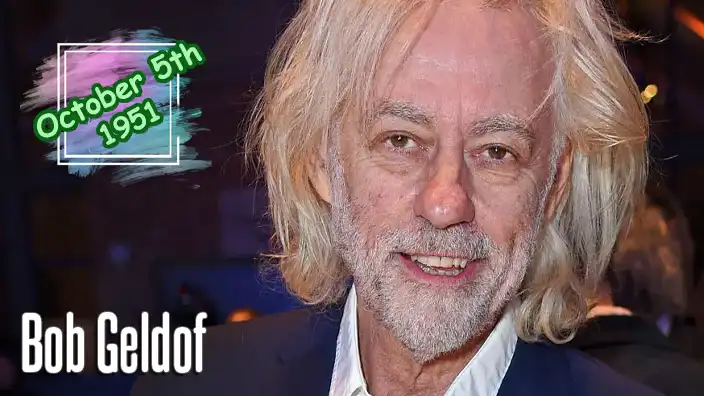
October 5, 1951, in Dún Laoghaire, Ireland
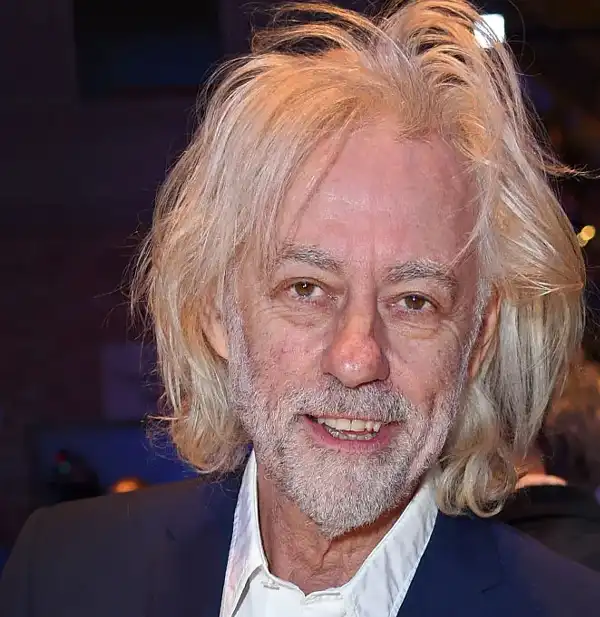
Robert Frederick Zenon Geldof was born on October 5, 1951, in Dún Laoghaire, County Dublin, Ireland. His early life included considerable hardship. His mother, Evelyn, died when he was still a child, and Geldof later described an unhappy school experience in which he was bullied. After leaving school, he worked at various jobs and spent time in Canada, where he became involved in music journalism before eventually returning to Ireland.
In Dublin during the mid-1970s, Geldof joined a group originally called the Nightlife Thugs. Sensibly deciding that this might limit their chances of being invited anywhere respectable, the musicians adopted the name The Boomtown Rats, reportedly inspired by a gang mentioned in Woody Guthrie's autobiography Bound for Glory.
The Boomtown Rats emerged just as punk and new wave were transforming British and Irish popular music. Geldof became the group's lead singer and principal spokesman, roles for which his sharp tongue, untidy appearance and willingness to express an opinion about virtually anything made him exceptionally well equipped.
The band moved to Britain and released its first single, “Lookin' After No. 1,” in 1977. Their self-titled debut album followed that year. Although associated with punk and new wave, The Boomtown Rats incorporated pop, rock, rhythm and blues and other influences, giving them considerably more musical range than a simple punk label suggested.
Commercial success followed rapidly. “Rat Trap,” from the band's second album, A Tonic for the Troops, reached No. 1 on the UK Singles Chart in 1978. It was an important achievement during a period when British popular music was changing rapidly, and it established The Boomtown Rats among the leading groups to emerge from the new-wave movement.
Then came the song that would become permanently associated with Geldof.
“I Don't Like Mondays” was released in 1979 and inspired by reports surrounding a school shooting in San Diego, California. Geldof had been working at a radio station in the United States when information about the shooting came through. The song transformed the disturbing story into a haunting piano-led composition that was markedly different from much of the band's earlier material.
“I Don't Like Mondays” reached No. 1 in the United Kingdom and remained there for several weeks. It became The Boomtown Rats' best-known international song and demonstrated Geldof's ability to turn a grim news story into something musically memorable without treating the underlying event lightly.
The band's successful period continued with songs including “Someone's Looking at You,” “Banana Republic” and “The Elephant's Graveyard.” Albums such as The Fine Art of Surfacing, Mondo Bongo, V Deep and In the Long Grass followed as The Boomtown Rats moved beyond their original punk-era sound.
By the early 1980s, however, the band's commercial momentum was declining. Geldof was also pursuing work outside music. He appeared in the leading role of Pink in the 1982 film Pink Floyd – The Wall, directed by Alan Parker and based upon Pink Floyd's enormously successful album. Geldof played a psychologically damaged rock star descending into isolation and madness, which was not exactly the cheerful musical cameo one might expect from a singer taking a side job.
Then television changed the direction of Geldof's life.
In 1984, Geldof watched a BBC report by journalist Michael Buerk about the catastrophic famine in Ethiopia. The images of starvation affected him deeply. Rather than simply making a donation or expressing concern, Geldof contacted musician Midge Ure of Ultravox and began discussing what musicians could do to raise money.
The result was Band Aid.
Geldof and Ure wrote “Do They Know It's Christmas?” and assembled an extraordinary collection of British and Irish recording artists to perform it. The recording session took place at Sarm West Studios in London on November 25, 1984.
The performers included members of U2, Duran Duran, Spandau Ballet, Status Quo and Bananarama, along with artists including George Michael, Sting, Boy George, Paul Young and Phil Collins. Geldof used his contacts, determination and considerable powers of persuasion to bring the musicians together at extremely short notice.
The group was collectively named Band Aid.
“Do They Know It's Christmas?” was released in December 1984 and became an enormous commercial success. It reached No. 1 in the United Kingdom and sold millions of copies, raising substantial funds for famine relief. Whatever later debates arose around the song's lyrics and portrayal of Africa, the immediate achievement was extraordinary: popular musicians had been mobilized on a huge scale around an international humanitarian emergency.
For Geldof, however, the record was not enough.
Working with concert promoter Harvey Goldsmith and others, Geldof developed the idea of an enormous international benefit concert. The resulting event, Live Aid, took place on July 13, 1985, primarily at Wembley Stadium in London and John F. Kennedy Stadium in Philadelphia.
Live Aid became one of the defining events in popular-music history.
The lineup included Queen, U2, David Bowie, Elton John, Paul McCartney, The Who, Dire Straits, Sting, Madonna, Eric Clapton, Led Zeppelin, Mick Jagger, Tina Turner and many others. Phil Collins famously performed in London before boarding Concorde and flying across the Atlantic to appear in Philadelphia on the same day.
The Boomtown Rats also performed at Wembley, but Geldof's role extended far beyond appearing with his band. He had become one of the principal organizers and public faces of the entire undertaking, cajoling musicians, dealing with broadcasters, encouraging donations and attempting to keep an enormous international operation moving in roughly the same direction.
Television and radio broadcasts carried Live Aid around the world, producing a global audience on a scale that would have been almost unimaginable for an ordinary concert. The event raised huge sums for famine relief and established the benefit mega-concert as a powerful fundraising model.
One performance in particular became legendary. Queen's short Wembley set, led by Freddie Mercury, is routinely remembered among the great live performances in rock history. Geldof may have organized Live Aid to raise money rather than create musical history, but he accidentally managed both.
His humanitarian campaigning did not end when the stages were dismantled. Geldof continued advocating for famine relief, African development and debt reduction. His work brought him into contact with governments, international organizations and political leaders, taking him into territory far removed from the clubs where The Boomtown Rats had begun.
In recognition of his humanitarian work, Geldof received an honorary knighthood from Queen Elizabeth II in 1986. Because he is an Irish citizen rather than a British subject, the honor does not formally entitle him to use “Sir,” although “Sir Bob” has nevertheless become a widely used informal description. Geldof was appointed an honorary Knight Commander of the Order of the British Empire.
He also received numerous other honors and awards connected with his campaigning. Yet Geldof remained a musician rather than abandoning music entirely for activism. After The Boomtown Rats initially disbanded in 1986, he pursued a solo career.
His first solo album, Deep in the Heart of Nowhere, appeared in 1986 and included “This Is the World Calling.” Subsequent albums included The Vegetarians of Love, The Happy Club, Sex, Age & Death and How to Compose Popular Songs That Will Sell. The last title demonstrated that Geldof's ability to laugh at the music business had survived his transformation into an international campaigner.
The Boomtown Rats eventually reunited, returning to live performance in 2013. The reunion brought Geldof back to songs from the band's original career while introducing them to audiences who knew him primarily as the man behind Band Aid and Live Aid. In 2020, the group released Citizens of Boomtown, its first new studio album in decades.
Geldof's humanitarian efforts also continued into the new century. He worked closely with U2 singer Bono on campaigns addressing poverty and debt in Africa. In 2005, Geldof helped organize Live 8, a series of concerts staged in countries around the world ahead of the G8 summit in Scotland.
Unlike Live Aid, Live 8 was designed primarily to apply political pressure rather than directly raise money through ticket sales. The concerts called attention to poverty, debt and trade issues affecting Africa. Once again, Geldof used famous musicians and enormous media attention as tools for forcing humanitarian questions into public discussion.
His campaigning has not been without criticism. Academics, aid specialists and African commentators have debated aspects of Band Aid and Live Aid, including their portrayal of Africa, the effectiveness and distribution of aid, and the tendency of Western celebrity campaigns to present an enormous and diverse continent largely through images of poverty and crisis.
The lyrics of “Do They Know It's Christmas?” have also attracted increasing criticism over the years for presenting an oversimplified picture of Africa. Geldof has defended the project's fundamental purpose while acknowledging that the record emerged from a particular emergency and moment in time. Later versions of the song were recorded by new generations of performers to raise money for different humanitarian crises.
Those debates form an important part of Geldof's legacy because his campaigns became so influential. Band Aid helped establish a model in which celebrity, mass media, popular music and humanitarian fundraising could be combined on an enormous scale. The model inspired later projects while also generating serious questions about how humanitarian crises should be represented.
Geldof's personal life has also contained profound tragedy. His long relationship with television presenter Paula Yates attracted extensive media attention. The couple had three daughters before divorcing. Yates later had a relationship with INXS singer Michael Hutchence and had another daughter, Heavenly Hiraani Tiger Lily Hutchence.
Following Hutchence's death in 1997 and Yates's death in 2000, Geldof became closely involved in raising Tiger Lily alongside his own daughters and later became her legal guardian. Further tragedy struck the family in 2014 when Geldof's daughter Peaches died.
Such experiences provide a sobering counterpoint to the enormous public events associated with Geldof. The man known internationally for attempting to alleviate suffering on a massive scale has endured substantial loss within his own family.
His public personality has always been unusually direct. Geldof can be combative, impatient and gloriously unwilling to disguise irritation beneath polished celebrity manners. During the frantic organization of Live Aid, those characteristics became assets. Asking politely was useful. Refusing to go away was sometimes considerably more effective.
That persistence is central to understanding Bob Geldof's unusual place in popular culture. He was already a successful musician before Band Aid. The Boomtown Rats had produced major hits, including two British No. 1 singles, and Geldof had established himself as one of the recognizable personalities of new-wave music.
Yet when confronted with images of famine, he decided that celebrity itself could be used as a tool. He called musicians, persuaded record companies, recruited broadcasters and eventually helped assemble a global concert whose scale bordered on the absurd.
Live Aid did not solve famine, poverty or the complicated political and economic problems surrounding international aid. No concert possibly could. What it demonstrated was that popular culture could command enormous global attention and redirect some of that attention toward people who otherwise had very little access to it.
Bob Geldof therefore occupies a peculiar position in rock history. He is the singer who gave us “Rat Trap” and “I Don't Like Mondays,” the actor who played Pink in The Wall, the co-writer behind “Do They Know It's Christmas?” and the famously persistent organizer standing amid the controlled chaos of Live Aid.
Plenty of rock singers have wanted to change the world. Geldof actually got hold of the telephone numbers.