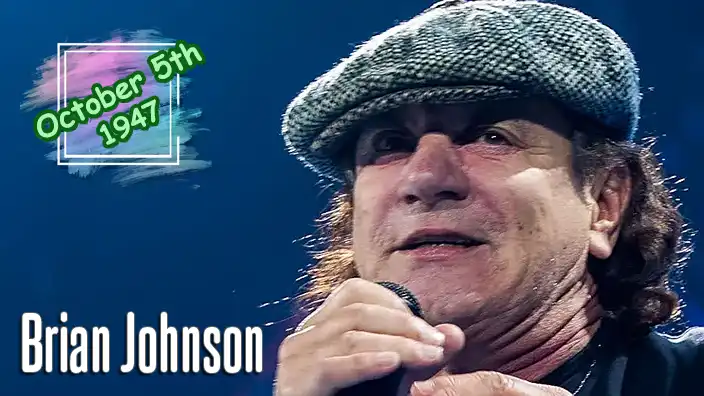
October 5, 1947, in Dunston, England

Brian Francis Johnson was born on October 5, 1947, in Dunston, County Durham, England, near Newcastle upon Tyne. His father, Alan, had served in the British Army and worked as a coal miner, while his mother, Esther, was Italian. Johnson grew up in the industrial northeast of England, a part of the country whose shipyards, mines, factories and working-class culture were a considerable distance from the glamorous world of international rock stardom that awaited him.
Music entered Johnson's life early. He sang with the local church choir and later performed with various groups while developing the powerful voice that would eventually become instantly recognizable. Before international success arrived, however, there were ordinary jobs to be done. Johnson trained as an engineer and worked in engineering, and he also served in Britain's Territorial Army. Rock superstardom was not exactly waiting outside the front door with a limousine.
During the late 1960s and early 1970s, Johnson performed with bands including the Gobi Desert Canoe Club and Fresh. He eventually became a founding member and lead singer of Geordie, a glam-rock band named after the familiar nickname associated with people from the Newcastle area. Geordie enjoyed chart success in Britain during the 1970s with songs including “Don't Do That,” “All Because of You” and “Can You Do It.”
Geordie gave Johnson his first substantial taste of the music business, complete with television appearances, touring and the peculiar fashions that accompanied the glam-rock era. Photographs of Johnson during this period provide useful evidence that even the future singer of AC/DC was unable to escape the gravitational pull of 1970s clothing.
The band's initial success eventually faded, and Johnson returned to a more ordinary working life while continuing to perform. He worked in automotive-related businesses and maintained his interest in music, but international rock stardom appeared to have passed him by. Then, in February 1980, AC/DC singer Bon Scott died in London.
Scott's death left AC/DC facing an enormous decision. The Australian band had spent years building an international following, and the 1979 album Highway to Hell had pushed them to a new level of success. Scott's distinctive personality and voice were fundamental to the band's identity. Continuing without him seemed almost impossible.
After considering whether the band should continue at all, Angus Young, Malcolm Young and their bandmates decided to search for another singer. Johnson's name entered the discussion partly because Scott himself had apparently once spoken favorably about seeing him perform with Geordie.
There was an entertaining story behind that recommendation. Years earlier, Scott had watched Johnson performing onstage when Johnson suddenly collapsed and was taken away for medical treatment. Scott reportedly thought Johnson's dramatic behavior was part of his stage act. In reality, Johnson was suffering from appendicitis. Few people audition for the future without realizing they are doing it, and fewer still manage it while requiring urgent medical attention.
Johnson was invited to London to audition for AC/DC in 1980. The circumstances were daunting. He was not simply auditioning for a successful rock band; he was potentially replacing a singer whose death had devastated both the musicians and their fans. Trying to imitate Bon Scott would have been futile, so Johnson brought his own voice and personality instead.
It worked.
AC/DC selected Brian Johnson as their new lead singer and almost immediately began work on the album that would determine whether the band could survive. Producer Robert John “Mutt” Lange joined the group at Compass Point Studios in the Bahamas, where AC/DC recorded Back in Black.
The album opened with the tolling bell of “Hells Bells,” followed by songs including “Shoot to Thrill,” “You Shook Me All Night Long,” “Rock and Roll Ain't Noise Pollution” and the title track. The album's black cover served as a tribute to Bon Scott, but musically the record made it clear that AC/DC intended to continue at full power.
Released in July 1980, Back in Black became an extraordinary commercial success and one of the biggest-selling albums in rock history. Johnson had gone from relative obscurity outside Britain to fronting one of the world's biggest rock bands on an album that would become permanently embedded in popular culture.
It is difficult to imagine a more intimidating first assignment.
Johnson's voice became a defining component of AC/DC's sound. His high, gritty delivery seemed almost mechanically engineered to sit above Angus Young's guitar and the band's enormous rhythm section. There is very little delicacy involved. A Brian Johnson vocal does not politely enter a room and introduce itself. It comes through the wall.
His visual appearance also became unmistakable. Johnson frequently performs wearing a flat cap, creating one of rock music's most recognizable silhouettes. The cap was originally a practical suggestion from his brother, who reportedly encouraged him to wear one onstage to stop sweat running into his eyes. A simple solution to perspiration became part of rock-and-roll iconography.
Following Back in Black, Johnson remained at the microphone as AC/DC released For Those About to Rock We Salute You in 1981. The album reached No. 1 in the United States, and its title track became one of the band's great concert spectacles, complete with cannon fire. Most singers finish a song and accept applause. AC/DC occasionally brings artillery.
Albums including Flick of the Switch, Fly on the Wall, Blow Up Your Video and The Razors Edge followed. The latter included “Thunderstruck,” which became another of AC/DC's signature songs and a permanent inhabitant of sporting events, movie soundtracks, television programs and anywhere else requiring approximately four and a half minutes of immediate electricity.
Johnson's years with AC/DC also produced albums including Ballbreaker, Stiff Upper Lip, Black Ice and Rock or Bust. The band's formula remained famously resistant to fashionable changes in popular music. Punk came and went, new wave arrived, hair metal exploded, grunge changed the landscape, alternative rock took over, digital music transformed the industry—and AC/DC largely continued being AC/DC.
There is something admirable about that degree of stubbornness.
Johnson also became closely associated with automobiles and motorsport. He is an enthusiastic collector and racer of cars and has competed in historic racing events. His passion eventually led to television work, including Cars That Rock with Brian Johnson, in which he explored the histories of famous automobiles and manufacturers. He has also appeared in Brian Johnson's A Life on the Road, interviewing fellow musicians about their experiences touring.
Cars make considerable sense as Johnson's other great enthusiasm. They contain engines, make tremendous amounts of noise and become considerably more exciting when somebody applies too much power. There may be a theme developing.
In 2016, however, Johnson faced one of the most serious challenges of his career. Doctors warned that continued exposure to extremely loud concert conditions could risk total hearing loss. During AC/DC's Rock or Bust tour, Johnson was forced to stop performing live with the band.
For a singer whose professional environment had involved decades of Marshall amplifiers, enormous PA systems and actual cannons, hearing problems were perhaps an occupational hazard with unusually good documentation. Nevertheless, being told he could no longer safely perform was devastating.
AC/DC completed the remaining dates of the tour with Guns N' Roses singer Axl Rose handling vocals. Johnson made clear that leaving the tour had not been his choice and that he hoped technological developments might eventually allow him to perform again.
That hope proved justified.
Johnson worked with audio experts on hearing technology designed to allow him to return to live performance without causing further damage. He subsequently rejoined AC/DC, along with drummer Phil Rudd and bassist Cliff Williams, for the recording of Power Up, released in 2020.
The album was also deeply connected to the memory of Malcolm Young, AC/DC's rhythm guitarist and musical backbone, who had died in 2017 after leaving the band because of illness. Angus Young drew upon musical ideas and guitar material created with Malcolm, giving the album an additional emotional connection to the band's history.
Johnson's return was more than a nostalgic reunion. AC/DC once again sounded unmistakably like AC/DC, and Power Up topped charts around the world. The man who had once faced the possibility that he might never perform with the band again was back behind the microphone.
In 2022, Johnson published his memoir The Lives of Brian, recounting the unlikely journey from working-class northeast England through Geordie and ultimately into AC/DC. The title was an appropriately cheeky nod toward Monty Python's Life of Brian, but the story itself demonstrated just how improbable his career had been.
Johnson returned to major live performance with AC/DC and remained part of a band whose concerts continue to attract enormous audiences. Decades after he first walked into that daunting audition, songs from Back in Black remain essential parts of the group's performances alongside material from the Bon Scott era and later Johnson albums.
What makes Brian Johnson's story particularly remarkable is the situation into which he arrived. Replacing a beloved lead singer is one of rock music's least enviable jobs. Replacing one who has died is harder still. The new singer faces grief within the band, suspicion from fans and inevitable comparisons with someone who can no longer answer them.
Johnson never replaced Bon Scott in the sense of attempting to become him. He became AC/DC's next singer, brought his own personality to the band and helped carry it into another era. The enormous success of Back in Black ensured that AC/DC survived its darkest moment, but Johnson's continued presence over the decades demonstrated that his arrival was far more than a successful emergency repair.
His career has now encompassed glam rock, hard rock, stadium tours, recording studios, racing cars, television, books, temporary hearing loss, a remarkable comeback and enough cannon fire to concern a moderately sized navy. Through all of it, the flat cap has remained firmly in place.
Brian Johnson joined AC/DC under circumstances in which failure would have surprised absolutely nobody. Instead, he walked into the studio with Angus Young, Malcolm Young, Cliff Williams and Phil Rudd and helped make Back in Black. There are easier ways to begin a new job.
Then again, easy has never sounded particularly much like AC/DC.