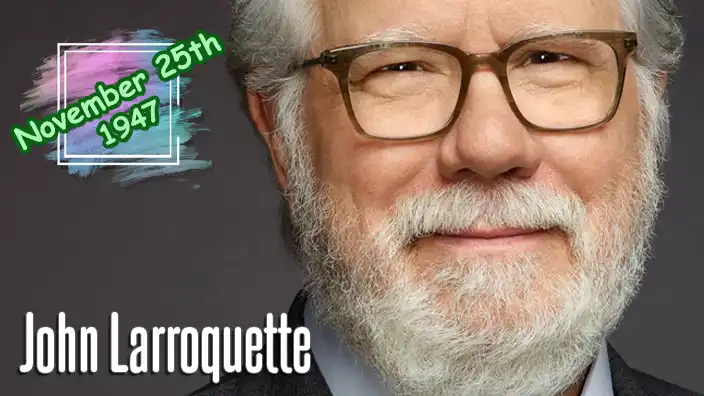
November 25, 1947, in New Orleans, Louisiana


John Larroquette is an American actor, comedian, voice artist, and theatrical performer whose distinguished career has earned him five Primetime Emmy Awards, a Tony Award, and a permanent place in American television comedy. Best known for portraying the outrageously self-confident prosecutor Dan Fielding in Night Court, Larroquette has demonstrated an extraordinary ability to move between comedy, drama, horror, fantasy, and musical theater. His commanding physical presence, deep resonant voice, sophisticated delivery, and impeccable comic timing have made him one of Hollywood's most recognizable character actors. Few performers could convincingly portray a morally questionable attorney, a Klingon warrior, a supernatural librarian, and a Broadway businessman without anyone questioning their professional qualifications.
John Bernard Larroquette was born and raised in New Orleans, Louisiana, a city celebrated for its music, distinctive culture, colorful personalities, and enthusiastic appreciation of good food. His mother worked in a department store, while his father served in the United States Navy. During his formative years, Larroquette developed a considerable interest in music, learning to play the clarinet and saxophone. His early musical experiences encouraged his appreciation of rhythm and performance, qualities that would eventually prove invaluable to his acting career. Comedy, much like music, depends heavily upon timing, and Larroquette would eventually demonstrate that he knew precisely when to deliver a punchline, raise an eyebrow, or allow an uncomfortable silence to do the work for him.
Before establishing himself as an actor, Larroquette spent time in the United States Naval Reserve and subsequently entered the broadcasting industry as a radio disc jockey. His early radio career encouraged him to develop the remarkably polished speaking voice that would become one of his most distinctive professional characteristics. Growing up in New Orleans, he naturally possessed a regional accent, but he refined his pronunciation to suit the demands of broadcasting. Radio also provided valuable experience in entertaining audiences without the assistance of facial expressions or physical movement. Considering that Larroquette would eventually become famous for his wonderfully expressive reactions to courtroom absurdities, his early audiences were probably missing half the entertainment.
Larroquette relocated to Los Angeles in 1973 to pursue opportunities in the entertainment industry. One of his earliest and most unusual Hollywood assignments involved providing the opening narration for director Tobe Hooper's independent horror film The Texas Chain Saw Massacre (1974). His deep, serious voice established an unsettling atmosphere before audiences had even been introduced to the movie's unfortunate characters. The film subsequently became one of the most influential productions in horror cinema, although Larroquette's contribution was originally uncredited. Rather amusingly, Larroquette has acknowledged that horror movies are not among his preferred forms of entertainment. He nevertheless returned to provide narration for several later installments in the franchise, demonstrating that one does not necessarily have to enjoy nightmares to provide them professionally.
His transition from voice work to on-screen acting gained momentum during the mid-1970s, with appearances in television productions including Doctor's Hospital and Sanford and Son. These early opportunities allowed Larroquette to develop his acting abilities while becoming familiar with the demanding schedules of network television. A more substantial opportunity arrived when he was cast in Baa Baa Black Sheep, later known in syndication as Black Sheep Squadron. The military adventure series starred Robert Conrad as Major Gregory "Pappy" Boyington and followed a fictionalized account of the exploits of a United States Marine Corps fighter squadron during the Second World War.
Larroquette portrayed Lieutenant Bob Anderson in Baa Baa Black Sheep, appearing alongside an ensemble cast of actors portraying military aviators operating in the Pacific theater. The series combined action, military camaraderie, personal conflicts, and the occasionally unconventional behavior of its pilots. The experience provided Larroquette with valuable exposure to a national television audience and demonstrated his ability to contribute to an ensemble production. Although his character operated in an environment governed by military discipline, Larroquette's most famous television character would later approach professional discipline as something generally applicable to other people.
Throughout the late 1970s and early 1980s, John Larroquette continued expanding his acting résumé with appearances in television programs and feature films. His towering height, distinctive voice, and authoritative manner made him particularly suitable for characters occupying positions of responsibility, although his natural comic abilities often introduced an unexpected dimension to those roles. He appeared in the science fiction horror film Altered States (1980), directed by Ken Russell, and subsequently joined the cast of the military comedy Stripes (1981), starring Bill Murray, Harold Ramis, and John Candy. In Stripes, he portrayed Captain Stillman, a military officer whose professional competence did not necessarily match the importance of his rank.
During the production of Stripes, Larroquette suffered a serious facial injury when a door that was supposed to open failed to do so, causing him to crash through its glass window. The accident required medical attention and represented one of the less glamorous realities of filmmaking. Although audiences generally associate military comedies with exaggerated mishaps and entertaining displays of incompetence, this particular incident was considerably more painful than anything required by the script. Fortunately, Larroquette recovered and continued building a successful career, presumably with a greater appreciation for doors that functioned as advertised.
Science fiction audiences were introduced to another side of Larroquette when he appeared as the Klingon officer Maltz in Star Trek III: The Search for Spock (1984). The movie, directed by Leonard Nimoy, continued the adventures of Admiral James T. Kirk and the crew of the USS Enterprise following the events of Star Trek II: The Wrath of Khan. Larroquette's character served aboard a Klingon vessel commanded by Kruge, portrayed by Christopher Lloyd. Beneath the elaborate makeup and distinctive Klingon appearance, Larroquette demonstrated his ability to adapt to the demands of science fiction filmmaking. Considering Dan Fielding's subsequent courtroom behavior, some viewers might argue that portraying an aggressive alien warrior was excellent preparation for a career in fictional American law.
The defining moment in John Larroquette's career arrived in 1984 when he joined the cast of the NBC sitcom Night Court. Created by Reinhold Weege, the series followed the eccentric employees and unusual defendants appearing before a Manhattan criminal court operating during the nighttime hours. Harry Anderson starred as Judge Harry Stone, a young, unconventional magistrate with a fondness for magic tricks and an unexpected sympathy for the people appearing before him. Larroquette portrayed Assistant District Attorney Reinhold Daniel Fielding Elmore, more commonly known as Dan Fielding, a man whose professional ambitions, enormous ego, romantic pursuits, and questionable ethics provided an almost unlimited supply of comedy.
Interestingly, Dan Fielding was initially conceived as a comparatively conservative and serious character. As the producers became increasingly familiar with Larroquette's personality and sense of humor, the character developed into the wonderfully arrogant, ambitious, sarcastic, and womanizing prosecutor remembered by television audiences. Larroquette brought considerable depth to a character who could easily have become nothing more than an unpleasant collection of personality defects. Beneath Fielding's selfishness and exaggerated confidence, occasional glimpses of vulnerability, generosity, loneliness, and genuine compassion revealed a more complicated individual. These moments helped audiences develop affection for a man who, under ordinary circumstances, would probably have been the subject of numerous complaints to the personnel department.
The success of Night Court depended heavily upon the relationships between its principal characters. Larroquette shared the screen with Harry Anderson, Richard Moll, Markie Post, Charles Robinson, and Marsha Warfield, creating one of the most memorable ensemble casts of American television comedy during the 1980s. Dan Fielding's ambitions and exaggerated self-importance frequently collided with Judge Stone's unconventional judicial philosophy, while his attempts to impress public defender Christine Sullivan, portrayed by Markie Post, produced numerous memorable situations. The courtroom's collection of eccentric defendants, unusual legal disputes, and thoroughly unpredictable employees provided an ideal environment for Larroquette's sophisticated sarcasm and physical comedy.
Larroquette's performance in Night Court earned him four consecutive Primetime Emmy Awards for Outstanding Supporting Actor in a Comedy Series, winning in 1985, 1986, 1987, and 1988. The achievement established a record at the time and confirmed his reputation as one of American television's finest comedic performers. In 1989, after collecting four consecutive awards, Larroquette requested that his performance no longer be submitted for Emmy consideration. It was a remarkably generous decision in an industry where actors generally welcome every available opportunity to collect another trophy. Dan Fielding would almost certainly have objected to such selfless behavior, particularly if there had been an opportunity to negotiate possession of a fifth statuette.
Night Court continued until 1992, completing nine seasons and becoming a beloved example of American ensemble comedy. Its mixture of absurd situations, eccentric personalities, occasional sentimentality, and unexpected social commentary distinguished it from more conventional workplace sitcoms. Larroquette's sustained performance throughout the series demonstrated his ability to maintain the appeal of a character whose personality might otherwise have become repetitive. The actor continually found new ways to reveal Fielding's insecurities, ambitions, frustrations, and surprisingly human qualities. For someone who spent so much time portraying a lawyer, Larroquette presented an exceptionally convincing case for making audiences laugh.
While enjoying his television success, Larroquette continued appearing in feature films. He portrayed Don Moore in the comedy Summer Rental (1985), starring John Candy as an exhausted air traffic controller attempting to enjoy a family vacation. He subsequently appeared in Blind Date (1987), directed by Blake Edwards and starring Bruce Willis and Kim Basinger, playing the increasingly troublesome David Bedford. The movie's escalating romantic complications and disastrous misunderstandings provided another excellent opportunity for Larroquette to demonstrate his flair for portraying professional-looking individuals whose behavior suggested that their qualifications had been obtained through questionable means.
His additional film credits include Second Sight (1989), Madhouse (1990), Tune in Tomorrow (1990), and Richie Rich (1994). In Richie Rich, starring Macaulay Culkin as the fabulously wealthy young title character, Larroquette portrayed Lawrence Van Dough, a dishonest executive determined to acquire the Rich family's fortune. His performance brought considerable comic energy to the villainous character, once again demonstrating his talent for combining outward sophistication with thoroughly questionable intentions. Hollywood evidently recognized that placing Larroquette in a business suit and allowing him to pursue money, power, or personal advantage was generally a reliable method of generating entertainment.
Following the conclusion of Night Court, Larroquette deliberately pursued a different television project rather than simply continuing the adventures of Dan Fielding. In 1993, he became the star of The John Larroquette Show, a sitcom developed with producer and writer Don Reo. Larroquette portrayed John Hemingway, a recovering alcoholic attempting to rebuild his life while working as the night manager of a bus station in St. Louis, Missouri. The series initially adopted a considerably darker tone than traditional network sitcoms, examining loneliness, addiction, personal responsibility, friendship, and the challenges of starting over. It demonstrated that Larroquette possessed considerably more dramatic range than audiences familiar with his courtroom antics might have expected.
The subject of alcoholism carried particular personal significance for Larroquette, who has spoken openly about his struggles with alcohol and his recovery. His willingness to incorporate aspects of that experience into a fictional television character gave the series an emotional authenticity that distinguished it from many contemporary comedies. Although The John Larroquette Show became somewhat lighter in tone as it progressed, its central premise continued exploring the difficulties of personal improvement and maintaining meaningful relationships. Larroquette received a Primetime Emmy nomination for Outstanding Lead Actor in a Comedy Series in 1994, further demonstrating that his considerable abilities were not limited to supporting roles.
The actor's transition into more serious dramatic performances became particularly evident through his appearances in David E. Kelley's legal drama The Practice. Larroquette portrayed Joey Heric, an intelligent, manipulative, and deeply disturbing character whose charm concealed a dangerous personality. The role represented a significant departure from the exaggerated comedy of Dan Fielding, allowing Larroquette to employ his familiar verbal sophistication in an altogether more unsettling manner. His ability to make the character simultaneously engaging and threatening earned him his fifth Primetime Emmy Award in 1998, this time for Outstanding Guest Actor in a Drama Series. He returned to the role several years later and received another Emmy nomination in 2002.
The contrast between his performances in Night Court and The Practice illustrates the considerable versatility of John Larroquette as an actor. Both productions involved the American legal system, yet the characters he portrayed occupied dramatically different ends of the entertainment spectrum. Dan Fielding generated laughter through his exaggerated arrogance and frequently unsuccessful schemes, while Joey Heric demonstrated how intelligence, confidence, and persuasive communication could become genuinely unsettling. Larroquette's success in both roles confirmed that his distinctive voice and authoritative appearance were equally effective in comedy and psychological drama.
In 2000, Larroquette appeared in the ambitious fantasy television miniseries The 10th Kingdom, portraying Tony Lewis, a New York maintenance worker who becomes involved in an extraordinary adventure through a magical world populated by familiar fairy-tale characters. The production combined traditional fairy tales with modern humor, elaborate fantasy settings, and considerably more complicated family relationships than those generally encountered in children's bedtime stories. Larroquette's portrayal of an ordinary man attempting to survive extraordinary circumstances provided considerable comic relief. Having already experienced fictional courtrooms, military operations, and alien civilizations, adding an enchanted kingdom to his professional itinerary seemed entirely reasonable.
That same year, Larroquette made a memorable guest appearance in the acclaimed political drama The West Wing, portraying White House Counsel Lionel Tribbey. His character was an intelligent, outspoken, and exceptionally irritable legal adviser whose commanding personality made an immediate impression. Despite appearing in only one episode, Larroquette delivered a performance that remained memorable among fans of the series. His character's forceful communication style and limited tolerance for incompetence demonstrated that Larroquette could dominate a scene without requiring an extended storyline. Apparently, after spending years dealing with fictional criminals, moving into a fictional presidential administration was simply another day at the office.
Larroquette returned to the world of television mysteries during the mid-2000s with the Hallmark Channel's McBride series of television movies. He portrayed Mike McBride, a former police officer who became a defense attorney and investigator, tackling complicated criminal cases through determination, observation, and legal expertise. The productions included titles such as McBride: Murder Past Midnight, McBride: The Chameleon Murder, and McBride: Fallen Idol. Unlike Dan Fielding, McBride possessed a considerably more admirable professional attitude and demonstrated genuine concern for his clients. The series appealed to audiences who enjoyed traditional detective stories, courtroom mysteries, and investigations that relied more heavily upon intelligent reasoning than spectacular explosions.
In 2007, John Larroquette joined the cast of Boston Legal, another successful legal comedy-drama created by David E. Kelley. He portrayed Carl Sack, a respected senior attorney who transferred to the Boston offices of Crane, Poole & Schmidt. Appearing alongside James Spader, William Shatner, and Candice Bergen, Larroquette brought an authoritative and relatively grounded personality to a law firm populated by extraordinarily unconventional individuals. Carl Sack's frustrations with the eccentric behavior of his colleagues provided numerous opportunities for subtle humor and dramatic commentary. After spending so many years portraying fictional lawyers, Larroquette had accumulated enough courtroom experience to make audiences wonder whether Hollywood ought to have awarded him an honorary law degree.
Although television and film had established his reputation, Larroquette achieved another major professional milestone when he made his Broadway debut in the 2011 revival of How to Succeed in Business Without Really Trying. The musical, originally introduced to Broadway audiences in 1961, satirizes corporate ambition, office politics, and the often questionable methods individuals employ to climb the professional ladder. Larroquette portrayed J. B. Biggley, the president of the World Wide Wicket Company, alongside Daniel Radcliffe, who played ambitious young businessman J. Pierrepont Finch. His commanding stage presence and comic abilities proved remarkably well suited to the production, earning him the Tony Award for Best Featured Actor in a Musical.
His Broadway success was particularly impressive because musical theater presents challenges considerably different from those encountered in television production. Live performances require actors to maintain their concentration, energy, timing, and character without the opportunity to request another take when something goes wrong. Larroquette's early musical interests, broadcasting background, and extensive experience in comedy contributed to his successful transition to the stage. He subsequently appeared alongside James Earl Jones and Angela Lansbury in the 2012 Broadway revival of Gore Vidal's political drama The Best Man, further demonstrating his ability to handle both musical comedy and serious theatrical productions.
Fantasy audiences discovered another memorable side of John Larroquette when he joined the cast of The Librarians in 2014. The television series, developed from the popular The Librarian television movies, followed a team responsible for protecting magical artifacts and defending the world against supernatural threats. Larroquette portrayed Jenkins, the knowledgeable, sarcastic, and occasionally impatient caretaker of the Library's Annex. His character possessed extensive knowledge of magical history, mythology, and supernatural phenomena, frequently providing guidance to younger colleagues whose enthusiasm exceeded their experience.
Throughout its four seasons, The Librarians combined adventure, comedy, mythology, history, fantasy, and intellectual curiosity, establishing a devoted following among audiences who appreciated imaginative storytelling. Jenkins became an important part of the series, with his dry humor, sense of responsibility, mysterious background, and occasionally reluctant affection for his colleagues providing emotional depth. Larroquette's performance demonstrated that his talents were particularly well suited to portraying knowledgeable authority figures surrounded by unpredictable individuals. The primary difference between Jenkins and Dan Fielding was that Jenkins actually knew what he was doing, which must have made for a refreshing professional experience.
Larroquette continued exploring different television genres through appearances in productions including Me, Myself & I, Blood & Treasure, The Good Fight, and the 2019 revival of The Twilight Zone. In Me, Myself & I, he portrayed the older version of Alex Riley, an inventor whose life was examined across three different periods. The series explored how childhood experiences, adult responsibilities, family relationships, and professional ambitions influence the development of an individual's personality. His later dramatic and adventure roles continued demonstrating that, despite his enduring association with Dan Fielding, Larroquette remained capable of developing distinctive characters across numerous forms of entertainment.
Nearly three decades after the original Night Court concluded, Larroquette returned to his most celebrated character in NBC's 2023 revival of the series. The new production starred Melissa Rauch as Judge Abby Stone, the daughter of Harry Anderson's original character. Rather than presenting Dan Fielding as the same ambitious prosecutor audiences remembered from the 1980s, the revival introduced a man whose experiences had substantially changed his outlook on life. Fielding returned to courtroom work as a public defender, bringing with him decades of legal experience, personal losses, considerable sarcasm, and a somewhat greater appreciation of human relationships.
The decision to portray an older, more reflective Dan Fielding allowed Larroquette to revisit the character without simply repeating the familiar jokes and behavior of the original series. The new interpretation retained Fielding's distinctive wit, occasional arrogance, and entertaining frustrations while exploring the consequences of his experiences outside the courtroom. The revival also introduced a new generation of television viewers to the character who had earned Larroquette four consecutive Emmy Awards. Returning to the same fictional workplace after an absence of several decades is an unusual accomplishment, although anyone familiar with the American legal system might suggest that some court cases actually take that long to resolve.
Away from his acting career, Larroquette has maintained interests that reflect a considerably quieter personality than many of his fictional characters. An enthusiastic collector of leather-bound first editions and fountain pens, he also enjoys photography and art. His appreciation of books and writing instruments seems particularly appropriate considering his portrayal of Jenkins in The Librarians. He married Elizabeth Larroquette in 1975, and the couple raised three children. His son Jonathan Larroquette developed his own career in entertainment, becoming known as a musician and co-host of the comedy podcast Uhh Yeah Dude.
John Larroquette's extraordinary professional achievements demonstrate the importance of versatility, timing, dedication, and a willingness to pursue unfamiliar opportunities. From his early experiences as a radio disc jockey and horror film narrator to his Emmy-winning television performances and Tony-winning Broadway appearance, he has continually challenged expectations about what audiences might expect from him. His performances have entertained generations of viewers, whether he was portraying an ambitious prosecutor, an eccentric supernatural caretaker, a dangerous criminal, or a sophisticated businessman. Few actors have spent so much of their professional lives surrounded by lawyers without eventually sending somebody an invoice. Fortunately for television audiences, Larroquette has generally preferred to deliver laughter instead.
IMDb – John Larroquette – Filmography, television appearances, acting credits, and professional accomplishments. IMDb – John Larroquette Biography – Personal background, early career, family, and professional history. IMDb – John Larroquette Trivia – Military service, personal interests, broadcasting background, and interesting career facts. Television Academy – John Larroquette – Official Emmy Award wins, nominations, and television career accomplishments. TV Insider – John Larroquette – Television career, biographical information, and notable performances. Rotten Tomatoes – John Larroquette – Movie and television credits, career highlights, and critical reception. Apple TV – John Larroquette – Early life, broadcasting career, voice acting, and entertainment history. TheTVDB – John Larroquette – Character names, television productions, film credits, and awards. Wikipedia – John Larroquette – Supplementary biographical information, Broadway performances, filmography, and career history. References & Sources