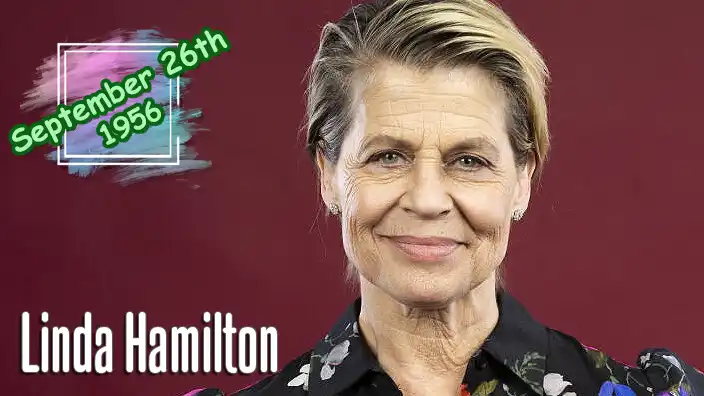
September 26, 1956, in Salisbury, Maryland
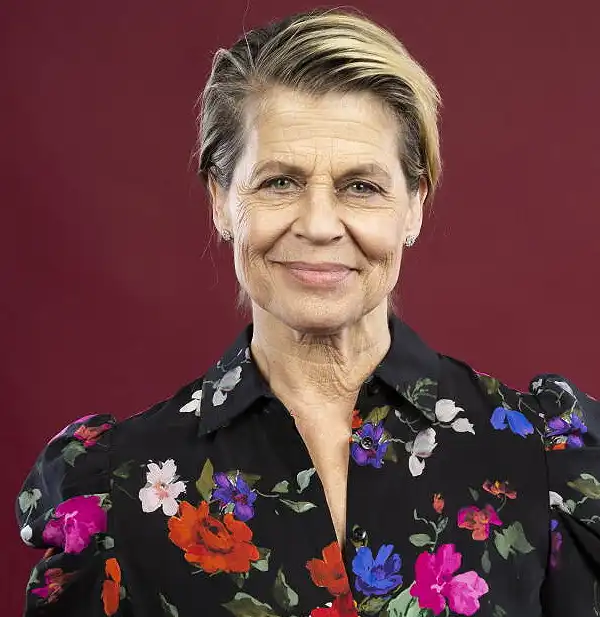
Born on September 26, 1956, in Salisbury, Maryland, Linda Carroll Hamilton grew up with an identical twin sister, Leslie, as well as an older sister and younger brother. Hamilton's father, a physician, died when she was young, and her mother later remarried. Growing up as an identical twin gave Hamilton an unusual childhood experience of constantly sharing attention with someone who looked remarkably like her. Years later, Hollywood would discover that having two Hamiltons available could occasionally be extremely useful.
Hamilton attended Washington College in Chestertown, Maryland, before deciding to pursue acting professionally. She subsequently studied acting in New York City, including work with respected acting teacher Lee Strasberg. Like many young performers, she began with television appearances and smaller roles rather than immediately being handed a shotgun and told that the future of humanity depended upon her.
Her early television work included appearances in series such as Shirley and Secrets of Midland Heights. Hamilton also appeared in the television adaptation of Stephen King's Children of the Corn—or rather, soon found herself becoming associated with the horror and thriller genres through projects of that period. Her early feature-film work included TAG: The Assassination Game and the 1984 adaptation of King's Children of the Corn, in which she played Vicky Baxter opposite Peter Horton. The film's story of adults encountering a murderous cult of children in rural Nebraska did little for the reputation of either cornfields or unsupervised youngsters.
Everything changed with another film released in 1984. Director James Cameron cast Hamilton as Sarah Connor in The Terminator, opposite Arnold Schwarzenegger as the Terminator and Michael Biehn as Kyle Reese. At the beginning of the movie, Sarah is an ordinary young woman working as a waitress in Los Angeles. She has no military training, no extraordinary powers and no reason to believe she has any particular importance to the future. Then a virtually indestructible cyborg arrives from 2029 with instructions to kill her.
The premise was wonderfully direct. In the future, Sarah's son John Connor will lead humanity's resistance against machines controlled by the artificial intelligence Skynet. The machines therefore send a Terminator into the past to murder Sarah before John can be born. The human resistance sends Kyle Reese back to protect her. Sarah spends much of the movie attempting to survive long enough to understand why the future has suddenly taken such a violent interest in her personal life.
Hamilton's performance was crucial because Sarah had to evolve during the story. She begins frightened and bewildered but gradually discovers reserves of courage and determination. By the conclusion, she is no longer merely someone being protected by Reese. She confronts the damaged Terminator herself and delivers the final blow. The transformation provided the foundation for one of the most dramatic character developments in modern action cinema.
Although The Terminator was produced on a relatively modest budget, it became a major success and helped establish Cameron, Schwarzenegger and Hamilton internationally. Schwarzenegger's mechanical assassin became one of cinema's most recognizable characters, but Sarah Connor proved equally important to the mythology. The waitress who survived the Terminator would not remain a waitress for long.
Hamilton continued working steadily after the film. She appeared in Black Moon Rising and starred opposite Peter Horton in the television movie King Kong Lives, while television provided another of her defining roles. In 1987, she began playing assistant district attorney Catherine Chandler in the CBS fantasy drama Beauty and the Beast, opposite Ron Perlman as Vincent.
The series reimagined the familiar fairy tale in contemporary New York. Catherine, after surviving a brutal attack, discovers an underground community living beneath the city and forms a powerful relationship with Vincent, a mysterious lion-like man. The program combined romance, fantasy, crime drama and elaborate subterranean architecture in a manner that could only have emerged from television with considerable confidence in its premise.
Hamilton's performance earned significant recognition. She received Emmy and Golden Globe nominations for Beauty and the Beast, demonstrating that her career extended well beyond science-fiction action films. She remained with the series for its first two seasons before departing, but Catherine Chandler became one of her best-known television characters.
Then, in 1991, Sarah Connor returned—and she had been extremely busy.
Terminator 2: Judgment Day reunited Hamilton with Schwarzenegger and director James Cameron. The difference in Sarah was startling. Years had passed since the first movie, and she had devoted herself to preparing for the nuclear catastrophe she believed was coming. She had learned weapons, survival techniques and combat skills while attempting to prepare her son John for his future role as leader of the human resistance. Her warnings about Judgment Day had instead resulted in her confinement in a psychiatric hospital.
Hamilton underwent extensive physical training for the role, dramatically changing her physique. The muscular, hardened Sarah Connor who appeared in Terminator 2 bore little resemblance to the frightened waitress of the original film. Yet the transformation was more than physical. Sarah had become obsessive, traumatized and fiercely protective of her son, sometimes approaching the same emotional coldness she despised in the machines.
That complexity made Sarah much more than a conventional action hero. One of the film's most important sequences occurs when she attempts to kill computer scientist Miles Dyson because his future work will contribute to the creation of Skynet. Sarah suddenly finds herself behaving like the Terminator from the first film: arriving from the future, in effect, to eliminate someone before he can perform actions he has not yet committed. She ultimately cannot go through with it, preserving the humanity that separates her from the machines.
Terminator 2 became a huge commercial and critical success and was celebrated for groundbreaking visual effects as well as its action sequences. Hamilton's Sarah Connor became one of cinema's most influential female action characters. The performance challenged a long-standing Hollywood assumption that women in action films primarily needed rescuing or existed to provide romantic motivation for male heroes. Sarah could protect herself, protect others and terrify the hospital staff without requiring anyone to hold her coat.
Hamilton won considerable praise for the role, including Saturn and MTV Movie awards. The image of Sarah Connor—with cropped hair, dark glasses, military clothing and an impressively developed set of arms—became inseparable from the movie itself. Countless later action heroines owed something to the path Hamilton helped establish.
There was even an unusual role for her identical twin sister Leslie Hamilton Gearren. Leslie appeared as Sarah's double in Terminator 2, most memorably during scenes requiring two versions of Sarah to appear together. Practical filmmaking techniques and identical twins accomplished effects that modern productions might simply hand to a computer. Apparently having a genetically convenient relative can save the visual-effects department considerable trouble.
Hamilton continued taking varied roles rather than attempting to reproduce Sarah Connor indefinitely. She starred in the disaster thriller Dante's Peak in 1997 opposite Pierce Brosnan, playing the mayor of a small town threatened by a volcano that has chosen an exceptionally inconvenient time to become active. The film became another widely seen entry in her career and placed Hamilton in yet another situation where survival required considerably more effort than most people encounter during an ordinary week.
Her later work included numerous television movies and guest appearances as well as roles in series such as Chuck. In the NBC action-comedy, Hamilton played Mary Elizabeth Bartowski, the long-absent mother of Zachary Levi's title character. Casting the woman who played Sarah Connor as the mysterious mother of another reluctant hero was hardly accidental, and the series enjoyed making use of Hamilton's formidable action credentials.
She also appeared in the science-fiction series Defiance and took roles across film and television while remaining closely identified with the franchise that had transformed her career. For years, however, Sarah Connor largely remained in Hamilton's past. She provided a voice appearance for Terminator Salvation, but other actresses portrayed versions of Sarah in subsequent productions.
That changed dramatically with Terminator: Dark Fate in 2019. The film brought Hamilton back as Sarah Connor for the first time in a major on-screen role since Terminator 2. Schwarzenegger also returned, while Cameron was involved as a producer and story contributor. Dark Fate ignored several intervening sequels and continued the storyline from Terminator 2, allowing audiences to meet an older Sarah who had spent decades dealing with the consequences of the events that defined her life.
Hamilton's return was notable precisely because the filmmakers did not attempt to pretend that no time had passed. This Sarah was older, scarred by loss and still exceptionally dangerous. Hamilton brought both the physical authority associated with the character and the accumulated bitterness of someone who had spent most of her adult life fighting futures that stubbornly refused to stay prevented.
Beyond Terminator, Hamilton has maintained a long career encompassing drama, fantasy, horror, action and television. Her work in Beauty and the Beast demonstrated her romantic and dramatic range, while Dante's Peak proved that she could anchor a large-scale disaster movie. Later television appearances introduced her to audiences who might have known Sarah Connor primarily as a piece of popular-culture history.
Yet Sarah Connor remains impossible to separate from Linda Hamilton, and with good reason. Across the first two Terminator films, audiences watched one character undergo an extraordinary transformation from an ordinary young woman into a battle-hardened survivor. Hamilton made both versions believable. Without the vulnerability of the first Sarah, the strength of the second would have meant far less.
The character's influence has endured because Sarah Connor was never simply strong. She was frightened, angry, obsessive, damaged, loving and occasionally wrong. Hamilton gave her enough humanity to prevent all the muscles, weapons and explosions from becoming the entire performance. Sarah fought machines because she believed humanity was worth preserving, even when preserving it occasionally required blowing up substantial portions of California.
Linda Hamilton's place in popular culture would be secure if she had never played another character after Terminator 2. Fortunately, her career contains considerably more than that. But when cinema history remembers the performers who changed expectations about women in action movies, there will almost certainly be room for Sarah Connor—and Linda Hamilton will probably arrive carrying something considerably more dangerous than a handbag.