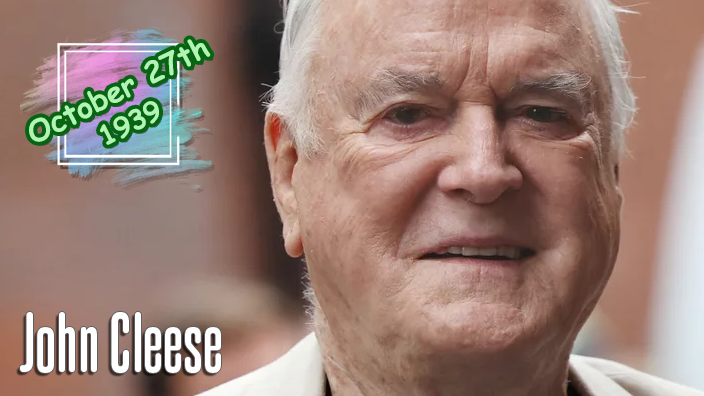
October 27, 1939, in Weston-super-Mare, England

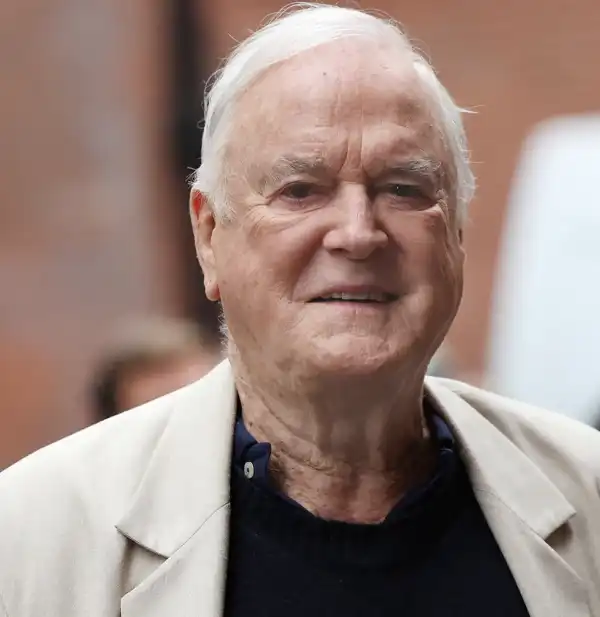
John Marwood Cleese was born on October 27, 1939, in Weston-super-Mare, Somerset, England, and grew up to become one of the most recognizable figures in British comedy. An accomplished actor, comedian, screenwriter, producer, and television presenter, Cleese developed a remarkable career built around sharp intelligence, absurd situations, impeccable comic timing, and an extraordinary ability to look completely furious while making millions of people laugh. His distinctive combination of sophisticated verbal humor and outrageous physical comedy helped establish him as an international entertainment icon. Whether arguing with a shopkeeper about a deceased parrot or attempting to run a hotel without being inconvenienced by guests, Cleese has consistently demonstrated that a perfectly respectable English gentleman can be spectacularly unreasonable.
Cleese was the only child of Reginald Francis Cleese, an insurance salesman, and Muriel Evelyn Cross. His family background contained an amusing detail that seems almost suspiciously appropriate for a future comedian: the family surname had originally been Cheese. His father changed it to Cleese, apparently preferring a name that would not invite endless dairy-related jokes. Unfortunately, his son subsequently entered a profession in which avoiding jokes was practically impossible. During his childhood, Cleese developed an appreciation for humor partly as a defense against teasing about his unusual height. He was also fascinated by the anarchic radio comedy of The Goon Show, featuring Spike Milligan, Peter Sellers, and Harry Secombe, whose surreal approach to entertainment would influence an entire generation of British comedians.
Educated at Clifton College in Bristol, Cleese displayed considerable academic ability and an interest in sports, particularly cricket. He later attended Downing College at the University of Cambridge, where he studied law and appeared destined for a conventional professional career. Fortunately for television audiences, the legal profession lost its opportunity to employ one of the world's most entertaining argumentative personalities. At Cambridge, Cleese became involved with the celebrated Footlights theatrical club, an organization renowned for producing outstanding British comedy talent. There, he met Graham Chapman, a fellow student who would become his longtime writing partner and a founding member of Monty Python. Their collaboration helped establish the foundations of a comedy revolution that would eventually make traditional sketch-show conventions look rather nervous.
Cleese's early professional career included writing for BBC radio and performing in theatrical revues, including Cambridge Circus, which enjoyed success in Britain and abroad. He subsequently contributed to The Frost Report, the influential British television comedy program hosted by David Frost. The series brought together several performers and writers who would later become central figures in Monty Python, including Michael Palin, Terry Jones, and Eric Idle. Cleese also appeared in At Last the 1948 Show, working alongside Graham Chapman, Tim Brooke-Taylor, and Marty Feldman. These programs provided valuable experience in political satire, social observation, and unconventional comedy, allowing Cleese to develop his particular talent for portraying pompous authority figures whose dignity rapidly disintegrated under pressure.
In 1969, Cleese joined Graham Chapman, Eric Idle, Terry Jones, Michael Palin, and Terry Gilliam to create Monty Python's Flying Circus, one of the most influential comedy programs in television history. Broadcast by the BBC, the series rejected many established rules of sketch comedy, frequently abandoning conventional punchlines in favor of surreal interruptions, animated sequences, bizarre characters, and unexpected changes of direction. Cleese became particularly memorable for portraying stern officials, argumentative customers, eccentric instructors, and increasingly frustrated authority figures. His extraordinary height, commanding voice, and expressive face made him ideally suited to characters who began with an air of superiority before descending into complete absurdity. The show's innovative humor developed an international following and permanently changed expectations of what television comedy could accomplish.
Among Cleese's most celebrated Monty Python performances was the famous Dead Parrot sketch, in which an increasingly exasperated customer attempts to convince a pet shop owner that his recently purchased Norwegian Blue parrot is unmistakably deceased. Another unforgettable creation was the Minister of Silly Walks, a government official whose elaborate and physically demanding walking technique suggested that British bureaucracy had finally found a way to become even less efficient. The Argument Clinic sketch demonstrated Cleese's mastery of verbal confrontation, while his appearances as the Black Knight in Monty Python and the Holy Grail displayed his willingness to embrace spectacularly ridiculous situations. These performances became enduring examples of British absurdist humor, inspiring generations of comedians and demonstrating that even the most nonsensical premise can become hilarious when delivered with absolute seriousness.
The success of Monty Python's Flying Circus led to a series of influential comedy films, beginning with And Now for Something Completely Different in 1971. The troupe followed with Monty Python and the Holy Grail in 1975, a wonderfully irreverent interpretation of Arthurian legend featuring murderous rabbits, argumentative knights, and a distinct shortage of actual horses. Monty Python's Life of Brian arrived in 1979, generating controversy while becoming one of the group's most acclaimed productions. In 1983, Monty Python's The Meaning of Life explored the human condition through a collection of outrageous sketches and musical sequences. Cleese's contributions to these films demonstrated his versatility as both a performer and writer, while the productions helped establish Monty Python as a lasting cultural phenomenon.
Although Monty Python brought Cleese worldwide recognition, his greatest individual television achievement arguably arrived with Fawlty Towers, the celebrated British sitcom he co-created and wrote with his then-wife, American actress and writer Connie Booth. First broadcast in 1975, the series introduced audiences to Basil Fawlty, the irritable proprietor of a fictional seaside hotel in Torquay, Devon. Basil desperately wanted to operate a respectable establishment catering to distinguished guests, but unfortunately found himself surrounded by ordinary customers, unpredictable employees, and the everyday inconveniences associated with running a hotel. His inability to control his temper transformed relatively minor problems into catastrophes of almost military proportions. Cleese's performance captured the essence of a man whose determination to preserve dignity guaranteed that he would lose it at every opportunity.
The brilliance of Fawlty Towers rested partly in its exceptionally tight writing and memorable supporting characters. Prunella Scales portrayed Basil's formidable wife, Sybil, whose sharp tongue and commanding personality frequently reduced her husband to nervous obedience. Connie Booth played Polly Sherman, the resourceful waitress who regularly attempted to prevent the hotel from collapsing into chaos, while Andrew Sachs portrayed Manuel, the Spanish waiter whose misunderstandings became a recurring source of confusion. Despite producing only twelve episodes across two series, broadcast in 1975 and 1979, Fawlty Towers became one of the most celebrated sitcoms ever made. Episodes such as The Germans, The Hotel Inspectors, and Communication Problems remain outstanding examples of carefully constructed farce. The series proved that a relatively small number of brilliantly written episodes could achieve a reputation that much longer television productions might envy.
Cleese's success continued in cinema, particularly with the 1988 comedy A Fish Called Wanda, which he wrote and starred in alongside Jamie Lee Curtis, Kevin Kline, and fellow Monty Python performer Michael Palin. Cleese played Archie Leach, a respectable British barrister whose orderly existence disintegrates after he becomes entangled with a group of eccentric criminals pursuing stolen diamonds. The film combined British social awkwardness with American-style comic energy, producing a wonderfully unpredictable mixture of romance, deception, and criminal incompetence. Cleese received an Academy Award nomination for Best Original Screenplay and won the BAFTA Award for Best Actor in a Leading Role. Kevin Kline also received an Academy Award for his supporting performance. The film demonstrated that Cleese could successfully translate his distinctive comedic talents into mainstream international cinema without sacrificing the intelligent absurdity that had made him famous.
His extensive film career also included appearances in Time Bandits (1981), Silverado (1985), Clockwise (1986), Fierce Creatures (1997), George of the Jungle (1997), and Rat Race (2001). In Clockwise, Cleese portrayed an obsessively punctual school headmaster whose attempts to attend an important conference descend into a nightmare of missed connections and escalating disasters. The role seemed particularly appropriate for an actor whose finest characters frequently experience emotional collapse when confronted with life's smallest inconveniences. In Rat Race, he played the eccentric billionaire Donald Sinclair, who organizes a wildly unpredictable competition for his own amusement. His ability to move between restrained dialogue, extravagant physical comedy, and theatrical villainy made him a valuable addition to an unusually wide range of productions.
Cleese also became familiar to younger generations through appearances in major international film franchises. In Harry Potter and the Sorcerer's Stone (2001) and Harry Potter and the Chamber of Secrets (2002), he portrayed Nearly Headless Nick, the friendly Hogwarts ghost whose unfortunate execution had left him with a rather inconvenient anatomical problem. He entered the James Bond universe in The World Is Not Enough (1999), playing the assistant to Desmond Llewelyn's beloved gadget specialist Q. His character, initially nicknamed R by Bond, subsequently assumed the role of Q in Die Another Day (2002). Cleese also provided the voice of King Harold, Princess Fiona's father, in Shrek 2 (2004), Shrek the Third (2007), and Shrek Forever After (2010). His unmistakable voice and talent for portraying dignified individuals confronting ridiculous circumstances made him particularly effective in animated comedy.
Beyond film and television, Cleese demonstrated a serious interest in education, psychology, communication, and business training. He helped establish Video Arts, a company specializing in instructional films that used humor to explain workplace management, communication, and professional behavior. The approach reflected his belief that comedy could make complicated ideas more memorable and encourage audiences to recognize their own mistakes. He also collaborated with psychiatrist and psychotherapist Robin Skynner on the books Families and How to Survive Them and Life and How to Survive It, which explored relationships, emotional development, and psychological well-being through accessible conversations. These projects revealed an intellectual curiosity extending well beyond the entertainment industry, although his ability to make serious subjects amusing remained firmly intact.
Cleese has also worked extensively as a public speaker, author, and television presenter, discussing subjects ranging from creativity and psychology to politics and the changing nature of comedy. His memoir So, Anyway..., published in 2014, explored his childhood, education, early career, and the experiences that eventually led to Monty Python. His later book Creativity: A Short and Cheerful Guide, published in 2020, examined the creative process and offered practical insights into developing original ideas. Cleese has frequently emphasized the importance of allowing the mind time to explore possibilities without immediately demanding practical results. It is a philosophy that makes considerable sense coming from someone who helped turn a deceased parrot, an imaginary argument business, and a government department devoted to ridiculous walking into internationally recognized comedy.
Throughout his career, Cleese has received numerous honors recognizing his contributions to entertainment. His achievements include BAFTA recognition, a Primetime Emmy Award for his guest appearance on Cheers, and nominations for major international film and television awards. He served as Rector of the University of St Andrews in Scotland and has maintained connections with academic institutions, including Cornell University. His influence extends far beyond individual performances, with countless comedians, writers, and television producers acknowledging the importance of Monty Python and Fawlty Towers in shaping modern comedy. His work helped demonstrate that humor could be intellectually ambitious, socially observant, physically outrageous, and gloriously ridiculous, sometimes all within the same sketch.
Cleese has never been particularly reluctant to express an opinion, and his outspoken public commentary has occasionally generated controversy. His observations about political correctness, freedom of expression, and contemporary comedy have attracted both supporters and critics, reflecting a personality that has long preferred vigorous debate to polite silence. Whatever one's views of his public statements, his influence on comedy remains substantial. His performances helped establish a style of humor in which authority is questioned, social pretensions are punctured, and the apparent seriousness of everyday life is exposed as frequently absurd. Few entertainers have made indignation such an effective instrument of laughter.
John Cleese's extraordinary career represents a remarkable contribution to British and international entertainment. From his early Cambridge performances to the worldwide success of Monty Python, the magnificent disasters of Fawlty Towers, and his memorable appearances in Hollywood films, he has consistently demonstrated the value of originality, intelligence, and impeccable timing. His characters may be argumentative, impatient, pompous, or completely unreasonable, but audiences continue to recognize something wonderfully human beneath their spectacular shortcomings. And if his career has taught us anything, it is that life should never be taken too seriously — particularly when someone is trying to sell you a dead parrot and insists that it is merely resting.