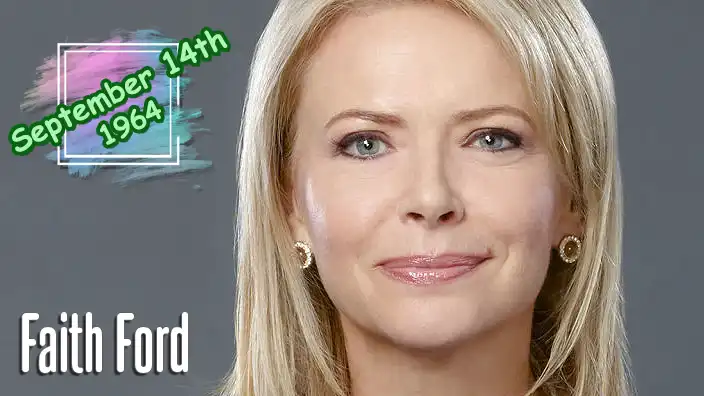
September 14, 1964, in Alexandria, Louisiana

Faith Alexis Ford was born on September 14, 1964, in Alexandria, Louisiana, and grew up in nearby Pineville. Her mother, Patricia Walker, was a schoolteacher, while her father, Charles Ford, worked as an insurance agent. Ford became interested in performing while attending Pineville High School, appearing in school productions and developing ambitions that stretched considerably farther than central Louisiana. During her senior year, she became a finalist in a modeling search, and at only 17 she moved to New York City to pursue modeling and acting. It was a substantial leap for a teenager from Louisiana, but New York provided the opportunities she was looking for, beginning with commercial work and eventually leading to television.
Ford's earliest significant television experience came through daytime drama. She appeared on One Life to Live and then joined NBC's Another World, playing Julia Shearer. Soap operas have traditionally provided young actors with one of television's most demanding training grounds: large quantities of dialogue, rapid production schedules, emotional scenes and characters whose romantic histories occasionally require diagrams. Ford gained valuable experience in front of the camera before leaving New York for Los Angeles, where she began pursuing prime-time television and film roles.
Her early Hollywood work included the short-lived CBS sitcom The Popcorn Kid in 1987 and the film You Talkin' to Me? that same year. She subsequently appeared in the acclaimed ABC drama thirtysomething as Janine, the somewhat accident-prone secretary. None of those roles made Ford a household name, but they kept her working and demonstrated the comic timing that would soon become particularly valuable. Then, in 1988, she was cast in a new CBS sitcom centered on a formidable television journalist returning to work after a stay at the Betty Ford Clinic. The series was Murphy Brown, and Ford's career was about to change dramatically.
Created by Diane English, Murphy Brown starred Candice Bergen as the title character, an experienced investigative reporter and news anchor working for the fictional television newsmagazine FYI. The ensemble included Charles Kimbrough as veteran anchorman Jim Dial, Joe Regalbuto as reporter Frank Fontana, Grant Shaud as producer Miles Silverberg and Ford as Corky Sherwood. Corky arrived with a résumé that seemed almost comically inappropriate for the hard-edged world of Washington journalism: she was a former Miss America who had begun her broadcasting career in lighter television before joining FYI. Her sunny personality and relative innocence contrasted sharply with Murphy's confidence, cynicism and years of experience.
It would have been easy for Corky to become little more than a running joke—the pretty former beauty queen who somehow wandered into a serious newsroom—but Ford made her considerably more substantial. Corky could be naïve and relentlessly cheerful, but she was also ambitious, hardworking and capable of surprising the people who underestimated her. As the series developed, she matured professionally without losing the personality that made her distinct from Murphy. The relationship between the two women became particularly important: Corky admired Murphy but did not simply become a younger copy of her, and their differences provided both comedy and an interesting contrast between generations and approaches to journalism.
Ford's performance was repeatedly recognized by the Television Academy. She received five Primetime Emmy Award nominations for Outstanding Supporting Actress in a Comedy Series, in 1989, 1990, 1991, 1992 and 1994. She also earned two consecutive Golden Globe nominations for her work on the show. Murphy Brown itself became one of the defining American television comedies of its era, collecting 18 Emmy Awards from 62 nominations during its original run. For Ford, spending ten seasons as Corky Sherwood transformed what might have been another sitcom supporting role into the character with which she would remain permanently associated.
The series was particularly notable because it mixed workplace comedy with contemporary politics and journalism. Real politicians, broadcasters and public figures occasionally appeared as themselves, while storylines frequently drew upon current events. That approach produced one of television's most famous encounters with real-world politics in 1992, when Vice President Dan Quayle criticized the fictional Murphy Brown for choosing to become a single mother. The show responded during its following season, and the resulting debate became part of American political and television history. Corky may not have been the character standing at the center of that controversy, but Ford was part of a sitcom that had become sufficiently influential for its fictional characters to be discussed in speeches by the vice president of the United States. Most comedies are pleased when somebody remembers to watch on Monday night.
During her years on Murphy Brown, Ford continued taking other roles. She appeared in television movies including The Substitute Wife, The Stepford Husbands, Her Desperate Choice and The Price of Heaven, demonstrating that her dramatic abilities extended beyond Corky's comic optimism. She also appeared in the much-discussed 1994 comedy North, directed by Rob Reiner. The film became notorious for the savage response it received from some critics, but for a working actor, every career contains projects that become classics and others that become useful opportunities to discuss something else.
When Murphy Brown concluded its original run in 1998, Ford immediately moved toward another starring television role. She played the title character in the CBS sitcom Maggie Winters, about a woman returning to her Indiana hometown after the collapse of her marriage. Ford also served as an executive producer. Although the series lasted only one season, it allowed her to move from ensemble supporting player to the center of her own sitcom and expand her involvement behind the camera. She subsequently joined Norm Macdonald on The Norm Show, playing social worker Shelly Kilmartin. Working opposite Macdonald required an entirely different comic rhythm from Murphy Brown, and Ford remained with the series through its conclusion in 2001.
Another major sitcom success arrived in 2003 with ABC's Hope & Faith. Ford starred as Hope Shanowski opposite Kelly Ripa as her sister, Faith Fairfield. Hope is a practical wife and mother whose comparatively orderly suburban life is disrupted when Faith, a self-absorbed soap-opera actress, loses her television job and moves into the family home. The basic arrangement gave the show an effective comic engine: Hope tried to maintain normal family life while Faith treated almost every situation as though it might benefit from considerably more drama.
Ford and Ripa developed the sisterly chemistry on which the series depended, with Hope generally serving as the responsible counterweight to Faith's impulsiveness. Ted McGinley played Hope's husband, Charley, while the cast also included Megan Fox as Hope's daughter Sydney during the later seasons. Hope & Faith ran for three seasons from 2003 to 2006 and gave Ford another recognizable television character distinct from Corky Sherwood. After years playing the cheerful younger member of a Washington newsroom, she was now the sensible mother attempting to control a household containing Kelly Ripa's fictional sister. One suspects covering Congress might occasionally have seemed easier.
Ford also appeared on the big screen opposite Vin Diesel in the 2005 family comedy The Pacifier. Diesel played Navy SEAL Shane Wolfe, who finds himself assigned to protect the children of a murdered scientist while their mother, Julie Plummer, played by Ford, travels abroad. The movie allowed Ford to work within a large studio family comedy and placed her alongside an action star whose principal challenge involved discovering that small children cannot necessarily be handled using military tactics. She later appeared in Disney's Prom in 2011 and continued working extensively in television movies, particularly family dramas and holiday productions.
Her television work after Hope & Faith included the ABC comedy Carpoolers, as well as guest appearances on programs ranging from Criminal Minds and My Name Is Earl to The Middle. Ford's ability to move between comedy and drama helped keep her career unusually varied. She could arrive in a sitcom and immediately fit its comic rhythm, then appear in a crime drama without seeming as though Corky Sherwood had accidentally wandered onto the wrong soundstage. Later credits included Killing It and a guest appearance on the revival of Night Court, in which she played Gina Stone.
Ford also became a familiar presence in television movies. Her credits included A Kiss at Midnight, Trading Christmas, Sorority Wars, Christmas in Mississippi and adaptations of Karen Kingsbury's The Bridge. Her performance in The Bridge, Part 2 earned her a Movieguide Grace Award in 2017. These projects introduced Ford to audiences who may not have watched Murphy Brown during its original run and allowed her to build a substantial second strand of her career in family-oriented television films.
Food has been another important part of Ford's life away from acting. Drawing upon the Southern cooking traditions she learned from her mother and grandmothers, she published Cooking with Faith in 2004. The book combined recipes with personal stories and reflected a connection to Louisiana that remained important despite decades spent working in Hollywood. For somebody whose career involved spending enormous amounts of time on sets, returning to family recipes and Southern cooking offered a rather different sort of production schedule, although both professions become stressful when something starts burning.
Ford married writer and director Campion Murphy in 1998, and the couple have also collaborated professionally. They co-produced the short film Citation of Merit, which appeared at film festivals around the United States. Her sister, Devon O'Day, has also built a career in broadcasting and entertainment, particularly in country radio. Ford's roots in Louisiana and the South have remained a recurring part of her public identity despite a career that took her first to New York and then Hollywood.
In 2018, Ford returned to the role that had made her famous when CBS revived Murphy Brown. Candice Bergen, Ford, Joe Regalbuto and Grant Shaud returned to a television-news landscape that had changed dramatically since the original series ended. Social media, cable-news competition and a highly polarized political environment provided the revived newsroom with an abundance of new material. Corky had changed as well, arriving as an experienced journalist rather than the former beauty queen who had once entered FYI with far more enthusiasm than newsroom experience.
The revival lasted one season, but seeing Ford back alongside Bergen and the surviving members of the original ensemble emphasized how strongly the characters had become associated with American television history. Corky Sherwood was no longer simply the newcomer learning from Murphy Brown. She had decades of experience of her own, allowing Ford to revisit the character without merely recreating what she had done during the 1980s and 1990s.
That longevity is perhaps the most interesting feature of Faith Ford's career. She entered television through soap operas, found her defining role in one of the most acclaimed sitcoms of its era, received five Emmy nominations, moved successfully into other comedies, starred in movies and television films, produced projects and eventually returned to Corky Sherwood three decades after first playing her. Few performers get one character that audiences remember for decades; fewer still manage to build a substantial career around that role without becoming completely trapped by it.
Corky Sherwood may always be the first name attached to Faith Ford, and there are considerably worse things than being remembered as part of a television series that helped define an era of American comedy. But Ford's career stretches from daytime soaps and thirtysomething through Murphy Brown, The Norm Show, Hope & Faith, feature films, television movies and guest appearances across several generations of television.
And after five Emmy nominations, ten original seasons in the FYI newsroom and another trip back to Murphy Brown decades later, Corky finally proved something she had probably known all along: never underestimate the beauty queen.