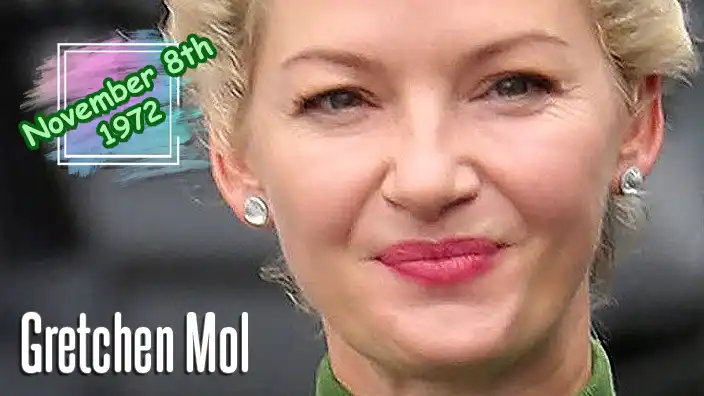
November 8, 1972, in Deep River, Connecticut


Gretchen Elise Mol was born on November 8, 1972, in Deep River, Connecticut, a small New England town that offered a considerably quieter upbringing than the glamorous and occasionally dangerous worlds she would later inhabit on screen. Her father, James Mol, worked in education, while her mother, Janet, was an artist and teacher. Growing up in a household that valued creativity and learning, Gretchen developed an interest in performing during her school years. She participated in theatrical productions and school musicals, discovering an enthusiasm for acting that would eventually lead her away from Connecticut and toward the competitive entertainment industry. Her early experiences provided the foundation for a career built upon careful character development and an appreciation for storytelling rather than simply the pursuit of celebrity.
Determined to become a professional actress, Gretchen moved to New York City as a teenager to study acting and musical theater. She trained at the American Musical and Dramatic Academy and the William Esper Studio, institutions associated with developing serious performance skills. Her education introduced her to the discipline of theatrical acting, including character analysis, emotional preparation, and the importance of listening and responding naturally to fellow performers. She also gained practical experience through theater productions and commercial work, gradually learning how to navigate auditions and professional expectations. Like many aspiring actors, she discovered that enthusiasm alone would not pay the rent, making persistence an essential part of her early career.
Before establishing herself in film, Gretchen worked in modeling and appeared in advertisements while pursuing acting opportunities. Her striking appearance attracted attention from photographers and casting professionals, although her primary ambition remained dramatic performance. She continued auditioning for theatrical productions and screen roles, gradually building professional connections within New York's entertainment community. Her early experiences demonstrated the importance of flexibility in an industry where performers frequently move between different forms of work while waiting for a significant opportunity. Modeling helped provide exposure, but Gretchen was determined to demonstrate that her abilities extended considerably beyond looking attractive in front of a camera.
Her film career began in 1996 with appearances in Spike Lee's Girl 6 and Abel Ferrara's crime drama The Funeral. These early productions introduced her to experienced filmmakers and established performers, providing valuable opportunities to observe professional filmmaking at close quarters. She subsequently appeared in Donnie Brasco in 1997, the acclaimed crime drama starring Johnny Depp and Al Pacino. Although her early roles were relatively small, they allowed her to gain experience in different genres and develop confidence in front of the camera. Working alongside established actors also exposed her to the importance of subtle performance, an approach that would become particularly valuable in her later dramatic roles.
Gretchen attracted wider attention in 1998 when she appeared in Rounders, a gambling drama starring Matt Damon and Edward Norton. She portrayed Jo, the girlfriend of Damon's character, Mike McDermott, a talented poker player struggling to balance his personal responsibilities with his attraction to high-stakes gambling. Her character represented stability and conventional expectations in contrast to Mike's increasingly risky decisions. Although Rounders did not become an enormous box-office success during its original release, it gradually developed a devoted following among poker enthusiasts and film audiences. Gretchen's performance introduced her to a broader audience and contributed to the growing industry interest surrounding her career.
That same year, Gretchen appeared in Woody Allen's Celebrity, playing Vicky, a young woman involved in the film's satirical exploration of fame, relationships, and the entertainment industry. The production featured an ensemble cast including Leonardo DiCaprio, Kenneth Branagh, Judy Davis, and Charlize Theron. Her appearance reinforced her emerging reputation as a promising actress capable of working alongside major Hollywood performers. During this period, she also attracted considerable attention from the entertainment press, particularly after Vanity Fair featured her in 1998 as a potential major star. The publicity created enormous expectations, transforming Gretchen into one of Hollywood's most discussed emerging actresses before she had accumulated the extensive filmography normally associated with established leading performers.
The sudden attention proved to be something of a double-edged sword. While the publicity increased her visibility, it also created expectations that were difficult to satisfy, particularly when several subsequent films failed to achieve major commercial success. Hollywood has a peculiar habit of announcing that someone is destined for superstardom and then acting surprised when the entire process takes longer than a weekend. Gretchen continued working steadily, choosing roles that interested her rather than attempting to manufacture the public image suggested by magazine headlines. Her experience illustrated the unpredictable nature of entertainment publicity, where an actress can be celebrated as the industry's next sensation before audiences have had much opportunity to become familiar with her actual work.
During the late 1990s, Gretchen appeared in several distinctive films, including The Thirteenth Floor, Sweet and Lowdown, and Cradle Will Rock, all released in 1999. In the science-fiction mystery The Thirteenth Floor, she portrayed Jane Fuller and Natasha Molinaro, characters connected to a complicated story involving virtual reality, simulated worlds, and questions about the nature of existence. The film developed a following among science-fiction enthusiasts who appreciated its philosophical themes and elaborate mystery. Gretchen's performance required her to navigate a storyline in which appearances and identities could not always be trusted, demonstrating her ability to handle unusual material beyond conventional romantic or dramatic roles.
Her appearance in Cradle Will Rock, directed by Tim Robbins, offered another opportunity to explore historical storytelling. Gretchen portrayed Marion Davies, the actress and longtime companion of newspaper publisher William Randolph Hearst. Set against the political and artistic tensions of the 1930s, the film examined the relationships between entertainment, wealth, artistic expression, and political influence. Portraying a recognizable historical personality required Gretchen to balance familiar public perceptions with the demands of the screenplay. Her performance contributed to a large ensemble cast and demonstrated her growing interest in period dramas, a genre that would eventually become particularly important in her television career.
Gretchen also maintained a strong connection to theater, appearing in productions that allowed her to develop characters beyond the limitations of film editing and brief screen appearances. She performed in Neil LaBute's The Shape of Things, first in London and subsequently in New York, before appearing in the 2003 film adaptation. The story explored manipulation, relationships, personal identity, and the uncomfortable boundaries between art and human behavior. Gretchen portrayed Jenny, one of four central characters whose relationships become increasingly complicated as the story unfolds. Her involvement across stage and screen versions demonstrated her commitment to theatrical performance and her ability to adapt the same character to different storytelling formats.
One of the most significant turning points in Gretchen's career arrived with The Notorious Bettie Page, which premiered in 2005 and received its theatrical release in 2006. Directed by Mary Harron, the biographical drama explored the life of Bettie Page, the American model whose distinctive appearance and provocative photographs made her an enduring figure in popular culture. Gretchen portrayed Page during the period when she became famous for her pin-up modeling, recreating the personality, appearance, and complicated experiences of a woman whose public image often concealed a more vulnerable private life. The role required extensive preparation, including studying photographs, learning about Page's background, and understanding the social attitudes that shaped her career.
Rather than portraying Bettie Page simply as a glamorous pin-up model, Gretchen approached the character as a complicated individual navigating conflicting expectations surrounding sexuality, religion, personal freedom, and public judgment. The film explored Page's experiences in 1950s America, when changing cultural attitudes and public controversy made her photographs both enormously popular and deeply controversial. Gretchen's performance emphasized the character's innocence, optimism, and emotional vulnerability, creating a portrayal that went beyond the familiar images associated with the model. Her work received considerable critical praise and earned a Satellite Award nomination for Best Actress in a Motion Picture Drama, helping reestablish her reputation as an accomplished dramatic performer.
The success of The Notorious Bettie Page demonstrated that Gretchen possessed the ability to carry a film centered on a demanding historical character. Her performance required her to communicate emotional complexity while recreating the mannerisms and visual style of one of America's most recognizable pin-up personalities. The film also allowed her to challenge assumptions about performers whose careers begin with considerable attention to their appearance. By presenting Bettie Page as a woman with ambitions, uncertainties, and personal convictions, Gretchen demonstrated the value of thoughtful characterization. It was an appropriate role for an actress who had experienced firsthand how easily the entertainment industry could become preoccupied with appearances rather than artistic ability.
In 2007, Gretchen appeared in the acclaimed Western 3:10 to Yuma, directed by James Mangold and starring Russell Crowe and Christian Bale. She portrayed Alice Evans, the wife of Bale's character, Dan Evans, a struggling rancher who becomes involved in a dangerous attempt to escort an outlaw to prison. Although the film focused primarily on the relationship between the two male leads, Gretchen's character contributed an important emotional dimension to the story. Alice represented the family responsibilities and financial pressures influencing her husband's decisions, providing a reminder that the consequences of violence and moral choices extend beyond the individuals directly involved.
Her television career continued developing with appearances in productions such as The Memory Keeper's Daughter in 2008, in which she portrayed Norah Henry, and the American adaptation of Life on Mars, broadcast from 2008 to 2009. In Life on Mars, Gretchen played Detective Annie Norris, a police officer working in a 1970s New York precinct where modern-day detective Sam Tyler mysteriously finds himself after an accident. The series combined crime drama, science fiction, and historical atmosphere, allowing Gretchen to portray a capable woman navigating the male-dominated environment of an earlier era. Although the American adaptation lasted only one season, the role demonstrated her ability to contribute substantially to a television ensemble while balancing dramatic storytelling with unusual genre elements.
Her most widely recognized television role arrived in 2010 when she joined HBO's historical crime drama Boardwalk Empire, created by Terence Winter and executive produced by Martin Scorsese. Set primarily in Atlantic City during the Prohibition era, the series explored organized crime, political corruption, illegal alcohol distribution, and the complicated relationships between powerful individuals operating outside the law. Gretchen portrayed Gillian Darmody, a former showgirl and the mother of Jimmy Darmody, played by Michael Pitt. Gillian was a deeply troubled woman whose experiences of exploitation, manipulation, and personal trauma influenced her increasingly desperate attempts to gain security and control over her life.
Gillian Darmody became one of Boardwalk Empire's most psychologically complicated characters, presenting Gretchen with some of the most demanding material of her career. The character's relationship with her son, her connections to powerful criminals, and her determination to protect her own interests created a disturbing mixture of affection, resentment, ambition, and emotional instability. Gretchen approached the role with considerable sensitivity, revealing the character's vulnerability without excusing her frequently destructive behavior. Her performance demonstrated an ability to portray a woman whose actions could be shocking and morally troubling while still allowing audiences to understand the experiences that had shaped her personality.
Throughout the five seasons of Boardwalk Empire, Gillian's storyline became increasingly dark as the consequences of earlier events began catching up with her. Gretchen's performance required her to navigate significant emotional changes, portraying a character whose outward confidence gradually gave way to desperation and psychological deterioration. The series' elaborate period costumes, historical settings, and detailed production design provided an immersive environment, but the emotional credibility of its characters remained essential to its success. Gretchen's portrayal of Gillian contributed substantially to the show's reputation for sophisticated storytelling and morally complex personalities, earning recognition from critics and viewers who appreciated her willingness to embrace difficult material.
Working on Boardwalk Empire also allowed Gretchen to collaborate with an extraordinary ensemble of performers, including Steve Buscemi, Michael Shannon, Kelly Macdonald, Michael Kenneth Williams, and Jack Huston. The production's emphasis on historical authenticity and cinematic presentation required careful preparation, particularly when portraying the social conventions and personal struggles of the 1920s. Gretchen's theatrical training and earlier experience with period films helped her develop a character who belonged convincingly within the series' historical world. Her work reinforced the importance of supporting characters in ensemble dramas, demonstrating that memorable storytelling frequently depends upon the people operating in the shadows of more prominent figures.
Following Boardwalk Empire, Gretchen continued working across film and television, appearing in productions including Laggies in 2014, True Story in 2015, and Anesthesia in 2015. These projects allowed her to explore contemporary characters and different dramatic situations after spending several years immersed in the historical world of Atlantic City. In True Story, she appeared alongside James Franco and Jonah Hill in a crime drama based on the relationship between a journalist and a man accused of murder. Her continued involvement in independent and character-driven films demonstrated that she remained interested in challenging material rather than restricting herself to roles resembling her most successful television character.
In 2016, Gretchen appeared in the critically acclaimed drama Manchester by the Sea, written and directed by Kenneth Lonergan. She portrayed Elise Chandler, the former wife of Joe Chandler and mother of Patrick Chandler, played by Lucas Hedges. The film explored grief, family relationships, emotional isolation, and the difficulties of rebuilding life after devastating personal loss. Although Gretchen's role was relatively limited, her character contributed to the complicated family circumstances surrounding the film's central storyline. The production received widespread critical recognition, including Academy Awards for Casey Affleck's leading performance and Lonergan's original screenplay.
That same period brought another significant television opportunity with the Hulu psychological thriller Chance, starring Hugh Laurie. Gretchen portrayed Jaclyn Blackstone, a woman whose complicated personal circumstances draw a forensic neuropsychiatrist into a dangerous situation involving violence, manipulation, and uncertain identities. The series explored psychological vulnerability and the blurred boundaries between professional responsibility and personal involvement. Gretchen's performance required her to portray a character whose motivations and experiences were not immediately clear, allowing her to draw upon the emotional ambiguity that had become a defining strength of her dramatic work.
Her television appearances also included the Netflix crime drama Seven Seconds in 2018 and the science-fiction horror series Nightflyers, based on a novella by George R. R. Martin. In Nightflyers, Gretchen portrayed Dr. Agatha Matheson, a psychiatrist traveling aboard a spacecraft on a mission that becomes increasingly dangerous and mysterious. The role combined psychological drama with science-fiction suspense, presenting another opportunity to work within an unconventional genre. She also appeared in Yellowstone, portraying Evelyn Dutton, the late wife of John Dutton and mother of several central characters. Although Evelyn appeared primarily through flashbacks, her influence on the Dutton family helped explain important relationships and emotional conflicts within the series.
Gretchen continued appearing in notable television productions during the 2020s, including HBO's Perry Mason and Showtime's American Gigolo. In Perry Mason, she portrayed Linda, the estranged wife of the title character, played by Matthew Rhys. The series reimagined the famous fictional attorney within the darker atmosphere of 1930s Los Angeles, emphasizing personal struggles, corruption, and complicated criminal investigations. Gretchen's character contributed to the emotional background of Mason's life, revealing the difficulties surrounding his family relationships. Her appearance reflected her continuing ability to contribute to historically styled dramas where character development and emotional tension are central to the storytelling.
In American Gigolo, which premiered in 2022, Gretchen portrayed Michelle Stratton, a woman whose past relationship with Julian Kaye, played by Jon Bernthal, becomes important to the series' central mystery. Inspired by the 1980 film starring Richard Gere, the television adaptation explored crime, personal reinvention, and the consequences of decisions made years earlier. Gretchen's performance brought emotional complexity to a character whose relationships were shaped by secrets and unresolved personal conflicts. The role demonstrated her ability to move between prestige historical dramas and contemporary psychological thrillers while maintaining the understated intensity that had become one of her professional trademarks.
Her more recent film work has included Palm Trees and Power Lines, Millers in Marriage, and the 2025 crime thriller Play Dirty. In Palm Trees and Power Lines, she portrayed Sandra, the mother of a teenage girl whose relationship with an older man becomes increasingly troubling. The film examined manipulation, vulnerability, and the difficulties of recognizing dangerous relationships, presenting a serious contemporary story far removed from the glamorous historical settings of some of Gretchen's best-known productions. In Millers in Marriage, she portrayed Eve Miller, contributing to an ensemble drama about relationships, ambition, and personal dissatisfaction. These projects demonstrated her continuing interest in independent filmmaking and emotionally demanding stories.
In Play Dirty, based on characters created by crime novelist Donald E. Westlake, Gretchen appeared alongside Mark Wahlberg and LaKeith Stanfield in a thriller directed by Shane Black. She portrayed Grace Webb, contributing to a story involving professional criminals, elaborate schemes, and dangerous alliances. Her involvement in the production reflected the variety of her later career, which has included independent dramas, streaming television, and commercially oriented action films. Rather than relying exclusively on the recognition she gained through Boardwalk Empire, Gretchen has continued exploring opportunities across different genres and production formats.
Away from acting, Gretchen married filmmaker Tod Williams in 2004. Williams has worked as a director and screenwriter, with credits including The Door in the Floor and Paranormal Activity 2. The couple have two children, a son named Ptolemy and a daughter named Winter. Gretchen has generally maintained a relatively private family life, preferring to keep much of her personal world separate from the publicity associated with film and television. Her approach reflects a desire to balance professional commitments with family responsibilities, particularly during periods when demanding television productions require extended filming schedules and considerable time away from home.
Gretchen's professional journey has been particularly interesting because of the contrast between her early Hollywood publicity and the career she ultimately developed. During the late 1990s, entertainment magazines frequently presented her as an emerging superstar whose future seemed destined for major leading roles. When that prediction did not immediately translate into enormous box-office success, some industry observers treated her career as a disappointment. Yet her subsequent performances in The Notorious Bettie Page, Boardwalk Empire, and numerous independent productions demonstrated the limitations of judging artistic success through publicity and commercial expectations alone. Her career became an example of how persistence and thoughtful role selection can produce lasting professional respect.
Her performances have frequently focused on women whose lives are shaped by complicated social expectations, emotional conflicts, and personal struggles. Whether portraying Bettie Page's vulnerability beneath a famous public image or Gillian Darmody's disturbing combination of ambition and trauma, Gretchen has demonstrated a talent for exploring contradictions within human behavior. She rarely presents characters as entirely sympathetic or completely villainous, preferring performances that acknowledge their uncertainties and flaws. This approach has made her particularly effective in independent dramas and prestige television, where complex characterization often matters more than conventional Hollywood glamor.
Gretchen Mol's career illustrates the importance of resilience, versatility, and artistic independence in an industry that frequently confuses temporary publicity with lasting achievement. From her early appearances in Rounders and The Thirteenth Floor to her acclaimed portrayal of Bettie Page and unforgettable performance as Gillian Darmody in Boardwalk Empire, she has built an impressive collection of distinctive screen characters. Her willingness to explore challenging material has allowed her to remain an engaging presence in film and television long after the magazine headlines that first introduced her to Hollywood audiences. The entertainment industry once predicted that Gretchen Mol would become a major star. She responded by becoming something arguably more interesting: an actress whose performances are remembered long after the publicity has faded.
IMDb – Gretchen Mol — Personal biography, film and television credits, career milestones, and trivia. IMDb – Gretchen Mol Biography — Early life, family background, acting education, and professional development. Rotten Tomatoes – Gretchen Mol — Career overview, critical reception, and filmography. American Film Institute – Gretchen Mol — Film credits including The Notorious Bettie Page, Rounders, and 3:10 to Yuma. Fandango – Gretchen Mol Biography — Hollywood publicity, independent films, theatrical performances, and career development. TV Guide – Gretchen Mol Film and Television Credits — Television roles, recent productions, and film appearances. Metacritic – Gretchen Mol — Filmography, release information, and critical reception.References & Sources