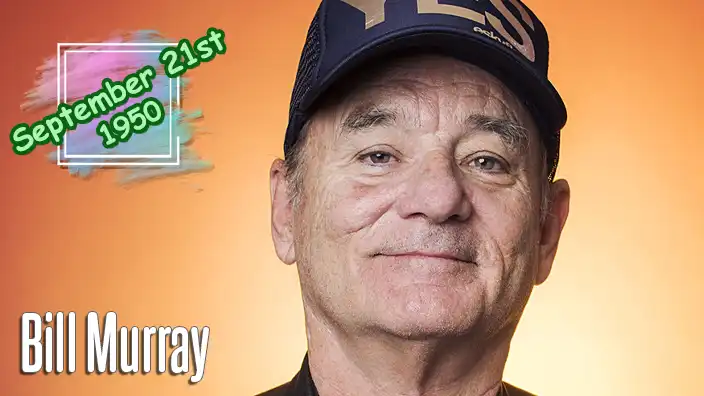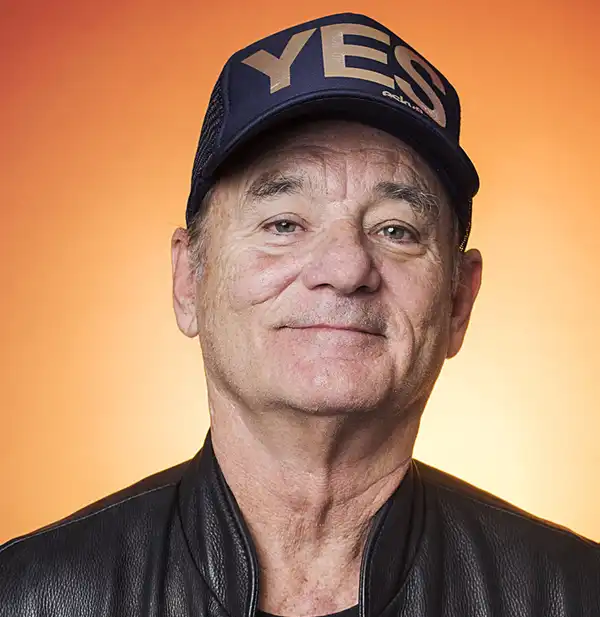
William James Murray was born on September 21, 1950, in Evanston, Illinois, and grew up in Wilmette as one of nine children in a large Irish Catholic family. With that many siblings under one roof, developing comic timing may have been less an artistic choice than a survival technique. Several members of the Murray family would eventually enter entertainment, most notably his older brother Brian Doyle-Murray, who became an actor and writer and would work alongside Bill on several projects. Long before Hollywood discovered him, however, Bill Murray's route toward acting was anything but carefully planned.
Murray briefly attended Regis College in Denver with thoughts of studying medicine, but academia proved an imperfect match. Comedy offered a more promising direction, particularly after he followed Brian into Chicago's celebrated Second City improvisational theater. Murray later recalled that the demanding environment provided serious training despite comedy's apparently spontaneous nature. Improvisation requires listening, timing and the ability to respond instantly when another performer takes a scene somewhere unexpected, all qualities that became central to Murray's distinctive screen persona. His performances often appear effortless, but that relaxed quality was built upon rigorous improvisational experience.
His first major national exposure came through The National Lampoon Radio Hour, where he worked among a remarkable collection of emerging comedians. Television soon followed. Murray joined Saturday Night Live during its early years after Chevy Chase departed, which was not necessarily the easiest seat in comedy to inherit. Audiences had already embraced the original cast, and Murray initially struggled to establish himself. Gradually, however, his characters, impressions and peculiar combination of confidence and absurdity won viewers over. By the time he left the program, he had become one of its defining early performers.
Movies were waiting. Murray appeared in Ivan Reitman's Meatballs in 1979 as irreverent summer-camp counselor Tripper Harrison, a role that established much of the screen personality audiences would soon recognize: sarcastic, rebellious, apparently relaxed and considerably smarter than he initially lets anyone know. Caddyshack followed in 1980, giving Murray the unforgettable role of Carl Spackler, the deranged groundskeeper engaged in escalating warfare with a gopher. The film also featured Chevy Chase and Rodney Dangerfield, but Murray's muttering, improvisational performance became one of its most enduring ingredients. He could make a man talking to himself about grass maintenance seem like civilization was hanging in the balance.
Murray reunited with director Ivan Reitman for Stripes in 1981, playing John Winger, a man whose collapsing personal life somehow leads him to conclude that joining the United States Army is the sensible next step. Harold Ramis co-starred, continuing a creative partnership that became central to Murray's early film career. Murray's ability to portray the irresponsible wise guy who somehow becomes worth rooting for was now firmly established. His characters frequently behaved as though rules were merely suggestions written for other people, yet audiences tended to forgive them because Murray could reveal vulnerability underneath the sarcasm just when it mattered.
Then, in 1984, came Ghostbusters. Murray played Dr. Peter Venkman alongside Dan Aykroyd's Ray Stantz and Harold Ramis's Egon Spengler, with Ernie Hudson joining the team as Winston Zeddemore. Venkman was supposedly a scientist, although his approach to scientific rigor occasionally appeared to consist of flirting with the client and hoping someone else understood the equipment. Murray's dry delivery provided an ideal counterweight to a story involving supernatural invasions, proton packs, possessed buildings and an extremely large marshmallow mascot wandering through Manhattan. The film became a major success and transformed the Ghostbusters into a permanent part of popular culture. Murray received a Golden Globe nomination for his performance.
The remarkable thing about Peter Venkman was that Murray seemed almost determined not to react appropriately to anything. Faced with an actual ghost, impending catastrophe or a towering supernatural monster, Venkman's default expression suggested that someone had delivered the wrong sandwich. That understatement became one of Murray's greatest comic weapons. Plenty of performers could deliver jokes; Murray could create one by pausing, staring and allowing the audience to realize exactly what his character thought without bothering to say it.
Murray continued through the 1980s with films including Little Shop of Horrors, Scrooged and Ghostbusters II. Scrooged, released in 1988, placed Charles Dickens's A Christmas Carol inside the ruthless world of American television. Murray played Frank Cross, a cynical network executive who receives the traditional Christmas Eve supernatural intervention. The role allowed him to be selfish, sarcastic and occasionally spectacularly unpleasant before gradually uncovering the humanity beneath the armor — a character journey that would become increasingly important as his career matured.
That transformation reached perhaps its most perfect expression in Groundhog Day in 1993. Directed by Harold Ramis, the film cast Murray as Phil Connors, an arrogant Pittsburgh television weatherman sent to Punxsutawney, Pennsylvania, to cover the annual Groundhog Day festivities. Phil despises the assignment, the town and approximately everyone occupying it. Then he wakes up the following morning and discovers that it is Groundhog Day again. And again. And again.
What begins as a clever comedy becomes something considerably deeper. Phil initially responds to the time loop with confusion, then selfish indulgence, manipulation and despair. Eventually, with apparently unlimited time and no way forward, he begins improving himself and helping others. Murray moves through those stages without abandoning the comedy, creating a performance capable of being hilarious, cruel, lonely and unexpectedly moving. The Academy of Motion Picture Arts and Sciences has described the film's time loop as providing Phil with an existential journey, and Groundhog Day was selected for preservation in the National Film Registry in 2006.
The relationship between Murray and Ramis, unfortunately, deteriorated badly during the making of Groundhog Day. Their differing ideas about the film contributed to a personal estrangement that lasted for many years. It was a sad rupture considering how much they had created together. The two eventually reconciled shortly before Ramis died in 2014, when Murray visited his former friend. Their collaboration had produced some of the most influential American comedies of their era, and Groundhog Day remains perhaps the finest example of what they accomplished together.
Murray's career began changing significantly during the late 1990s. He had already demonstrated dramatic ability, but Rushmore, directed by Wes Anderson and released in 1998, introduced audiences to another version of Bill Murray. He played wealthy industrialist Herman Blume, whose melancholy and dissatisfaction were conveyed through the same deadpan qualities Murray had spent years using for comedy. Instead of abandoning his established style, he discovered how effectively it could communicate sadness. The performance earned him a Golden Globe nomination and began a long creative relationship with Anderson.
Murray subsequently appeared in numerous Anderson films, including The Royal Tenenbaums, The Life Aquatic with Steve Zissou, Fantastic Mr. Fox, Moonrise Kingdom, The Grand Budapest Hotel and The French Dispatch. Anderson's meticulously composed, slightly peculiar cinematic world proved remarkably well suited to Murray, whose characters often seem simultaneously present and detached, as though observing their own lives from somewhere several feet to the side.
Then Sofia Coppola called — or, given Murray's famously unconventional approach to being contacted for film roles, eventually managed to reach him — about Lost in Translation. Released in 2003, the film paired Murray with Scarlett Johansson in Tokyo. Murray played Bob Harris, an American movie star visiting Japan to make a lucrative whiskey commercial while quietly confronting dissatisfaction with his career, marriage and direction in life. Johansson played Charlotte, a young woman experiencing her own uncertainty while accompanying her photographer husband.
Very little happens in Lost in Translation by conventional movie standards, and that is precisely why Murray's performance matters so much. Bob Harris spends much of the film observing, reacting and occasionally saying very little. Murray's face carries the rest. The comic actor who once fought a gopher and crossed proton streams revealed an extraordinary ability to communicate loneliness without theatrical speeches or emotional fireworks. His restrained performance became one of the most acclaimed of his career.
Murray won the Golden Globe for Best Actor in a Motion Picture – Musical or Comedy for Lost in Translation and received an Academy Award nomination for Best Actor. At the 2004 Academy Awards, he was nominated alongside Johnny Depp, Ben Kingsley, Jude Law and eventual winner Sean Penn. The film itself became an enormous success relative to its modest budget, and Sofia Coppola has said she wrote the role with Murray specifically in mind.
The Oscar nomination confirmed something that had gradually become impossible to ignore: Bill Murray was not simply a comedian who could occasionally perform serious material. He was a formidable dramatic actor whose comedy and drama came from many of the same instincts. His stillness, pauses and apparent emotional distance could produce laughter in one movie and heartbreak in another. The difference depended upon what was happening behind the expression.
Murray continued mixing mainstream productions with smaller, character-driven films. Jim Jarmusch's Broken Flowers cast him as an aging bachelor investigating the possibility that he had an adult son. He portrayed President Franklin D. Roosevelt in Hyde Park on Hudson, appeared in George Clooney's The Monuments Men, and delivered another widely praised performance in St. Vincent as Vincent MacKenna, a grumpy, financially struggling neighbor who forms an unlikely friendship with a young boy. That role brought another Golden Globe nomination.
He also appeared in the acclaimed television miniseries Olive Kitteridge, voiced Baloo in Disney's live-action adaptation of The Jungle Book, reunited with Sofia Coppola for On the Rocks, and continued his long association with Wes Anderson. Decades after Saturday Night Live, Murray remained difficult to categorize because he had never confined himself to a conventional career path. He could headline a comedy, appear briefly in someone else's movie, provide a voice performance or wander into a quirky independent production simply because the material interested him.
That unpredictability extends beyond his films. Murray has cultivated an unusual public reputation through stories of unexpected appearances at parties, sporting events, restaurants and other ordinary places. Some stories have undoubtedly grown in the telling, but enough documented encounters exist to reinforce the image of an actor who has never completely embraced the insulated machinery of celebrity. He has also been known for making himself unusually difficult for filmmakers to contact, historically preferring an answering system over the usual network of agents and assistants. It is an approach to Hollywood administration that could perhaps best be described as: if the movie really wants Bill Murray, the movie will find a way.
His career has not been without controversy. Accounts from some colleagues over the years have described difficult or inappropriate behavior on sets, and production on the film Being Mortal was suspended in 2022 following a complaint involving Murray. He later acknowledged that a disagreement involving behavior he regarded as humorous had not been received that way by a woman working on the production. Those reports complicated the lovable eccentric public image that had developed around him and became part of the broader discussion of his professional reputation.
What remains remarkable about Murray's work is the enormous distance between the apparent effort and the actual effect. He rarely looks like an actor desperately trying to make an audience laugh. Instead, he waits. He watches. He mutters something. He raises an eyebrow. Sometimes he simply remains silent until the silence itself becomes funny. That technique emerged from improvisational comedy but ultimately allowed him to move into performances of considerable emotional depth.
Bill Murray's filmography consequently charts an unusual journey through American popular culture: Saturday Night Live, Caddyshack, Stripes, Ghostbusters, Scrooged, Groundhog Day, Rushmore, Lost in Translation and decades of increasingly eclectic roles. He moved from anarchic comedian to blockbuster star to respected character actor without ever appearing terribly concerned about following the standard Hollywood instructions.
Perhaps that is why Murray remains so recognizable. Peter Venkman, Phil Connors and Bob Harris are enormously different men, yet each contains that unmistakable Murray quality — the sense that he has noticed something ridiculous about the situation before anyone else has and is deciding whether explaining it would be worth the trouble. Usually it isn't. A stare will do.