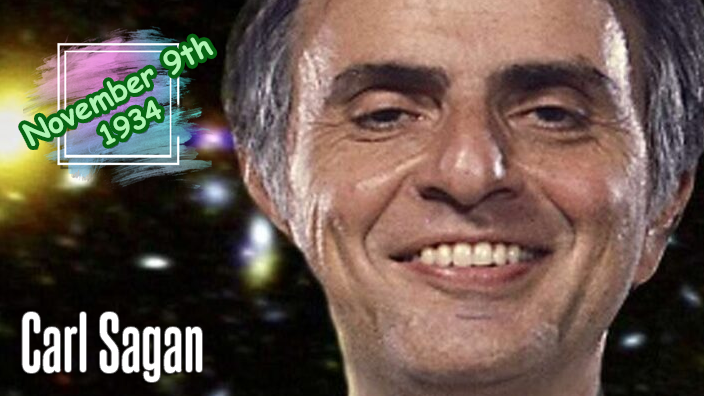
November 9, 1934, in Brooklyn, New York
 December 20, 1996, in Seattle, Washington

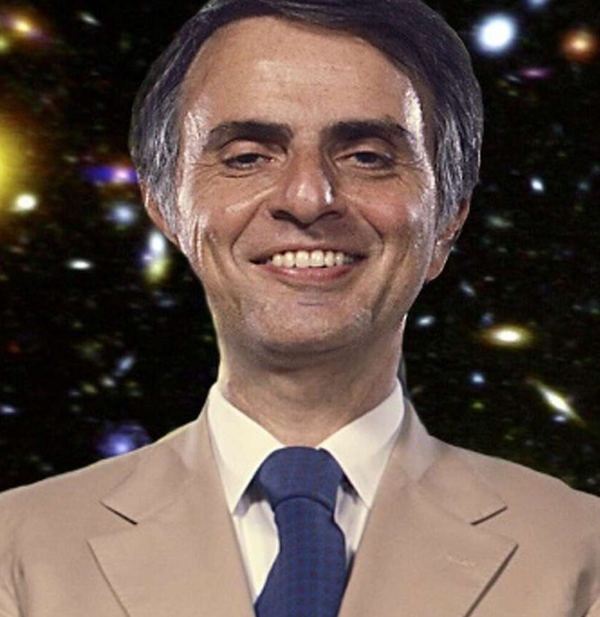
Carl Edward Sagan, born on November 9, 1934, in Brooklyn, New York, was an American astronomer, planetary scientist, astrophysicist, author, educator, and internationally celebrated science communicator whose work transformed the public understanding of astronomy and space exploration. Best remembered as the creator and presenter of the groundbreaking 1980 television series Cosmos: A Personal Voyage, Sagan possessed an extraordinary ability to explain complex scientific ideas through accessible language, vivid imagery, and a profound sense of wonder. His research contributed to important discoveries about the atmospheres and surfaces of planets, while his involvement with NASA's robotic exploration programs helped shape humanity's early investigations of the solar system. Through television, books, lectures, and public advocacy, Sagan encouraged generations of people to appreciate scientific discovery, question unsupported claims, and recognize Earth's extraordinary place within the vastness of space.
Sagan grew up in a working-class Jewish family in Brooklyn, the son of Samuel Sagan, a garment industry worker, and Rachel Molly Gruber, a homemaker. His parents encouraged his curiosity despite having little formal scientific education themselves, creating an environment in which questions about the natural world were welcomed. As a young boy, Sagan became fascinated by the stars, dinosaurs, science fiction, and the possibility of worlds beyond Earth. His childhood curiosity intensified after visiting the 1939 New York World's Fair, where futuristic exhibitions introduced him to technological possibilities that seemed almost magical. The fair's displays of electricity, machinery, and imagined future cities helped convince him that scientific discovery could transform human understanding and everyday life. For a child who already wondered what existed beyond the night sky, the experience provided a powerful reminder that the universe contained mysteries waiting to be explored.
One of Sagan's most memorable childhood experiences involved visiting a public library to learn about the stars. After asking a librarian for information, he discovered that the Sun was itself a star and that the countless points of light visible at night were distant suns scattered across enormous distances. The realization profoundly affected his understanding of the universe, revealing that the familiar world around him was only a small part of something unimaginably larger. He later described the experience as an important moment in the development of his scientific curiosity, emphasizing the remarkable ability of libraries to provide access to knowledge regardless of a family's wealth or social position. The discovery also introduced a question that would remain central to his professional career: if the universe contained so many stars and planets, might life exist somewhere beyond Earth?
Sagan attended Rahway High School in New Jersey before entering the University of Chicago, where he pursued an unusually broad scientific education. He earned a bachelor's degree in general and special honors in 1954, followed by a bachelor's degree in physics in 1955 and a master's degree in physics in 1956. His academic interests encompassed astronomy, biology, chemistry, and planetary science, reflecting his conviction that understanding the universe required knowledge from several scientific disciplines. He completed his doctorate in astronomy and astrophysics in 1960, producing research on the physical conditions of planets. During his university years, he studied under distinguished scientists and developed the analytical skills necessary for a career investigating planetary atmospheres, extraterrestrial environments, and the possibility of life beyond Earth.
His early scientific research focused particularly on the planet Venus, whose brilliant appearance in Earth's sky had inspired centuries of speculation about its surface. Before spacecraft began investigating Venus directly, some scientists and popular writers imagined that its thick cloud cover might conceal oceans, jungles, or other environments potentially suitable for life. Sagan helped demonstrate that Venus was far more hostile than these romantic interpretations suggested. His work examined the planet's atmosphere and the greenhouse effect, contributing to the understanding that extremely high surface temperatures resulted from the trapping of heat by atmospheric gases. Later spacecraft observations confirmed that Venus possesses an extraordinarily hot surface, crushing atmospheric pressure, and an environment dramatically different from Earth. The findings provided an important example of how scientific investigation could replace attractive speculation with evidence-based understanding.
Sagan also investigated the planet Mars, which had fascinated astronomers and science fiction writers for generations. Early observations of changing surface features encouraged speculation about vegetation, seasonal growth, and even intelligent civilizations, but Sagan approached these possibilities through careful scientific analysis. He studied the Martian atmosphere, surface conditions, and the role of windblown dust in producing changes visible from Earth. His research helped explain that many apparent seasonal variations were associated with dust movement rather than vegetation. These investigations contributed to a more realistic understanding of Mars as a cold, dry planet with a thin atmosphere and a complex geological history. Although Sagan remained deeply interested in the possibility of extraterrestrial life, he emphasized that such claims required convincing scientific evidence rather than wishful thinking.
Following his doctoral studies, Sagan conducted research at the University of California, Berkeley, and later worked at Harvard University and the Smithsonian Astrophysical Observatory. His academic career developed during an extraordinary period in scientific history, as the United States and Soviet Union competed to explore space through increasingly sophisticated rockets and spacecraft. The launch of Sputnik in 1957 had transformed public awareness of space technology, while the emerging American space program created unprecedented opportunities for planetary scientists to investigate worlds previously observed only through telescopes. Sagan recognized that robotic spacecraft could provide direct measurements of planetary environments, allowing researchers to test theories about atmospheric composition, temperature, surface conditions, and the possibility of biological activity.
In 1968, Sagan joined Cornell University in Ithaca, New York, where he became a professor of astronomy and space sciences and later served as director of the Laboratory for Planetary Studies. Cornell provided an academic home for much of his subsequent research, teaching, writing, and public communication. His work combined planetary science with broader investigations into the origins of life, atmospheric chemistry, and the environmental conditions necessary for biological processes. He encouraged students and colleagues to approach scientific questions with intellectual curiosity while maintaining rigorous standards of evidence. Sagan's academic interests frequently crossed traditional disciplinary boundaries, reflecting his belief that the most important scientific questions rarely fit neatly within a single department or specialized field.
One of Sagan's most significant scientific interests involved the chemical origins of life. Working with colleagues, he investigated how complex organic molecules might form under conditions resembling those present on the early Earth or other planetary environments. These experiments and theoretical studies contributed to the developing field of astrobiology, which examines the possibility of life beyond Earth and the conditions necessary for its emergence. Sagan recognized that understanding life's origins required collaboration among astronomers, chemists, geologists, and biologists. Although the precise circumstances surrounding the emergence of life remain an important scientific question, his research helped establish the study of extraterrestrial biology as a legitimate area of scientific investigation rather than merely a subject for imaginative fiction.
Sagan became closely involved with NASA's planetary exploration programs, contributing scientific expertise to missions that investigated Venus, Mars, and the outer planets. He participated in research and advisory activities associated with the Mariner missions, which provided some of humanity's earliest close-up observations of neighboring planets. These spacecraft revealed environments that frequently differed dramatically from earlier expectations, demonstrating the importance of direct observation in scientific discovery. Sagan appreciated that each successful mission could transform humanity's understanding of an entire world, replacing centuries of speculation with measurements, photographs, and new scientific questions. His involvement also reinforced his belief that space exploration represented one of civilization's most important intellectual achievements.
The Viking program became particularly important to Sagan's interest in extraterrestrial life. In 1976, NASA successfully landed Viking 1 and Viking 2 on Mars, conducting detailed investigations of the planet's surface and atmosphere. The landers carried experiments designed to search for possible biological activity in Martian soil, representing humanity's first sustained attempt to investigate life directly on another planet. Sagan contributed to the scientific discussions surrounding the mission and advocated for carefully designed experiments capable of distinguishing biological processes from nonbiological chemical reactions. Although the Viking experiments did not establish the existence of Martian life, they provided valuable information about the planet's environment and demonstrated the extraordinary complexity of searching for organisms beyond Earth.
Sagan's involvement in the Voyager program further strengthened his connection with humanity's exploration of the solar system. Launched in 1977, Voyager 1 and Voyager 2 traveled toward the outer planets, eventually providing spectacular observations of Jupiter, Saturn, Uranus, Neptune, and numerous moons. Sagan participated in the scientific imaging team and helped interpret the extraordinary discoveries produced by the spacecraft. The missions revealed active volcanoes on Jupiter's moon Io, complex structures within Saturn's rings, and unexpected geological features across the outer solar system. These discoveries transformed planetary science by demonstrating that distant worlds were not simply frozen, unchanging objects but dynamic environments shaped by geological, atmospheric, and gravitational processes.
One of Sagan's most imaginative contributions to the Voyager missions involved the creation of the Voyager Golden Record, a phonograph record carried aboard each spacecraft as a message from humanity to any extraterrestrial civilization that might someday encounter them. Sagan chaired the committee responsible for selecting the record's contents, working with collaborators including Frank Drake, Ann Druyan, and others. The records contained photographs, natural sounds, spoken greetings in numerous languages, and musical selections representing different cultures and historical periods. Their purpose was not to provide a practical means of communicating with nearby extraterrestrials, but to offer a symbolic introduction to Earth's diversity, creativity, and biological richness. It was an extraordinary undertaking, effectively preparing a small cultural introduction for an audience that might not exist and, if it did, might not discover the message for millions of years.
The Golden Record reflected Sagan's conviction that space exploration could encourage humanity to consider its place within a much larger cosmic environment. Rather than representing a single nation or political system, the project attempted to present Earth as a shared home inhabited by diverse cultures and living organisms. Its selection of music, images, and greetings emphasized both human achievement and the extraordinary natural environment that made civilization possible. The records remain aboard the Voyager spacecraft as they continue their journeys through interstellar space, carrying a small collection of Earth's sounds and images far beyond the planets. Although the likelihood of their discovery by another civilization is extremely uncertain, the project remains one of the most recognizable symbols of humanity's desire to explore and communicate beyond its own world.
Sagan's scientific reputation increasingly accompanied a remarkable ability to communicate with the general public. During the 1970s, he appeared on television programs, delivered lectures, and wrote accessible books explaining astronomy and planetary science. His appearances on The Tonight Show Starring Johnny Carson helped introduce scientific discussions to audiences who might never have attended a university lecture or read an astronomy textbook. Carson appreciated Sagan's enthusiasm and distinctive speaking style, while viewers responded to his ability to explain enormous cosmic distances and complicated scientific concepts without becoming unnecessarily technical. His television appearances also helped establish the familiar public image of a thoughtful scientist speaking enthusiastically about the wonders of the universe, often accompanied by references to enormous numbers of stars and galaxies.
In 1977, Sagan published The Dragons of Eden: Speculations on the Evolution of Human Intelligence, an ambitious exploration of the development of intelligence, the human brain, and the evolutionary origins of consciousness. The book combined scientific research with broader reflections on human behavior, demonstrating Sagan's interest in subjects extending beyond astronomy. It received the Pulitzer Prize for General Nonfiction in 1978, establishing him as a major popular science author. The award recognized his ability to communicate challenging scientific ideas to a broad audience while encouraging readers to consider the biological and evolutionary processes that shaped human intelligence. His success demonstrated that serious scientific writing could attract substantial public interest when presented with clarity, imagination, and an engaging narrative.
Sagan achieved his greatest public recognition in 1980 with the premiere of Cosmos: A Personal Voyage, a thirteen-part documentary television series that transformed science communication. Developed with Ann Druyan and Steven Soter, the program combined astronomy, history, biology, philosophy, and scientific discovery into an ambitious exploration of the universe and humanity's place within it. Sagan served as the presenter, guiding audiences through subjects ranging from the origins of galaxies to the development of life on Earth. The series used innovative visual effects, historical dramatizations, and imaginative sequences to explain scientific concepts that might otherwise have seemed inaccessible. Its combination of educational depth and cinematic storytelling established a new standard for television documentaries.
The opening sequences of Cosmos became particularly memorable, with Sagan introducing viewers to the vastness of space while traveling aboard an imaginary spacecraft known as the Ship of the Imagination. This storytelling device allowed the program to move freely between distant galaxies, ancient civilizations, planetary surfaces, and the microscopic structures of living organisms. Rather than presenting science as a collection of disconnected facts, Sagan emphasized the relationships between discoveries and the human curiosity that made them possible. His calm delivery, distinctive voice, and evident enthusiasm created an atmosphere of intellectual adventure, encouraging viewers to consider the universe as something they could begin to understand through observation and reasoning. For millions of households, Sunday evening television suddenly became an opportunity to travel billions of miles without leaving the sofa.
The original Cosmos series became one of the most widely watched educational television programs in history, reaching hundreds of millions of viewers internationally through broadcasts and subsequent distribution. Its success demonstrated that audiences were willing to engage with serious scientific material when it was presented with imagination, enthusiasm, and respect for their intelligence. Sagan avoided treating viewers as passive recipients of information, instead inviting them to participate in the process of discovery by asking questions and considering evidence. The series also explored the history of scientific thought, emphasizing the contributions of thinkers such as Johannes Kepler, Isaac Newton, and other figures whose discoveries transformed humanity's understanding of the natural world.
One of the most influential concepts introduced to a broad audience through Cosmos was the Cosmic Calendar, a method of representing the approximately 13.8-billion-year history of the universe as a single calendar year. In this analogy, the Big Bang occurs at the beginning of January, the formation of the solar system takes place in September, and human civilization appears during the final moments of December 31. The comparison allows audiences to appreciate the extraordinary scale of cosmic time and the relatively brief period during which human beings have existed. Sagan used the idea to illustrate the importance of perspective, reminding viewers that even events separated by thousands of years occupy only a tiny fraction of the universe's history. It is a wonderfully effective way to make human arguments about being five minutes late seem rather less significant.
The success of Cosmos was accompanied by the publication of a companion book, also titled Cosmos, which became an international bestseller. The book expanded upon many of the series' central themes, combining scientific explanations with historical accounts and reflections on humanity's relationship with the universe. Sagan's writing emphasized the importance of curiosity, intellectual humility, and evidence-based reasoning, encouraging readers to recognize both the achievements and limitations of scientific knowledge. His ability to explain complex ideas through vivid comparisons helped make astronomy accessible to people without formal scientific training. The book's popularity reinforced his reputation as one of the world's most effective science communicators, while the television series became an enduring influence on documentary filmmaking and public science education.
In 1985, Sagan published the science-fiction novel Contact, exploring the possibility of receiving a message from an extraterrestrial civilization. The story follows radio astronomer Ellie Arroway as she investigates an extraordinary signal from space, confronting scientific, political, philosophical, and personal questions surrounding humanity's first contact with intelligent life beyond Earth. The novel reflected Sagan's longstanding interest in the search for extraterrestrial intelligence while emphasizing the importance of scientific evidence and the complexities of interpreting unfamiliar information. It also explored the relationship between science and religion, presenting characters with different perspectives on humanity's place in the universe. The book was later adapted into the 1997 film Contact, starring Jodie Foster and Matthew McConaughey, although Sagan died before the movie reached theaters.
Sagan was a prominent advocate for the scientific search for extraterrestrial intelligence, commonly known as SETI. He argued that the enormous number of stars and planets in the universe made the possibility of life elsewhere worthy of serious investigation, even though convincing evidence of extraterrestrial civilizations had not been discovered. His interest in SETI was grounded in scientific curiosity rather than claims of alien visitation, and he consistently emphasized the need to distinguish plausible hypotheses from unsupported speculation. He helped establish the Planetary Society in 1980 alongside Bruce Murray and Louis Friedman, creating an organization dedicated to advancing space exploration, planetary science, and public participation in scientific discovery. The society became an important platform for encouraging public support for robotic missions, astronomical research, and the continuing search for life beyond Earth.
Sagan's commitment to scientific skepticism became another defining feature of his public work. He challenged pseudoscientific claims, unsupported assertions about extraterrestrial visitors, astrology, and other beliefs that lacked convincing evidence. Rather than dismissing curiosity about unusual phenomena, he encouraged people to investigate claims through observation, logical reasoning, and careful evaluation of available information. His approach emphasized that extraordinary possibilities should not be rejected simply because they appear unfamiliar, but neither should they be accepted without adequate supporting evidence. This distinction became central to his educational philosophy, reflecting his belief that scientific thinking provided essential tools for understanding a complicated world.
His concerns extended beyond astronomy to the environmental and political challenges facing humanity. During the Cold War, Sagan participated in scientific research examining the potential climatic consequences of large-scale nuclear conflict. He helped publicize the concept of nuclear winter, which proposed that smoke and soot from widespread nuclear fires could reduce sunlight and produce severe global cooling, threatening agriculture and ecosystems. Although the precise magnitude of these effects has been the subject of continuing scientific investigation and debate, the research contributed to public discussions about the environmental consequences of nuclear warfare. Sagan argued that scientific knowledge carried responsibilities extending beyond academic research, particularly when technological developments created risks capable of affecting the entire planet.
Sagan also spoke frequently about climate change, atmospheric pollution, and the importance of protecting Earth's environment. His research on Venus had demonstrated how greenhouse gases could dramatically influence planetary temperatures, providing a powerful example of the relationship between atmospheric composition and climate. He encouraged audiences to recognize that Earth possessed environmental conditions uniquely suited to supporting known life and that those conditions should not be taken for granted. His perspective connected planetary science with environmental responsibility, emphasizing that understanding other worlds could provide valuable lessons about the fragility and complexity of our own planet. For Sagan, studying distant planets was never simply an exercise in curiosity; it also offered opportunities to understand the natural processes that make Earth habitable.
One of Sagan's most enduring contributions to public understanding came through the famous Pale Blue Dot photograph, taken by NASA's Voyager 1 spacecraft on February 14, 1990. At Sagan's urging, the spacecraft turned its camera back toward the inner solar system and captured an image of Earth from approximately 3.7 billion miles away. In the photograph, our planet appears as a tiny point of light suspended within a scattered beam of sunlight, almost indistinguishable from the surrounding darkness. The image provided an extraordinary visual demonstration of Earth's smallness within the solar system and became one of the most recognizable photographs in the history of space exploration. It also inspired Sagan to reflect on humanity's shared existence and the importance of treating one another and the planet with greater compassion.
Sagan developed these reflections in his 1994 book Pale Blue Dot: A Vision of the Human Future in Space, which explored the significance of space exploration and humanity's long-term future beyond Earth. The book combined scientific explanations with philosophical observations about civilization, conflict, environmental responsibility, and the possibilities of future exploration. Sagan argued that seeing Earth from enormous distances could encourage a greater appreciation of humanity's shared home, revealing the limited importance of political boundaries and everyday disputes when viewed against the scale of the cosmos. His reflections became among the most widely remembered passages in popular science writing, frequently quoted in documentaries, educational programs, and discussions about humanity's relationship with the planet.
In 1995, Sagan published The Demon-Haunted World: Science as a Candle in the Dark, an influential examination of scientific skepticism, critical thinking, and the dangers of misinformation. The book encouraged readers to develop practical methods for evaluating claims, identifying logical errors, and distinguishing reliable evidence from persuasive but unsupported arguments. Sagan emphasized that scientific thinking was not simply a collection of facts learned in school but a disciplined approach to asking questions and examining the world. His concerns about public misunderstanding of science remain relevant in an era when information can spread rapidly through digital communication, often without careful verification. The book became an important resource for educators, scientists, and readers interested in developing stronger critical-thinking skills.
Sagan's personal life included three marriages. His first wife was biologist Lynn Margulis, with whom he had two sons, Dorion and Jeremy. He later married artist and writer Linda Salzman, with whom he had a son, Nick. In 1981, he married author and producer Ann Druyan, his longtime creative collaborator, with whom he had two children, Alexandra and Samuel. Druyan played an important role in several of Sagan's most influential projects, including Cosmos, the Voyager Golden Record, and his later writing. Their partnership combined intellectual collaboration with personal affection, reflecting a shared commitment to science communication, exploration, and the importance of encouraging public curiosity about the universe.
During the 1990s, Sagan developed a serious illness after being diagnosed with myelodysplastic syndrome, a disorder affecting the bone marrow's ability to produce healthy blood cells. He underwent treatment that included bone marrow transplants, continuing to work and communicate publicly about science despite significant health challenges. His determination to remain intellectually active reflected the curiosity and enthusiasm that had defined his career. Carl Sagan died on December 20, 1996, in Seattle, Washington, from pneumonia associated with complications of his illness. His death prompted tributes from scientists, educators, writers, and members of the public who recognized his extraordinary contributions to astronomy and science communication.
Sagan received numerous professional honors during his lifetime, including the Pulitzer Prize, NASA's Distinguished Public Service Medal, and the National Academy of Sciences' Public Welfare Medal. His achievements reflected both his scientific research and his exceptional ability to communicate the importance of discovery to the public. Although his prominence occasionally attracted criticism from colleagues who questioned the relationship between academic research and popular celebrity, his influence on public interest in astronomy was undeniable. Many scientists subsequently credited Cosmos and Sagan's books with inspiring their own interest in scientific careers, demonstrating the lasting educational impact of his work.
His legacy continued through later television productions inspired by the original Cosmos. In 2014, astrophysicist Neil deGrasse Tyson presented Cosmos: A Spacetime Odyssey, a modern continuation of the series developed with the involvement of Ann Druyan. The production introduced a new generation of viewers to the history of scientific discovery while using contemporary visual effects to explore subjects that Sagan had helped popularize decades earlier. A further series, Cosmos: Possible Worlds, followed in 2020, continuing the tradition of combining scientific education with imaginative storytelling. These productions demonstrated the enduring strength of Sagan's original approach, which treated the universe as an extraordinary subject worthy of both rigorous investigation and genuine emotional wonder.
Sagan's influence also extended into popular culture through references in films, television programs, music, and educational materials. His distinctive speaking style and enthusiastic descriptions of enormous cosmic distances became widely recognizable, while his phrase “billions and billions” entered popular conversation despite its association with a popular impression of his speech rather than a habitual expression from his original television series. He eventually embraced the phrase with humor, using it as the title of his posthumously published collection Billions and Billions: Thoughts on Life and Death at the Brink of the Millennium. The collection, published in 1997, brought together essays exploring scientific discovery, environmental responsibility, civilization, and the human experience. It provided another example of Sagan's ability to connect scientific knowledge with questions about everyday life and humanity's future.
The continuing importance of Carl Sagan's work lies in his conviction that scientific knowledge belongs to everyone, not simply to specialists working in universities and research institutions. He believed that people could appreciate the extraordinary discoveries of astronomy, biology, and physics when those subjects were explained clearly and honestly. His approach encouraged intellectual humility, recognizing that human knowledge remains incomplete and that future discoveries may transform current understanding. Rather than presenting uncertainty as a weakness, Sagan celebrated it as an invitation to investigate further. This perspective helped establish a model for modern science communication, influencing countless educators, documentary presenters, writers, and researchers who seek to make complicated subjects understandable without sacrificing scientific accuracy.
As admirers celebrate Carl Sagan's birthday on November 9, they remember a scientist whose curiosity, imagination, and remarkable communication skills helped millions of people discover the wonders of the universe. From his childhood fascination with the stars to his research on planetary atmospheres, involvement with NASA's spacecraft missions, creation of Cosmos, and influential writing about science and humanity, Sagan dedicated his life to expanding knowledge and encouraging others to ask questions. His legacy remains visible in the continuing exploration of the solar system, the search for extraterrestrial life, and the countless individuals inspired to study science because of his work. And while the universe contains more stars than anyone could reasonably count without taking several very long coffee breaks, Carl Sagan helped us understand something equally important: our tiny planet may occupy only an almost invisible corner of the cosmos, but the curiosity of its inhabitants allows them to explore the universe far beyond their own world.
References & Sources