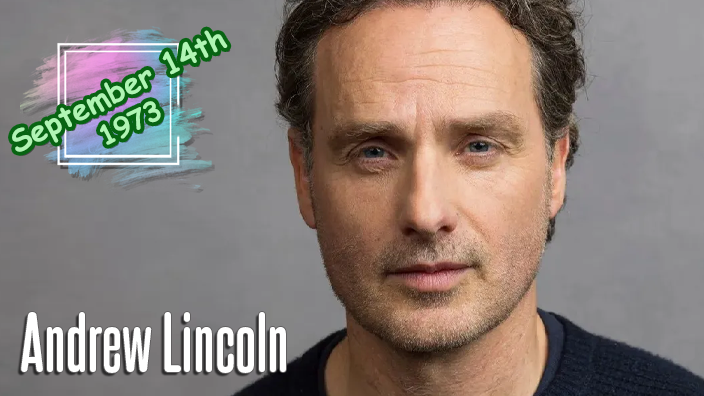
September 14, 1973, in London, England
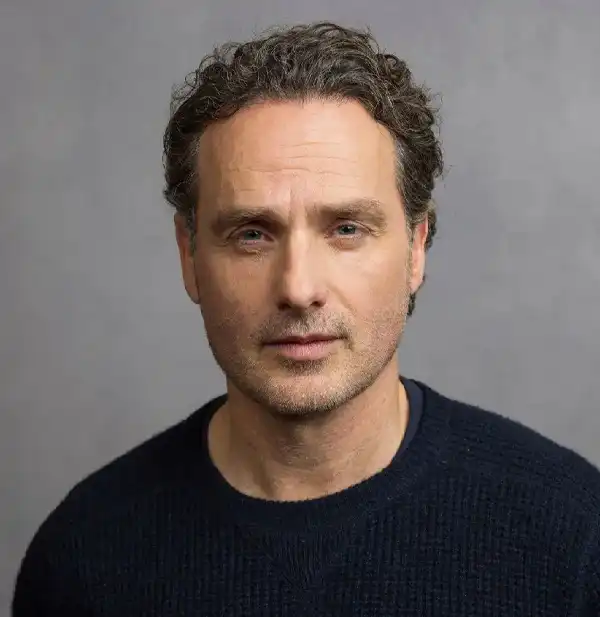
Born on September 14, 1973, in London, England, Andrew James Clutterbuck spent part of his childhood in Hull before his family eventually settled in Bath, Somerset. His father was a civil engineer, while his mother worked as a nurse. Acting was not necessarily the obvious family profession waiting for him at the breakfast table, and Lincoln's first steps toward the stage were considerably less grand than his later career might suggest.
While attending Beechen Cliff School in Bath, he became involved in a school production of Oliver!, playing the Artful Dodger. By Lincoln's own later accounts, the initial attraction of acting had at least something to do with meeting girls. Many distinguished careers have begun with artistic inspiration, a burning desire for self-expression, or an overwhelming need to explore the human condition. Apparently, occasionally wanting to impress girls works just as well.
Whatever brought him through the door, acting soon became considerably more serious. Lincoln spent time with the National Youth Theatre and subsequently trained at London's prestigious Royal Academy of Dramatic Art. RADA records him as graduating from its acting program in 1994. It was during his training that Andrew Clutterbuck adopted the professional surname Lincoln. Considering the number of times Rick Grimes would eventually have to shout his own name during moments of extreme distress, television sound engineers everywhere may owe somebody a debt of gratitude.
Lincoln's professional screen career began in British television. He appeared in an episode of the Channel 4 comedy Drop the Dead Donkey in 1994, but the role that first made viewers take serious notice arrived shortly afterward. He was cast as Edgar “Egg” Cook in the BBC drama This Life, which followed a group of young professionals sharing a house in London.
This Life became an important British television drama of the 1990s, combining careers, relationships, sex, arguments, friendship, and the sort of shared-house tensions that make living alone suddenly seem enormously attractive. Egg was one of its central characters, and Lincoln's performance established him as a recognizable young actor. More importantly, it demonstrated the easy naturalism that would continue to characterize much of his work.
He followed This Life with a variety of television and film appearances rather than immediately becoming attached to another enormous long-running role. That period allowed him to build a career across drama, comedy, film, television, and theater. His credits included The Woman in White, Bomber, Human Traffic, A Likeness in Stone, and other British productions.
Then came Teachers.
Beginning in 2001, Lincoln played Simon Casey in the Channel 4 comedy-drama about a group of secondary-school teachers whose personal lives frequently suggested that the pupils were not necessarily the least mature people in the building. Simon was a probationary English teacher attempting to negotiate classrooms, colleagues, relationships, and adulthood with varying degrees of competence.
Lincoln took preparation for the part seriously. His brother was a teacher, and Lincoln spent time at his brother's school researching the profession before playing Simon. One can only imagine the staff-room reaction when somebody announced that an actor would be hanging around observing them. There are probably few environments where the words “just behave normally” guarantee quite so completely that nobody will.
Teachers also allowed Lincoln to move behind the camera. He directed episodes of the series, and that work brought him a BAFTA Television Award nomination for Best New Director (Fiction) in 2004. It was evidence that his interests extended beyond simply arriving on set, learning the lines, and asking where lunch was being served.
By then, Lincoln was also developing a film career. His most internationally familiar pre-zombie movie role came in Richard Curtis's 2003 romantic comedy Love Actually. Lincoln played Mark, the painfully lovestruck friend of Peter, played by Chiwetel Ejiofor, who secretly harbors feelings for Peter's new wife Juliet, played by Keira Knightley.
The role produced one of the movie's most famous sequences: Mark arriving at Juliet's door and silently declaring his feelings using a series of handwritten cards while pretending, for Peter's benefit, that Christmas carolers are outside.
It has become one of the most recognizable scenes in modern romantic comedy. It has also been debated endlessly in the years since the film appeared, with viewers divided over whether it is achingly romantic or an absolutely terrible way to behave toward your best friend's wife. Either way, the scene remains firmly embedded in popular culture. Lincoln briefly returned as Mark for the 2017 charity short Red Nose Day Actually, proving that cue cards apparently have remarkable longevity when stored properly.
Lincoln continued taking varied roles after Love Actually. Particularly notable was the supernatural television drama Afterlife, in which he played psychology lecturer Robert Bridge opposite Lesley Sharp's medium Alison Mundy. The series gave Lincoln material considerably darker than Teachers and provided another opportunity to demonstrate his ability with emotionally complicated characters.
His performance in Afterlife earned him a Golden Nymph for Outstanding Actor in a Drama Series at the Monte-Carlo Television Festival in 2007. It was another indication that Lincoln was becoming a respected dramatic performer, although nothing in his career up to that point could have predicted quite what was about to happen.
In 2010, Andrew Lincoln was cast as Rick Grimes in AMC's television adaptation of Robert Kirkman's comic-book series The Walking Dead.
That changed everything.
Rick is introduced as a sheriff's deputy who is wounded in the line of duty and subsequently awakens from a coma in a hospital to discover that civilization has collapsed. The dead are walking, society has disintegrated, his family is missing, and apparently nobody had thought to leave a useful explanatory leaflet beside his hospital bed.
Lincoln therefore had the unenviable job of introducing viewers to the apocalypse while Rick himself was trying to understand it.
The opening episodes established the qualities that would define the character: determination, loyalty, courage, vulnerability, and a stubborn refusal to surrender even when surrender would have been considerably easier. Rick begins the story as a lawman still trying to apply the moral expectations of civilized society to a world in which civilization has effectively packed its suitcase and left without forwarding instructions.
That struggle became one of the central themes of The Walking Dead.
As the series progressed, Rick changed dramatically. He became a leader because circumstances demanded one, but leadership repeatedly required decisions that would have been unthinkable before the outbreak. Lincoln had to portray not merely an action hero fighting monsters but a man gradually transformed by trauma, grief, responsibility, violence, and the constant fear of losing everyone he cared about.
That distinction mattered enormously.
The zombies—or “walkers,” as the series generally calls them—provided the immediate danger, but The Walking Dead was rarely simply about escaping shambling corpses. Its strongest stories asked what remained of morality when laws, institutions, police, courts, governments, and normal social expectations disappeared. Rick Grimes became the character through whom many of those questions were explored.
Lincoln's performance could move from quiet exhaustion to ferocious violence within moments. Rick could be compassionate, frightening, broken, hopeful, unreasonable, inspiring, and occasionally several of those things before lunch.
He also perfected a particularly intense stare suggesting that somebody nearby was about to receive either an important leadership speech or a very unfortunate afternoon.
One of the more remarkable aspects of Lincoln's performance was his American accent. To millions of viewers who encountered him first through The Walking Dead, discovering that Rick Grimes was played by an English actor could be genuinely surprising. Lincoln worked extensively on the Southern American voice required for the character and was known for maintaining the accent during filming days.
The transformation was sufficiently convincing that hearing Lincoln speak naturally in interviews became something of a novelty for American audiences. Rick Grimes sounded thoroughly Georgian; Andrew Lincoln most certainly did not.
The role required more than an accent. Filming The Walking Dead in Georgia meant long days in heat, humidity, mud, forests, abandoned buildings, and enough artificial blood to keep an industrial laundry awake at night. Rick's physical and emotional deterioration was often visible on screen, and Lincoln embraced the increasingly battered appearance of a survivor for whom regular grooming had understandably fallen some distance down the list of priorities.
The series became an international phenomenon and one of AMC's defining programs. Lincoln's Rick stood at its center for much of its run, appearing in 125 episodes according to IMDb. His work brought numerous award nominations and wins, including the Saturn Award for Best Actor on Television in 2017 and a People's Choice Award for Favorite TV Anti-Hero in 2014.
Yet Lincoln eventually decided that the enormous commitment required by the production was taking him away from his family for too much of the year. He left The Walking Dead as a regular cast member during its ninth season in 2018. Importantly, however, Rick Grimes was not killed.
In The Walking Dead, that distinction is rather significant.
Lincoln returned briefly during the original series finale in 2022, but the larger continuation of Rick's story arrived with The Walking Dead: The Ones Who Live in 2024. The six-episode series reunited Rick with Michonne, played by Danai Gurira, and finally addressed questions that had remained unanswered following his earlier departure.
Lincoln did considerably more than reprise the role. He was also an executive producer and co-creator of The Ones Who Live, demonstrating how closely connected he had become to the character and the larger Walking Dead universe. His performance earned another Saturn Award nomination, this time for Best Actor in a Television Series.
Rick Grimes may dominate international perceptions of Lincoln, but his career has never consisted solely of dispatching walkers.
His other screen work has included Made in Dagenham, the French romantic comedy Heartbreaker, Wuthering Heights, Strike Back, Penguin Bloom, and an appearance in Guillermo del Toro's Cabinet of Curiosities. He has also worked extensively as a narrator and voice-over performer. British audiences may therefore have heard Andrew Lincoln's voice in advertising and documentary narration without necessarily realizing that the man speaking was the future sheriff of the zombie apocalypse.
Lincoln has continued moving into projects beyond The Walking Dead. His later television work includes the British thriller Coldwater, in which he plays John, and his career has increasingly included producing responsibilities alongside acting. That progression from actor to director, producer, executive producer, and co-creator reflects a career considerably broader than the single role for which he is most famous.
Away from acting, Lincoln has generally maintained a relatively private family life. He married Gael Anderson in 2006, and they have two children. Anderson is the daughter of Ian Anderson, the frontman and flautist of Jethro Tull, meaning Lincoln married into a family already accustomed to unusual working environments, although even progressive-rock tours probably involve fewer decomposing corpses.
Lincoln has also supported charitable causes. He has been associated with Shelter, the British organization working to address homelessness, and traveled to Ghana with Voluntary Service Overseas to learn more about international development and volunteer work.
There is an interesting contrast between Andrew Lincoln's public profile and the character that made him internationally famous. Rick Grimes is intense, frequently blood-covered, permanently worried, and surrounded by people who have an alarming tendency to become either dead or undead. Lincoln himself has generally avoided turning celebrity into a permanent public spectacle.
Perhaps one of the funniest indications of that separation is his admitted reluctance to watch himself on screen. IMDb records Lincoln joking that he does not watch The Walking Dead and is “allergic to my own face.” For a man whose face appeared on posters, billboards, television screens, merchandise, and convention displays around the world, avoidance must occasionally have required some impressive evasive maneuvers.
His career also provides a useful reminder of how thoroughly one role can alter the world's perception of an actor. British viewers who knew him as Egg from This Life or Simon from Teachers watched a familiar homegrown performer become an international television star. Audiences elsewhere often encountered Rick Grimes first and discovered afterward that the Georgia sheriff was actually Andrew Clutterbuck from London, trained at RADA and previously famous for silently waving romantic cue cards at Keira Knightley.
That is quite a professional journey.
More importantly, Andrew Lincoln made Rick Grimes memorable because he never treated him simply as the man carrying the gun. Beneath the action was always somebody struggling with responsibility: responsibility to his children, his friends, his community, his principles, and eventually to whatever fragments of civilization might still be worth rebuilding.
That gave The Walking Dead its emotional center during many of its most important years.
Zombies may have provided the gruesome spectacle, but Andrew Lincoln provided something considerably harder to manufacture with prosthetics and buckets of stage blood: a human being audiences cared about.
And after everything Rick Grimes survived, perhaps the greatest achievement of all is that Andrew Lincoln can still walk onto a television set without immediately checking the nearest exit for walkers.