September 14, 1947, in Omagh, Northern Ireland
 July 13, 2026, in Sydney, Australia
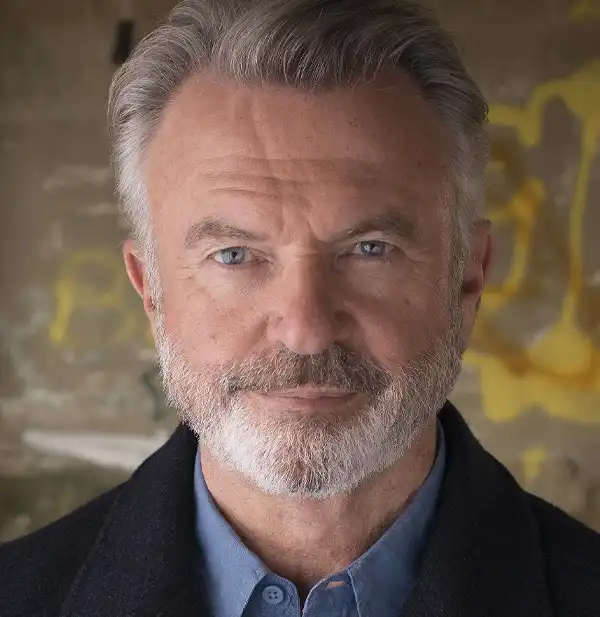
Sam Neill was born Nigel John Dermot Neill on September 14, 1947, in Omagh, Northern Ireland. His father, Dermot Neill, was a New Zealander serving with the Royal Irish Fusiliers, while his mother, Priscilla, was English. The family returned to New Zealand when Neill was a child, and it was there that he grew up and established the national identity with which he would remain closely associated throughout his life. The name Sam arrived during his school years when, faced with several other boys called Nigel, he adopted something less plentiful. The nickname stuck permanently and, from a cinematic perspective, probably worked out rather well. “Sam Neill” sounds like a man capable of surviving velociraptors. “Nigel Neill” sounds rather more like someone who has arrived to inspect the boiler.
Neill attended Christ's College in Christchurch and studied English literature at the University of Canterbury before continuing his education at Victoria University of Wellington, where he graduated with a Bachelor of Arts in English literature. His route into acting was not the conventional drama-school-to-audition path. He became involved with theater while studying but also worked behind the camera, joining the New Zealand National Film Unit and making documentaries. That experience gave him a practical education in filmmaking before international audiences knew his face and helped establish a lifelong interest in storytelling that extended beyond simply performing in front of a camera.
His major film breakthrough came with Roger Donaldson's Sleeping Dogs in 1977. Neill played Smith, an ordinary man caught in a New Zealand descending into authoritarian government and civil conflict. The film became an important production in the revival of New Zealand feature filmmaking and established Neill as a serious screen actor. Greater international attention followed with Gillian Armstrong's My Brilliant Career in 1979, in which he starred opposite Judy Davis as wealthy landowner Harry Beecham. The role demonstrated something that would become increasingly obvious throughout Neill's career: he was remarkably difficult to pigeonhole. He could be charming without becoming sugary, threatening without chewing the scenery, funny without announcing the joke, and authoritative without needing to raise his voice.
Hollywood soon noticed, and in 1981 Neill made a considerable turn toward the dark side by playing Damien Thorn in Omen III: The Final Conflict. Damien, of course, was not merely troublesome, unpleasant or having a particularly difficult week. He was the Antichrist. Going from romantic leading man to the Antichrist is quite a career move; most actors settle for a detective series. Neill continued working extensively during the 1980s in Britain, Australia, New Zealand and international productions. Among his most extraordinary performances was Andrzej Żuławski's Possession, opposite Isabelle Adjani. The intense psychological horror film later developed a substantial cult following and remains one of the stranger entries in a filmography that was never afraid to wander into unusual territory.
Television brought another important role when Neill portrayed the legendary intelligence operative Sidney Reilly in Reilly, Ace of Spies. His performance earned him a Golden Globe nomination and strengthened his international reputation. He also came surprisingly close to becoming James Bond, screen-testing for 007 following Roger Moore's departure from the role. Timothy Dalton ultimately got the job, and Neill later indicated that he had not been particularly enthusiastic about becoming Bond anyway. Somewhere in the great cinematic multiverse, however, Sam Neill is ordering vodka martinis while a velociraptor wearing a tuxedo sits suspiciously at the opposite end of the bar.
The late 1980s brought Dead Calm, the taut 1989 thriller in which Neill starred alongside Nicole Kidman and Billy Zane. Neill and Kidman played a married couple attempting to recover from personal tragedy aboard their yacht when they encounter a mysterious stranger at sea. As generations of thrillers have repeatedly demonstrated, mysterious strangers discovered in the middle of nowhere should generally be waved at politely from a considerable distance. The film became an international success and an important early showcase for Kidman while reinforcing Neill's reputation as an actor capable of anchoring suspense without overwhelming it. In 1990, he appeared in The Hunt for Red October as Captain Vasily Borodin, executive officer aboard the Soviet submarine commanded by Sean Connery's Marko Ramius. Borodin dreams aloud about eventually living peacefully in America, the sort of hopeful personal plan experienced moviegoers know a supporting character should never discuss until safely after the closing credits.
Then came 1993, an extraordinary year even by the standards of Neill's varied career. Steven Spielberg cast him as paleontologist Dr. Alan Grant in Jurassic Park, based on Michael Crichton's bestselling novel, and the film transformed an already respected international actor into one of the most recognizable faces in cinema. Grant and paleobotanist Dr. Ellie Sattler, played by Laura Dern, are invited to inspect billionaire John Hammond's revolutionary theme park on Isla Nublar, where scientists have used genetic engineering to recreate dinosaurs. Hammond thinks this is marvelous. Grant is considerably less certain, and events soon prove that the paleontologist may have had a point.
Grant understands dinosaurs as extinct creatures preserved in stone, so discovering that somebody has brought them back to life, surrounded them with tourists, and entrusted security to electrical fences and optimistic corporate planning gives him rather more practical experience with paleontology than he had anticipated. Naturally, the security systems fail. What follows involves a Tyrannosaurus rex, velociraptors, stranded children, overturned vehicles, electric fences and an increasingly persuasive demonstration that extinct animals may have been perfectly satisfactory remaining extinct. Neill gave Grant exactly the right mixture of expertise, skepticism, courage and irritation. He was not a swaggering action hero but a scientist suddenly placed in an environment where his academic knowledge had become an essential survival skill.
Grant's relationship with John Hammond's grandchildren, Lex and Tim Murphy, also provided one of the film's quieter emotional arcs. He begins the story distinctly uncomfortable around children and ends it fiercely protective of them. The dinosaurs were spectacular, but characters audiences cared about were what gave the spectacle meaning. Jurassic Park became a worldwide phenomenon and a landmark in filmmaking, combining groundbreaking computer-generated imagery with extraordinary animatronic dinosaurs created by Stan Winston and his team. Alan Grant became inseparable from the franchise, and Neill returned to the role in Jurassic Park III in 2001. Grant had, quite sensibly, developed no desire whatsoever to revisit an island inhabited by dinosaurs, but circumstances deposited him among them again. The movie also provided one of the franchise's strangest moments when Grant dreams of a velociraptor sitting beside him on an airplane and calmly saying, “Alan.” Some actors spend entire careers waiting for Shakespearean dialogue. Sam Neill got a talking velociraptor.
Remarkably, Jurassic Park represented only half of Neill's extraordinary cinematic story in 1993. He also appeared in Jane Campion's The Piano, playing Alisdair Stewart opposite Holly Hunter, Harvey Keitel and Anna Paquin. Stewart is a New Zealand frontiersman who enters an arranged marriage with Hunter's mute Scottish pianist, Ada McGrath. The role could hardly have been further removed from Alan Grant: Stewart is rigid, emotionally repressed, possessive and increasingly dangerous as he realizes that he cannot control his wife or her feelings. Neill resisted making him a simplistic villain, instead exposing the insecurity, jealousy and emotional inadequacy beneath his brutality. The Piano became one of the year's most acclaimed films, winning the Palme d'Or at Cannes and three Academy Awards. Appearing in Jurassic Park and The Piano in the same year neatly summarized the breadth of Neill's abilities. One had a Tyrannosaurus rex chasing a Jeep. The other most certainly did not.
Neill remained prolific throughout the 1990s and beyond. His films included John Carpenter's wonderfully strange In the Mouth of Madness, Restoration, The Horse Whisperer, Bicentennial Man and the 1997 science-fiction horror film Event Horizon. In the latter, Neill played Dr. William Weir, designer of an experimental spacecraft that disappears and mysteriously returns after apparently traveling somewhere extremely unpleasant. The correct response to discovering this would have been to turn around immediately and go home. They did not. Cinema ensued. Although Event Horizon was not initially a major success, it developed a substantial cult following and became another example of Neill's willingness to venture into darker and stranger material.
His television career was equally varied. Neill played Cardinal Thomas Wolsey in The Tudors, Emerson Hauser in Alcatraz, and Chief Inspector Chester Campbell in Peaky Blinders. Campbell became one of Tommy Shelby's principal adversaries, and Neill played him with controlled menace, gradually revealing darker qualities as the character's obsession with Shelby intensified. His Northern Irish accent for the role received some assistance from Liam Neeson. Being coached by Liam Neeson seems like an arrangement in which one pays very close attention, completes one's homework on time, and most certainly does not say, “Could you repeat that?”
A very different role arrived with Taika Waititi's Hunt for the Wilderpeople in 2016. Neill played Hector “Hec” Faulkner, a gruff farmer who becomes the reluctant guardian and eventual companion of Ricky Baker, played by Julian Dennison. The unlikely pair disappear into the New Zealand wilderness and become the subjects of a nationwide manhunt. The film allowed Neill's understated comic abilities to take center stage while exploring grief, loneliness, companionship and unconventional family. Hec was precisely the sort of character Neill played beautifully: outwardly difficult, emotionally guarded and considerably warmer than he wanted anyone to notice. Neill also cheerfully participated in the Marvel universe, appearing in Thor: Ragnarok and Thor: Love and Thunder as an Asgardian actor portraying Odin. After decades of serious dramatic work, there was apparently no reason not to dress as the ruler of Asgard and participate in deliberately questionable community theater.
In 2022, nearly three decades after the original Jurassic Park, Neill returned as Alan Grant in Jurassic World Dominion. The film reunited him with Laura Dern and Jeff Goldblum, bringing Grant, Ellie Sattler and Ian Malcolm together again. For audiences who had first watched Spielberg's movie in 1993, their reunion provided a direct connection with the film that had begun the franchise and a considerable dose of nostalgia. Neill could now play Grant not merely as the scientist audiences remembered but as a man carrying decades of experience with creatures that most sensible paleontologists encounter only as fossils.
Away from acting, Neill built another substantial life in New Zealand. He established Two Paddocks, his vineyard and winery in Central Otago, becoming deeply involved in producing Pinot Noir and other wines. What began modestly developed into a serious winemaking operation and an important part of his life. His farm also became famous among his followers for its animals, many of which were named after friends and fellow performers. Pigs, ducks, chickens, sheep, cattle and assorted other residents appeared in his social-media posts, often accompanied by Neill's characteristically dry commentary. After years of being chased by imaginary dinosaurs, keeping real animals apparently seemed perfectly reasonable.
Neill published his memoir, Did I Ever Tell You This?, in 2023, combining stories from his childhood, family, friendships, career, vineyard and filmmaking adventures with the understated humor familiar from his interviews and public appearances. The circumstances surrounding the book were serious. Neill revealed that he had been diagnosed in 2022 with stage-three angioimmunoblastic T-cell lymphoma, a rare form of blood cancer, after experiencing swollen glands while promoting Jurassic World Dominion. He underwent treatment while continuing to work, and writing the memoir began partly as a way of occupying himself during that period. Rather than becoming simply an account of illness, the book developed into a reflection on an extraordinarily full life.
Neill continued acting and remained productive during his final years. In April 2026 came particularly welcome news when he announced that he was cancer-free following treatment. Sadly, only a few months later, his family announced that Sam Neill had died suddenly on July 13, 2026, in Sydney, Australia, surrounded by his family. Because of his previous illness, many naturally assumed that his cancer had returned, but his family emphasized that this was not the case and that Neill remained cancer-free when he died. His longtime agent, Philip Grenz, subsequently confirmed that his death was caused by pneumonia. The distinction mattered: Sam Neill had successfully overcome the lymphoma he had been fighting, and his death resulted from a separate and sudden illness.
News of his death brought tributes from colleagues, filmmakers, political leaders and audiences around the world. Those who had worked alongside him remembered not merely a celebrated actor but a generous colleague and friend. Laura Dern, who shared the screen with him as Ellie Sattler across the Jurassic films, remembered a friendship extending far beyond Isla Nublar. Nicole Kidman recalled the support Neill had given her during her early career, while Peaky Blinders colleague Cillian Murphy was among those paying tribute to his kindness, humor and talent. The reaction demonstrated something that had long been evident from interviews with Neill's colleagues: behind a career filled with villains, monsters, psychopaths and dinosaurs was a man who inspired considerable personal affection.
Neill received significant honors during his lifetime. He was appointed an Officer of the Order of the British Empire in 1991 for services to acting and later received one of New Zealand's highest honors. Following changes to New Zealand's honors system and his acceptance of redesignation, he became a Knight Companion of the New Zealand Order of Merit and could properly be called Sir Sam Neill. Yet the title never seemed to alter his public personality. He remained associated as readily with muddy boots, vineyards, farm animals and self-deprecating jokes as with premieres and red carpets, and that lack of unnecessary Hollywood grandeur was undoubtedly part of his appeal.
Sam Neill's career was enormous without ever appearing manufactured around stardom. Sleeping Dogs connected him with the emergence of modern New Zealand cinema, My Brilliant Career helped establish him internationally, and Reilly, Ace of Spies demonstrated his ability to command television drama. Dead Calm showed his strength in a tightly wound thriller, The Piano placed him at the center of one of the most acclaimed films of the 1990s, Peaky Blinders introduced his considerable menace to another generation, and Hunt for the Wilderpeople reminded audiences how funny and quietly touching he could be. Across more than five decades he played spies, scientists, villains, husbands, explorers, policemen, clergymen, farmers and men who really should have left the haunted spaceship alone.
And then there was Alan Grant. Jurassic Park made Sam Neill internationally famous, but it never defined the limits of his talent. There will always be another generation discovering the film for the first time, watching Grant remove his sunglasses as he sees a living dinosaur and sharing his expression of absolute disbelief. Neill gave the spectacle a human center: an intelligent, skeptical scientist confronted with the impossible and trying desperately to keep everyone alive while other people learned the expensive consequences of ignoring him. His death brought an extraordinary career to an end, but the performances remain—intelligent, varied, sometimes frightening, frequently funny and unmistakably his. Not bad at all for a boy called Nigel who decided there were already quite enough Nigels at school.