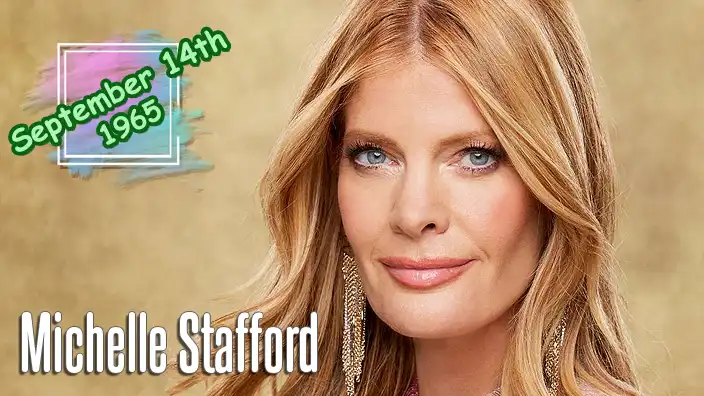
September 14, 1965, in Chicago, Illinois
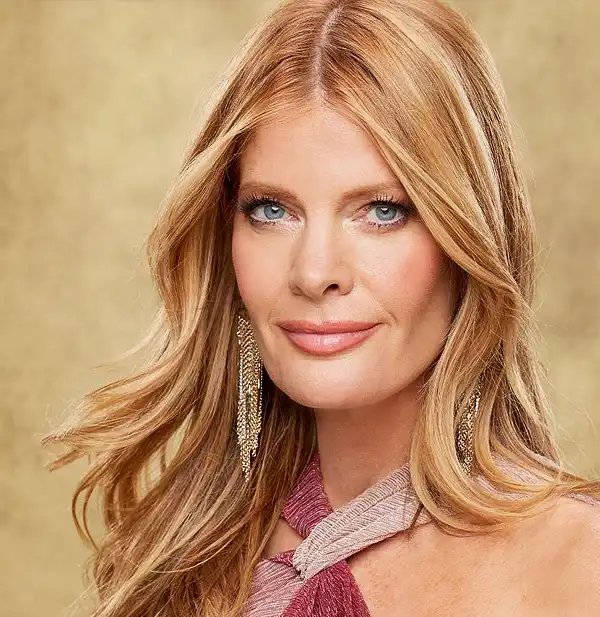
Michelle Stafford was born on September 14, 1965, in Chicago, Illinois, and was raised in California. Long before daytime television became her professional home, Stafford pursued modeling after graduating from high school, and the work took her well beyond the United States. She modeled in Japan, France and Italy and spent about a year living in Italy, an experience she has credited with drawing her out of her naturally conservative shell. The international modeling career might have provided a perfectly respectable path of its own, but Stafford increasingly became interested in acting and eventually returned to the United States determined to pursue it. That meant auditions, classes, rejection and all the other traditional ingredients Hollywood provides free of charge to aspiring performers.
There was also a serious interruption before her entertainment career properly began. Stafford was diagnosed with a brain tumor as a young woman. She recovered and resumed pursuing her ambitions, eventually turning from modeling toward acting. Her first significant television role came in 1990 on the Fox daytime drama Tribes, a teenage soap opera created by veteran daytime writer Leah Laiman. The series lasted only a few months, but it gave Stafford practical experience in the peculiar world of soap opera production, where actors can face enormous quantities of dialogue and rapidly developing storylines on schedules that make leisurely preparation something enjoyed mostly by people working in other professions.
Stafford continued auditioning and performing on stage, including appearing in productions directed by celebrated actor Charles Durning. Her theatrical work included John Patrick Shanley's Savage in Limbo, in which the Los Angeles Times singled her out for praise. Yet steady television success remained elusive. Stafford has subsequently spoken about just how difficult those years were, recalling periods when she simply was not booking work and began wondering whether the career she wanted was ever going to happen. Then came an audition in 1994 for a CBS daytime drama that had already been running successfully for more than two decades. As Stafford later observed, that single audition changed her life.
The role was Phyllis Summers on The Young and the Restless. Created by William J. Bell, Phyllis arrived in Genoa City in October 1994 and was initially intended as a short-term character. That plan did not survive Michelle Stafford. Phyllis created such an immediate impact that producers expanded the role and placed Stafford under contract. Instead of arriving, disrupting a few lives and disappearing into the great soap-opera wilderness, Phyllis became one of the show's major characters. It was the beginning of an association between actress and character that would continue, with interruptions, for more than three decades.
Phyllis was never designed to be everybody's agreeable neighbor. Manipulative, passionate, impulsive, fiercely protective and capable of turning an emotional disagreement into a situation requiring legal representation, she became precisely the sort of character soap operas thrive upon. Her early story involved rock singer Danny Romalotti, played by Michael Damian, and her determination to secure a relationship with him despite the rather significant obstacle of Danny being involved with Christine Blair, played by Lauralee Bell. Phyllis lied about the paternity of her child Daniel in an effort to keep Danny, establishing very early that she was prepared to treat conventional morality as something of a rough draft.
What prevented Phyllis from becoming merely a conventional villain was Stafford's ability to give her vulnerability, humor and genuine emotional depth. Phyllis could do dreadful things and then somehow persuade viewers to understand why she had done them, even if understanding stopped some considerable distance short of approval. Over the years she became a mother, businesswoman, romantic partner, rival, friend and enemy, often managing several of those jobs simultaneously with the same person. Her relationships with characters including Jack Abbott and Nick Newman became central parts of The Young and the Restless, while her rivalry with Christine developed into one of the show's longest-running feuds.
Stafford's work quickly attracted industry recognition. She won the Daytime Emmy Award for Outstanding Supporting Actress in a Drama Series in 1997, only a few years after joining the program. She also became a favorite at the Soap Opera Digest Awards, winning Outstanding Female Newcomer, Outstanding Villainess and later Outstanding Lead Actress. The recognition reflected what viewers already knew: Stafford had taken a character intended for relatively limited use and made Phyllis far too entertaining to discard.
Stafford left The Young and the Restless in 1997 to pursue other opportunities. She joined Aaron Spelling's prime-time drama Pacific Palisades, playing Joanna Hadley in the glossy series about ambitious young professionals in Southern California. The program lasted only one season, but Stafford continued expanding her résumé through guest appearances on shows including Players, Two Guys, a Girl and a Pizza Place, Diagnosis Murder, JAG, Frasier, Judging Amy and Strong Medicine. She also had a recurring role on Pamela Anderson's action-comedy series V.I.P., demonstrating that she could move comfortably beyond daytime television.
Her film work included an appearance in the 1999 thriller Double Jeopardy, starring Ashley Judd and Tommy Lee Jones. Stafford subsequently appeared in films including Attraction, Vampires Anonymous and Durant's Never Closes. Yet Phyllis Summers remained a difficult character to leave behind, both for viewers and apparently for the producers of The Young and the Restless. In 2000, Stafford returned to Genoa City and reclaimed the role that had established her career.
Her second run became considerably longer than the first. Stafford developed Phyllis through marriages, divorces, motherhood, business battles, romantic triangles, feuds and enough personal crises to exhaust a small city. Soap-opera characters are expected to survive circumstances that would send ordinary people into permanent retirement, and Phyllis proved particularly durable. Stafford could shift rapidly between comedy, rage, heartbreak and scheming, sometimes within the same scene, while maintaining the essential energy that made the character recognizable.
In one particularly unusual storyline, Stafford even found herself playing two characters at once. During 2006 and 2007, longtime The Young and the Restless villain Sheila Carter underwent plastic surgery to look exactly like Phyllis. This allowed Stafford to portray both Phyllis and Sheila disguised as Phyllis, the sort of sentence that makes perfect sense to longtime soap viewers and causes everyone else to stare quietly at the wall for a moment. It also gave Stafford an opportunity to differentiate two characters who shared the same face while making sure viewers could follow which dangerous woman they were actually watching.
Stafford's work during this period brought further acclaim. In 2004 she won the Daytime Emmy for Outstanding Lead Actress in a Drama Series. By then Phyllis had become one of the defining characters of modern Young and the Restless, and Stafford's willingness to embrace both the character's uglier qualities and her emotional vulnerability kept her from becoming predictable. Phyllis could be outrageous, but Stafford rarely played her as though she knew she was the villain of somebody else's story.
After another lengthy run, Stafford left The Young and the Restless in 2013. Rather than immediately joining another traditional television series, she created her own comedy web series, The Stafford Project. Stafford created, executive produced and starred in the project, which drew loosely upon her experiences as an actress and single mother. The series allowed her to poke fun at Hollywood, dating, parenting, aging and her own public persona while giving her considerably greater creative control than an actor normally enjoys on a daytime drama. Entertainment Weekly praised the series, while TV Guide included it among web productions worth watching.
Stafford's absence from daytime television did not last particularly long. In 2014 she joined ABC's General Hospital as Nina Reeves, originating another character who quickly became central to the show. Nina arrived with a spectacularly complicated history, even by soap standards. She had spent years in a coma, discovered that her husband had been unfaithful, struggled with the consequences of having lost years of her life, and embarked upon a series of emotionally charged relationships and conflicts. For Stafford, the role provided the rare opportunity for an actress so strongly associated with one soap character to create another major daytime personality from scratch.
She remained with General Hospital from 2014 until 2019, establishing Nina as an important character in Port Charles. Playing Nina also allowed Stafford to demonstrate that the intensity audiences associated with Phyllis Summers belonged to the actress rather than simply the writing of one particular program. Nina could be damaged, funny, volatile, sympathetic and dangerous, and Stafford once again found ways of making unpredictable behavior emotionally understandable.
Then Genoa City called again.
In June 2019, Stafford returned to The Young and the Restless and once again became Phyllis Summers. By this point, the relationship between actress and character had become one of daytime television's longest and most recognizable partnerships. Stafford had originated Phyllis in 1994, left, returned, left again, created another successful soap character and then returned once more. Soap-opera casting can occasionally resemble a very complicated family reunion where nobody is entirely certain who has been married to whom since the previous gathering.
Her return demonstrated that Phyllis still had considerable life left in her. Stafford continued playing the character's volatile relationships, business ambitions, family loyalties and rivalries while bringing the accumulated history of decades to the performance. A character who had once arrived as a disruptive outsider had become one of Genoa City's veterans. Phyllis had children, longstanding enemies, former husbands, old lovers and enough buried history to make almost any conversation potentially dangerous.
In 2024, Stafford's work brought another major career milestone when she won the Daytime Emmy Award for Outstanding Lead Performance in a Daytime Drama Series: Actress. It was her third Daytime Emmy victory and her first in two decades. CBS records Stafford as having received thirteen Daytime Emmy nominations for her work on The Young and the Restless, with wins for Supporting Actress in 1997 and Lead Actress in 2004 and 2024. Winning again so many years after her first Emmy underscored the durability of both Stafford's performance and Phyllis Summers.
Stafford has also built interests outside acting. She founded Skin Nation, a skincare company focused on plant-based products, adding entrepreneur to a résumé that already included actress, writer, producer and director. Her digital work has included Secret Mind of a Single Mom, which she wrote, directed and performed with her daughter. Stafford is the mother of two children, Natalia and Jameson, and has spoken openly and humorously about single motherhood, balancing parenting with a demanding acting career and refusing to pretend that either occupation always proceeds according to plan.
That candor has become an important part of Stafford's public personality. Unlike the carefully controlled image sometimes associated with television stars, she has often embraced humor, imperfection and the absurdities of everyday life. It also helps explain why she has been so effective as Phyllis. Stafford does not appear frightened of making the character messy. Phyllis can be selfish, loving, ridiculous, determined, cruel, loyal and catastrophically wrong, sometimes before the first commercial break.
The longevity of Stafford's career is especially impressive in daytime television, where production schedules are relentless and characters can accumulate decades of complicated history. She has repeatedly left the comfort of an established role to pursue other work, only to return and discover new territory within the same character. Along the way she created Nina Reeves on General Hospital, worked in prime-time television and film, produced her own digital comedy, directed, wrote and built a business outside entertainment.
Yet Phyllis Summers remains the role at the center of Michelle Stafford's career, and perhaps that is appropriate. A character intended to make a brief appearance in 1994 became a permanent fixture largely because Stafford made her impossible to ignore. More than three decades later, she continues bringing the same unpredictability to Genoa City, where Phyllis has accumulated enough romances, rivalries, scandals and questionable decisions to fill several ordinary lifetimes.
Michelle Stafford went into one audition hoping for another acting job and emerged with a character that would follow her across decades, earn thirteen Emmy nominations and three wins, and secure her place in daytime television history.
Apparently, nobody told Phyllis Summers she was supposed to be temporary. Probably just as well.