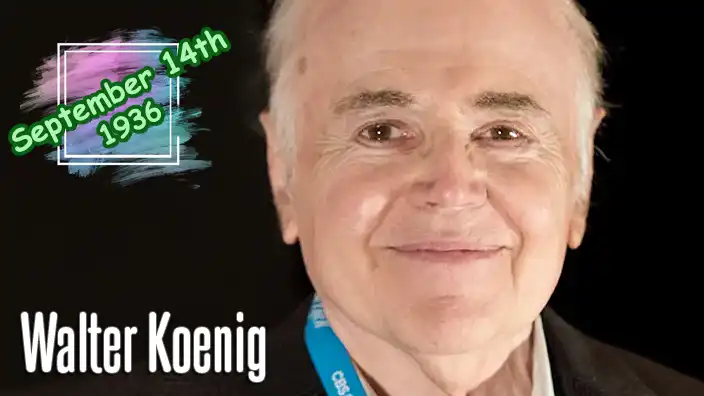
September 14, 1936, in Chicago, Illinois
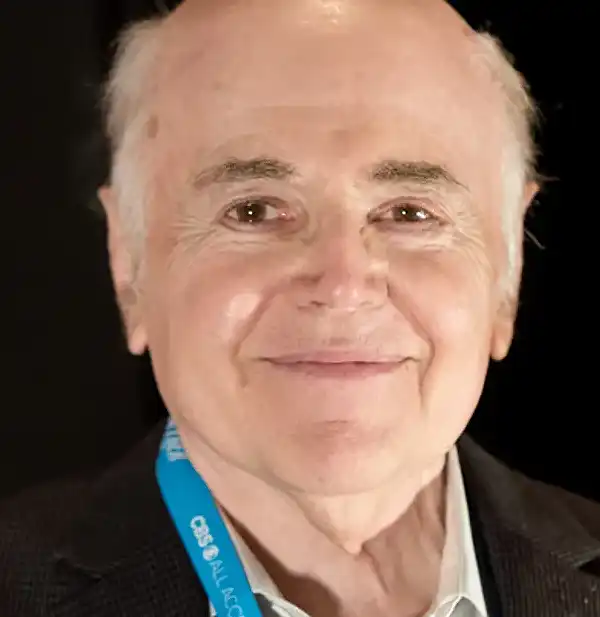
Walter Marvin Koenig was born on September 14, 1936, in Chicago, Illinois, to Isadore and Sarah Koenig. His parents were Russian Jewish immigrants whose family had lived in Lithuania before emigrating from the Soviet Union, and the family surname had been shortened from Koenigsberg to Koenig. During Walter's childhood, the family moved to Manhattan, where he grew up and attended school. His father's political beliefs also placed the family uncomfortably close to the investigations and suspicions of the McCarthy era; Isadore Koenig was a communist and came under FBI scrutiny at a time when such an association could have serious consequences in the United States.
Acting was not initially Walter Koenig's intended profession. He attended Grinnell College in Iowa with plans to study pre-medicine before transferring to the University of California, Los Angeles, where he earned a bachelor's degree in psychology. A professor encouraged his interest in acting, and Koenig eventually trained at the Neighborhood Playhouse School of the Theatre in New York. There he studied the craft seriously and prepared for a profession that, at the time, offered absolutely no indication that he would eventually spend decades answering questions about warp drives, Klingons and why a Russian serving aboard a starship sounded quite the way he did.
Koenig began working professionally during the early 1960s, accumulating the sort of television résumé familiar to young actors of the period. His early appearances included programs such as Combat!, The Untouchables, Ben Casey, Mr. Novak, Gidget and I Spy. He also appeared in The Lieutenant, the military drama created by Gene Roddenberry. That connection would become particularly important because Roddenberry was soon developing another television series, this one set considerably farther from Earth and featuring fewer Marines but substantially more aliens.
Star Trek premiered in 1966 with William Shatner as Captain James T. Kirk, Leonard Nimoy as Mr. Spock, DeForest Kelley as Dr. Leonard McCoy and a diverse supporting crew aboard the USS Enterprise. Koenig was not part of the original first-season cast. He joined during the second season in 1967 as Ensign Pavel Andreievich Chekov, a young Russian navigator with a thick accent, an abundance of hair and an entertaining habit of attributing major human achievements to Russia. He quickly became an important member of the Enterprise crew and provided a younger presence intended, at least partly, to appeal to youthful viewers.
Chekov's nationality carried greater significance than the character's jokes might suggest. Star Trek was being broadcast during the Cold War, when relations between the United States and Soviet Union were defined by nuclear weapons, espionage, ideological rivalry and the possibility that an international crisis could become catastrophic. Yet on Roddenberry's 23rd-century starship, an American captain, a Russian navigator, a Japanese helmsman, a Black communications officer, a Scottish engineer and a half-Vulcan science officer worked together as colleagues. Chekov's presence suggested that humanity had eventually managed to move beyond the divisions of the Cold War. In the late 1960s, simply placing a proud Russian character on the bridge of an American television hero's starship carried a message about the future.
Koenig's own Russian family background made him an interesting choice for the part, although Chekov's famous accent was a performance rather than Koenig's natural speaking voice. The exaggerated pronunciation became one of the character's trademarks, particularly his tendency to turn a “v” sound into something closer to a “w.” Decades later, Star Trek IV: The Voyage Home would exploit that wonderfully when Chekov wandered around 1980s San Francisco asking unsuspecting Americans where he could find the “nuclear wessels.” The fact that a man with a heavy Russian accent was wandering around during the Cold War asking civilians for directions to a nuclear-powered naval vessel somehow failed to result in his immediate arrest, proving that San Francisco pedestrians were either remarkably trusting or had somewhere else to be.
The original Star Trek was canceled in 1969 after three seasons, and at the time there was little reason to imagine that Koenig had just joined one of the most enduring entertainment franchises ever created. The series had struggled in the ratings and seemed destined to become another short-lived television production. Syndication changed everything. Repeated broadcasts introduced Star Trek to new audiences, fan organizations grew, conventions appeared, and the canceled television series developed into a cultural phenomenon. Koenig and his fellow cast members gradually discovered that the Enterprise had not completed its mission at all.
The franchise returned to the cinema with Star Trek: The Motion Picture in 1979, reuniting the original cast. Koenig returned as Chekov, now promoted and given a larger role aboard the refitted Enterprise. He subsequently appeared in Star Trek II: The Wrath of Khan, Star Trek III: The Search for Spock, Star Trek IV: The Voyage Home, Star Trek V: The Final Frontier and Star Trek VI: The Undiscovered Country. He also appeared in the opening section of Star Trek Generations in 1994, which helped transfer the theatrical franchise from Kirk's generation to the crew of Star Trek: The Next Generation.
Star Trek II: The Wrath of Khan gave Koenig one of Chekov's most substantial movie roles. Chekov encounters Khan Noonien Singh, played by Ricardo Montalbán, after accidentally landing on the planet where Khan and his followers have been marooned. There is a famous continuity curiosity attached to the encounter: Khan recognizes Chekov even though Koenig had not yet joined Star Trek when Khan originally appeared in the first-season episode “Space Seed.” Fans have spent decades devising explanations for how the two men could have met offscreen. Such matters are taken seriously in Star Trek circles. Empires may rise and fall, but continuity will be investigated.
Koenig's relationship with Star Trek extended beyond acting. When the franchise moved into animation with Star Trek: The Animated Series, budget considerations meant Chekov was not included as a regular character. Koenig nevertheless became the first member of the original cast to write an episode of Star Trek, scripting “The Infinite Vulcan.” The episode involved cloning, an enormous duplicate of Spock and an attempt to create peace throughout the galaxy, demonstrating that if Koenig could not actually be aboard the animated Enterprise, he was perfectly capable of making life complicated for everybody who was.
Writing became an important second career. Koenig wrote television episodes for programs including Land of the Lost, Family and The Powers of Matthew Star, as well as books, comic books and other projects. His publications included the memoir Warp Factors: A Neurotic's Guide to the Universe and Chekov's Enterprise, an account connected with the making of Star Trek: The Motion Picture. In later years he continued contributing creatively to the Star Trek universe, including co-writing the story “Chekov's Challenge” with Chris McAuley. Koenig therefore became more than an actor associated with a famous character; he also helped add material to the fictional universe that had made him famous.
Although Chekov inevitably dominated public recognition of Koenig, another science-fiction role demonstrated a very different side of his acting. Beginning in the 1990s, he appeared in Babylon 5 as Alfred Bester, a senior officer in the sinister Psi Corps. Bester was intelligent, manipulative, arrogant and frequently chilling, about as far removed from the eager young Chekov as an actor could reasonably travel without changing planets. Koenig relished the opportunity, and he has indicated that he regarded Bester as one of his finest roles. For viewers who knew him only as the likable navigator of the Enterprise, watching him arrive on Babylon 5 with a pleasant smile and deeply questionable intentions could be quite an adjustment.
Bester became one of Babylon 5's most memorable recurring characters despite appearing in a relatively small number of episodes. Creator J. Michael Straczynski gave Koenig material that allowed him to play menace through intelligence and confidence rather than simple aggression. Bester often behaved as though he were the cleverest person in the room and was frequently irritatingly close to being correct. The performance helped ensure that Koenig was not remembered exclusively for a role he had first played in the 1960s and introduced him to another generation of science-fiction viewers.
Koenig also worked extensively on stage. His theatrical work included both contemporary and classical material, and one particularly notable production was The Boys of Autumn, in which he played an elderly Tom Sawyer opposite Mark Lenard as Huckleberry Finn. Lenard was himself well known to Star Trek audiences as Spock's father, Sarek. Koenig's career therefore repeatedly crossed paths with the Star Trek family even when he was nowhere near the bridge of the Enterprise.
His association with the franchise became permanent, but Koenig generally approached it with humor and an appreciation for the fans who kept the original series alive long after its cancellation. He participated in conventions, interviews, fan events and later productions connected with the Star Trek community. In 2012, he received a star on the Hollywood Walk of Fame, joining several of his original-series colleagues who had already received the honor. Leonard Nimoy, Nichelle Nichols and George Takei were among those present for the ceremony, making the occasion something of an Enterprise reunion without anybody needing to reverse the polarity of anything.
Koenig's personal life included a long marriage to actress Judy Levitt, whom he married in 1965. They had two children, Danielle and Andrew. Their son Andrew Koenig became an actor and was particularly remembered for playing Richard “Boner” Stabone on the television sitcom Growing Pains. The family suffered a devastating loss when Andrew died by suicide in 2010. Walter subsequently spoke publicly about his son's death and urged people struggling with depression to seek help rather than remain isolated. Judy Levitt Koenig died in 2022 after more than five decades of marriage.
Koenig has also been involved with humanitarian and human-rights causes. His interests have extended well beyond entertainment, and he has used his public profile to support charitable work and campaigns concerning human rights. That social awareness fits naturally with the optimistic ideals that helped make Star Trek important to generations of viewers. The series imagined a future in which humanity had survived its prejudices and national rivalries sufficiently to explore the universe together, and Koenig's Russian Chekov had been one small but highly visible part of that message.
The Star Trek universe eventually found another way to acknowledge Chekov and Koenig's contribution. In the 2023 final season of Star Trek: Picard, Koenig provided the voice of Federation President Anton Chekov, identified as the son of Pavel Chekov. It was a brief but affectionate connection between the original series and a much later generation of Star Trek. Decades after Walter Koenig first stepped onto the Enterprise bridge wearing a Starfleet uniform, the Chekov name remained part of the Federation.
Koenig has continued working rather than treating his famous science-fiction past as the end of the story. In 2026, his performance in the short drama Mr. Fleischmann brought him the Best Actor award in the June-July edition of Indie Short Fest. The film concerns a reclusive Holocaust survivor in Los Angeles confronted with traumatic memories when the Nazi officer responsible for the deaths of his parents unexpectedly reappears in his life. The dramatic material was far removed from the science-fiction roles with which Koenig is most closely identified and provided another reminder of the actor behind the famous Russian accent.
Walter Koenig's place in television history would be secure if he had done nothing beyond Star Trek. Pavel Chekov became part of one of popular culture's most recognizable ensembles, and his presence on the Enterprise represented something larger than comic relief or another officer at a control panel. At the height of the Cold War, American television presented a future in which a Russian proudly served alongside Americans, Japanese, Scots, Africans, aliens and anyone else qualified to help keep a starship from exploding. It was an optimistic idea disguised as weekly science fiction.
Yet Koenig's career reached well beyond Chekov. He acted on stage and television, wrote scripts and books, created comic-book material, taught acting, played one of Babylon 5's finest villains and continued performing decades after the Enterprise first carried him into popular culture. Chekov may always be the name shouted across convention halls when Walter Koenig enters the room, but the man who played him built a career considerably larger than one navigator's chair.
Still, if someone happens to be looking for the nuclear wessels, he remains the obvious fellow to ask.