September 15, 1977, in Hammersmith, England
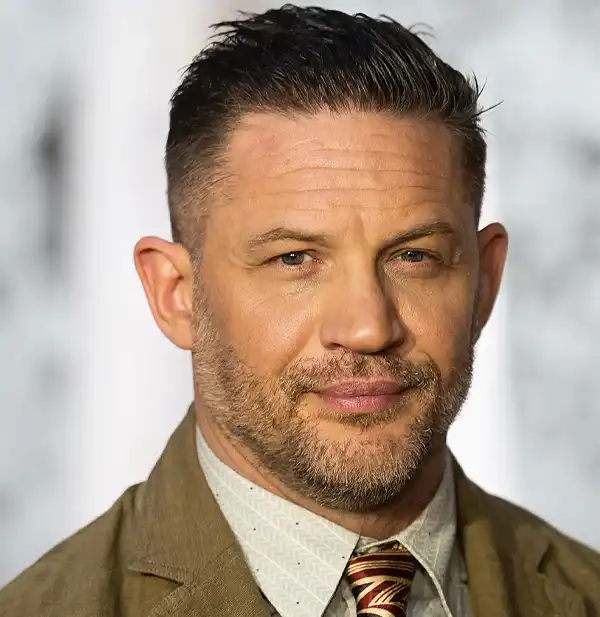
Edward Thomas Hardy was born on September 15, 1977, in Hammersmith, London, and grew up in East Sheen. He was the only child of novelist and comedy writer Edward "Chips" Hardy and artist Anne Barrett, so creativity was already part of the household in which he grew up. His teenage years, however, were turbulent, and Hardy has spoken candidly over the years about his youthful problems with alcohol, drugs and getting into trouble. Acting eventually provided a more productive direction for all that restless energy. He studied at Richmond Drama School before attending the Drama Centre London, an institution known for its demanding approach to actor training. Among his contemporaries was Michael Fassbender, another future star, and Hardy quickly developed a reputation as an intensely committed performer.
Before acting became his profession, Hardy briefly wandered into a rather different corner of show business. In 1998, he won a modeling competition on the British television program The Big Breakfast, earning a contract with the Models 1 agency. It is an entertaining footnote considering the screen persona he later developed: before he was breaking Batman over his knee, apparently somebody was judging whether he looked good enough for fashion photography. Acting soon took priority, and Hardy's first substantial television opportunity came in the acclaimed 2001 World War II miniseries Band of Brothers, in which he played Private John Janovec. That same year, he made his feature-film debut as Specialist Lance Twombly in Ridley Scott's Black Hawk Down. Appearing almost immediately in two major military productions was an impressive way to begin a screen career.
Hollywood noticed quickly. Hardy was cast as Shinzon in 2002's Star Trek: Nemesis, playing the principal villain opposite Patrick Stewart's Captain Jean-Luc Picard. Shinzon was a clone of Picard, giving the young Hardy the slightly intimidating assignment of going head-to-head with one of science fiction's most established actors while playing a character genetically connected to him. The film was not the major success its producers had hoped for, and Hardy's career did not immediately turn into a procession of Hollywood blockbusters. Instead, he spent the following years working extensively in British television, theater and film, appearing in projects including Layer Cake, The Virgin Queen, Marie Antoinette and RocknRolla. His theater work also attracted considerable praise, including the London Evening Standard Theatre Award for Outstanding Newcomer for performances in Blood and In Arabia We'd All Be Kings.
The performance that dramatically changed perceptions of Hardy came in 2008 with Bronson. Directed by Nicolas Winding Refn, the film cast him as notorious British prisoner Charles Bronson, born Michael Peterson. Hardy underwent a striking physical transformation, adding considerable weight and muscle, shaving his head and growing an enormous mustache while constructing a performance that was violent, theatrical, disturbing and unexpectedly funny. Rather than portraying Bronson simply as a brutal criminal, Hardy emphasized the man's strange sense of showmanship and appetite for notoriety. The result was difficult to ignore. Bronson demonstrated not only Hardy's physical commitment but his willingness to make bold and occasionally uncomfortable choices, establishing him as an actor capable of disappearing inside a character rather than simply relying upon conventional leading-man appeal.
Christopher Nolan was among the filmmakers who took notice, casting Hardy as Eames in the 2010 science-fiction thriller Inception. Surrounded by an ensemble that included Leonardo DiCaprio, Joseph Gordon-Levitt, Marion Cotillard, Elliot Page and Cillian Murphy, Hardy played the team's charming and sarcastic "forger," capable of impersonating other people within dreams. The role showed a lighter side of his screen presence and proved that he could steal moments without transforming himself into a physical monster. The following year brought Warrior, in which Hardy played Tommy Conlon, a troubled former Marine who enters a mixed martial arts tournament and ultimately finds himself facing his estranged brother, played by Joel Edgerton. Once again, considerable physical preparation was involved, but the performance depended upon much more than muscle. Tommy is furious, damaged and largely incapable of expressing what is happening inside him, and Hardy made the character's silences as important as anything he said.
Nolan called again for 2012's The Dark Knight Rises, this time asking Hardy to become Bane, the physically imposing and intellectually formidable villain who threatens Gotham City and Christian Bale's Batman. Following Heath Ledger's extraordinary performance as the Joker in The Dark Knight was an unenviable assignment, so Hardy wisely created something completely different. Much of his face was hidden behind Bane's distinctive mask, depriving him of one of an actor's most useful tools, but Hardy compensated through posture, movement, his eyes and one of the most recognizable voices in modern superhero cinema. The voice became endlessly imitated, sometimes affectionately and sometimes because audiences genuinely wondered whether they had understood what he had just said. Either way, Bane became one of Hardy's most recognizable characters.
Hardy then demonstrated just how little spectacle he actually needed. In Steven Knight's Locke, released in 2013, he played construction manager Ivan Locke during a nighttime drive from Birmingham to London. Hardy is essentially the only actor physically visible throughout the movie, with the story unfolding through a series of telephone conversations as Locke's professional and personal life begins collapsing around him. There are no enormous action sequences, alien creatures or masked villains—just Hardy, a car, a telephone and an increasingly dreadful evening. Holding an entire feature film together under those conditions provided one of the clearest demonstrations of his ability as an actor. He could command attention without gaining enormous amounts of muscle, wearing a strange mask or threatening anybody with bodily harm.
One of Hardy's most famous roles arrived with George Miller's Mad Max: Fury Road in 2015. He inherited the role of Max Rockatansky from Mel Gibson, who had played the character in the original films, and faced the difficult task of stepping into an established franchise without simply imitating his predecessor. Hardy's Max is a haunted survivor who initially wants little more than to stay alive and be left alone, only to become caught up with Charlize Theron's Imperator Furiosa as she attempts to rescue a group of women from the tyrannical Immortan Joe. Hardy spends substantial portions of the film saying relatively little, but in a movie featuring enormous vehicles roaring across the desert, spectacular stunt work and almost continuous mayhem, Max hardly needs to deliver lengthy speeches. Mad Max: Fury Road received ten Academy Award nominations and won six, becoming one of the most acclaimed action films of its generation.
Hardy apparently decided that playing one character at a time was becoming unnecessarily restrictive. Also in 2015, he starred in Legend as both Ronnie and Reggie Kray, the notorious twin gangsters who dominated parts of London's criminal underworld during the 1960s. Playing identical twins required Hardy to create two clearly different personalities while frequently acting opposite himself. Reggie is presented as the more controlled and socially capable brother, while Ronnie is volatile, eccentric and unpredictable. Hardy received the British Independent Film Award for Best Actor for the dual performance. One Tom Hardy had apparently become insufficient.
The same remarkable year brought Alejandro González Iñárritu's The Revenant, starring Leonardo DiCaprio. Hardy played John Fitzgerald, the ruthless frontiersman whose actions drive much of the film's brutal story. His performance earned him an Academy Award nomination for Best Supporting Actor, the first Oscar nomination of his career. The role again demonstrated Hardy's ability to make himself thoroughly unpleasant without reducing a character to a simple villain. Fitzgerald is selfish, dangerous and morally compromised, but Hardy gives him enough human motivation to prevent him from becoming merely a convenient obstacle for DiCaprio's Hugh Glass.
Television meanwhile produced another character who became a particular favorite with audiences. Hardy joined Peaky Blinders as Alfie Solomons, the unpredictable Jewish gang leader operating from Camden Town. Alfie could be charming, threatening, philosophical, funny and completely impossible to trust, sometimes managing most of those qualities during the same conversation. Hardy's scenes opposite Cillian Murphy's Tommy Shelby became highlights of the series, and Alfie's remarkable ability to return after circumstances that appeared distinctly terminal became something of a running joke among viewers. Hardy also created, co-wrote and starred in Taboo, developed with his father Chips Hardy and writer Steven Knight. Set in early 19th-century London, the dark drama follows James Keziah Delaney, who returns to England after years abroad and becomes entangled with powerful commercial and political interests.
Then Marvel entered the picture. Hardy starred as journalist Eddie Brock in 2018's Venom, based on the Marvel Comics character. Eddie becomes bonded with an alien symbiote called Venom, leaving two dramatically different personalities sharing the same body. Eddie is anxious, overwhelmed and increasingly exhausted; Venom is enormous, violent, permanently hungry and not especially interested in ordinary standards of social behavior. Hardy supplied performance work for both personalities, effectively giving himself another opportunity to argue with himself on screen. Despite mixed critical reviews, Venom became a major commercial success and developed a substantial following, with Hardy returning in Venom: Let There Be Carnage in 2021 and Venom: The Last Dance in 2024. He also became increasingly involved creatively, receiving story credits and serving as a producer.
The Venom films revealed something that audiences familiar only with Hardy's heavier dramatic roles might not have expected: he is very good at physical comedy. Much of Eddie Brock's appeal comes from watching an increasingly frazzled man attempting to negotiate with a gigantic alien organism living inside him and expressing strong opinions about everything from food to human behavior. Hardy's willingness to make Eddie look ridiculous prevents the character from becoming another conventionally invincible superhero. He continued balancing major productions with varied character roles, portraying gangster Al Capone in Capone, appearing alongside Austin Butler and Jodie Comer in The Bikeriders, and starring in Gareth Evans' action thriller Havoc. His career choices have rarely suggested any great interest in settling permanently into one comfortable category.
Away from acting, Hardy has become particularly well known for his affection for dogs. They have accompanied him to interviews and events, appeared in photographs with him and become an unexpectedly prominent part of his public image. His late dog Woody was especially familiar to fans after accompanying Hardy to film sets and premieres, and Hardy has supported animal-related charitable causes. He has also worked with organizations supporting young people and veterans. In 2018, Hardy was appointed Commander of the Order of the British Empire, or CBE, for services to drama.
Hardy married actress Charlotte Riley in 2014 after the pair met while working on the television adaptation of Wuthering Heights. He also has a son from an earlier relationship and has generally tried to keep his family life relatively private despite his international fame. That distinction between the private man and the extraordinarily visible performer has helped Hardy maintain a degree of mystery. He may be one of Britain's most recognizable actors, but he has never seemed particularly interested in turning every part of his life into public entertainment.
Transformation remains one of the clearest themes running through Tom Hardy's career. Some actors bring a recognizable variation of themselves to each new project, while Hardy appears much more interested in discovering how thoroughly he can disappear. He changes his body, voice, posture, facial hair and mannerisms, sometimes to the point where audiences need a few minutes to adjust. Yet underneath those transformations is a remarkably controlled performer. Bronson demonstrated his fearlessness, Locke showed that he could command an entire film while sitting in a car, Warrior revealed his emotional restraint, The Revenant earned him an Academy Award nomination, Mad Max: Fury Road placed him at the center of one of modern cinema's most celebrated action films, and Venom proved that Tom Hardy arguing with another version of Tom Hardy could support an entire franchise.
From a turbulent youth and formal drama training to British television, theater and enormous Hollywood productions, Hardy has built a career without becoming particularly predictable. When he appears on screen, there is no guarantee what he will look like, what voice he will use, whether he will be hero or villain, or whether another Tom Hardy will suddenly appear beside him. That unpredictability is a large part of the appeal. The only reasonably safe assumption is that whatever character Hardy is playing, somebody nearby is probably having a very difficult day.