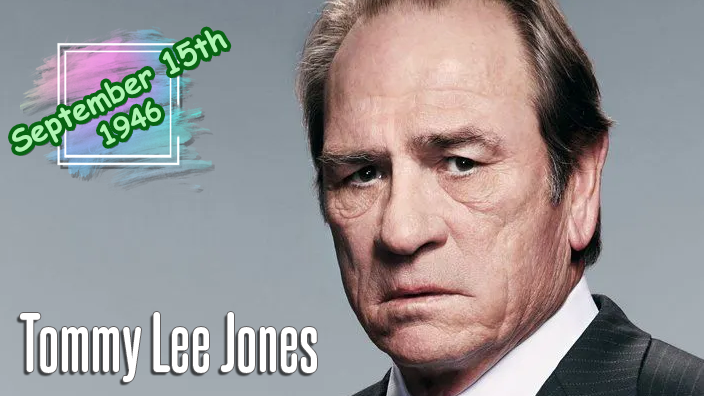
September 15, 1946, in San Saba, Texas
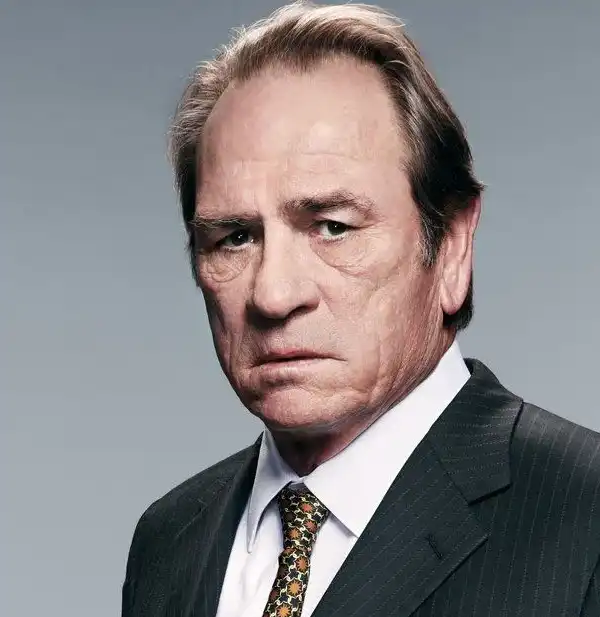
Tommy Lee Jones was born on September 15, 1946, in San Saba, Texas, the only child of Lucille Marie Scott and Clyde C. Jones. His father worked in the oil fields, while his mother held a variety of jobs that included police officer, schoolteacher and beauty-shop owner. Jones' childhood included moves around Texas as his father's work took the family to different communities, giving the future actor an upbringing far removed from Hollywood. He eventually attended St. Mark's School of Texas in Dallas on a scholarship, where academic ability and athletic talent began opening doors that would take him well beyond his home state.
Jones went to Harvard University, where one of the more entertaining coincidences in American cultural history occurred: his college roommate was Al Gore, the future vice president of the United States. Jones studied English literature and played offensive guard for Harvard's football team. He was a member of the undefeated 1968 team that famously came from behind against Yale, scoring 16 points in the final 42 seconds to produce a 29–29 tie. The Harvard student newspaper immortalized the extraordinary finish with the headline "Harvard Beats Yale 29–29." Jones graduated cum laude in 1969 with a Bachelor of Arts degree in English, leaving Harvard with both a serious education and the useful knowledge that apparently a tie can occasionally count as a victory if everybody agrees the ending was sufficiently ridiculous.
Acting rather than football became his profession. Jones moved to New York and quickly found work on the stage, making his Broadway debut in A Patriot for Me in 1969. His first film appearance followed in the 1970 romantic drama Love Story, starring Ryan O'Neal and Ali MacGraw. Jones played Hank Simpson, one of Ryan O'Neal's Harvard roommates, giving him the unusual experience of making his film debut in a story set at the university he had just left. He continued working steadily in theater, television and film throughout the 1970s, building the sort of career that develops through persistence rather than overnight celebrity.
Television provided several important early opportunities. Jones appeared on the daytime drama One Life to Live and took roles in television movies and miniseries while continuing his film work. A particularly significant performance came in 1980's Coal Miner's Daughter, the acclaimed biography of country singer Loretta Lynn. Jones played Lynn's husband, Oliver "Doolittle" Lynn, opposite Sissy Spacek, whose performance won the Academy Award for Best Actress. Jones brought humor, roughness and affection to a character who could easily have become a conventional supporting husband, and the film helped establish him with a much wider audience.
He continued taking a broad mixture of roles, refusing to settle comfortably into one category. In The Executioner's Song, the 1982 television adaptation of Norman Mailer's book, Jones portrayed convicted murderer Gary Gilmore. The grim and psychologically demanding performance earned him the Primetime Emmy Award for Outstanding Lead Actor in a Limited Series or Special. The role was an early demonstration of Jones' ability to play deeply troubling characters without asking audiences to like them. He could create humanity without sanding away the unpleasant edges, a quality that would become particularly important in many of his later performances.
Western stories proved especially well suited to Jones. In 1989, he played former Texas Ranger Woodrow F. Call in the enormously successful television miniseries Lonesome Dove, adapted from Larry McMurtry's Pulitzer Prize-winning novel. Robert Duvall played his longtime friend Augustus "Gus" McCrae, and the relationship between the two aging former Rangers became the emotional foundation of the sprawling story. Jones received an Emmy nomination for his performance, while the miniseries became one of the most acclaimed Western productions in television history. Call's stern, restrained personality was a natural fit for Jones, although anyone concluding that he was simply playing himself would be underestimating the precision behind the performance.
Oliver Stone cast Jones as businessman Clay Shaw in JFK, released in 1991. The sprawling drama examined New Orleans District Attorney Jim Garrison's investigation into the assassination of President John F. Kennedy, with Kevin Costner portraying Garrison. Jones' performance as Shaw earned him his first Academy Award nomination, for Best Supporting Actor. It also placed him inside one of the most discussed and controversial American films of the decade. His ability to suggest charm, intelligence and ambiguity made Shaw a memorable presence within Stone's enormous ensemble cast.
Jones then demonstrated that he could make an excellent action-movie villain. In 1992's Under Siege, starring Steven Seagal, he played William Strannix, a former CIA operative leading a group of mercenaries who seize the battleship USS Missouri. Jones attacked the role with wild-eyed enthusiasm, providing a flamboyant contrast to the stern authority figures for which he would later become particularly famous. The movie was a major commercial success and reminded audiences that Jones could be every bit as entertaining when he was the person causing the trouble.
The following year brought the role that transformed him into a major Hollywood star. In The Fugitive, Harrison Ford played Dr. Richard Kimble, wrongly convicted of murdering his wife and desperately searching for the real killer after escaping custody. Jones played Deputy U.S. Marshal Samuel Gerard, the relentlessly determined lawman pursuing him. Gerard is not presented as evil or even particularly hostile toward Kimble. He simply has a job to do and intends to do it, preferably without wasting time discussing everybody's feelings.
One exchange became especially famous. Kimble insists that he did not kill his wife, and Gerard responds that he does not care. The moment perfectly captures the character: Gerard isn't judging Kimble's guilt or innocence because, at that stage of the story, it isn't his responsibility. His responsibility is finding the fugitive.
Jones' performance stole scenes from a movie already led by Harrison Ford, which is not an especially easy thing to do. He won the Academy Award for Best Supporting Actor for The Fugitive, along with a Golden Globe, and Samuel Gerard became one of his signature characters. Jones returned to the role in the 1998 spin-off U.S. Marshals, this time pursuing Wesley Snipes.
The success of The Fugitive led to an extraordinarily busy period. Jones appeared as baseball legend Ty Cobb in Cobb, played a prison warden in Natural Born Killers, and joined the Batman universe as Harvey Dent, better known as Two-Face, in 1995's Batman Forever. His Two-Face was considerably more colorful and manic than many of his later roles, battling Val Kilmer's Batman alongside Jim Carrey's Riddler. The film gave audiences the unusual spectacle of Tommy Lee Jones and Jim Carrey apparently competing to determine who could consume the greatest quantity of scenery before the closing credits.
Then came the black suit and sunglasses.
In 1997's Men in Black, Jones played Agent K opposite Will Smith's newly recruited Agent J. The premise involved a secret organization monitoring extraterrestrial activity on Earth, but the film's comedy depended heavily upon the contrast between its two stars. Smith's Agent J is energetic, talkative and astonished by the bizarre universe suddenly revealed around him. Jones' Agent K behaves as though alien invasions, exploding creatures and memory-erasing devices are merely routine paperwork before lunch.
The pairing worked beautifully.
Jones' famously dry delivery became the perfect counterweight to Smith's exuberance. Agent K could explain something completely absurd with the weary tone of a man reminding somebody where office supplies were stored. Men in Black became an enormous international success, and Jones returned for Men in Black II in 2002 and Men in Black 3 in 2012.
Although blockbuster films made Jones internationally recognizable, he continued seeking more demanding dramatic work. He appeared in Double Jeopardy, Rules of Engagement, Space Cowboys and The Missing, among numerous other productions. He also increasingly moved behind the camera, directing projects as well as acting in them.
One of his most acclaimed achievements as a filmmaker came with The Three Burials of Melquiades Estrada, released in 2005. Jones directed and starred in the modern Western as rancher Pete Perkins, who attempts to fulfill a promise to his murdered friend by returning the man's body to Mexico. The film competed at the Cannes Film Festival, where Jones won the award for Best Actor and Guillermo Arriaga received the screenplay prize. The movie demonstrated Jones' deep affinity for Western landscapes and morally complicated stories, while proving that his talents extended well beyond acting.
In 2007, Jones delivered two particularly strong performances. He starred in Paul Haggis' In the Valley of Elah as Hank Deerfield, a retired military investigator searching for answers after his soldier son disappears following his return from Iraq. The restrained and deeply sorrowful performance earned Jones an Academy Award nomination for Best Actor.
That same year, he appeared in Joel and Ethan Coen's No Country for Old Men, adapted from Cormac McCarthy's novel. Jones played Sheriff Ed Tom Bell, an aging Texas lawman attempting to understand a new level of violence represented by Javier Bardem's terrifying Anton Chigurh. Bell spends much of the story following the aftermath rather than engaging directly in conventional action, and Jones gives the character a weary intelligence that anchors the film. No Country for Old Men won four Academy Awards, including Best Picture.
The role seemed almost designed for him: Texas landscape, sparse dialogue, moral uncertainty and a lawman who has lived long enough to suspect the world may be changing faster than he can understand it. Jones didn't need theatrical fireworks. A pause, a glance or a slightly altered tone could communicate Bell's exhaustion more effectively than a speech.
Steven Spielberg later cast Jones as Congressman Thaddeus Stevens in Lincoln, the 2012 historical drama starring Daniel Day-Lewis as President Abraham Lincoln. Stevens was a fierce abolitionist and powerful Radical Republican who played an important role in the struggle to pass the Thirteenth Amendment abolishing slavery. Jones brought his familiar forcefulness to the part while also revealing the private emotional life beneath Stevens' formidable public personality. The performance earned him another Academy Award nomination for Best Supporting Actor.
Jones returned to directing with The Homesman in 2014, adapted from Glendon Swarthout's novel. He starred opposite Hilary Swank in the stark Western story about transporting three mentally ill women across the American frontier. Like The Three Burials of Melquiades Estrada, the film rejected romanticized ideas about the West in favor of hardship, isolation and moral complexity. Jones' interest in Western themes has never seemed rooted merely in cowboy nostalgia; his films tend to examine the cost of surviving in landscapes where traditional myths collide with considerably harsher realities.
His later work has continued across genres. Jones appeared in Jason Bourne, the science-fiction film Ad Astra with Brad Pitt, the comedy The Comeback Trail, Wander, Finestkind and other productions. Even after decades of success, he has continued moving between large studio movies and smaller character-driven projects rather than treating his Academy Award as permission to coast comfortably toward retirement.
Away from acting, Jones has long maintained a strong connection to Texas and is an accomplished polo player. He has owned ranch property and has participated competitively in polo for many years, a sport requiring considerably more athletic ability than sitting majestically on a horse while somebody else does all the work. His background as a Harvard football player and later enthusiasm for polo reflect a physical side that has existed alongside his acting career from the beginning.
Jones has also maintained a reputation for valuing privacy and approaching celebrity with considerably less enthusiasm than Hollywood sometimes expects. He is known for being serious about his work and not especially interested in performing an endlessly cheerful public version of himself. That reserved personality has inevitably contributed to his screen image, but the breadth of his career demonstrates that the actor and the characters should not be confused. Someone capable of playing the manic Two-Face, sinister William Strannix, emotionally guarded Woodrow Call, deadpan Agent K and weary Sheriff Bell is doing considerably more than simply arriving on set and looking stern.
Across more than five decades, Tommy Lee Jones has accumulated an extraordinary range of credits while retaining a screen presence that is immediately recognizable. He has won an Academy Award and an Emmy, received multiple additional Oscar nominations, directed acclaimed films, worked with filmmakers including Oliver Stone, Steven Spielberg, the Coen brothers and Robert Altman, and appeared alongside generations of major actors.
Yet his enduring appeal may come from something simpler. Jones rarely appears to be trying to persuade an audience that he belongs on screen. He simply arrives and occupies it.
That quality made Samuel Gerard believable as the man capable of chasing Harrison Ford across half the country, Agent K convincing as someone who had spent decades quietly protecting Earth from extraterrestrials, and Ed Tom Bell heartbreaking as an aging sheriff realizing that experience might no longer provide all the answers.
Tommy Lee Jones has played heroes, villains, presidents, lawmen, soldiers, cowboys, criminals, aliens' worst nightmare and at least one Batman villain with an alarming wardrobe.
Through all of it, he has retained that unmistakable expression suggesting that whatever foolishness is currently happening around him needs to stop immediately.
Preferably before he has to get out of the chair.