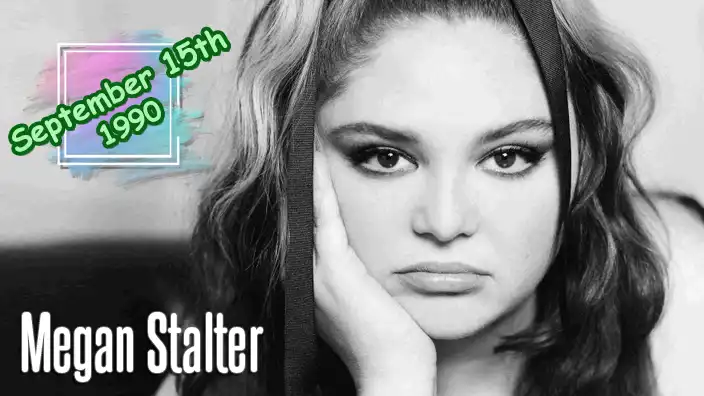
September 15, 1990, in Cleveland, Ohio

Megan Stalter was born on September 15, 1990, in Cleveland, Ohio, and spent much of her childhood in Ohio, including Dayton, Huber Heights and Centerville. She was the eldest of four children and grew up in a large extended family where being quiet apparently wasn't going to get anybody very far. Her mother worked as a nurse and her father as a tattoo artist, and Stalter has frequently described herself as deeply influenced by her Midwestern upbringing and the funny, expressive women around her.
The desire to perform arrived early, although the theatrical establishment did not immediately recognize that it had a future comedy star on its hands. Stalter participated in school productions but wasn't exactly showered with leading roles. She has joked about being relegated to parts such as "Nun No. 5," which probably wasn't the glamorous beginning she had imagined.
Fortunately, being given tiny parts didn't convince her that she possessed tiny talent.
That extraordinary confidence—or, as Stalter herself has jokingly described it, a certain amount of delusion—became one of the qualities that eventually shaped her comedy. Many of her characters have absolutely no doubt that they are beautiful, talented, successful and irresistible. The fact that every available piece of evidence suggests otherwise is merely an inconvenience.
After high school, Stalter attended Sinclair Community College and spent some time at Wright State University. She explored nursing and education before deciding that her real ambition was performing. She also spent time doing missionary work in Peru. Her religious upbringing and evolving relationship with faith would later become material she explored both personally and professionally.
Comedy ultimately won.
Stalter began taking improv classes in Dayton before moving to Chicago, one of America's great training grounds for improvisational and alternative comedy. She spent several years developing her act there while supporting herself with other work, including nannying. Chicago gave her somewhere to experiment, fail, improve, create characters and discover exactly what sort of comedian she wanted to become.
By 2019, Stalter had moved to New York and was becoming known within the alternative comedy scene. She wrote and performed for the revived National Lampoon Radio Hour and created The Megan Stalter Show, an online series that gave her increasingly eccentric characters somewhere to run loose.
Then the world shut down.
For a comedian trying to establish herself through live performance, the COVID-19 pandemic could hardly have arrived at a worse moment. Comedy clubs closed, audiences disappeared and performers suddenly found themselves sitting at home with nowhere to perform.
Stalter responded by pointing a telephone at herself.
It proved to be a very good decision.
During the pandemic, she began producing a torrent of short character videos and performing on Instagram Live. They were deliberately homemade rather than polished studio sketches. Stalter used whatever clothes, props and surroundings happened to be available and created characters who seemed completely convinced of their own abilities while failing spectacularly in front of the viewer.
There were terrible bosses, hopeless influencers, questionable salespeople, self-important professionals and women trying desperately to maintain control of situations that had clearly escaped several minutes earlier.
The performances depended heavily upon awkward pauses, misplaced confidence, mangled language and Stalter's ability to make viewers simultaneously cringe and want to give the character a reassuring hug.
One of her most famous creations appeared in 2021.
In a spoof Pride Month advertisement, Stalter played an employee of the fictional Cecily's Butter Shop attempting to demonstrate the company's suddenly discovered enthusiasm for LGBTQ+ customers. The sketch began with an exuberant "Hi, gay!" and mercilessly parodied the sometimes clumsy way corporations embrace Pride Month.
The video went viral.
By then, Stalter had developed an enormous online following, and people within the entertainment industry were paying attention. The comedian who had been making sketches with whatever she could find around the house was suddenly being described as one of the most exciting new voices in American comedy.
Then came Hacks.
The HBO comedy stars Jean Smart as veteran Las Vegas comedian Deborah Vance and Hannah Einbinder as young comedy writer Ava Daniels. Stalter joined the series as Kayla Schaeffer, an assistant working for talent manager Jimmy LuSaque, played by Paul W. Downs.
Calling Kayla an assistant is technically accurate in much the same way that calling a tornado "a weather event" is technically accurate.
Kayla is spectacularly inappropriate, endlessly confident and almost entirely unfamiliar with the concept of professional boundaries. She also happens to be the daughter of Jimmy's boss, making the normal solution to a catastrophically unsuitable employee—showing her where the door is—a little more complicated.
Stalter's particular style of comedy was perfectly suited to the character. Kayla can say something outrageous with such complete sincerity that everybody else in the scene appears momentarily unsure whether they heard her correctly.
What could easily have been a small recurring joke became one of the show's standout supporting performances.
Kayla's relationship with Jimmy developed considerably as the series continued. Beneath the incompetence and chaos, the character gradually revealed loyalty, determination and an unexpectedly good instinct for the entertainment business. She wasn't merely there to cause Jimmy's blood pressure to rise. Kayla became an increasingly important part of his professional life and eventually his business partner.
The role also brought Stalter increasing industry recognition. Her performance ultimately earned her a Primetime Emmy nomination for Outstanding Supporting Actress in a Comedy Series.
For somebody whose major breakthrough had begun with homemade videos recorded on a phone, an Emmy nomination represented quite a journey.
Stalter meanwhile began demonstrating that she could do considerably more than steal television scenes.
She appeared in the 2022 reboot of Queer as Folk and in the comedy Please Don't Destroy: The Treasure of Foggy Mountain. She also appeared in Chelsea Peretti's First Time Female Director.
Then came Cora Bora.
The independent comedy gave Stalter a leading film role as Cora, a struggling musician whose open relationship is not going quite as successfully as she has convinced herself it is. Cora travels home to Portland intending to surprise her girlfriend and discovers that her relationship—and quite a few other parts of her life—may require reassessment.
The role allowed Stalter to use the awkwardness and misplaced confidence familiar from her comedy while revealing something more vulnerable underneath. Cora can be selfish, impulsive, infuriating and painfully human. Instead of simply turning her into a walking punchline, Stalter makes the audience understand why someone might behave so badly while desperately trying to convince herself that everything is fine.
That mixture of comedy and emotional vulnerability became even more important with Too Much.
Created by Lena Dunham and Luis Felber for Netflix, the romantic comedy series cast Stalter as Jessica, a New Yorker whose life has been thoroughly rearranged by heartbreak. Jessica moves to London, expecting a fresh start and perhaps a period of splendid isolation, only to become involved with Felix, an English musician played by Will Sharpe.
It was Stalter's first major television leading role.
The casting was significant because Jessica is not written as the conventional polished romantic-comedy heroine who spends two hours looking immaculate while insisting she is hopelessly disorganized. Stalter brings the same emotional excess, awkwardness and unpredictability that made her comedy distinctive in the first place.
Her characters are allowed to be loud.
They are allowed to want things.
They are allowed to embarrass themselves.
And, crucially, they don't necessarily have to become entirely different people before somebody can love them.
That makes Stalter an unusual presence in modern romantic comedy. The characteristics that once made her homemade characters seem ridiculous—too much confidence, too much emotion, too much enthusiasm and too little concern about appearing dignified—can become strengths when placed inside a character with genuine emotional depth.
Her career has continued to expand beyond acting. Stalter has worked as a writer and producer as well as a performer. IMDb credits her as a writer on National Lampoon Radio Hour and as co-creator and writer of The Megan Stalter Show. She also served as an executive producer on Cora Bora.
She has continued performing live comedy as well, bringing the unpredictable energy of her online work before actual audiences. That transition isn't always easy. An internet comedian can stop recording and try again. A live audience inconveniently refuses to disappear when something goes wrong.
For Stalter, the possibility that everything might go wrong is rather the point.
Her comedy frequently lives in those uncomfortable seconds when a normal person would retreat from embarrassment. Stalter's characters charge forward. If a joke fails, they may explain it. If an explanation fails, they may explain the explanation. Somewhere nearby, an imaginary human resources department begins preparing paperwork.
Yet there is usually affection underneath the absurdity.
Stalter doesn't simply play stupid people. Many of her best characters desperately want to be liked, respected, successful or helpful. Their confidence frequently disguises insecurity, and their inability to recognize their own shortcomings makes them strangely relatable.
Most of us have experienced the horrible realization that we have said exactly the wrong thing.
A Megan Stalter character simply says it again, louder.
That approach has taken her from improv classes in Ohio and Chicago to New York's alternative comedy scene, viral internet fame, an Emmy-winning television series, leading film roles and a starring role in a major romantic comedy.
It has also helped establish a recognizable comedy voice at a time when performers no longer need to wait patiently for a television network to discover them. Stalter found an audience directly, using little more than a smartphone, improvised characters and an extraordinary willingness to look ridiculous.
The production values eventually became considerably more expensive.
Fortunately, the awkwardness survived.